Concrete Wall Work in Miami Starts With the Structure
A concrete wall is not just a barrier; it is usually doing structural work, and in Miami it is often doing double duty carrying vertical load and resisting hurricane wind. That is why any work on a concrete wall, whether cutting an opening, drilling a penetration, or demolishing a section, has to start with an understanding of what the wall is holding up.
Treating a concrete wall like a partition is how small jobs turn into structural problems. Let me walk through what Miami property owners should know before anyone touches a blade or a drill to a concrete wall.

Load-Bearing, Shear, or Partition The First Question
The first question is what kind of wall you have. A load-bearing wall carries weight from above. A shear wall resists lateral wind and seismic forces. A partition wall just divides space. In Miami, exterior walls are almost always load-bearing and part of the wind-resisting system, and many interior walls in concrete buildings are too.
You cannot tell by looking. A structural engineer or an experienced contractor determines what the wall is doing, and that determination drives every decision after it. Our guide to concrete wall removal explains the assessment process and why it matters.
Cutting an Opening the Right Way
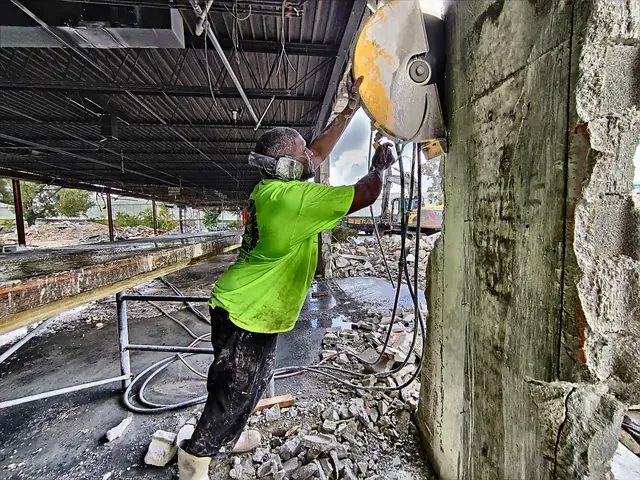
Cutting an opening in a concrete wall, for a door or a window, is done with a track-mounted wall saw that bolts to the surface and cuts a straight, square opening. If the wall is load-bearing, the opening needs temporary shoring and a permanent header to carry the load around it. This is structural work, and in Miami-Dade it requires a permit and often an engineer’s design.
The cut is made wet, which controls dust and cools the blade, and the slurry has to be contained. A clean, square opening frames perfectly and leaves the wall doing its job. Skipping the header is how you get cracks running from the corners of a new opening.
Drilling Penetrations Through a Concrete Wall
Drilling a hole through a concrete wall, for a pipe, conduit, or vent, is core drilling, and it is precise work. A core drill cuts a perfectly round hole through the concrete and any rebar, leaving clean edges that match the penetration exactly.
Even a small hole in a structural wall should be planned, because a cluster of unplanned penetrations can weaken the wall. A professional locates the reinforcement before drilling and places the holes where they will not compromise the structure. It is the same care as cutting an opening, scaled to the size of the hole.

Demolishing a Concrete Wall Safely
Demolishing a concrete wall is a different job from cutting or drilling it, and it has its own rules. If the wall is load-bearing, its load has to be transferred before it comes down, and the demolition has to be sequenced so the structure stays stable throughout. This is not a job for a sledgehammer and a weekend.
The dust, slurry, and debris from wall demolition all have to be controlled, and the reinforcement has to be dealt with, because cutting through rebar is part of breaking a reinforced wall. Our guide to demolition in Miami-Dade covers the safety and permitting side.
Reinforcement and How It Changes the Cut
Most concrete walls in Miami are reinforced, which means the saw is going to hit steel, and that changes the job in predictable ways. The blade has to be matched to cut through the rebar, the feed rate has to slow when the blade reaches the steel, and the structural implications of cutting the reinforcement have to be considered. Cutting rebar in a wall is routine when it is planned, and dangerous when it is not.
The reinforcement also tells you something about the wall’s purpose. Heavily reinforced walls are usually structural, which means the opening or penetration needs the same care you would give a load-bearing element. A professional reads the reinforcement and adjusts both the saw and the plan. Our guide to cutting reinforced concrete covers how the steel changes the work.
CMU Block Versus Poured Concrete Walls
Concrete walls in Miami come in two main forms: poured concrete and CMU block. Poured concrete is solid and strong, and it is common in high-rises and engineered structures. CMU block is the workhorse of residential and light commercial construction, and it is built from hollow units that are often filled with grout and reinforced at the cells.
The two cut differently, and the tool and technique change with the material. Block cuts fast but the hollow cells affect where anchors and openings can go; poured concrete cuts slower but holds consistently anywhere. A contractor who knows which wall they are dealing with chooses the right approach from the start. Our guide to concrete wall cutting cost explains how the wall type shapes the job.
The Slurry and Dust on a Wall Job
Wall cutting is a wet process, and the slurry it produces is a real part of the job, especially on interior walls where it can stain and damage surrounding finishes. A professional contains the slurry with plastic and vacuums, and they protect the floor and the adjacent walls before the saw starts. The goal is to cut the opening without leaving a cement-colored mess behind.
The dust is the other hazard, and even with water, some cutting generates airborne silica. Proper respiratory protection and containment are part of the job, not optional extras. Our guide to concrete dust and silica explains the protection that belongs on every wall job.
A concrete wall is rarely just a wall in Miami. It is often part of the building’s structure, and on an exterior it is part of the wind load path that keeps the whole building standing in a hurricane. That means any work on a concrete wall, whether it is a cut, a drill, or a removal, starts with understanding what the wall is doing before you change it. Treat every wall as structural until it is proven otherwise.
The thickness and the reinforcement are the two facts that shape the work. A thin interior partition cuts fast and needs no engineering, while a thick shear wall with heavy rebar is a different job entirely, with permits, shoring, and a header in the plan. Getting those two facts straight before you quote is how you avoid underbidding the job or cutting into something load-bearing by mistake.
The age of the wall changes the job more than most people expect. A wall in a newer Miami building is usually standard reinforced concrete with drawings you can find, while an older wall may be CMU block, may have been modified over the years, or may hide conduits no one documented. Older walls reward a scan before any cutting, because what the plans say and what is actually in the wall have often drifted apart over decades of renovations.
The best way to approach any concrete wall is to assume it is doing more than it looks like it is doing. A wall that appears to be a simple partition may be carrying load or hiding reinforcement, and the only way to know for sure is to have it assessed. That assumption costs nothing and saves everything.
Get the Wall Assessed Before You Do Anything
Whether you are cutting, drilling, or demolishing, the first step on any concrete wall is an assessment of what the wall is doing. That single step keeps a small project small and a structural project safe. In Miami, where concrete walls carry load and resist wind, it is not optional. Bring in a professional who works with engineers, and your wall work will be done right, without compromising the building it is holding up.