Why concrete floor sawing is the most common concrete cutting service — and why it looks simpler than it actually is
Of all the concrete cutting operations performed on Miami job sites every day, concrete floor sawing — also called flat sawing or slab sawing — is by far the most frequent. The saw sits on the concrete surface, the blade cuts downward, and the operator walks behind it guiding the cut line. It looks straightforward, and in concept it is. But concrete floor sawing involves decisions about blade selection, cut depth, saw size, power source, and cutting sequence that directly determine whether the job is completed efficiently or becomes an all-day struggle. A floor saw cutting control joints in a 4-inch residential patio slab runs a different blade at a different feed rate than the same saw cutting a 12-inch reinforced industrial floor section. The concrete floor sawing that looks like a single operation from a distance is actually a set of distinct applications with distinct requirements.
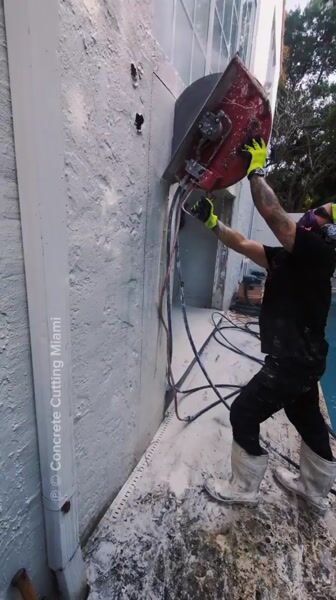
In Miami, concrete floor sawing must account for local concrete characteristics that affect blade choice and cutting technique. The limestone aggregate in South Florida concrete is softer than granite but more abrasive — it wears diamond blades differently, and the blade bond hardness must be selected accordingly. The high water table means floor slabs on grade may be damp from below, which affects cutting characteristics — moisture in the concrete changes how the diamond blade interacts with the material. Wet cutting with slurry containment is standard practice, both for blade cooling and for compliance with OSHA silica dust standards and Miami-Dade County slurry regulations. The floor sawing operation that works in a dry slab in Arizona needs adjustment for a damp slab in Miami. The cutting principles are the same. The blade and technique choices are different.
The primary applications of concrete floor sawing in Miami
Control joint cutting
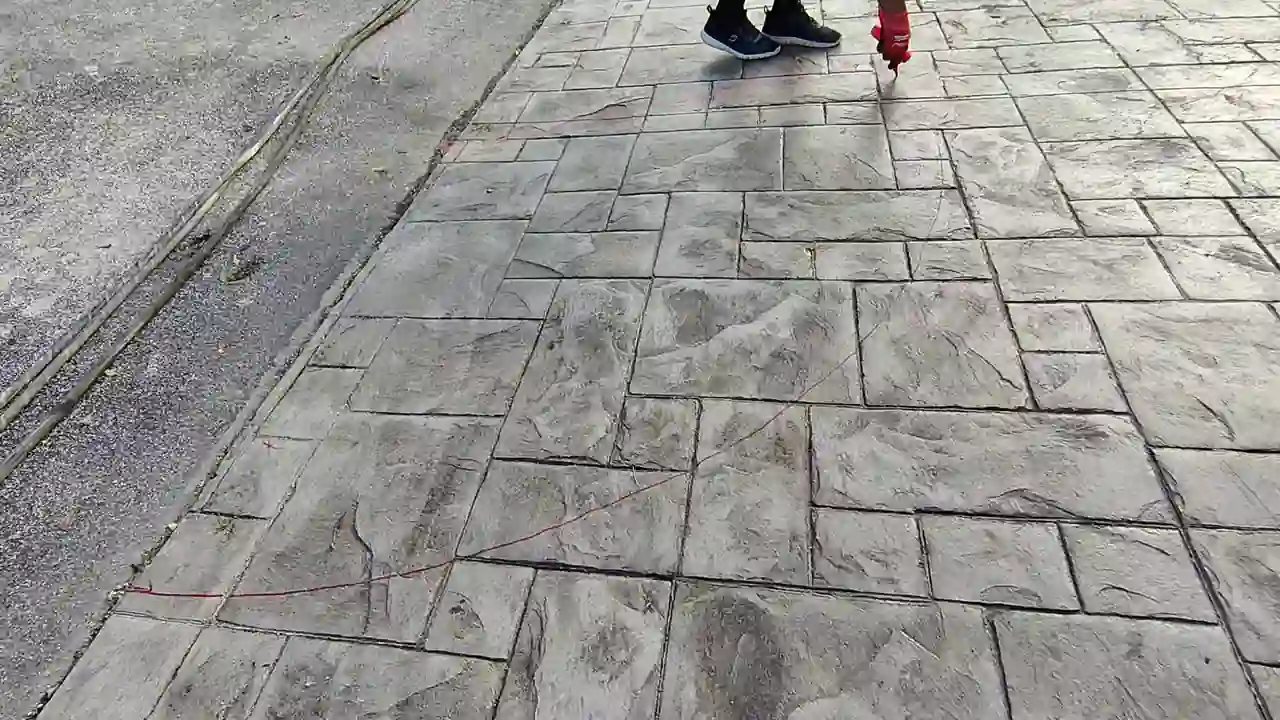
The most common application of concrete floor sawing is cutting control joints in newly placed concrete slabs. Concrete shrinks as it cures, and without control joints — weakened planes cut into the slab surface that encourage cracking to occur along predetermined lines — the slab will crack randomly. Control joints are cut within 24 hours of concrete placement, using a green concrete blade designed for the abrasive, uncured concrete surface. The joint depth must be at least one-quarter of the slab thickness — 1 inch deep for a standard 4-inch residential slab. The joint spacing is determined by slab thickness — typically 24 to 36 times the thickness, meaning joints every 8 to 12 feet for a 4-inch slab. Slab sawing for control joints is time-sensitive work — the cutting window opens when the concrete is hard enough to support the saw without surface damage (typically 4 to 6 hours after placement in Miami’s climate) and closes when the concrete has cured enough that random cracking may have already begun (24 to 48 hours).
Slab trenching for plumbing and electrical
Concrete floor sawing creates trenches for new plumbing drain lines, water supply lines, and electrical conduit runs. Two parallel cuts are made at the trench width — typically 6 to 12 inches apart — and the concrete between the cuts is broken out. The trench depth accommodates the pipe or conduit diameter plus bedding material and minimum cover requirements. In post-tension slabs — common in South Florida — GPR scanning before cutting is mandatory to locate PT cables and avoid cutting them. GPR scanning maps the cable locations before the saw touches the floor. Trench cutting in occupied buildings requires dust control and noise management — the floor saw is operating inside the building while it is in use.
Slab sectioning for demolition
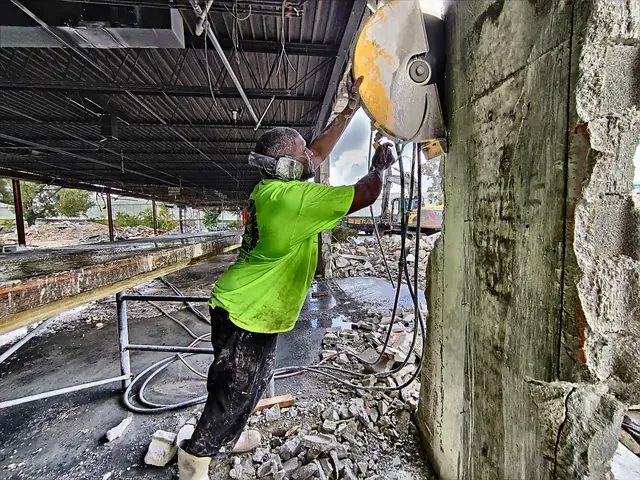
When a concrete floor slab needs to be partially or fully removed, concrete floor sawing sections the slab into pieces sized for the removal equipment. The perimeter of the removal area is cut first, separating the concrete to be removed from the concrete being preserved. Then the interior is cut in a grid pattern, producing sections typically 2 to 3 feet square. The individual sections are broken up and removed. Floor sawing before demolition prevents vibration from breaking force from traveling into the surrounding concrete — the defining advantage of cut-before-break demolition.
Expansion joint cutting
Concrete floor sawing creates expansion joints in slabs and pavement — wider cuts than control joints, typically filled with a compressible material, that allow the concrete to expand and contract with temperature changes without buckling or cracking. Expansion joints are cut to the full slab depth in many cases, and the cut width is typically one-half to three-quarters of an inch. In Miami’s thermal environment — where concrete surface temperatures can cycle from 50 degrees to over 130 degrees daily — adequate expansion joint spacing is critical for preventing thermal stress cracking in large slabs and pavements.
Industrial floor modifications
In Miami’s industrial facilities — warehouses, manufacturing plants, distribution centers — concrete floor sawing modifies existing floors for new equipment layouts, drainage improvements, and structural upgrades. Industrial floors are typically thicker (6 to 8 inches minimum) and more heavily reinforced than residential or commercial floors, requiring larger floor saws with more powerful engines and larger diamond blades. Cutting industrial floors often involves cutting through hardened concrete that has been in service for years or decades — cured concrete cutting requires different blade characteristics than green concrete cutting.
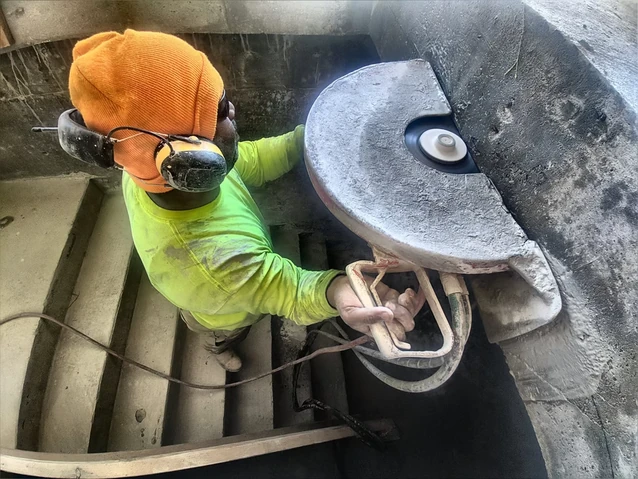
Concrete floor sawing equipment — choosing the right saw for the floor conditions
- Small walk-behind saws: 14- to 20-inch blade capacity, gasoline or electric powered, 5 to 8 inches maximum cutting depth. These are the standard concrete floor sawing machines for residential work — patios, driveways, sidewalks, and small commercial slabs. They are light enough to be transported in a pickup truck and maneuvered through residential gates and tight spaces.
- Mid-size walk-behind saws: 20- to 30-inch blade capacity, gasoline or diesel powered, 8 to 12 inches maximum cutting depth. These saws handle commercial and light industrial floor sawing — retail spaces, office building slabs, parking garage decks, and medium-thickness industrial floors. They weigh several hundred pounds and require a trailer or truck for transport.
- Large diesel walk-behind and ride-on saws: 30- to 48-inch blade capacity, diesel powered, 12 to 18 inches maximum cutting depth. These are the heavy-production concrete floor sawing machines for industrial floors, pavement, bridge decks, and heavy civil applications. They weigh over 1,000 pounds and require a trailer with a loading ramp.
- Electric floor saws: Electric-powered walk-behind saws are used for indoor concrete floor sawing where exhaust emissions are prohibited — occupied buildings, hospitals, schools, food processing facilities. They require access to adequate electrical power, which may limit their use to facilities with appropriate power supply.
Blade selection for concrete floor sawing
The diamond blade is the single most important variable in concrete floor sawing performance. The blade must be matched to the concrete type (cured vs green), the aggregate type (Miami limestone — hard bond), and the reinforcement (rebar requires a segmented blade with a bond that handles steel contact). A green concrete blade on cured concrete will wear out rapidly because the bond is too soft for cured material. A cured concrete blade on green concrete will glaze and stop cutting because the bond is too hard. The blade diameter determines maximum cutting depth — depth equals approximately 40 percent of blade diameter for most floor saws. Diamond blade selection for Miami floor sawing must account for the abrasive limestone aggregate that wears blades faster than harder aggregate types.
What concrete floor sawing costs per linear foot
The cost of concrete floor sawing in Miami depends on the slab thickness, reinforcement type and density, total linear footage, access conditions, and whether slurry containment is required. Short runs of cutting — a single trench line or a few control joints — have higher cost per linear foot because equipment mobilization and setup time are spread over fewer feet of cutting. Long runs — hundreds of linear feet of control joints or trenching — have lower cost per linear foot. Concrete cutting costs should be quoted after an onsite assessment that evaluates the specific floor conditions, not over the phone based on the square footage alone.
We perform concrete floor sawing throughout Miami-Dade County — from residential patios and driveways to commercial floors and industrial slabs. Every floor sawing job starts with the right blade for the concrete and continues with the right saw for the access and depth requirements. Contact us to discuss your floor sawing project and receive a quote that accounts for your specific concrete conditions.