World of Concrete 2026 Ticket Pricing and the Equipment Intelligence You Need Before You Walk That Floor
World of Concrete 2026 is scheduled to run at the Las Vegas Convention Center in late January, and early registration pricing typically opens in the late summer of the preceding year. As of current projections, all-access professional passes are expected to range from $295 to $695 USD, depending on registration tier and whether you bundle education sessions with exhibit hall access. Single-day exhibit hall passes have historically landed in the $75–$150 range for walk-in attendees, while contractor group packages — usually four or more registrants from the same company — unlock discounted rates that can drop per-person costs by 20 to 30 percent. If you’re a specialty subcontractor focused on cutting, coring, and demolition, the full education bundle is almost always worth the premium. The technical sessions on diamond tooling alone justify the price difference.
Why Diamond Tooling Dominates the WOC Show Floor Every Single Year
Walk any aisle at World of Concrete and within three minutes you will encounter at least a dozen diamond blade manufacturers competing for floor space. That’s not an accident. Diamond tooling is the single highest-margin consumable category in the concrete cutting industry, and WOC is where manufacturers debut next-generation segment geometries, bond hardness innovations, and laser-welded core technologies. For any contractor making purchasing decisions in 2026, attending with a technical checklist — not just a business card stack — is the only professional approach. This post gives you that checklist.
Segment Height, Diamond Concentration, and Bond Matrix Hardness Explained
The three variables that define a diamond blade’s performance envelope are segment height, diamond concentration, and bond matrix hardness. Segment height — typically measured in millimeters and ranging from 7mm to 15mm for most construction-grade blades — directly determines blade longevity. A 15mm segment on a 14-inch blade gives you significantly more usable life than a 7mm segment, but only if the bond matrix is matched correctly to your aggregate hardness.
Diamond concentration is expressed as a ratio, with 100 concentration representing approximately 4.4 carats of diamond per cubic centimeter of segment. Most general-purpose blades run between 25 and 40 concentration. Higher concentration is not universally better — in soft, abrasive materials like green concrete or sandstone-aggregate mixes, a lower concentration with a softer bond actually cuts faster because fresh diamond crystals are exposed more readily as the bond wears.
Bond matrix hardness is the variable most contractors get wrong when selecting blades. A hard bond matrix retains diamond crystals longer but is designed for soft, abrasive materials. A soft bond matrix releases worn diamonds faster, exposing fresh cutting edges — this is what you want in hard, dense concrete with high PSI ratings, such as the reinforced structural slabs common in structural concrete modification projects across South Florida.
Blade Diameter and Arbor Specifications for Common Cutting Equipment
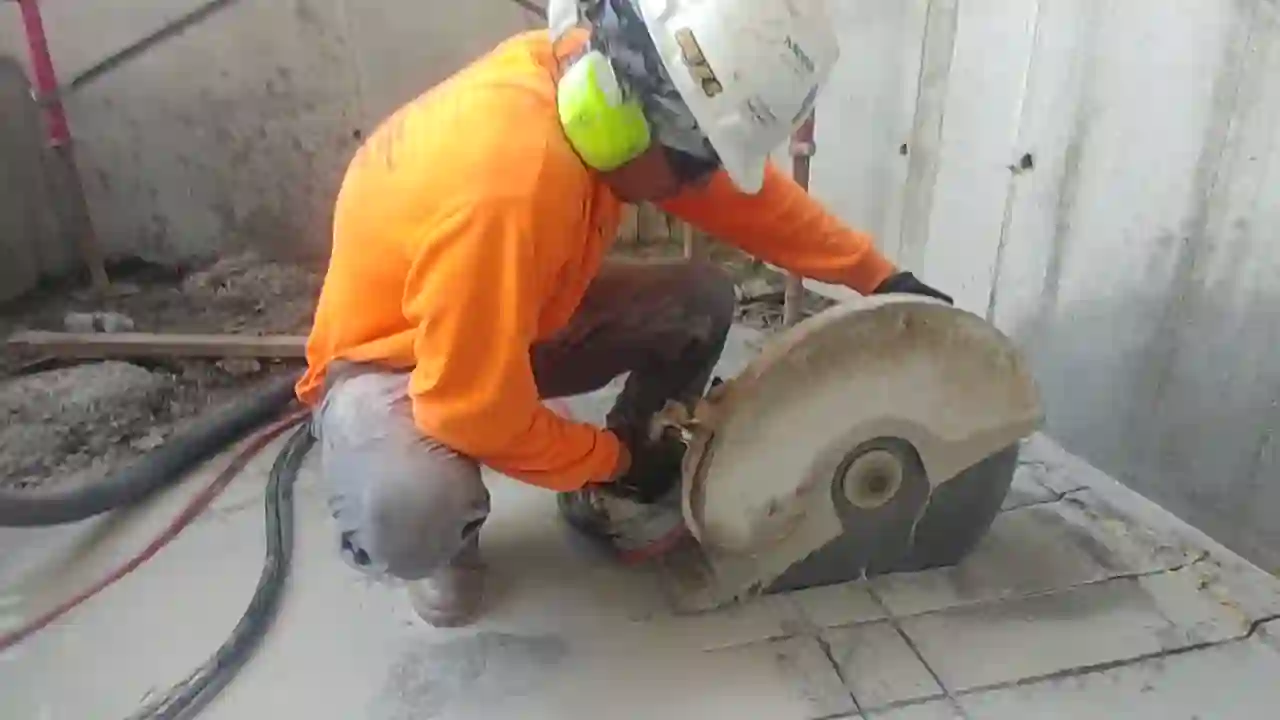
At WOC 2026, you will see blades ranging from 4-inch angle grinder discs all the way to 60-inch hydraulic wall saw blades. Understanding the arbor and flange specifications for your specific equipment is non-negotiable before any purchase. The most common arbor sizes in the North American market are 1-inch, 20mm, and 5/8-11 thread for handheld equipment, while floor saws typically use a 1-inch bore with key slots. Wall saws and wire saws operate on entirely different mounting systems — flanged spindle assemblies with torque ratings that must be matched to the saw’s horsepower output.
For hydraulic chain saw applications — a tool that sees heavy use in confined-space demolition and underwater cutting — blade and chain selection becomes even more critical. The hydraulic chain saw platform uses segmented diamond chains rather than traditional circular blades, and chain pitch, drive link count, and segment spacing must all be specified to match the bar length and hydraulic flow rate of the host machine. At WOC, at least three major manufacturers typically demo hydraulic chain systems, and comparing chain segment geometries side by side is one of the most technically valuable activities you can do on that show floor.
RPM Ratings, Peripheral Speed, and Why Your Saw’s Horsepower Changes Everything
Every diamond blade carries a maximum RPM rating stamped on the core. This is not a suggestion — it is a safety threshold derived from the blade’s core tensile strength and the centrifugal forces generated at speed. A 14-inch blade rated at 4,400 RPM should never be mounted on a saw capable of spinning it faster. But the more nuanced issue is peripheral speed, measured in surface meters per minute (m/min) or surface feet per minute (SFPM). Optimal cutting performance for most diamond blades occurs between 3,000 and 5,500 SFPM. A blade spinning too slowly in hard concrete will glaze over — the bond matrix work-hardens and diamond crystals stop exposing themselves. A blade spinning too fast in abrasive material burns through segments prematurely.
Horsepower at the blade is equally critical. Under-powered saws force the operator to increase downward pressure to maintain cut rate, which causes lateral blade deflection, uneven segment wear, and in worst-case scenarios, segment loss. For production floor sawing in 6-inch reinforced slabs, a minimum of 25 horsepower at the blade is the industry baseline. High-production contractors running 18-inch blades in 12-inch-thick post-tensioned decks should be looking at 65+ horsepower diesel units.
Dust Control Integration and Blade Cooling Requirements at the Equipment Level
Diamond blades generate heat through friction, and heat is the primary cause of premature segment failure. Wet cutting with a continuous water supply of 1–3 gallons per minute per blade inch of diameter is the engineering standard for production cutting. Dry cutting blades — which use a segmented rim design with wide gullets to dissipate heat through airflow — are limited to intermittent cuts of no more than 30 to 45 seconds before requiring a cooling pause. Any manufacturer at WOC 2026 claiming a dry-cut blade suitable for continuous production cutting should be questioned aggressively.
Dust control is inseparable from blade cooling in wet cutting applications. Slurry management, vacuum shroud integration for dry applications, and HEPA filtration on grinders are all topics covered in depth in our dust control resource library. Silica exposure regulations have tightened significantly under OSHA Table 1, and at WOC 2026, expect to see a major expansion of integrated dust suppression systems built directly into saw platforms rather than added as aftermarket accessories.
Evaluating Wire Saw Diamond Bead Specifications for Large-Scale Demolition
Wire saws represent the highest-performance cutting technology on the WOC floor, and bead specification is where most contractors lack technical depth. Diamond wire consists of a steel cable strung with sintered diamond beads at regular intervals — typically 30 to 40 beads per meter. Bead diameter (usually 10mm to 11.5mm), bead length, and spring spacing between beads all affect cutting speed, kerf width, and wire longevity. For the type of large-scale structural work seen in Golden Beach demolition projects, wire saws cutting through 24-inch reinforced concrete walls require beads with high diamond concentration and a hard bond matrix to handle the dense aggregate and heavy rebar schedules typical of coastal high-rise construction.
Wire tensioning is equally important. Insufficient tension causes the wire to wander laterally, producing a non-planar cut face that complicates subsequent structural connections. Most hydraulic wire saw units maintain tension automatically via a feedback-controlled tensioning cylinder, but operators must still verify tension settings against the manufacturer’s specification for wire diameter and cutting material density.
Building Your WOC 2026 Equipment Evaluation Checklist
- Blade segment height — minimum 10mm for production work, 12mm+ for high-abrasion applications
- Bond matrix hardness rating — confirm the manufacturer provides hardness data matched to concrete PSI ranges
- Diamond concentration — request the concentration value in writing, not just a “premium” or “professional” label
- Core tensile strength and laser weld specifications — laser-welded segments outperform sintered cores in wet cutting applications above 5,000 SFPM
- RPM and SFPM ratings — verify compatibility with your existing saw inventory before purchasing
- Wet vs. dry cutting designation — never use a wet-only blade in dry applications regardless of perceived convenience
- Wire bead count per meter — for wire saws, higher bead count increases cut quality but reduces speed in heavily reinforced concrete
- Dust suppression integration — evaluate whether the tool platform supports OSHA Table 1 compliance out of the box

Getting the Most Technical Value Out of Your WOC 2026 Investment
Ticket price at World of Concrete 2026 is a line item, not a barrier. Whether you pay $295 for exhibit-only access or $695 for the full education package, the return on that investment is entirely determined by how technically prepared you are before you arrive. Knowing the difference between a hard-bond blade engineered for 8,000 PSI structural concrete and a soft-bond blade designed for abrasive masonry is the difference between a contractor who buys smart and one who burns through tooling budgets. Walk that floor with specifications in hand, ask manufacturers for data sheets rather than brochures, and compare peripheral speed ratings against your actual equipment. That’s how experienced concrete cutting professionals use WOC — not as a trade show, but as a sourcing and intelligence operation.