What a Diamond Blade Actually Does When It Hits Rebar in the Field
Here’s the short answer most contractors get when they ask whether a diamond concrete blade will cut rebar: technically, yes. Here’s the answer that actually matters on a live Miami job site with six inches of clearance, a crew breathing recycled air, and a slab full of #5 bar on 12-inch centers — it depends entirely on your blade spec, your machine setup, your cutting depth, and whether your operator even knows the rebar is there before the blade finds it. Diamond blades are engineered to abrade and grind through crystalline silica matrix. Rebar is ductile steel. Those two materials respond to a spinning diamond segment in completely opposite ways, and when your blade unexpectedly transitions from one to the other mid-cut, the consequences range from accelerated segment wear all the way to catastrophic blade failure. Understanding that interaction isn’t academic — it’s the difference between a clean cut and a medical incident.
The Metallurgical Reality of Diamond Segments Meeting Steel Rod
Diamond blades cut concrete through a process of micro-fracturing aggregate and paste matrix using synthetic diamond crystals bonded in a metallic or resin matrix segment. The bond hardness is engineered to erode at a rate that continuously exposes fresh diamond crystals as the old ones dull. Rebar disrupts this entire system. When a spinning diamond segment contacts mild steel rebar, three things happen almost simultaneously: the diamond crystals don’t abrade the steel efficiently — they deflect or shatter against it. The segment bond, designed to release under abrasive load, doesn’t get the friction signal it needs to shed properly. And the lateral force spike generated by the blade catching on ductile steel can torque the blade body, inducing micro-cracks in the steel core or, in worst-case scenarios, causing segment ejection.
The blade won’t simply stop. In many cases it will push through the rebar, particularly if the bar diameter is small (#3 or #4) and the blade is running at full RPM with adequate horsepower. But “pushing through” is not cutting. It’s a violent, uncontrolled deformation event that shortens blade life dramatically and introduces unpredictable lateral forces into the machine. On a precision concrete sawing operation where tolerances matter, that kind of force spike is unacceptable.
Blade Specification Variables That Change the Rebar Equation Completely
Not all diamond blades respond to rebar the same way. The key variables that determine how badly a rebar encounter damages your blade are bond hardness, diamond concentration, segment geometry, and core tensile strength. Soft-bond blades designed for hard aggregate concrete will wear catastrophically on rebar contact because the bond erodes before the diamonds can do any useful work on the steel. Hard-bond blades hold up better mechanically but tend to glaze over when the cutting matrix isn’t receiving proper abrasive feedback — which is exactly what happens when the blade is running through ductile steel instead of aggregate.
Specialty rebar-tolerant blades do exist. These use a segmented geometry with wider gullets to clear steel debris, a harder core steel to resist torque spikes, and a diamond concentration calibrated for mixed-material cuts. If your Miami demolition scope involves cutting reinforced slabs where rebar exposure is expected and unavoidable — trench cuts, core locations near post-tension zones, or full slab removals — specifying a rebar-tolerant blade from the outset is non-negotiable. The upfront cost difference is real. The cost of a blown blade in a confined basement at 2 PM on a Friday is substantially more real. Review how blade and equipment costs factor into your overall cutting price before you make spec decisions based on sticker price alone.
Confined Space Cutting in Miami and Why Rebar Detection Becomes a Life-Safety Issue
South Florida construction sites present a specific set of access and logistics challenges that amplify every risk associated with unexpected rebar contact. Parking structures with 7-foot clearances. Mechanical rooms with existing equipment blocking three sides of your cut line. Below-grade utility vaults where ventilation is inadequate and the only egress is a 30-inch hatch directly above the work zone. In these environments, a blade failure isn’t just an equipment problem — it’s a confined space emergency.
Blade segment ejection in a confined space is a ballistic event. Segments travel at velocities that exceed 100 mph at standard operating RPM. In an open exterior environment, that risk is serious but manageable with proper PPE and exclusion zones. In a 10-by-12-foot mechanical room with three workers present, it’s a different category of hazard entirely. Job site safety protocols for confined space cutting must include pre-cut rebar mapping as a mandatory step, not an optional one.
Ground-penetrating radar (GPR) scanning before any cut in a confined space is the professional standard. It’s not slow. A competent GPR operator can map a 20-foot cut line in under 15 minutes, identify all rebar, post-tension cables, conduit, and voids, and hand the operator a marked layout before the blade ever touches the slab. The cost of that scan is trivial compared to the cost of a blade failure, a worker injury, or a regulatory compliance incident triggered by a dust or silica exposure event in an unventilated space.
Operational Protocols for Rebar-Heavy Cuts in Access-Restricted Zones
When the scope requires cutting through confirmed reinforced concrete in a confined or access-limited area, the operational approach shifts significantly from standard slab cutting. The following protocols reflect field-tested practice on Miami commercial and infrastructure projects where rebar density and site constraints are both elevated:
- Pre-cut GPR mapping with marked rebar depth and spacing: Every cut line gets scanned. Rebar locations are transferred to the slab surface with paint or chalk so the operator has a visual reference during the cut.
- Blade selection based on confirmed rebar density: If GPR shows bar spacing tighter than 12 inches or bar diameter at #6 or above, a rebar-tolerant blade is mandatory regardless of cost pressure.
- Reduced feed rate through rebar zones: Operators slow blade advance by 30 to 50 percent when crossing known rebar locations. This reduces the lateral force spike and gives the segment time to work through the steel rather than slamming into it.
- Increased water flow during rebar contact: Wet cutting with elevated slurry flow helps cool the segment and flush steel debris from the gullets, reducing the risk of segment loading and glazing.
- Blade inspection after every rebar crossing: In confined space operations, the blade comes out of the cut after each rebar encounter for a visual segment inspection. Cracked segments or unusual segment wear patterns are a stop-work condition.
- Ventilation and atmospheric monitoring running continuously: Cutting reinforced concrete in a confined space generates both silica dust and metal particulate. Local exhaust ventilation and continuous atmospheric monitoring are not optional.
These aren’t bureaucratic checkboxes. They are the operational difference between a job that finishes on schedule with zero incidents and one that generates a workers’ compensation claim, an OSHA inspection, and a client relationship that doesn’t survive the project. Avoiding the most common concrete cutting mistakes on confined-space rebar cuts requires exactly this level of pre-planned discipline.
Flat Saw Operations in Tight Corridors Where Rebar Exposure Is Guaranteed
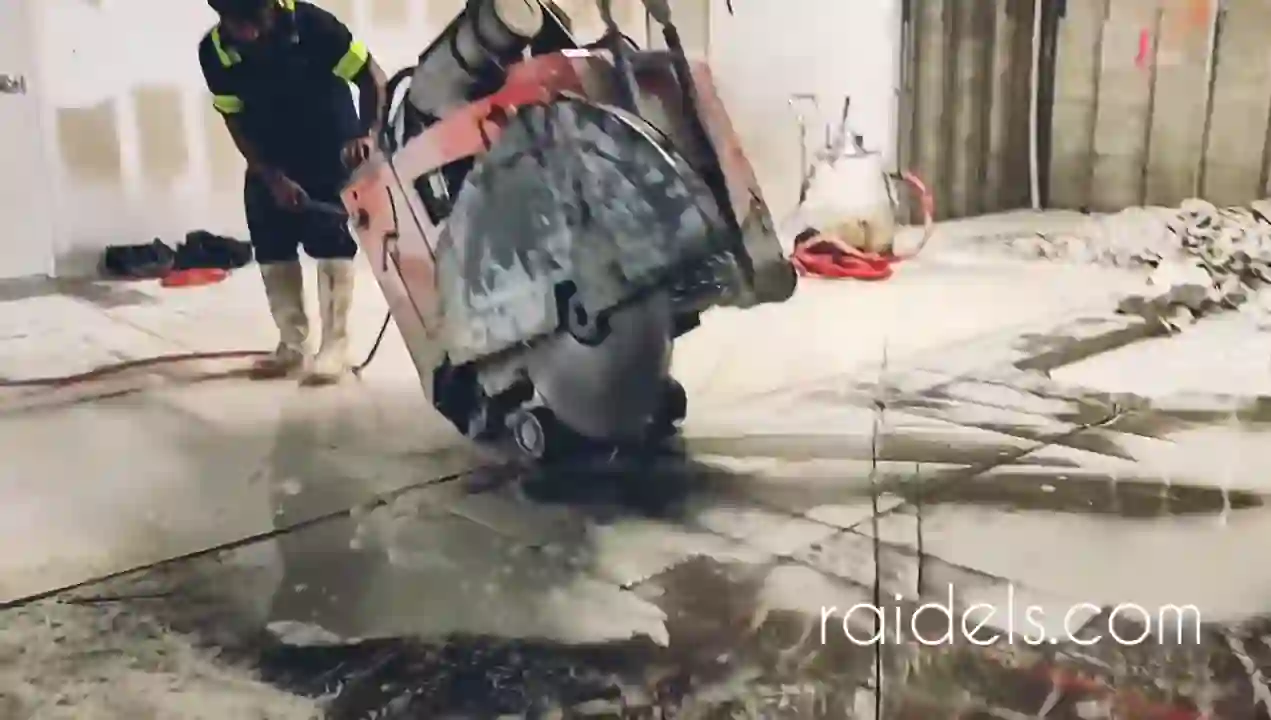
Flat sawing in access-restricted corridors — think parking deck expansion joint replacements, utility trench cuts through reinforced slabs in mechanical rooms, or lane cuts on covered bridge decks — presents a specific blade management challenge. The flat saw platform is powerful and efficient, but it also commits the blade to a fixed cutting plane with significant momentum behind it. When a flat saw blade hits an unexpected rebar at full feed rate, the machine doesn’t stop — it transfers that energy directly into the blade core and the operator’s hands through the machine frame.
In tight corridors where the operator has limited room to react and no clear egress path away from the machine, that energy transfer is a serious injury vector. Flat saw operations in confirmed rebar zones require walk-behind machines with dead-man controls, not ride-on units. The operator needs to be positioned to release the feed instantly and step clear if the machine behavior changes. In a 36-inch-wide corridor with walls on both sides, that positioning has to be planned before the cut starts, not improvised when the blade catches.
What Post-Tension Zones Add to the Rebar Cutting Risk Profile
Miami’s commercial construction stock is heavily post-tensioned. PT slabs look like reinforced concrete from the surface, but the internal geometry is fundamentally different — and the consequences of blade contact with a stressed tendon are categorically more severe than hitting passive rebar. A PT tendon under 33,000 pounds of tensile load that is suddenly severed by a blade releases that energy instantaneously. The tendon end can travel 20 feet or more and penetrate solid material. In a confined space, that event is fatal.
GPR scanning distinguishes PT tendons from passive rebar by their depth profile and spacing pattern, but PT identification requires an experienced scanner who knows what to look for. Any time a cut is planned in a building constructed after 1975 in Miami-Dade or Broward County, PT should be assumed until GPR confirms otherwise. This is not a conservative overreaction — it is the professional standard for anyone who has seen what a released PT tendon does in an enclosed space.
The Bottom Line for Miami Contractors Facing Rebar Cuts in Constrained Environments
Diamond blades will cut rebar. The question that actually drives every operational decision on a real job site is whether you want them to, under what conditions, with which blade, and with what pre-cut intelligence in hand. In Miami’s dense urban construction environment — where confined spaces, limited access, and heavily reinforced legacy structures are the norm rather than the exception — treating rebar cutting as an incidental variable rather than a primary planning factor is how projects go wrong in ways that are both expensive and preventable. The technical capability exists to execute these cuts safely and efficiently. Deploying that capability correctly requires the kind of pre-job planning, equipment selection discipline, and operational protocol that separates professional concrete cutting contractors from equipment operators with a blade and a prayer.