Why “Demolition Near Me” Returns the Wrong Results and What to Do Instead
Every week, property owners and general contractors punch “demolition near me” into a search engine and end up calling the first number they see. That number usually belongs to a generalist hauler with a rented excavator and no real understanding of concrete structure, load-bearing walls, post-tension slabs, or the selective demolition techniques that separate a controlled takedown from a liability event. Before you make that call, you need a framework — a technical checklist that filters out the noise and connects you with a crew that actually knows what they’re doing when reinforced concrete, embedded utilities, and tight urban clearances are involved.
Step 1 — Define Your Demolition Scope Before Calling Anyone
The single most expensive mistake in demolition contracting is calling three companies and describing your project differently each time. Contractors will bid what they hear, not what you need. Lock down your scope first. Ask yourself these questions and write the answers down before the first phone call:
- Full structural demolition or selective? Full demo means everything comes down to grade. Selective means you’re removing specific elements — a concrete driveway, a partition wall, a slab section — while preserving the surrounding structure.
- What material type are you removing? Unreinforced concrete, standard rebar-reinforced concrete, post-tensioned slabs, and fiber-reinforced concrete each require different blade specifications, hydraulic pressures, and safety protocols.
- What are the access constraints? Is equipment getting in via a residential driveway, a narrow alley, or through a finished interior? This determines whether you need a full-size hydraulic breaker, a robotic demolition unit, or hand-held core drilling and wall saw work to pre-cut panels before removal.
- Are there embedded utilities? Electrical conduit, plumbing, gas lines, and data runs inside or directly beneath a concrete slab change every part of the demolition plan.
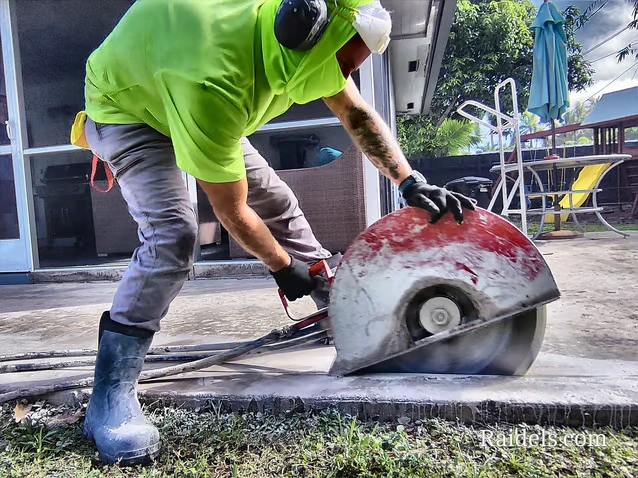
For projects involving concrete driveway removal in Miami, the scope definition is especially critical because South Florida slabs frequently sit over compacted fill with unpredictable depth variations, and some driveways connect to municipal curb cuts that require separate permitting.
Step 2 — Understanding the Core Demolition Methods and When Each Applies
A qualified demolition contractor near you should be able to explain exactly which method they’re using and why. If they can’t, that’s a red flag. Here are the primary techniques used in professional concrete demolition:
Hydraulic Breaking for Mass Concrete Removal
Hydraulic breakers mounted on excavators or skid steers are the workhorses of slab and footing demolition. They deliver impact energy measured in foot-pounds — typically between 200 and 18,000 ft-lbs depending on the attachment class. For residential slabs (4–6 inches, 3,000–4,000 PSI), a mid-range breaker in the 800–1,200 ft-lb class is standard. For commercial footings or thickened edge beams exceeding 12 inches, you’re looking at 3,000+ ft-lb tools. Ask your contractor what breaker class they’re bringing. If they don’t know the spec, they’re guessing.
Diamond Wire Saw Cutting for Precision Panel Removal
When you’re removing a section of concrete adjacent to a live structure — a pool deck next to a foundation, a floor slab next to a load-bearing column — hydraulic breaking is too aggressive. Diamond wire sawing allows operators to cut continuous straight lines through reinforced concrete up to 36 inches thick without inducing vibration into the surrounding structure. The wire travels at 20–30 meters per second through a series of pulleys, and the cutting depth is limited only by the pulley configuration, not the material thickness. This is the correct tool for bridge abutments, basement wall removal, and any cut within 18 inches of a post-tension tendon zone.
Wall Sawing for Vertical and Overhead Cuts
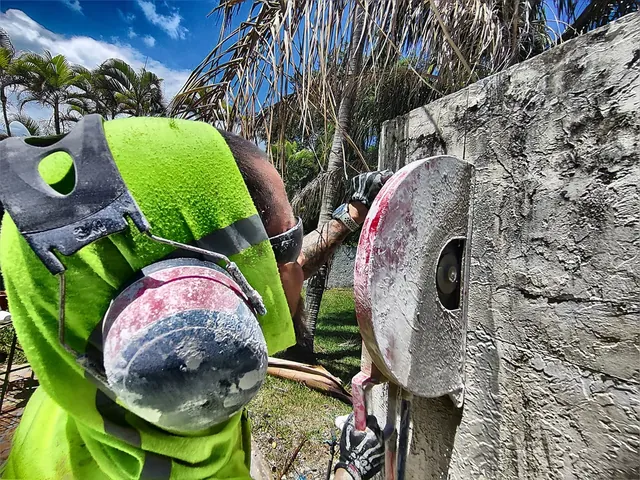
Track-mounted wall saws are essential for creating door and window openings in existing concrete walls, removing sections of retaining walls, and cutting through tilt-up panels. Blade diameters range from 14 inches to 60 inches, with cutting depths up to 24 inches per pass on a 60-inch blade. For projects requiring this level of precision, explore the full range of wall saw services available for Miami-area structural modifications. A proper wall saw operator tracks blade tension, coolant flow rate, and RPM simultaneously — it’s a skilled trade, not a laborer task.
Robotic Demolition for Confined and Interior Spaces
Brokk-style remote-controlled demolition robots have changed interior concrete removal permanently. These units weigh between 400 and 3,500 lbs, fit through standard doorways, and can deliver hydraulic breaking force equivalent to a mid-size excavator without the machine weight loading the floor structure. For hospital renovations, parking garage column removal, and basement slab demolition with low ceiling clearance, robotic units are the only safe option.

Step 3 — Permit Requirements You Cannot Ignore in Florida
Florida Building Code Section 105 requires a demolition permit for the removal of any structure or structural component. In Miami-Dade County specifically, the permitting process includes a pre-demolition inspection, utility disconnect verification, and in many cases an asbestos survey for structures built before 1980. The Florida Department of Environmental Protection also enforces NESHAP (National Emission Standards for Hazardous Air Pollutants) regulations for asbestos-containing materials, which require a licensed asbestos inspector to survey the structure before any mechanical demolition begins.
Any contractor telling you permits aren’t necessary for “just a slab” or “just a wall” is either uninformed or deliberately cutting corners that will become your liability. Verify permit status independently through the Miami-Dade Building Department portal before work begins. For a broader look at regulatory requirements across the state, the concrete cutting and demolition standards across Florida vary by county, and what’s acceptable in Broward may require additional steps in Miami-Dade.
Step 4 — Vetting a Local Demolition Contractor on Technical Criteria
Price is the last thing you should compare. Here’s the technical checklist to run through before you accept any bid:
- State Contractor License: In Florida, demolition work requires a licensed General Contractor (CGC) or a licensed Demolition Contractor. Verify the license number at myfloridalicense.com before any conversation about pricing.
- Insurance Minimums: General liability at $1,000,000 per occurrence is the floor. For structural demolition near occupied buildings, require $2,000,000 aggregate. Ask for a certificate of insurance naming your entity as additional insured.
- Equipment Ownership vs. Rental: A contractor who owns their equipment knows how it performs. A contractor renting a breaker from a tool yard the morning of your job does not. Ask directly — do you own or rent your primary demolition equipment?
- Dust and Noise Mitigation Plan: Professional crews use wet-cutting methods, HEPA-filtered vacuum systems for interior work, and sound-dampening shrouds on hydraulic breakers in residential areas. If they have no plan for dust or noise control, they haven’t done this in a neighborhood before.
- Debris Disposal Documentation: Concrete waste must go to a licensed C&D (Construction and Demolition) debris facility. Request the disposal facility name and ask if they provide a weight ticket. This protects you from illegal dumping liability.
Step 5 — Realistic Cost Benchmarks for Demolition in South Florida
Cost transparency is where most demolition searches fall apart. Homeowners expect flat prices; the reality is that demolition pricing is driven by material type, reinforcement density, access difficulty, haul distance, and disposal fees. As a general benchmark for the Miami metro area:
- Residential concrete slab removal (4-inch, unreinforced): $3.50–$6.00 per square foot including haul-off
- Reinforced slab removal (6-inch, #4 rebar at 12-inch OC): $6.00–$10.00 per square foot
- Post-tension slab removal (requires X-ray scanning and tendon management): $12.00–$20.00+ per square foot
- Interior wall demolition (concrete block, 8-inch CMU): $18–$35 per linear foot depending on height and reinforcement
- Full residential structure demolition (1,200–2,000 SF): $8,000–$22,000 depending on material composition and permit complexity
For a deeper breakdown of what drives these numbers and how timelines interact with cost, the detailed analysis at concrete removal costs and timelines covers the variables that most contractors won’t explain upfront.
The One Question That Separates Professional Demolition Crews from Everyone Else
After you’ve checked licenses, verified insurance, and reviewed the equipment list, ask this single question: “What’s your procedure if you encounter an unexpected post-tension tendon or an unmarked utility during breaking?” A professional crew will describe a specific stop-work protocol, a GPR (ground-penetrating radar) scan process, and a re-evaluation procedure. An unqualified crew will hesitate, generalize, or tell you it won’t happen. That answer tells you everything about how they operate when the unexpected occurs — which, in demolition, is always.
Searching for demolition near you doesn’t have to mean settling for the closest available truck. With the right technical criteria in hand, you can filter your options down to contractors who understand concrete as a structural material, not just as debris to be hauled away. That distinction is the difference between a project that finishes on schedule and one that creates structural damage, utility strikes, or regulatory violations that outlast the demolition itself.