Why Rail Saw Operations Demand a Higher Standard of Job-Site Discipline
Rail saw services occupy a unique tier in the concrete cutting trade. Unlike handheld angle grinders or walk-behind flat saws, a rail-mounted diamond blade saw operates on a fixed track system capable of cutting reinforced concrete walls, bridge abutments, and structural slabs at depths exceeding 24 inches in a single pass. That raw cutting capacity is exactly what makes rail saws indispensable on major demolition and structural modification projects—and exactly what makes an unmanaged job site a serious liability. At Concrete Cutting Miami, LLC, we treat every rail saw deployment as a high-consequence operation, because that’s precisely what it is. OSHA’s 29 CFR 1926 Subpart Q (Concrete and Masonry Construction) sets the floor for compliance, but the best crews in South Florida push well beyond the minimum standard.
Pre-Cut Site Assessment and Hazard Identification Protocols
Before a single rail anchor gets bolted to a concrete substrate, a qualified site supervisor must complete a written hazard assessment. This isn’t a checkbox exercise—it’s a forensic review of the work environment. In Miami’s dense urban construction landscape, that means identifying embedded electrical conduit, post-tension cables, water supply lines, and structural rebar grids using ground-penetrating radar (GPR) scanning. Cutting through a live post-tension tendon with a rail saw generates catastrophic snap-back energy that can kill or severely injure anyone within the blast radius.
The hazard assessment must also account for overhead obstructions, floor load ratings (rail saw assemblies with hydraulic power units can weigh over 2,000 lbs.), and proximity to occupied spaces. For projects tied to structural modifications, the structural engineer of record should sign off on the cut plan before mobilization begins. This isn’t bureaucratic overhead—it’s the difference between a controlled operation and a structural collapse.
Mandatory Pre-Task Documentation
- GPR Scan Report — Signed by a certified GPR technician, showing all embedded utilities and tension cables within the cut zone
- Job Hazard Analysis (JHA) — Specific to rail saw operation, listing each identified hazard and corresponding control measure
- Equipment Inspection Log — Documenting blade condition, track integrity, hydraulic line pressure, and motor housing status
- Exclusion Zone Diagram — A scaled site map showing the minimum 10-foot exclusion perimeter around the active cut
- Emergency Response Plan — Including nearest trauma center, on-site first aid kit location, and emergency contact chain
Rail Track Anchoring and Blade Alignment Safety Requirements
One of the most underestimated hazards in rail saw services is improper track installation. The rail system must be anchored to the work surface using manufacturer-specified fasteners torqued to precise specifications—typically between 40 and 60 ft-lbs depending on the system. A rail that shifts mid-cut doesn’t just ruin the kerf geometry; it can cause the diamond blade to bind, shatter, or deflect violently. Blade segments ejected from a 14- to 30-inch diamond blade traveling at 3,000+ RPM become ballistic projectiles.
Blade alignment must be verified with a precision straightedge before power-up. The blade must run perfectly parallel to the track and perpendicular to the cut face. Any angular deviation greater than 0.5 degrees should halt the operation until the track is re-anchored and re-checked. Our crews use digital angle finders, not eyeballed estimates. This level of rigor is consistent with the safety culture we document across our job-site safety operations throughout Miami-Dade and Broward counties.
Hydraulic Power Unit Hazard Controls
- Hydraulic line pressure must be verified against the OEM specification before each use—overpressure conditions can rupture hoses under load
- Fluid leak inspection — Any hydraulic fluid on the floor creates a slip hazard and a fire risk near hot cutting surfaces
- Anti-vibration mounts must be intact to prevent resonant frequency transfer to the track system during extended cuts
- Dead-man switch functionality must be tested prior to every shift—this is a non-negotiable OSHA compliance item
Slurry Management and Water Suppression Compliance During Rail Saw Cuts
Rail saw cutting is a wet process. Diamond blades require continuous water cooling to prevent thermal degradation of the blade matrix and to suppress respirable crystalline silica dust—the primary occupational health hazard in concrete cutting. OSHA’s Silica Rule (29 CFR 1926.1153) mandates engineering controls that keep worker silica exposure below 50 micrograms per cubic meter of air as an 8-hour TWA. Wet cutting with adequate water flow rate (typically 1–3 gallons per minute at the blade) is the most reliable engineering control available for rail saw operations.
But water suppression creates its own hazard set. Slurry runoff from a deep rail saw cut can be voluminous—a single 20-foot horizontal cut through a 16-inch reinforced wall can generate 50+ gallons of concrete slurry. Uncontrolled slurry migration contaminates storm drains, creates slip hazards, and violates local environmental regulations. Our approach to slurry containment mirrors the standards we’ve outlined in our guide to environmental compliance and water containment mastery. Containment berms, vacuum slurry recovery systems, and pH-adjusted disposal are all part of a compliant rail saw operation.
Personal Protective Equipment Standards Specific to Rail Saw Work
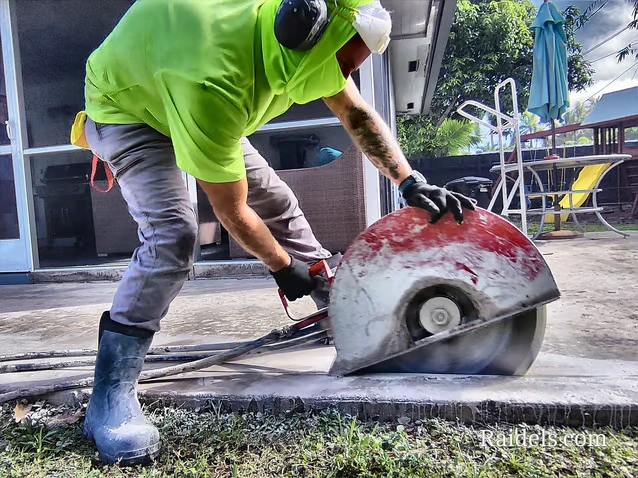
General construction PPE is not sufficient for rail saw services. The specific hazard profile of this equipment demands a tiered PPE approach that goes beyond hard hat and safety glasses. Every operator and spotter within the exclusion zone must wear the following:
- ANSI Z87.1-rated face shield over safety glasses — blade fragment and slurry splash protection
- NIOSH-approved half-face respirator with P100/OV cartridges — for silica dust and any chemical off-gassing from cured concrete additives
- Cut-resistant gloves (ANSI A4 minimum) — for blade handling and track assembly
- Hearing protection rated NRR 25 or higher — rail saw hydraulic units and blade-on-concrete contact routinely exceed 95 dB(A)
- Steel-toed, puncture-resistant boots with metatarsal guards where overhead blade handling is required
- High-visibility vest — critical in multi-trade environments where equipment operators may be moving materials nearby
Exclusion Zone Management and Crew Positioning During Active Cuts
No unauthorized personnel enter the exclusion zone while the blade is powered. This rule has no exceptions. The exclusion zone for a rail saw operation extends a minimum of 10 feet in all directions from the blade path, with particular attention to the blade’s leading edge trajectory. If the blade were to bind and kick back, the operator must be positioned to the side of the blade—never directly behind or in front of the cutting plane.
Spotters must be stationed at all access points to the exclusion zone with clear line-of-sight to the operator. Two-way radio communication between the operator and spotters is required on any job site where ambient noise levels exceed 85 dB(A)—which is essentially every rail saw job. This level of crew coordination is especially important on projects involving debris removal, where material handling crews may be working in adjacent zones. For projects in coastal environments, additional coordination with gravel removal operations in Miami Beach ensures that material staging doesn’t compromise the exclusion perimeter.
Post-Cut Structural Verification Steps
- Visual inspection of the cut face for rebar exposure, unintended fractures, or evidence of tension cable proximity
- Temporary shoring verification before any cut section is removed or repositioned
- Slurry neutralization and pH testing before slurry disposal or discharge
- Blade and track inspection for wear, cracking, or deformation before the next deployment
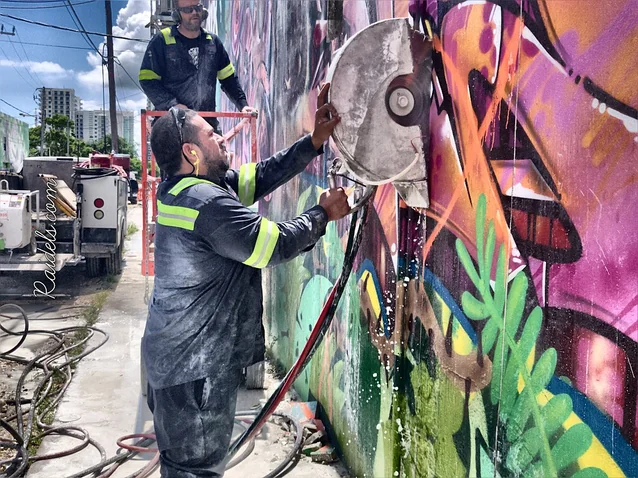
Building a Safety-First Rail Saw Culture That Outlasts Any Single Project
The technical protocols described here are only as effective as the crew culture that executes them. At Concrete Cutting Miami, LLC, every rail saw operator goes through a structured competency evaluation before being cleared for unsupervised operation. That evaluation covers equipment assembly, hazard recognition, emergency shutdown procedures, and OSHA documentation requirements. Safety briefings happen at the start of every shift—not just at project kickoff. When conditions change (weather, adjacent trade activity, scope changes), the JHA gets updated and re-briefed on the spot.
Rail saw services represent some of the most technically demanding work in the concrete cutting industry. The clients who hire us for structural wall removal, bridge deck modification, and deep-slab penetration deserve a contractor who treats safety as an engineering discipline—not an afterthought. Every cut we make is planned, documented, and executed with the same precision we apply to the diamond blade itself. That’s not a marketing position. That’s how serious concrete professionals operate.