Why Slab Thickness Is the First Number Every Safe Concrete Cutter Calculates
Before a single blade spins on a Miami job site, before PPE gets distributed, before saw depth is dialed in — the slab thickness gets measured. Not estimated. Not eyeballed. Measured with a core sample, a ground-penetrating radar scan, or a physical inspection of exposed edges. That number — whether it’s 4 inches of residential pour or 14 inches of post-tensioned commercial deck — determines every downstream safety decision made that day. Slab thickness drives blade selection, cutting speed, water suppression requirements, vibration exposure limits, and the structural risk profile of the entire operation. Treating it as an afterthought is how workers get hurt.
OSHA’s Concrete Cutting Standards and What Slab Thickness Has to Do With Them
OSHA doesn’t publish a regulation that says “measure your slab before cutting” in those exact words — but the obligation is embedded throughout 29 CFR 1926 Subpart Q (Concrete and Masonry Construction) and Subpart Z (Toxic and Hazardous Substances, including silica under 1926.1153). The thicker the slab, the longer the cut takes. The longer the cut takes, the greater the cumulative silica dust exposure. OSHA’s respirable crystalline silica standard sets an action level of 25 µg/m³ as an 8-hour TWA — and a permissible exposure limit (PEL) of 50 µg/m³. On a thick slab cut without proper wet suppression or integrated vacuum systems, a worker can breach that PEL in under 15 minutes.
Our team at Concrete Cutting Miami tracks every OSHA compliance requirement tied to silica, structural integrity, and equipment operation. Understanding slab thickness as a silica exposure multiplier is non-negotiable on every commercial and residential project we take on in South Florida.
Table A Compliance and Blade Depth Correlation
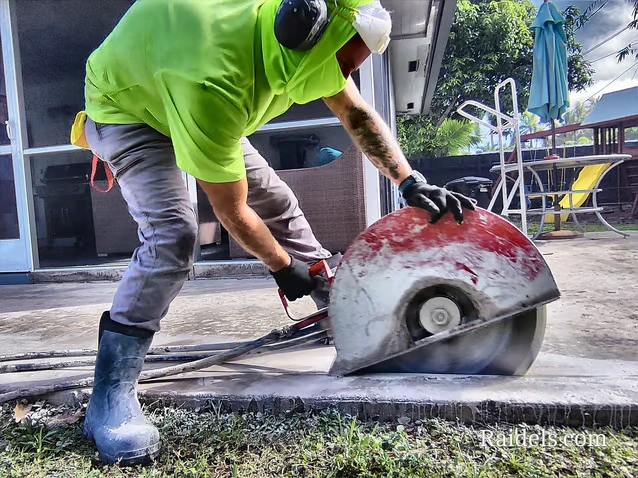
OSHA’s Table A for silica in construction lists specific engineering controls by task type. For walk-behind saws cutting concrete — one of the most common applications where slab thickness matters — Table A requires either a blade-integrated water delivery system or a vacuum with HEPA filtration rated at 25 CFM or greater at the blade. When slab thickness exceeds 6 inches, cut time per linear foot increases significantly, which means the dust generation window extends proportionally. Operators must either reduce cut speed, increase water flow rate, or implement mandatory rotation intervals to stay within compliant exposure windows.
Structural Hazard Mapping Before the First Cut
Slab thickness alone doesn’t tell the full story — but it’s the anchor point for a complete structural hazard map. A 6-inch slab with embedded post-tension cables behaves completely differently under a saw than a 6-inch unreinforced residential pour. Before any cutting begins, the site crew must identify:
- Rebar spacing and depth — typically 1.5 to 2 inches from the bottom of the slab in standard residential pours, but highly variable in structural slabs
- Post-tension cable location — catastrophic snap-back injuries occur when blades contact live PT cables without prior de-tensioning or cable mapping via GPR
- Embedded conduit and utilities — electrical conduit, plumbing sleeves, and data lines are routinely cast into slabs of all thicknesses
- Aggregate type and hardness — Miami’s local limestone aggregate behaves differently than granite aggregate imported for high-spec commercial pours
- Slab support conditions — is the slab on grade, suspended, or cantilevered? Cutting a suspended slab without shoring changes the entire fall and collapse risk profile
This kind of pre-cut hazard mapping is what separates professional demolition from dangerous guesswork. If you’re weighing whether to hire a crew or attempt this yourself, read our breakdown on DIY vs. professional demolition before you pick up any tools.
Blade Selection Protocol Based on Verified Slab Thickness
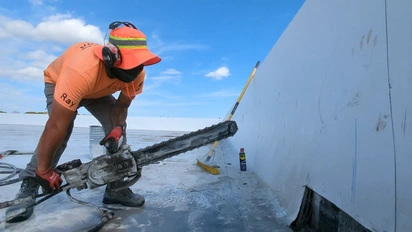
Diamond blade specification is a direct function of slab thickness, aggregate hardness, and reinforcement density. Running the wrong blade on a thick slab doesn’t just slow the job — it creates heat fractures in the blade segment, increases the probability of blade walk, and raises the risk of segment ejection. Segment ejection events have caused fatalities on concrete cutting sites. The physics are straightforward: a blade segment detaching from a 14-inch diameter blade spinning at 3,600 RPM becomes a projectile with lethal kinetic energy.
Recommended Blade Specifications by Slab Thickness Range
- 3–4 inch slabs (standard residential): Soft-bond diamond blades with 10mm segment height; standard RPM; wet or dry operation permissible with proper dust controls
- 5–7 inch slabs (commercial-grade or thick residential): Medium-bond blades; mandatory wet suppression; blade diameter minimum 14 inches for single-pass cuts
- 8–12 inch slabs (structural commercial decks): Hard-bond blades with 15mm+ segment height; multi-pass cutting protocol required; operator vibration monitoring mandatory
- 12+ inch slabs (heavy industrial or bridge deck): Wire saw or wall saw systems preferred over flat saw; hydraulic power units; full exclusion zone perimeter required during operation
For a detailed walkthrough of what thick-slab removal actually involves from a technical and safety standpoint, our complete guide to removing a thick concrete slab covers every phase from assessment through disposal.
Hand-Arm Vibration Syndrome and Exposure Limits Tied to Cut Duration
OSHA doesn’t yet have a standalone HAVs (Hand-Arm Vibration Syndrome) standard, but the General Duty Clause (Section 5(a)(1)) creates an enforceable obligation to protect workers from recognized hazards — and HAVs qualifies. Thicker slabs mean longer cutting durations, which directly increases vibration exposure. The European Union’s Physical Agents Directive sets an 8-hour exposure action value of 2.5 m/s² and a limit value of 5 m/s². Most concrete saws exceed 5 m/s² during active cutting. At those levels, a worker cutting through a 10-inch slab for a full shift without rotation is accumulating dangerous cumulative exposure. Mandatory tool rotation schedules, anti-vibration gloves rated to ISO 10819, and vibration-dampening handle systems are not optional accessories on thick-slab jobs — they’re core safety infrastructure.
Slurry and Water Management on Wet-Cut Operations
Wet cutting is the primary silica control method for most flat saw operations, but it creates its own hazard cascade that’s directly proportional to slab thickness. Thicker slabs generate more slurry per linear foot. That slurry — a suspension of fine silica particles, water, and concrete fines — is a slip hazard, an environmental discharge violation risk, and a secondary silica exposure source if it dries and becomes airborne. OSHA and the EPA both have jurisdiction here. Slurry must be contained, vacuumed, and disposed of according to local stormwater ordinances. In Miami-Dade County, discharge of concrete slurry into storm drains is a violation of the county’s stormwater management code, with fines that can escalate quickly on commercial projects.
For Miami property owners and contractors managing renovation projects that involve slab work, our Miami home improvement resource library covers compliance requirements specific to South Florida’s regulatory environment.
Shoring and Fall Protection When Cutting Suspended Slabs
When slab thickness is measured on a suspended deck — a parking garage, a second-story floor system, or a commercial mezzanine — the structural hazard profile changes entirely. Cutting through a suspended slab without proper shoring below the cut zone creates the risk of sudden slab section drop. Even a 12-inch by 12-inch section of 6-inch thick normal-weight concrete weighs approximately 75 pounds. A 4-foot by 4-foot panel weighs over 1,200 pounds. Workers below the cut zone, or the cutter themselves if the blade binds and the slab shifts, face crush and fall hazards that are entirely preventable with proper shoring towers and engineered lift plans. OSHA 1926.701 requires that no construction loads be placed on a concrete structure unless the employer determines that the structure is capable of supporting the load — and that determination must be made in writing by a qualified person.
This level of technical complexity is exactly why projects involving structural slab removal benefit from the same disciplined approach as precision concrete demolition work — where every cut is planned, every hazard is mapped, and every worker on site understands the risk profile before the first blade drops.
Building a Pre-Task Safety Plan Around Slab Thickness Data
The most effective job-site safety tool for concrete cutting operations is a pre-task plan (PTP) that’s built around verified slab thickness data. A properly constructed PTP for a slab cutting operation includes the measured thickness at multiple points across the cut zone, the identified reinforcement type and approximate depth, the selected blade specification and justification, the silica control method and monitoring schedule, the vibration rotation plan, the slurry management protocol, and the emergency response procedures specific to the site. This isn’t paperwork for paperwork’s sake — it’s the operational framework that keeps crews safe when conditions on a Miami job site shift unexpectedly, as they always do. Slab thickness is the foundation of that plan. Get that number right, and every other safety decision follows from a position of knowledge rather than assumption.