Why the DIY vs Professional Demolition Question Is More Technical Than You Think
Every week in Miami, someone rents a rotary hammer from a big-box store, watches two YouTube videos, and starts attacking a concrete slab with the confidence of a seasoned contractor. Sometimes it works out. More often, it doesn’t — and the consequences range from a botched timeline to a collapsed structural element, a severed rebar tendon, or a utility strike that shuts down an entire block. The DIY vs professional demolition debate is not simply about saving money. It is a technical risk-assessment problem, and if you approach it without the right framework, you are gambling with your structure, your schedule, and your safety record.
This guide is written from the perspective of a senior concrete consultant who has seen both sides of this equation play out on job sites across South Florida. The goal is to give you a clear, honest set of criteria — technical, logistical, and financial — so you can make the right call before a single tool touches your concrete.
The Structural Variables That Immediately Disqualify DIY Demolition
Before any demolition work begins, the first question a professional asks is: what is this concrete connected to? In residential and commercial construction across Miami-Dade and Broward counties, concrete elements are rarely isolated. Slabs share load paths with footings. Walls carry lateral forces tied to shear panels. Even a simple patio slab can be post-tensioned — meaning it contains high-tension steel cables under thousands of pounds of prestress force. Cutting a post-tensioned tendon without proper identification and release protocols can cause the cable to snap back with lethal velocity.
Here are the structural conditions that categorically require professional demolition, not DIY:
- Post-tensioned slabs: Common in Miami high-rises and many residential construction projects after the 1980s. Tendons must be identified via GPR scanning before any cutting begins.
- Load-bearing walls: Any concrete wall that contributes to vertical or lateral load transfer requires shoring plans and engineering sign-off before removal.
- Basement and below-grade walls with hydrostatic pressure: Removing sections without waterproofing and pressure-relief protocols invites water intrusion and soil collapse.
- Slabs over active utilities: Miami’s dense underground infrastructure — gas, electrical conduit, fiber optic, water mains — requires utility locating services and often vacuum excavation before demolition.
- Concrete with unknown compressive strength: Without core sample testing or original mix design documentation, you cannot predict fracture behavior, especially with older poured-in-place structures.
If any of these conditions apply to your project, the conversation about DIY is over. You are now in professional territory, and the concrete demolition safety protocols that govern that work exist for very specific engineering reasons.
Where DIY Demolition Is Actually Viable — and the Exact Scope Limits
Let’s be fair: there are scenarios where a competent, tool-savvy homeowner or general contractor can handle concrete removal without a specialist. The key is understanding the precise scope boundaries that separate manageable work from work that requires licensed expertise.
DIY demolition is generally viable when all of the following conditions are true:
- The concrete is non-structural (decorative slabs, thin walkways under 4 inches, non-load-bearing partition walls).
- No rebar or only light mesh reinforcement is present, confirmed by visual inspection or a basic rebar locator scan.
- The work area has been utility-cleared by 811 (Florida’s call-before-you-dig service) with a minimum 72-hour advance notice.
- Dust and silica exposure controls are in place — wet cutting methods or HEPA-filtered vacuum systems are non-negotiable under OSHA’s respirable crystalline silica standard (29 CFR 1926.1153).
- Debris disposal is planned in advance, with weight estimates calculated (standard concrete runs approximately 150 lbs per cubic foot).
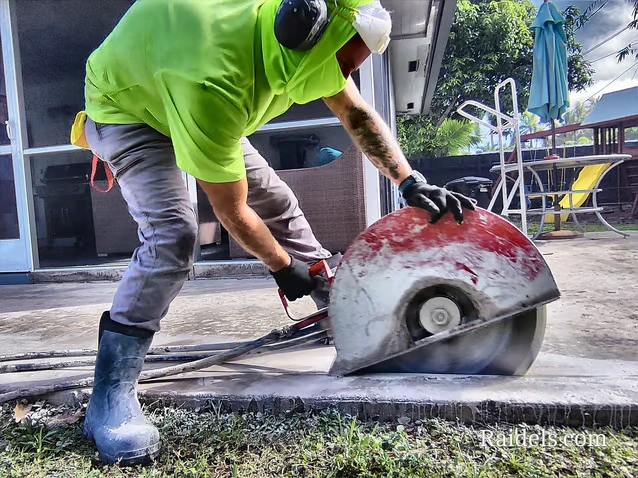
Even within these limits, the tools matter enormously. A standard rotary hammer is appropriate for small sections. Anything over 20 square feet of 4-inch slab calls for a walk-behind electric or gas-powered saw with a diamond blade rated for the aggregate hardness of your specific mix. If you are working in the Miami area and want to explore the technical side of DIY concrete cutting, understanding blade selection, depth-of-cut sequencing, and water supply requirements is mandatory reading before you start.
The Real Cost Comparison — Factoring in What DIY Estimates Always Miss
The most common justification for DIY demolition is cost savings. It is also the most commonly miscalculated variable in the entire project. Here is a realistic breakdown of what DIY concrete demolition actually costs when you account for every line item:
- Tool rental: A walk-behind concrete saw runs $150–$350 per day in Miami. Diamond blades for reinforced concrete cost $80–$250 each and may require replacement mid-job.
- Dump fees: Concrete debris disposal at a Miami-Dade transfer station runs approximately $65–$90 per ton. A 200 sq ft, 4-inch slab generates roughly 2.5 tons of debris.
- Labor time: Demolishing and removing that same 200 sq ft slab manually takes an experienced two-person crew 6–10 hours. Inexperienced crews routinely double that timeline.
- Utility locating services: A private utility locating service (beyond 811) runs $300–$800 and is often required for work near known underground infrastructure.
- Remediation costs if something goes wrong: A severed water main, a cracked footing, or a utility strike can add $5,000–$50,000 in repair costs instantly.
Professional demolition firms in Miami typically quote $2–$6 per square foot for straightforward slab removal, including cutting, breaking, hauling, and disposal. When you stack up all the DIY line items honestly, the gap narrows dramatically — and the professional option carries liability coverage that DIY work never does. For a detailed breakdown of how to manage demolition costs without blowing your budget, this resource on concrete removal in Kendall West walks through a real project scenario with actual numbers.
Cutting Method Selection — Why Technique Determines Risk Level
Professional demolition is not simply “doing the same thing but better.” It involves entirely different cutting technologies that are not available at equipment rental counters. Understanding these methods helps you evaluate what you are actually hiring when you bring in a specialist.
Diamond Blade Flat Sawing for Controlled Slab Removal
Flat sawing uses a walk-behind or ride-on saw with a diamond segmented blade to make precise, straight cuts to a controlled depth. This is the workhorse of slab demolition and is appropriate for most horizontal concrete removal. Professionals set blade depth incrementally — typically in 1-inch passes on reinforced concrete — to minimize blade deflection and prevent tendon strikes in post-tensioned systems.
Wire Saw Applications for Massive or Irregularly Shaped Sections
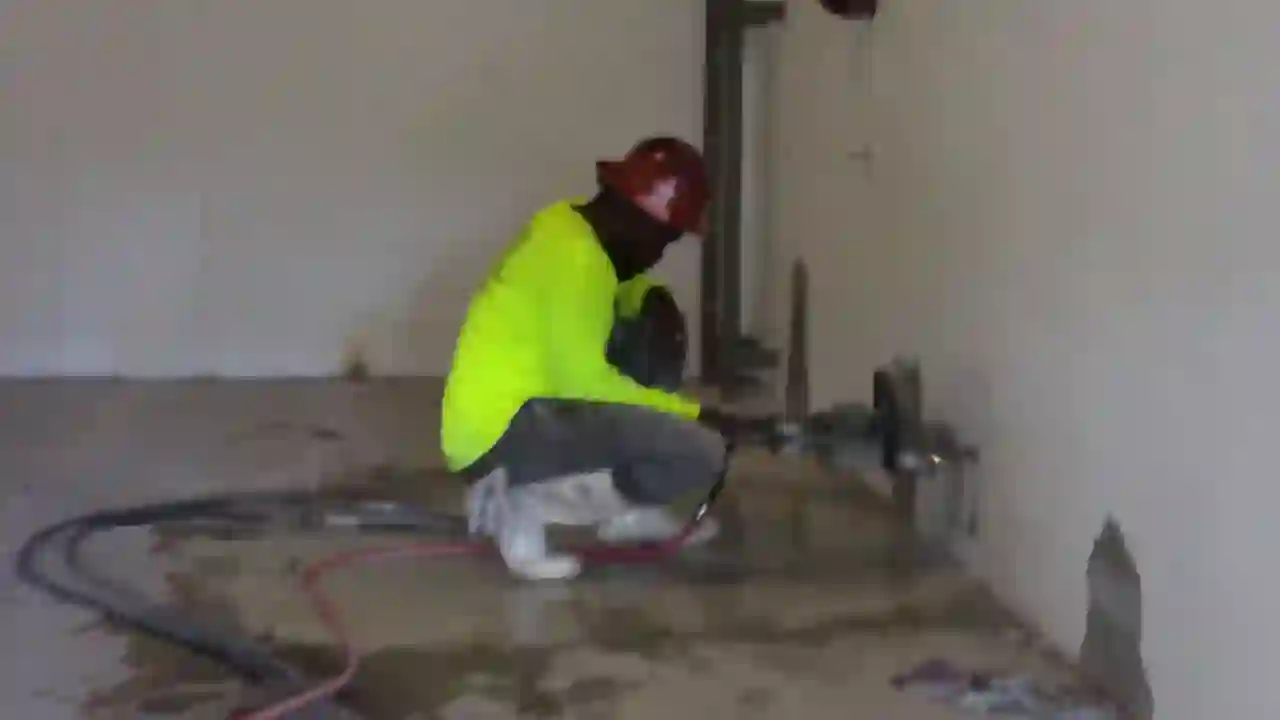
When sections are too large, too deep, or too geometrically complex for flat sawing, wire saws are the professional standard. A diamond-impregnated wire is looped around the concrete section and pulled at high speed using a hydraulic or electric drive unit. This method is especially common in bridge deck work, thick foundation walls, and marine structures. If you are dealing with a project that involves deep cuts or confined-space geometry, the wire saw category covers the technical parameters of this method in detail.
Hydraulic Breakers vs. Chemical Demolition Agents
Hydraulic breakers (mounted on excavators or used as handheld tools) are fast and effective for non-precision demolition but generate extreme vibration that can crack adjacent structures and damage underground utilities. Chemical demolition agents — expansive grout poured into pre-drilled holes — offer a silent, vibration-free alternative for sensitive environments. Professionals select between these methods based on proximity to existing structures, vibration tolerance thresholds, and access constraints.
Permitting, Liability, and the Legal Framework in Miami-Dade County
Miami-Dade County requires demolition permits for any structural concrete removal, any work affecting load-bearing elements, and any demolition within a certain distance of property lines or easements. DIY work performed without permits creates title problems, voids homeowner’s insurance coverage for related damage, and can result in stop-work orders that freeze your entire project.
Licensed concrete cutting and demolition contractors carry general liability insurance (typically $1M–$2M per occurrence) and workers’ compensation coverage. When you hire a licensed professional, that coverage protects you as the property owner if something goes wrong. DIY work leaves you personally exposed to every possible liability scenario.
For a deeper look at the safety standards and regulatory framework governing this type of work, the resources available through the industry education section provide ongoing technical guidance on compliance, best practices, and emerging demolition technologies in the South Florida market.
The Decision Framework — A Direct Set of Go/No-Go Criteria
Use this framework before committing to either path. If you answer “yes” to any item in the professional column, stop the DIY planning immediately.
- Go DIY if: Non-structural slab under 4 inches, no rebar confirmed, utilities cleared, proper PPE and dust controls available, debris disposal arranged, and total area under 150 sq ft.
- Go Professional if: Any post-tension suspicion, load-bearing element involvement, proximity to utilities, slab thickness over 6 inches, reinforcement present, permit required, or project is in a multi-family or commercial structure.
- Always go Professional if: You are unsure about any of the above. Uncertainty in concrete demolition is not a condition you manage with optimism — it is a condition you resolve with expertise.
The concrete under your project has been there for years, possibly decades. It is not going anywhere on its own schedule. Taking the time to assess it correctly, select the right method, and engage the right team is not overcaution — it is the technical standard that separates successful demolition projects from expensive disasters. Make the call based on the criteria, not the budget line alone, and your project will stay on track from the first cut to the final haul-out.