Why Control Joint Sawing Is the Line Item That Makes or Breaks a Flatwork Bid
Walk into any concrete estimating meeting in Miami and you’ll hear the same conversation — someone lowballed the joint sawing, the crew ran into green concrete, a blade set cost $400, and now the job is bleeding money. Control joint saws are not a secondary consideration on flatwork projects. They are a primary cost driver, a scheduling anchor, and a technical variable that separates experienced concrete contractors from the ones who are learning expensive lessons on your dime. Whether you’re cutting a warehouse slab in Doral, a parking deck in Brickell, or a municipal sidewalk replacement in Hialeah, understanding the true cost structure of control joint sawing is non-negotiable if you want your bid to hold up.
The Technical Function of a Control Joint Saw and Why Depth Precision Drives Cost
A control joint saw — sometimes called a crack control saw or contraction joint saw — creates a deliberate plane of weakness in a concrete slab so that when thermal shrinkage and drying shrinkage forces act on the slab, cracking occurs at the cut rather than randomly across the surface. The industry standard depth is one-quarter of the slab thickness. On a 6-inch slab, that means a 1.5-inch cut. On a 10-inch industrial slab, you’re cutting 2.5 inches. That difference in depth is not trivial — it directly affects blade selection, cutting speed, and ultimately, your cost per linear foot.
Early-entry dry-cut saws, conventional wet-cut walk-behind saws, and ride-on joint saws each perform differently depending on slab thickness, aggregate hardness, and the timing window available after pour. Miami’s climate introduces an additional variable — high ambient temperatures accelerate hydration, compressing the sawing window significantly compared to northern markets. A slab poured at 7 a.m. in August in Miami may reach the optimal cutting window by 11 a.m., leaving a very tight timeline before the concrete becomes hard enough to cause raveling or blade binding.
Early-Entry Saws vs. Conventional Wet Saws — Cost Implications per Linear Foot
Early-entry saws (such as the Soff-Cut series) use a skid plate system and a dry diamond blade to cut green concrete within 1 to 4 hours of finishing. These machines eliminate the need for water suppression systems on the slab surface, reduce raveling risk, and allow smaller crews to cover more square footage in a compressed window. However, the blades are proprietary, wear faster in hard aggregate mixes, and replacement costs run $150 to $300 per blade depending on the diameter and segment bond hardness.
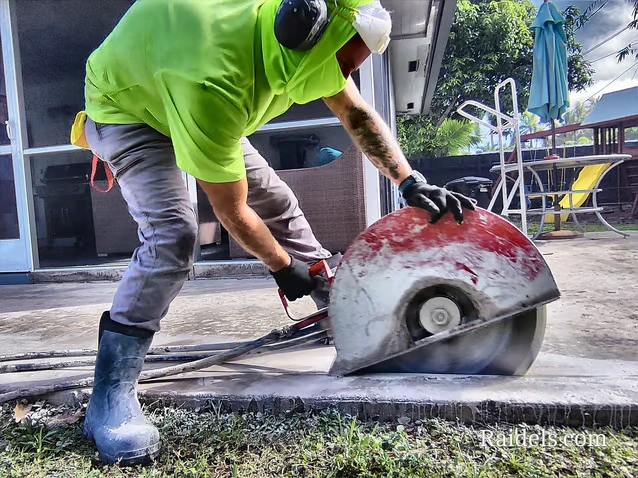
Conventional wet-cut walk-behind saws use 14-inch to 18-inch diamond blades with a continuous water feed for cooling and slurry control. These machines are slower per linear foot in the early cutting window but are significantly more cost-effective on thicker slabs where early-entry machines cannot achieve required depth. Blade costs for wet-cut saws range from $200 to $600 per blade, with lifespan varying from 300 to 1,200 linear feet depending on aggregate type, mix design, and operator technique.
For bidding purposes, a realistic cost range for control joint sawing in Miami falls between $0.45 and $1.20 per linear foot for standard residential and light commercial flatwork. Heavy industrial slabs with hard aggregate, tight joint spacing, or restricted access can push that figure to $1.80 to $2.50 per linear foot. These numbers must account for mobilization, blade consumption, water or slurry management, and labor at prevailing Miami rates.
Timeline Estimation for Control Joint Sawing on Miami Flatwork Projects
Scheduling control joint sawing is one of the most mismanaged aspects of concrete flatwork project management. The sawing window is not flexible — it is dictated by the concrete mix design, ambient temperature, wind speed, and solar radiation. In Miami’s subtropical climate, contractors routinely deal with accelerated set times that compress the available window to as little as 2 to 3 hours on hot, sunny days.
A standard walk-behind wet saw with an experienced operator will cut approximately 200 to 350 linear feet per hour under normal conditions. An early-entry saw on green concrete can achieve similar rates but requires the operator to work in close proximity to the finishing crew, creating coordination challenges on larger pours. For a 10,000-square-foot slab with joints on a 12-foot grid, you’re looking at roughly 1,700 linear feet of cutting. At 250 linear feet per hour, that’s nearly 7 hours of active sawing — which means on a large pour, you may need two saws running simultaneously to stay inside the window.
This is a critical bidding factor. Two-saw mobilization doubles your equipment cost for that day, increases your crew requirement, and adds slurry management complexity. Contractors who fail to model this correctly either miss the sawing window (resulting in random cracking and potential liability) or absorb unplanned costs that erode margin. Always calculate the linear footage of joints required, divide by your realistic production rate per saw, and determine whether the window demands a single-saw or multi-saw deployment before finalizing your price.
How Slab Thickness, Aggregate, and Mix Design Affect Your Bid Price
Not all concrete cuts the same. Miami projects frequently use local limestone aggregate, which is softer than the granite or traprock found in northern markets. Softer aggregate generally extends blade life but can cause undercutting and raveling if the saw speed is not calibrated correctly. Silica sand additions, fly ash substitutions, and high-early-strength admixtures all change the cutting behavior of the slab and must be accounted for in your blade selection and production rate assumptions.
Fiber-reinforced concrete — increasingly common in Miami warehouse and logistics facility construction — presents a specific challenge for control joint saws. Synthetic fibers can wrap around blade segments, increasing heat and reducing blade life by 20 to 40 percent compared to plain concrete of equivalent strength. When bidding fiber-reinforced flatwork, increase your blade consumption estimate accordingly and factor in additional downtime for blade inspection and replacement.
Rebar and wire mesh near the surface also affect sawing costs. While control joints are designed to be cut above the reinforcement plane, inconsistent cover or misplaced mesh can result in blade contact with steel, causing immediate blade damage. A single rebar strike can cost you a $400 blade. On reinforced slabs, always confirm cover depths with the structural drawings before finalizing your cutting depth and blade selection.
For deeper technical context on how cutting techniques vary across project types, the concrete cutting techniques resource library provides additional breakdowns that are directly applicable to joint sawing bid preparation.
Bidding Factors That Most Contractors Underestimate on Control Joint Saw Work
Beyond blade costs and labor, there are several line items that routinely get missed or underweighted in joint sawing bids. Slurry disposal is one of the most significant. Wet sawing generates a concrete slurry that cannot be discharged into storm drains under Miami-Dade environmental regulations. Slurry must be contained, allowed to dry, and disposed of as solid waste — or vacuumed up with a slurry management system. The cost of slurry containment and disposal on a large pour can reach $500 to $1,500 depending on slab size and proximity to drainage infrastructure.
Traffic control and access restrictions add another layer of cost on public-facing projects. Sawing in active parking lots, near roadways, or adjacent to occupied buildings requires signage, barriers, and sometimes flagging personnel. These costs are project-specific but should never be treated as negligible. On projects involving asphalt cutting and trenching alongside concrete work, the mobilization costs for joint sawing can often be offset by combining equipment deployments — a legitimate value-engineering opportunity worth presenting to clients during the bid phase.
Foundation preparation scopes that include slab-on-grade work will almost always require control joint sawing as part of the finished deliverable. Understanding how joint layout interacts with the structural design is essential — poorly placed joints that don’t align with column lines or load transfer points can create long-term serviceability issues. Contractors bidding foundation preparation projects should verify joint layout with the structural engineer of record before mobilizing, as field changes to joint patterns after the fact are expensive and disruptive.
When Sawing Fails and Crack Repair Becomes the Cost You Didn’t Bid
The worst financial outcome in control joint sawing is not a missed cut — it’s a missed window. When concrete cracks before the joints are cut, or when joints are cut too shallow to relieve stress effectively, random cracking propagates across the slab surface. Repairing those cracks is a separate, costly scope of work that falls outside the original contract in most cases, creating disputes and delays. Miami contractors dealing with crack repair after failed joint sawing operations face a very different set of technical and financial challenges — ones that are well-documented in the Miami concrete crack repair services overview.
The financial exposure from a failed sawing operation on a 20,000-square-foot commercial slab can easily reach $15,000 to $40,000 in crack repair costs, not counting the reputational damage or potential contract disputes. That risk profile makes proper sawing window management one of the highest-ROI activities on any flatwork project. Investing in an additional saw, an additional operator, or even delaying the pour start time to ensure a manageable sawing window is almost always cheaper than the alternative.
Building a Defensible Control Joint Saw Bid in Miami’s Market
A technically defensible bid for control joint sawing work in Miami should include explicit line items for mobilization, blade consumption (calculated against slab area, thickness, and aggregate type), labor hours with a realistic production rate assumption, slurry management, and a contingency for extended sawing windows driven by weather or pour delays. Equipment rental or ownership cost allocation should be transparent in your internal estimate even if it’s rolled into a unit price on the client-facing proposal.
Specifying the saw type in your proposal — early-entry vs. conventional wet-cut — also signals technical competence to sophisticated clients and general contractors. It demonstrates that you’ve thought through the timing constraints, not just the linear footage. In a competitive Miami market where concrete cutting work is frequently bid on price alone, that level of technical specificity can be the differentiator that wins you the job at a sustainable margin.
Control joint sawing is never just a line item. It is a time-critical, equipment-intensive, technically demanding operation that touches the long-term performance of every slab it serves. Price it accordingly, schedule it rigorously, and bid it with the technical depth it deserves.