The Real Reason DIY Concrete Removal Fails Before the First Swing
Most homeowners who attempt DIY concrete removal underestimate the job by about 400 percent. They price out a rental saw, watch a few videos, and assume the hard part is breaking the material. It isn’t. The hard part is everything that happens before, during, and after the break — the site logistics, the debris management, the equipment access, and the very real danger of working in spaces that were never designed for demolition activity. As a senior concrete consultant who has walked hundreds of residential and commercial sites across South Florida, I can tell you that confined space challenges and access limitations kill more DIY concrete removal attempts than dull blades ever will.
Understanding the Weight and Volume Math Before You Touch a Tool
Concrete weighs approximately 150 pounds per cubic foot. A standard 4-inch residential slab covering a 10-by-10-foot area contains roughly 50 cubic feet of material — that’s 7,500 pounds of debris before you’ve accounted for any aggregate, wire mesh, or rebar embedded in the pour. When you break that slab into manageable chunks, you’re not reducing the weight; you’re multiplying the handling problem. Now instead of one continuous surface, you have dozens of jagged, irregular pieces that must be manually loaded, carted, and dumped into a container that itself requires vehicle access to your site.
This is where the logistics cascade begins. A standard roll-off dumpster needs a clear overhead clearance of at least 22 feet and a driveway or pad capable of supporting 60,000-plus pounds of gross vehicle weight. Many Miami residential properties — particularly older lots in Coral Gables, Little Havana, and Coconut Grove — have mature tree canopies, narrow side yards, and decorative pavers that make dumpster placement a negotiation rather than a placement. If the container can’t reach the demolition zone, every pound of broken concrete gets wheelbarrowed by hand. That changes your labor equation dramatically.
Confined Space Demolition Inside Garages, Utility Rooms, and Crawl Spaces
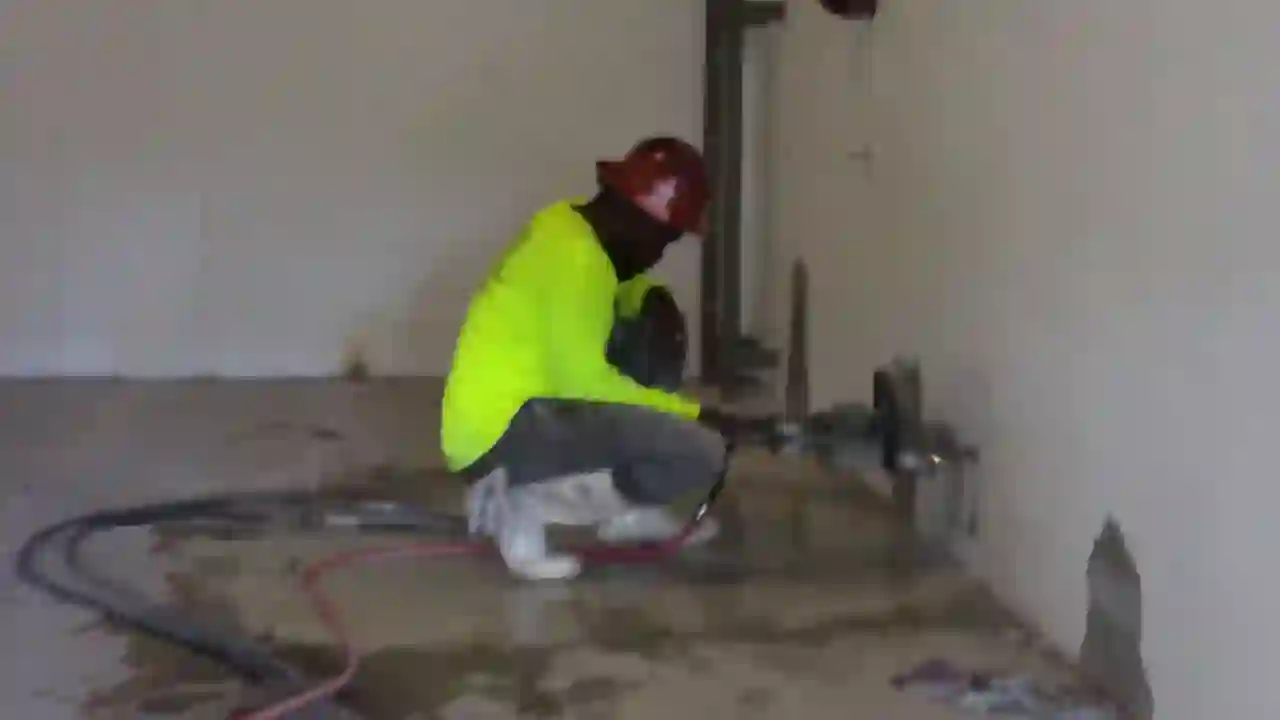
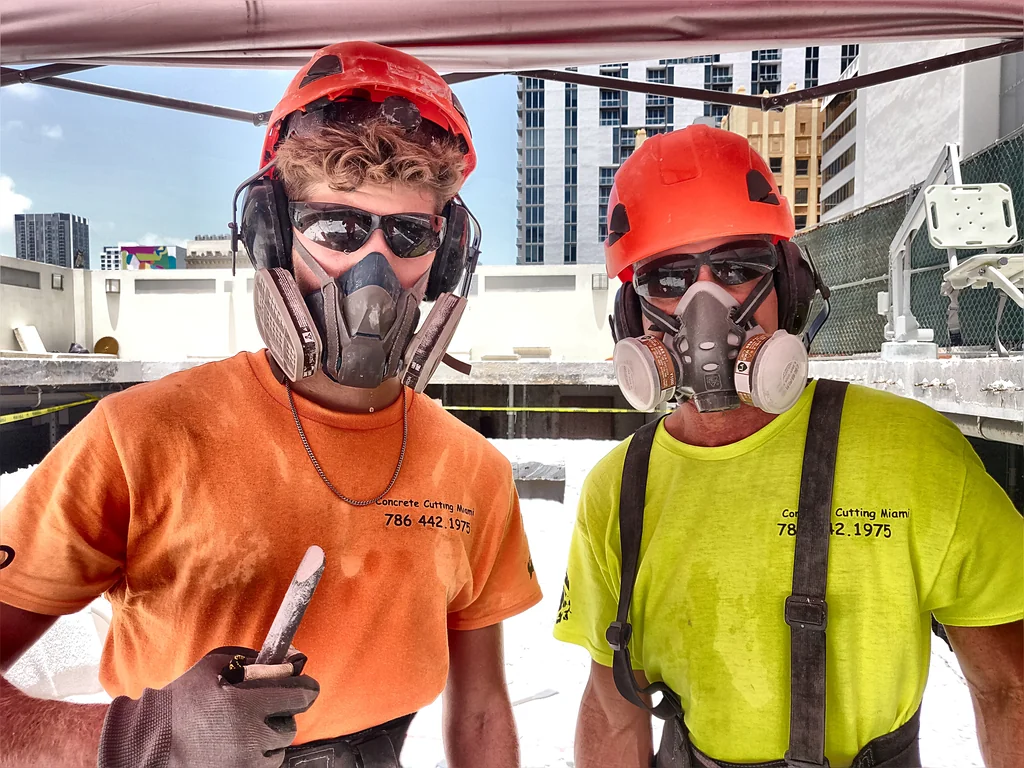
Interior concrete removal is an entirely different discipline from open-air slab work. When the target slab sits inside a garage, mechanical room, basement utility area, or under a staircase, you are operating in a confined or semi-confined space. The hazards multiply immediately. Silica dust — already a serious concrete saw hazard in open environments — becomes acutely dangerous when ventilation is limited. OSHA’s permissible exposure limit for respirable crystalline silica is 50 micrograms per cubic meter averaged over an 8-hour shift. In a closed garage with a walk-behind saw running dry, you can exceed that threshold in under three minutes.
Beyond air quality, confined spaces restrict your swing radius, your tool positioning, and your egress. A standard electric demolition hammer requires about 18 inches of vertical clearance above the work surface for a full stroke. Drop ceilings, overhead plumbing, HVAC ducts, and low-hanging electrical conduit routinely cut that clearance to 10 or 12 inches, forcing operators into awkward postures that increase fatigue, reduce control, and elevate the risk of tool deflection injuries.
Ventilation Staging for Interior Concrete Cutting Operations
Professional crews handling interior concrete removal establish a ventilation protocol before any cutting begins. This typically involves a negative-pressure exhaust fan positioned at the primary egress point, drawing contaminated air out of the work zone rather than pushing fresh air in. A secondary supply fan at an opposing opening creates a cross-draft that keeps respirable particulate moving toward the exhaust. DIY operators almost never implement this setup because the equipment — industrial-grade HEPA-filtered fans with appropriate CFM ratings — isn’t available at a standard tool rental counter.
Wet cutting is the other mitigation strategy, and it introduces its own site logistics problem. Water slurry from diamond cutting operations must be contained, collected, and disposed of properly. Concrete slurry is highly alkaline (pH 11–13) and cannot be discharged into storm drains under EPA and Miami-Dade stormwater regulations. In a confined interior space, managing slurry runoff while maintaining safe footing is a genuine operational challenge that requires planning, containment berms, and a wet-vac extraction system running simultaneously with the saw.
Equipment Access Limitations That Determine Your Entire Removal Strategy
The equipment you can physically get to the work area dictates everything about how the job gets done. This is not a minor consideration — it is the foundational constraint around which every other decision is built. A walk-behind flat saw with a 14-inch blade weighs between 200 and 350 pounds depending on the model. Getting that machine through a 32-inch interior door, down a half-flight of stairs, or across a soft landscaped yard without damaging the surrounding structure requires rigging knowledge that most homeowners don’t have.
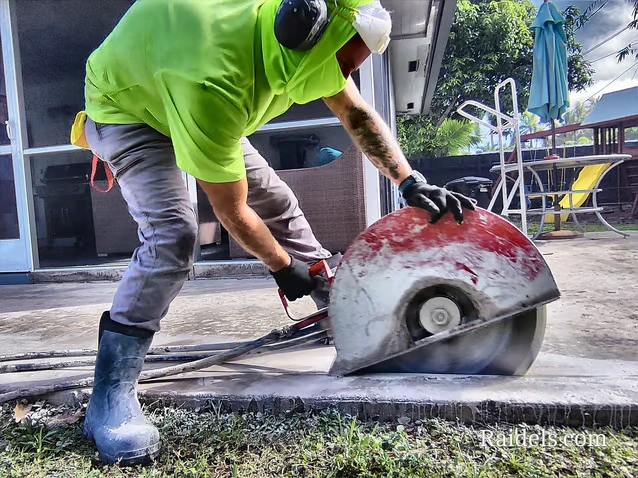
Handheld con saws offer more maneuverability in tight spaces, and they’re capable of impressive cuts when operated correctly — including, in some configurations, cutting through embedded steel, as detailed in this breakdown of con saw steel cutting technique. But handheld operation in confined spaces demands two-handed grip stability, proper blade guard positioning, and a clear understanding of kickback dynamics. The diamond blade safety protocols for handheld saws in restricted environments are significantly more demanding than open-air operation because there’s no room to react to a blade bind or tool rotation event.
Navigating Rebar, Post-Tension Cables, and Embedded Conduit During Removal
Older Miami construction — particularly slabs poured before 1985 — frequently contains embedded electrical conduit, copper water lines, and in some cases, post-tension cables that are still under load. Cutting into an active post-tension cable without proper survey and depressurization is a life-safety event. The cable will release stored energy instantaneously, with enough force to cause fatal injuries and structural collapse of the supported section. GPR (ground-penetrating radar) scanning before any saw work is non-negotiable on post-tension slabs, and rental GPR units require trained operators to interpret the results accurately.
Even standard reinforced slabs present debris complications that affect site logistics. Rebar cut during demolition produces sharp, irregular steel fragments mixed into the concrete rubble. This material cannot be indiscriminately dumped into a standard C&D dumpster in Miami-Dade County — mixed concrete and metal debris has specific disposal requirements, and some facilities charge premium tipping fees or refuse loads that aren’t properly segregated. Professional crews sort and separate on-site. DIY operators typically discover this at the dump gate.
The Debris Removal Bottleneck That Stalls Every Amateur Job
Here is the sequence that plays out on nearly every failed DIY concrete removal attempt: The homeowner breaks the slab successfully on day one. By midday, the broken material fills the work zone and there is nowhere to stand. The wheelbarrow path to the dumpster is blocked by debris. The dumpster is already half-full from the first few loads. Work stops. The site sits open for days or weeks while logistics get sorted. Rain events saturate the exposed subgrade. The project cost climbs as rental equipment accrues daily charges.
Professional concrete removal crews size their debris handling capacity to match their production rate before the job starts. For a 500-square-foot interior slab removal, that typically means pre-positioning two roll-off containers, staging a dedicated debris runner with a heavy-duty wheelbarrow and ramp system, and scheduling a mid-job container swap if the volume warrants it. The cutting crew never stops because the hauling crew never falls behind. That coordination is a logistics discipline, not an accident.
Dust Suppression and Neighbor Notification Obligations Under Miami-Dade Ordinances
Miami-Dade County Code Chapter 24 and the Florida Building Code both impose dust suppression obligations on demolition activities, including residential concrete removal. Visible dust migration beyond the property line can trigger stop-work orders and fines. In dense urban neighborhoods — Wynwood, Little Haiti, Brickell residential — this is an active enforcement concern. Professional crews use water misting systems, perimeter dust screens, and wet-cutting protocols to maintain compliance. DIY operators running dry cuts in a backyard with no suppression equipment are technically in violation from the first pass of the blade.
When the Site Tells You to Call a Professional Instead
There are site conditions that categorically disqualify DIY concrete removal as a viable approach, regardless of the operator’s skill level or motivation. Post-tension slabs are one. Any slab adjacent to a load-bearing wall or structural footing is another. Interior spaces under 200 square feet with limited egress points, slabs over 6 inches thick, any removal requiring saw depths greater than 4 inches in a single pass, and any site where equipment access requires crossing a neighboring property — all of these conditions move the job into professional territory.
The economics matter too. When you add up tool rental, disposal fees, PPE, dust suppression equipment, and the labor hours required to move debris from a confined space manually, the gap between DIY cost and professional cost narrows considerably. What you cannot price into that calculation is the liability exposure from a silica overexposure event, a post-tension cable strike, or a structural failure caused by removing a slab that was doing more work than it appeared to be doing.
DIY concrete removal is achievable under the right conditions — an accessible outdoor slab, no embedded tension systems, clear debris egress, and a realistic understanding of the physical demands involved. But the moment site logistics get complicated, confined spaces enter the picture, or access limitations force improvised solutions, the job has outgrown the DIY category. Recognizing that boundary before you start is the most technically sound decision you can make.