The Real Complexity Behind Fort Lauderdale Concrete Fence Cutting Jobs
When most property owners or general contractors call about a Fort Lauderdale concrete fence project, they’re thinking about the wall itself — how thick it is, how long the run is, whether it’s precast panel or poured-in-place. What they’re rarely thinking about is everything surrounding that wall. And in Fort Lauderdale’s dense urban grid, tight residential corridors, and waterfront parcels with zero setback, that surrounding environment is exactly what determines whether a job runs clean or turns into a logistical nightmare. As a senior concrete consultant who has managed hundreds of fence and barrier demolition projects across South Florida, I can tell you plainly: the concrete is almost never the hard part. The site is.
Why Fort Lauderdale Parcels Create Unique Access Constraints
Fort Lauderdale’s zoning and parcel layout is fundamentally different from Miami-Dade’s. You’re dealing with a city that developed heavily in the mid-20th century with narrow lot widths, canal-adjacent properties, and HOA-governed communities where equipment access is tightly restricted. A standard concrete fence along a property line in a Wilton Manors or Victoria Park neighborhood may back directly against a canal easement on one side and a zero-lot-line structure on the other. That eliminates the standard approach of positioning a wall saw or hydraulic splitter with lateral clearance.
The practical result is that crews must pre-engineer their access strategy before a single blade touches concrete. This means conducting a full site survey that documents:
- Overhead clearance — power lines, tree canopy, and roof overhangs that restrict boom or crane swing
- Ground surface load ratings — pavers, pool decks, and soft fill that cannot support tracked equipment without ground protection matting
- Gate and entry dimensions — many Fort Lauderdale residential properties have single-access gates as narrow as 36 inches, making it impossible to bring in standard-width concrete saws
- Utility corridors — buried irrigation, low-voltage landscape wiring, and FPL easements that run parallel to fence footings
- Neighbor and HOA notification requirements — some communities mandate 72-hour notice before any mechanical demolition begins
Missing any one of these during pre-planning doesn’t just slow the job — it can result in equipment damage, utility strikes, or a complete work stoppage. For a deeper look at how demolition logistics are handled across South Florida, see our archive of Miami demolition project case studies.
Confined Space Cutting Protocols for Fence Footing Removal
The above-grade wall section of a concrete fence is straightforward to cut. The footing is where confined space dynamics come into play. Fort Lauderdale concrete fences — particularly older masonry block walls and precast concrete panel fences — are typically set on continuous footings that run 18 to 36 inches below grade. When a footing must be fully removed rather than abandoned in place, crews are working in an excavated trench that qualifies as a confined space under OSHA 29 CFR 1926.651 standards.
A trench that is 4 feet deep and less than 4 feet wide — which is standard for fence footing removal — requires:
- Competent person designation and continuous atmospheric monitoring for oxygen deficiency and combustible gases
- Sloping, shoring, or trench box installation depending on soil classification (Fort Lauderdale’s sandy, water-table-influenced soils often require Type C classification)
- Means of egress within 25 lateral feet of any worker in the trench
- Spoil pile placement at minimum 2 feet from the trench edge
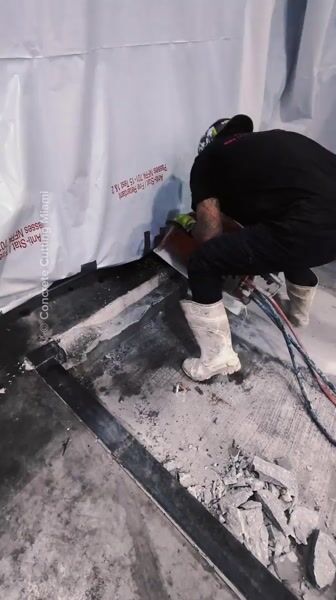
In tight urban lots, meeting these requirements while simultaneously operating a core drill or hydraulic breaker inside the trench requires choreography between the equipment operator, the confined space attendant, and the competent person. There is no room for improvisation. Every crew member’s role must be pre-assigned before excavation begins. Proper PPE selection and deployment is non-negotiable in these environments — respirators, hard hats with chin straps, cut-resistant gloves, and steel-toed boots with metatarsal guards are baseline.
Blade and Equipment Selection When Lateral Clearance Is Under 18 Inches
Standard wall saws require a minimum of 24 to 30 inches of clearance on the non-cutting face to accommodate the drive motor and rail system. When a Fort Lauderdale concrete fence sits within 12 inches of a neighboring structure, that option disappears entirely. This is where the equipment selection conversation becomes genuinely technical.
The primary alternatives in confined access scenarios are:
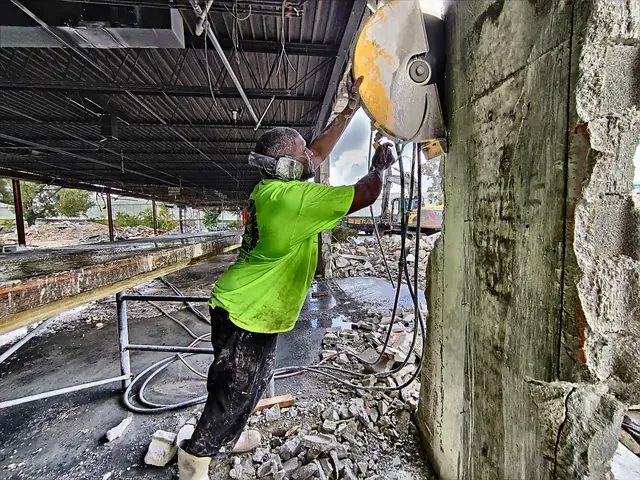
- Diamond chain saws — These tools cut with a bar-and-chain configuration similar in geometry to a chainsaw but using segmented diamond links. They can operate in clearances as tight as 6 inches on the back face and are particularly effective on reinforced masonry block fences up to 12 inches thick.
- Handheld ring saws — Offering a cutting depth of up to 10 inches on a single pass, ring saws are the go-to for segmenting precast concrete fence panels into liftable sections when overhead clearance prohibits a wall saw rail mount.
- Hydraulic bursting — For unreinforced or lightly reinforced footings, hydraulic bursting cylinders inserted into pre-drilled holes can fracture the footing without any swing clearance requirement. This method generates zero silica dust airborne, which is a significant advantage in occupied residential settings.
- Wire saw systems — In extreme access limitation scenarios where no other tool can reach, a diamond wire threaded through core-drilled pilot holes can cut any geometry. Setup time is higher, but wire saw cutting is the only method that is truly geometry-agnostic.
Equipment selection also has direct cost implications. Understanding how tool choice drives project pricing is critical — our cost control resource library breaks down how these decisions affect your bottom line on fence and barrier projects.
Slurry Management and Water Reclamation in Zero-Drainage Environments
Diamond blade cutting of concrete is a wet process. Water suppresses silica dust, cools the blade, and extends segment life. On a standard open job site, slurry runoff is managed with berms and a vacuum slurry system. On a confined Fort Lauderdale residential lot — particularly one adjacent to a canal or storm drain — uncontrolled slurry discharge is an environmental violation under Florida DEP regulations and Broward County stormwater ordinances.
Proper slurry management in these settings requires a closed-loop recirculation system or, at minimum, a portable slurry dam and wet-vac recovery setup. The slurry — a mixture of water, fine concrete particulate, and silica — must be collected, allowed to settle, and disposed of as solid waste. It cannot be discharged into landscaping, storm drains, or canal easements. On narrow Fort Lauderdale lots where there is literally no flat ground to position a settling tank, crews must get creative with portable containment trays and staged vacuum recovery.
This is also where core drilling cost variables become relevant — slurry management infrastructure adds time and labor that must be factored into any accurate project estimate for confined site work.
Coordinating Debris Removal When Heavy Equipment Cannot Enter the Site
Once a concrete fence section is cut into manageable pieces, those pieces still have to leave the property. A standard 8-inch-thick precast concrete fence panel running 6 feet tall and 8 feet wide weighs approximately 1,400 pounds. Getting that piece from the backyard of a Fort Lauderdale property with a 36-inch gate to a roll-off container on the street requires either:
- Further segmentation into hand-carry pieces (under 80 lbs each) using a combination of ring saw and hydraulic splitter
- A mini-skid steer with a grapple attachment, assuming the gate is at least 36 inches and the ground surface can support the machine
- A crane or picker truck positioned on the street with a long-reach boom, if overhead and setback clearances permit
In many Fort Lauderdale scenarios, the answer is all three methods used in sequence across different sections of the same job. Pre-planning the debris flow — where pieces land after cutting, how they’re staged, and in what order they exit — is as important as the cutting plan itself. A crew that cuts fast but has no debris egress plan will stack themselves into a corner, literally.

Permit and Right-of-Way Considerations Specific to Broward County Fence Work
Fort Lauderdale sits within Broward County’s jurisdiction, and fence demolition or modification that involves any work within the right-of-way — including sidewalk-adjacent concrete fences common in older neighborhoods — requires a Broward County right-of-way permit in addition to a City of Fort Lauderdale demolition permit. The permit process can add 5 to 15 business days to project timelines and may require a traffic control plan if equipment must be staged in or adjacent to the roadway.
For commercial properties along Federal Highway, Sunrise Boulevard, or Oakland Park Boulevard, lane closure permits and MOT (Maintenance of Traffic) plans are often required even for what appears to be a simple fence removal. Failing to pull these permits doesn’t just risk a stop-work order — it can void your general liability coverage if an incident occurs during unpermitted work.
The operational lesson here is that Fort Lauderdale concrete fence projects should never be scoped purely based on the wall dimensions. Every project begins with a logistics assessment: access, utilities, confined space classification, slurry management, debris egress, and permit requirements. Get those right, and the cutting itself is the easy part. Skip them, and you’re looking at cost overruns, regulatory exposure, and delays that no client wants to explain to their HOA or building department.
Working with a contractor who brings that pre-planning discipline to every Fort Lauderdale concrete fence project isn’t a luxury — it’s the difference between a job that finishes on schedule and one that becomes a case study in what not to do.