What Makes Palmetto Bay Concrete Removal Harder Than Most Crews Expect
Palmetto Bay is one of Miami-Dade County’s most desirable residential villages — mature tree canopy, wide lots, and well-established neighborhoods. But that same character that makes it attractive to homeowners creates a genuine operational headache for concrete removal crews. The moment you pull up to a Palmetto Bay job site, you’re already sizing up constraints that don’t exist on a clean commercial slab in an industrial corridor. Mature ficus hedges flanking a six-foot gate opening, a 60-foot oak with a root system that owns half the driveway, a rear patio that’s only accessible by threading a machine between a pool cage and a CBS wall — this is the baseline here, not the exception. Understanding these site dynamics before the first saw blade spins is what separates a smooth project from a costly, neighbor-involving disaster.
Pre-Mobilization Site Assessment Protocol for Confined Residential Lots
Before any equipment is dispatched to a Palmetto Bay address, a thorough pre-mobilization site assessment is non-negotiable. This isn’t a walkthrough — it’s a structured evaluation that covers equipment ingress and egress paths, overhead clearance for boom lifts or crane-assisted slab removal, underground utility mapping, and load-bearing capacity of any surfaces the equipment will traverse to reach the work zone.
In Palmetto Bay specifically, the pre-assessment must account for the village’s strict noise ordinance windows, which directly affect scheduling and the selection of hydraulic versus pneumatic breaking equipment. It also needs to flag any protected tree canopy within the work zone footprint. Miami-Dade’s urban forestry regulations can prohibit equipment staging within the drip line of protected specimens, which often forces crews to reconfigure their entire haul-out path.
- Gate and opening measurements: Document every access point in inches, not feet — a difference of four inches can determine whether a mini-excavator with a hydraulic breaker attachment can enter at all.
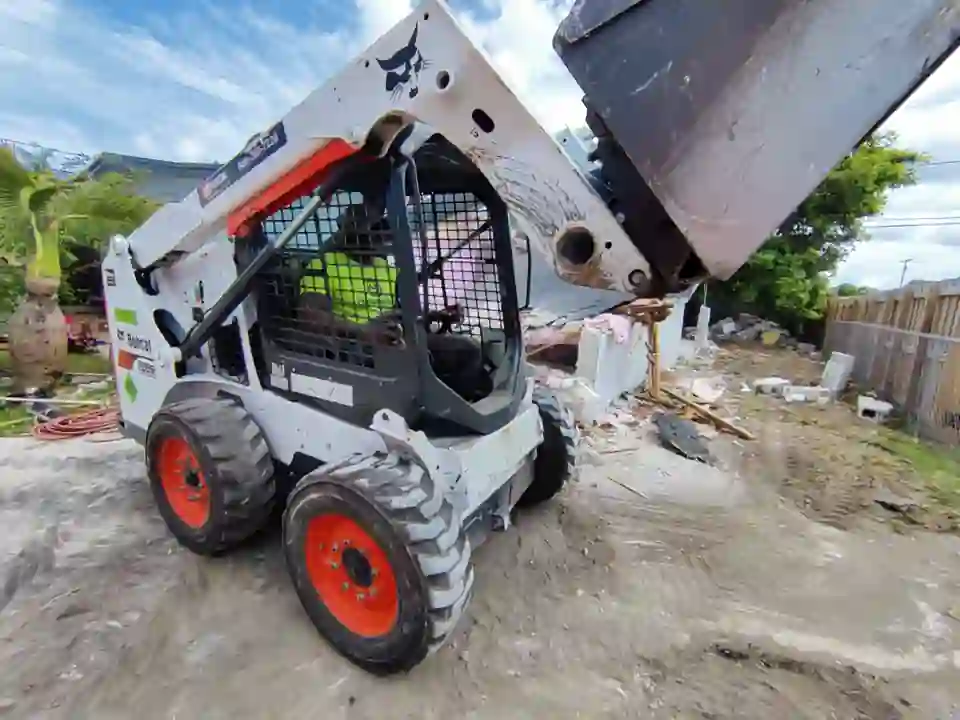
- Surface load capacity: Many Palmetto Bay properties have decorative paver driveways over shallow sand beds. A loaded dump trailer or skid steer can cause significant surface damage if load distribution isn’t calculated in advance.
- Overhead obstructions: Power service drops, mature tree canopy, and pool screen enclosures all create vertical constraints that affect equipment selection.
- Utility locates: Florida 811 calls are mandatory, but in older Palmetto Bay neighborhoods, private irrigation, landscape lighting, and pool plumbing lines are often unmapped and run directly under slabs slated for removal.
Equipment Selection When Access Is the Primary Constraint
The standard toolkit for concrete removal — a large hydraulic excavator, a full-size skid steer, and a 10-wheel dump truck staged at the curb — simply doesn’t work in most Palmetto Bay rear-yard scenarios. Equipment selection here is driven almost entirely by the tightest constraint on the access path, and that constraint is often a 48-inch gate opening or a 90-degree turn through a side yard that’s 36 inches wide at the narrowest point.
In these conditions, the primary breaking and removal machine is typically a rubber-tracked mini-excavator in the 1.7-to-3.5-ton class, fitted with a hydraulic breaker rated between 400 and 700 foot-pounds of impact energy. This combination can handle standard 4-inch residential slabs, pool decks, and driveway aprons without requiring the access clearances of larger iron. For slabs with post-tension cables or thicker structural sections, the breaking sequence must be carefully planned to avoid cable snapback — a serious safety hazard in confined spaces where there’s no safe retreat distance.
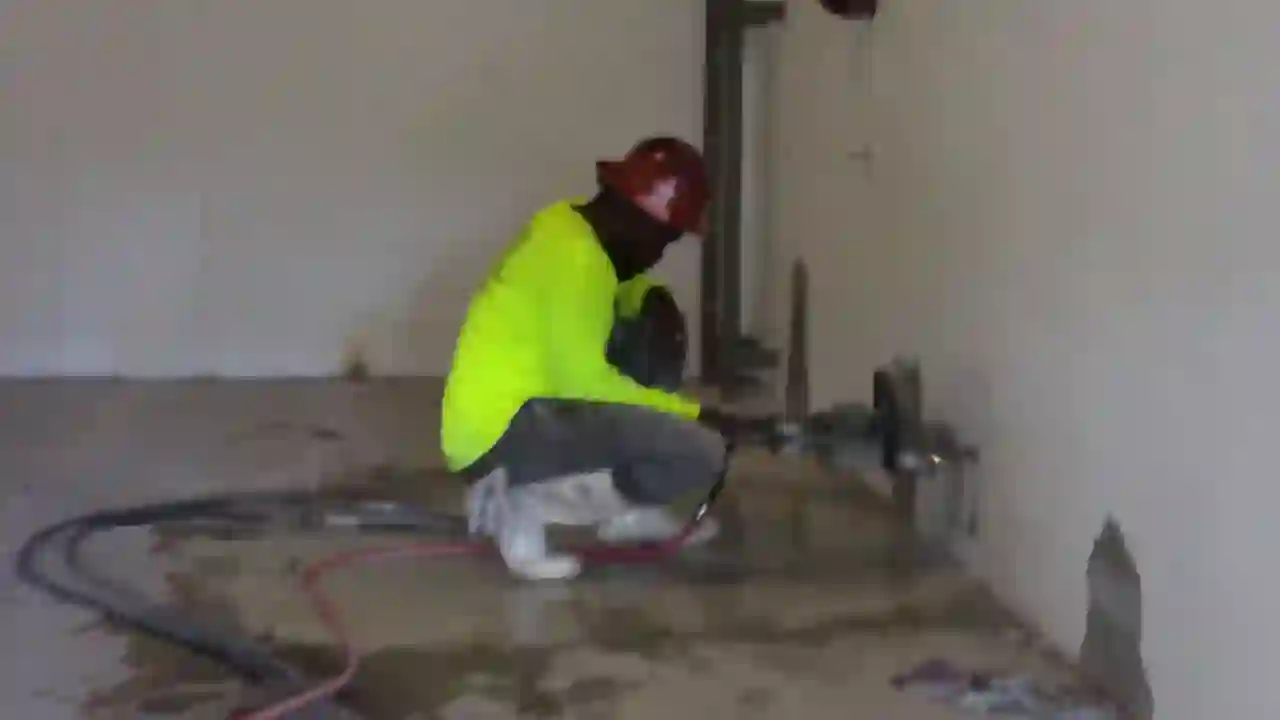
When even a mini-excavator can’t access the work zone, the fallback is manual demolition using electric rotary hammer drills, electric chipping hammers, and purpose-built concrete splitters. This approach is slower and more labor-intensive, but it’s the only viable method in truly confined spaces. It also aligns with the kind of low-vibration, low-noise methodology that Palmetto Bay’s noise ordinance effectively mandates during restricted hours. For projects where precision cutting is required before breaking, core drilling services are often integrated into the demolition sequence to relieve stress concentrations and allow controlled slab segmentation.
Debris Haul-Out Logistics When There Is No Straight Line to the Street
Getting broken concrete out of a confined rear yard is frequently the most time-consuming phase of a Palmetto Bay removal project. A standard 4-inch concrete slab weighs approximately 50 pounds per square foot. A 500-square-foot rear patio generates roughly 25,000 pounds of broken material — over 12 tons — that has to move from the work zone to a waiting container or truck, often through a path that can’t accommodate any wheeled equipment larger than a walk-behind concrete buggy.
For these haul-out scenarios, the most efficient method is a relay system using rubber-tracked mini-loaders or electric concrete buggies staged at intermediate points along the access path. The broken material is loaded into the buggy at the work face, transported to a staging area at the gate, then transferred to a skid steer or mini-excavator bucket for final loading into a roll-off container positioned at the street. This relay approach adds labor cost but eliminates the risk of surface damage from overloaded equipment and keeps the operation moving at a predictable pace.
Roll-off container placement in Palmetto Bay also requires attention to the village’s right-of-way regulations. In many cases, containers cannot be placed on the street without a permit, which means the driveway itself becomes the staging area — further complicating equipment flow. Projects that involve significant concrete volume often benefit from a phased haul-out approach, where the container is swapped out in stages rather than waiting for a single full load. This mirrors the kind of adaptive logistics planning discussed in depth when examining how site logistics vary dramatically by geography and municipality.
Confined Space Hazards Specific to Slab and Foundation Removal
When concrete removal work occurs in partially enclosed spaces — under elevated structures, within pool equipment rooms, beneath cantilevered decks, or inside enclosed garages — confined space protocols must be formally implemented. In Palmetto Bay, this scenario comes up regularly when homeowners need slab removal beneath an existing covered lanai or within a screened enclosure that can’t be disassembled before work begins.
The primary hazards in these environments are silica dust accumulation, carbon monoxide from gasoline-powered equipment, and limited egress in the event of a structural shift during breaking operations. OSHA’s silica standard (29 CFR 1926.1153) mandates engineering controls — wet methods, vacuum shrouds, or HEPA-filtered local exhaust ventilation — for any concrete breaking or grinding that generates respirable crystalline silica dust. In a confined space, these controls are not optional enhancements; they’re the difference between a compliant operation and a serious health exposure event.
For this reason, all gasoline-powered equipment is prohibited in enclosed or semi-enclosed work zones on our Palmetto Bay projects. Battery-electric and hydraulic-powered tools are the standard in these environments. Dust suppression via continuous water misting is implemented at the point of cut or break, and air monitoring is conducted when work continues for more than two consecutive hours in a space with limited natural ventilation. These practices also align with broader environmental compliance standards that govern concrete demolition across Miami-Dade County.
Structural Considerations When Removing Slabs Adjacent to Pool Shells and Footings
A significant percentage of Palmetto Bay concrete removal projects involve pool deck removal, either as a standalone scope or as part of a full outdoor living renovation. The technical challenge here is that pool decks are typically constructed in close proximity to the pool shell’s bond beam, and the bond beam itself is often the structural anchor for the coping and tile system. Aggressive breaking too close to the bond beam can fracture the coping, crack the tile, or — in worst cases — induce a stress crack in the shell itself.
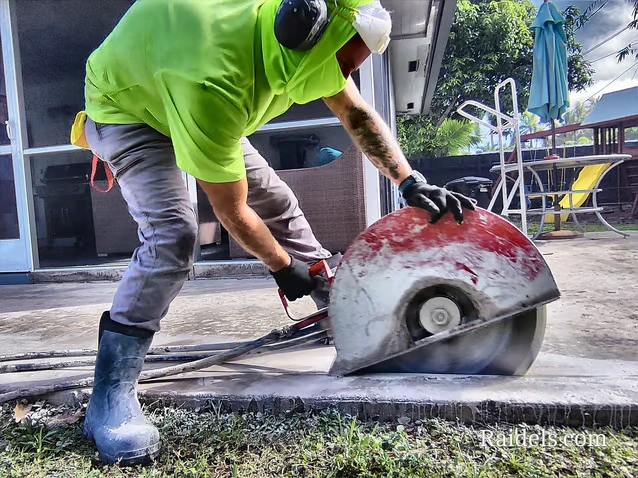
The correct approach is to establish a controlled cut line using a walk-behind flat saw or a hand-held angle grinder with a diamond blade, set at a depth that severs the slab without penetrating into the bond beam zone. This cut creates a clean separation between the deck slab and the pool structure, allowing the deck to be broken and removed without transmitting impact energy into the shell. The same principle applies when removing concrete adjacent to CBS foundation walls, where uncontrolled breaking can dislodge mortar joints or crack block cells. The technical complexity of these adjacency conditions is part of what makes projects like these comparable to the demanding removal work seen in other Miami-Dade coastal communities.
Scheduling, Neighbor Coordination, and Village Permit Requirements
Palmetto Bay’s municipal code requires permits for concrete removal that involves structural elements, and the village’s building department has specific submittal requirements for demolition scopes that affect drainage patterns or impervious surface calculations. Projects that remove a significant area of impervious concrete may trigger a stormwater review, particularly in neighborhoods where the village has implemented post-construction drainage standards.
Neighbor coordination is not a courtesy in Palmetto Bay — it’s a practical necessity. Concrete breaking generates impact noise and vibration that travels through the ground and into adjacent structures. In neighborhoods where homes are built on continuous slab foundations at close setbacks, a neighbor’s complaint to code enforcement can halt a project mid-scope. Pre-project notification letters, delivered at least 48 hours before mobilization, document good-faith outreach and establish a communication channel for any concerns that arise during operations.
Work windows in the village are typically restricted to weekday daylight hours, with no work permitted on Sundays. This means project scheduling must be tight, with clear daily production targets based on the equipment and crew configuration deployed. A 600-square-foot rear patio removal in a confined access scenario should be budgeted at two full working days minimum — one day for breaking and segmentation, one day for haul-out and site restoration — with a contingency day built in for unforeseen utility conflicts or equipment access complications.
Palmetto Bay concrete removal done right is a methodical, logistics-first operation. Every constraint on site — the gate width, the tree canopy, the pool shell adjacency, the noise ordinance, the permit requirement — has a technical solution. The difference between a project that runs clean and one that turns into a neighbor dispute and a code enforcement visit is the quality of the pre-mobilization planning and the discipline of the crew executing it.