Why Getting Rid of an Inground Pool Is a Concrete Demolition Job First and a Landscaping Job Second
Most homeowners who want to get rid of an inground pool start by calling a landscaping company or a general contractor. That’s the wrong first call. The dominant cost driver on any pool removal project is concrete demolition — specifically, how you cut, break, and extract a reinforced concrete shell that was engineered to resist hydrostatic pressure for decades. Before you price mulch or sod, you need to understand what’s happening underground. A standard residential inground pool in the Miami-Dade and Broward corridor contains anywhere from 4 to 8 inches of gunite or shotcrete shell, steel rebar on 6- to 12-inch centers, a plumbing grid that penetrates the shell in multiple locations, and a deck slab that may be structurally tied to the pool bond beam. Every one of those elements affects your bid price, your equipment selection, and your project timeline.
Full Removal Versus Partial Abandonment — The Cost Fork That Changes Everything
The first bidding decision that separates a $4,000 job from a $18,000 job is the removal method. Miami-Dade County and most municipalities in Broward permit two approaches: full structural removal and partial abandonment (sometimes called a “pool fill-in”). Understanding the concrete scope of each method is essential before you accept any contractor’s number.
Full Structural Removal — Scope and Pricing Breakdown
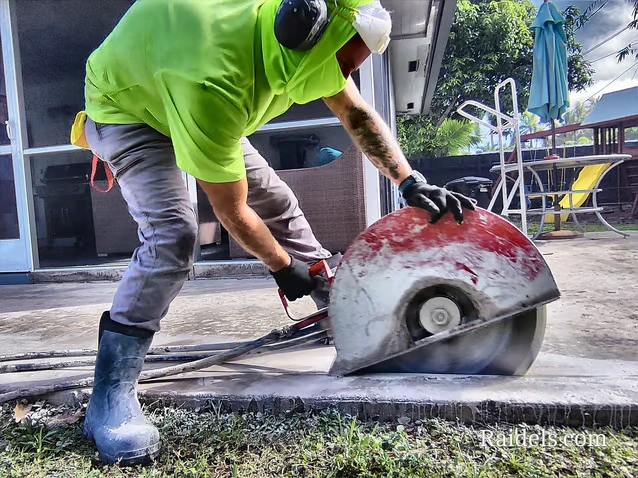
Full removal means the entire shell, deck, plumbing, and bond beam are excavated and hauled off-site. On a 400-square-foot pool with a 4-foot average depth, you’re looking at roughly 12 to 18 cubic yards of reinforced concrete debris, depending on shell thickness. Flat sawing or slab sawing the deck perimeter is typically the first cut operation — this severs the deck from the bond beam cleanly and allows equipment access without cracking adjacent hardscape. For accurate cost context on that specific operation, review our slab sawing services resource before you finalize your scope of work.
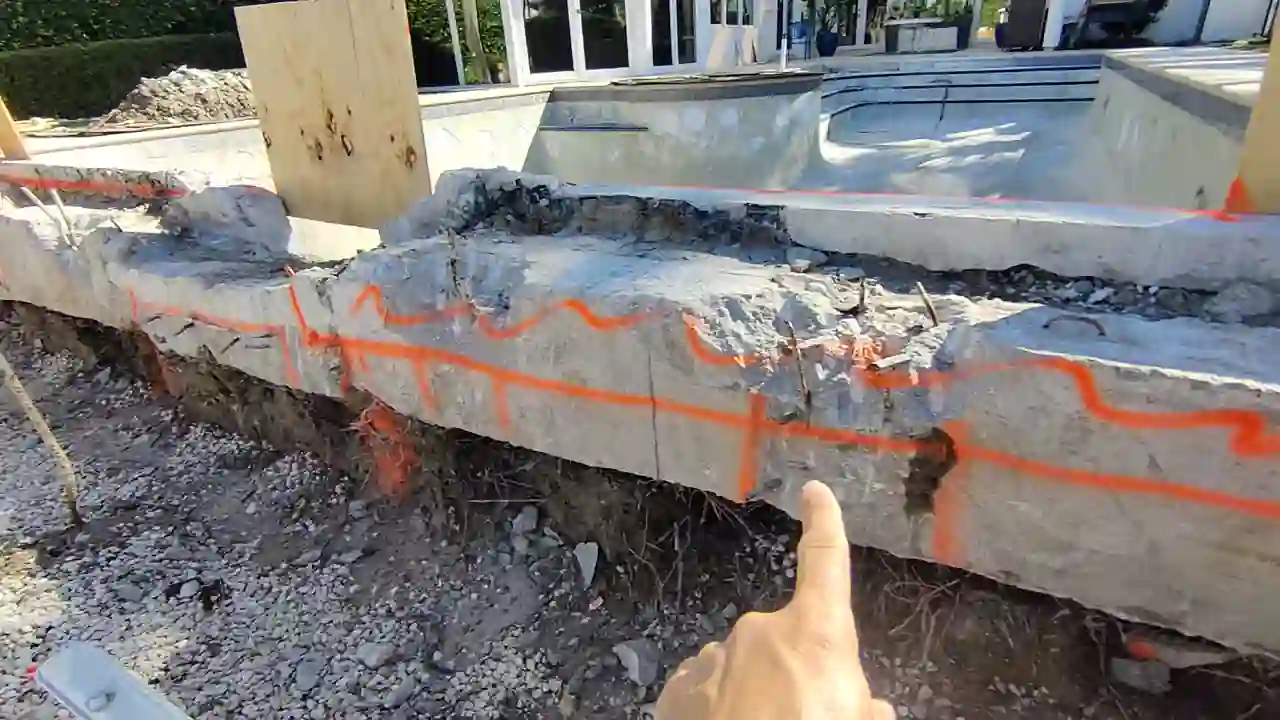
After deck severance, a track excavator with a hydraulic breaker attachment fractures the shell in lifts. Rebar is cut with a plasma torch or angle grinder as sections are extracted. Plumbing penetrations require hand-breaking around pipe collars to avoid cracking into areas you want to preserve. Full removal jobs in South Florida typically run between $9,500 and $18,000 for a standard residential pool, with the wide spread driven by shell thickness, rebar density, access constraints, and haul distance to the nearest concrete recycling facility.
Partial Abandonment — Where the Real Permitting Risk Lives
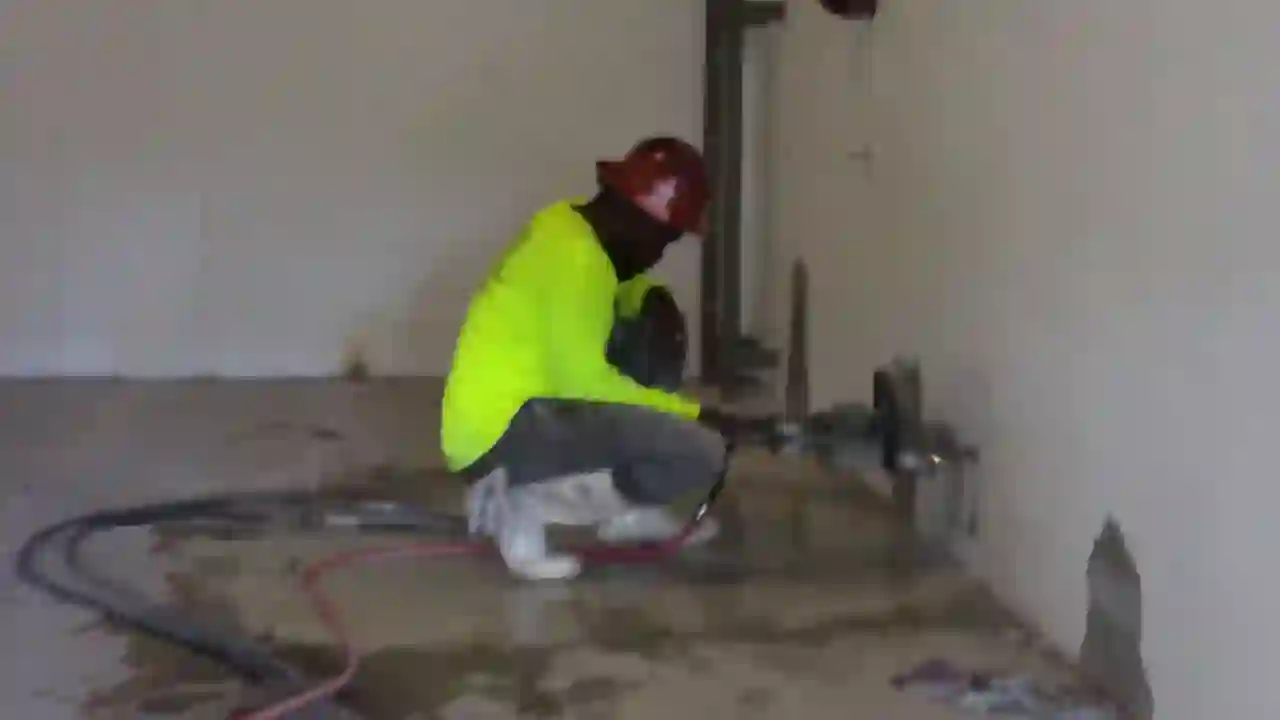
Partial abandonment involves punching drainage holes through the pool floor, removing the top 18 to 36 inches of shell wall (jurisdiction-specific), collapsing or cutting the remaining structure, and backfilling with compacted clean fill. The concrete cutting scope is smaller, but it is not absent. Municipalities require a minimum shell reduction depth, and that means flat sawing or core drilling the drainage ports and cutting the upper shell sections to meet code. Partial abandonment jobs typically run $4,000 to $8,500 in the Miami metro area. However, partial abandonment carries a permanent deed restriction in most Florida counties, and future construction on that footprint requires geotechnical review. That’s a cost that doesn’t show up on the demolition invoice but absolutely shows up when you go to sell or build.
The Permit Timeline Is the Actual Project Timeline — Stop Ignoring It
Every contractor who quotes you a “two-day job” is quoting you the physical demolition window. They are not quoting you the permit timeline, and in South Florida that distinction is enormous. Miami-Dade Building Department currently processes pool demolition permits in 3 to 6 weeks for standard residential applications. Broward County municipalities vary significantly — some process in 10 business days, others run 4 to 5 weeks. Add a revision cycle if your survey is incomplete or your contractor submits without a signed structural engineer letter (required for partial abandonment in many jurisdictions), and you’re looking at 8 to 10 weeks before a shovel touches the ground.
The physical demolition timeline on a full removal breaks down roughly as follows: deck saw cutting — 4 to 8 hours; hydraulic breaking and shell extraction — 1 to 2 days; plumbing removal and grading — half day; compaction and final grade — half day. Total on-site time for a standard job is 2.5 to 4 working days. Partial abandonment is faster: drilling, cutting, collapsing, and backfilling typically runs 1.5 to 2.5 days. Neither of those timelines accounts for permit issuance, inspection scheduling, or the mandatory post-fill compaction inspection that most counties require before you can pour a new slab or plant grass.
Bidding Factors That Swing Your Quote by Thousands of Dollars
When you’re collecting bids to get rid of an inground pool, you need to know which variables are actually being priced and which ones are being ignored until change-order time. Here are the factors that carry the most pricing weight on South Florida jobs.
- Shell Thickness and Rebar Density: Older pools built in the 1970s and 1980s frequently have 6- to 8-inch gunite walls with heavy rebar — sometimes #5 bar on 8-inch centers. That’s significantly more tonnage and cutting time than a modern 4-inch shell. A contractor who doesn’t core-drill a sample hole before bidding is guessing at your shell spec.
- Equipment Access Width: A standard track excavator with a hydraulic hammer needs a minimum 8-foot clear access path. Pools surrounded by screen enclosures, fencing, or mature landscaping may require hand-demolition for portions of the job, which adds labor hours and cost. Get your site access measured before the bid walk.
- Deck Slab Scope: Is the deck included in the removal price? Many bids exclude the deck entirely or price it as a per-square-foot add-on. Deck removal on a 600-square-foot pool surround using flat saw cutting and a skid steer can add $1,800 to $3,500 to the base price. Always clarify this in writing. For detailed cost context on flat saw operations specifically, the flat saw cost breakdown on our site is a useful reference before you negotiate line items.
- Soil Conditions and Groundwater Depth: South Florida’s water table is notoriously shallow. If your pool shell sits in saturated soil or if the excavation hits standing water, you may need dewatering equipment, which adds a daily rental cost of $300 to $700. This is rarely included in a base bid.
- Haul Distance and Tipping Fees: Concrete debris must go to a licensed recycling or disposal facility. Tipping fees in Miami-Dade currently run $45 to $65 per ton. A full removal on a medium-sized pool generates 15 to 22 tons of debris. That’s $675 to $1,430 in tipping fees alone — and haul distance from your site to the facility adds fuel and time.
- Backfill Material Specification: Clean fill, flowable fill, and compacted structural fill are three different materials with three different price points. If you plan to build on the footprint later, your structural engineer may specify flowable fill or engineered fill with compaction testing — that can add $1,500 to $3,000 over basic clean fill pricing.
How to Read a Pool Removal Bid Like a Concrete Professional
A legitimate pool demolition bid should itemize concrete cutting separately from breaking, breaking separately from hauling, and hauling separately from backfill. If you receive a single lump-sum number with no line items, you have no way to evaluate what’s included or to compare bids accurately. Before you sign anything, we strongly recommend reading through our guide on understanding concrete cutting prices — it gives you the framework to decode what contractors are actually charging for and where the markup lives.
Ask every bidder to specify: the removal method (full vs. partial), whether the deck is included, the assumed shell thickness and rebar spec, the number of truckloads and assumed tipping fees, the backfill material type and compaction standard, and who pulls the permit and pays the permit fee. Those seven questions will immediately separate the contractors who know this work from those who are winging it.
For projects in the Fort Lauderdale and northern Broward corridor, permitting timelines and code requirements differ from Miami-Dade. Our Fort Lauderdale project documentation covers jurisdiction-specific requirements that affect both your timeline and your bid scope. And if you want to see how similar demolition projects have been executed locally, browse our Miami project case studies for real-world scope and equipment examples.
Site Safety Requirements That Add Cost and Time to Every Pool Removal
Concrete demolition adjacent to occupied structures carries specific safety obligations that responsible contractors price into their bids. Hydraulic breaking generates significant vibration — if your pool is within 15 feet of a foundation, a retaining wall, or underground utilities, you need a pre-demolition vibration baseline and potentially a monitored breaking protocol. Silica dust control is mandatory on any concrete cutting operation under OSHA 1926.1153, which means wet-cutting methods or HEPA vacuum shroud systems on all saw operations. If your contractor isn’t mentioning dust suppression in their scope, they’re either not compliant or they’re planning to skip it. For a deeper look at how safety protocols affect project scope and cost, our site safety resource library covers the regulatory framework in detail.
The Real Cost of Waiting to Get Rid of an Inground Pool
Deferred pool removal carries its own cost structure that rarely gets discussed. An unused pool accumulates mosquito breeding liability, increases your homeowner’s insurance exposure, and in Florida’s climate, an unmaintained shell can develop hydrostatic cracking within 18 to 24 months of being drained. That cracking doesn’t just affect the shell — it can migrate to the bond beam and the adjacent deck slab, increasing your eventual demolition cost by 15 to 30 percent as the concrete becomes more fractured and harder to extract in manageable sections. The job you price today at $11,000 may cost $14,500 in two years if the shell has deteriorated significantly. That’s not a scare tactic — it’s basic concrete mechanics applied to a structure that was designed to hold water, not to sit empty in saturated South Florida soil.
Get your bids itemized, get your permit timeline in writing, and make sure your contractor has a concrete cutting specialist on the crew — not just an excavator operator with a hydraulic breaker. The difference in execution quality between those two approaches is visible in the finished grade, the compaction results, and whether your future landscaping or construction holds up over time.