Why Hollywood FL Jobsite Conditions Demand a Different Equipment Conversation
Hollywood, Florida sits in a construction corridor where aging post-tension slabs, high-silica aggregate mixes, and coastal humidity create a tooling environment that punishes generic equipment choices. When a contractor calls us for concrete cutting Hollywood work, the first questions we ask aren’t about scheduling — they’re about compressive strength, aggregate type, slab reinforcement, and ambient temperature on the cut day. Those variables determine every piece of equipment that goes on the truck. This post breaks down the technical decision tree that separates precise, efficient Hollywood concrete cutting from blade-burning, overheating disaster jobs.
Floor Saw Specifications for High-PSI Hollywood Slabs
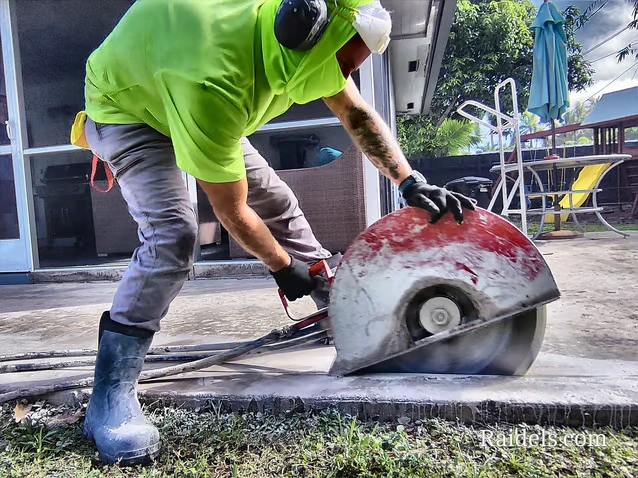
The dominant slab type in Hollywood’s commercial corridor — particularly along US-1 and the industrial pockets near I-95 — runs between 4,000 and 6,500 PSI compressive strength. At that range, you are not reaching for a 25-horsepower electric walk-behind. The baseline tool for this class of work is a diesel flat saw in the 65–80 HP range, with a direct-drive or hydraulic drive system capable of maintaining consistent blade RPM under load. RPM consistency is non-negotiable: blade segment wear accelerates exponentially when rotational speed fluctuates mid-cut.
For depth capacity, Hollywood slab-on-grade work typically requires cuts from 6 to 18 inches. A 30-inch blade on a properly spec’d flat saw delivers a maximum cut depth of approximately 12 inches in a single pass. For deeper cuts — common in utility trench work along Hollywood Boulevard or in parking structure decks — a two-pass strategy using a 36-inch blade at full depth is the standard protocol. Blade arbor size must match exactly: most production flat saws in this class run a 1-inch arbor, and any wobble from a worn arbor flange will destroy a premium diamond blade within one linear foot.
Water delivery systems on the saw deserve the same attention as horsepower ratings. Hollywood’s concrete, especially in structures built between 1975 and 1995, often contains hard river-run aggregate. Cutting that material dry, even with a dry-rated blade, generates heat that glazes diamond segments within minutes. A minimum water flow of 3.5 gallons per minute at the blade contact point is the field standard. Operators should verify that the water delivery tube is positioned to feed both sides of the blade, not just the leading edge.
Diamond Segment Bond Hardness and Hollywood Aggregate Profiles
This is where most tooling mistakes happen. Diamond blades are rated by bond hardness — the matrix that holds the diamond crystals in the segment. Soft bond blades are designed for hard, abrasive materials. Hard bond blades are engineered for soft, non-abrasive materials. Hollywood’s concrete mix designs create a split scenario that requires careful field assessment before blade selection.
Older Hollywood residential slabs (pre-1990) frequently used oolitic limestone aggregate sourced from Miami-Dade quarries. Oolitic limestone is relatively soft and highly abrasive — a combination that demands a medium-to-hard bond segment (typically rated in the 45–55 Rockwell C range for the bond matrix). Using a soft bond blade on this aggregate type causes premature segment loss, where diamonds shed before they’ve completed their useful cutting life.
Newer commercial pours in Hollywood’s redevelopment zones — particularly the mixed-use projects near Young Circle — increasingly specify crushed granite or trap rock aggregate for structural performance. These hard aggregates require a soft bond (25–35 Rockwell C) so the matrix wears away fast enough to continuously expose fresh diamond crystals. Running a hard bond blade on granite aggregate is one of the fastest ways to glaze a segment and turn a $400 blade into scrap metal in under 200 linear feet.
For reinforced concrete — which covers virtually every structural application in Hollywood, from load-bearing wall openings to parking deck expansion joints — the presence of rebar introduces a third variable. Rebar is soft and ductile. It doesn’t cut; it gets ground through. This polishes diamond segments rapidly. The correct response is a segmented rim blade with a turbo-style gullet pattern, which maintains cooling airflow and prevents segment overheating during the steel contact phase of each pass.
Wall Saw and Wire Saw Equipment Specs for Vertical and Overhead Cuts
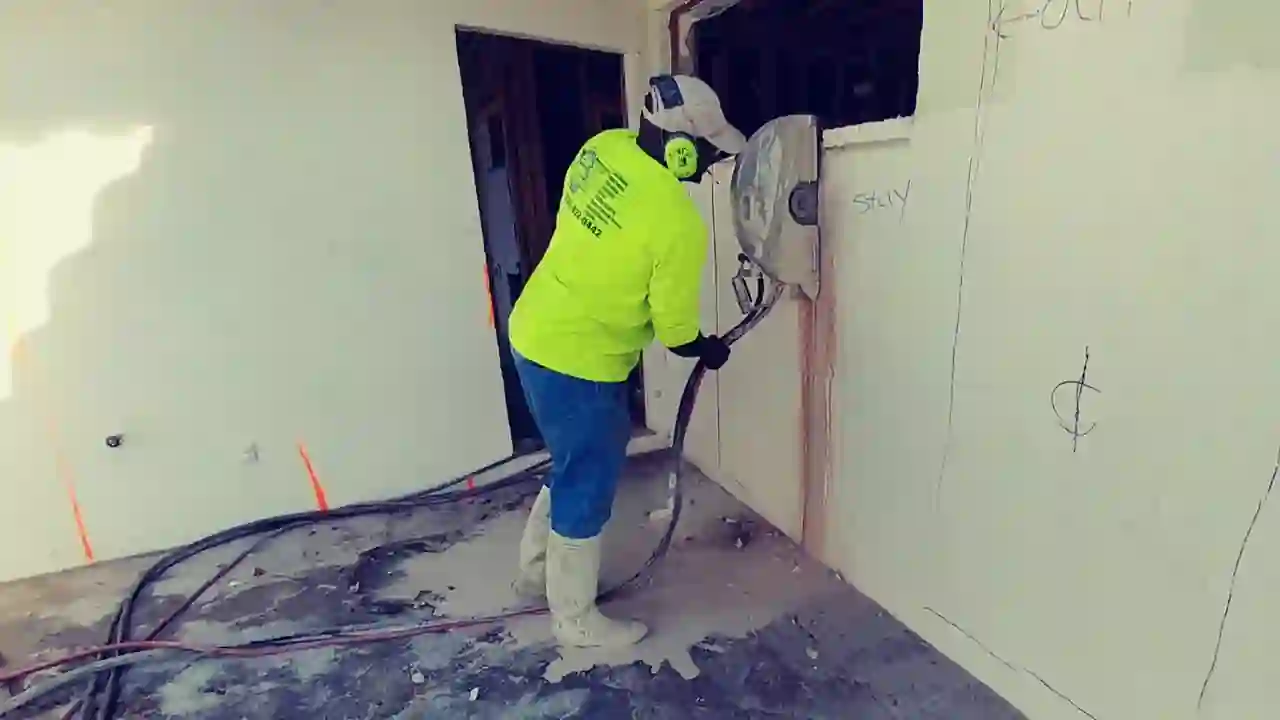
Hollywood’s renovation market — particularly the hotel corridor along Ocean Drive adjacent to the city and the condo conversion projects near the beach — generates significant demand for wall sawing and wire sawing. These applications require a completely different equipment and tooling profile than flat slab work.
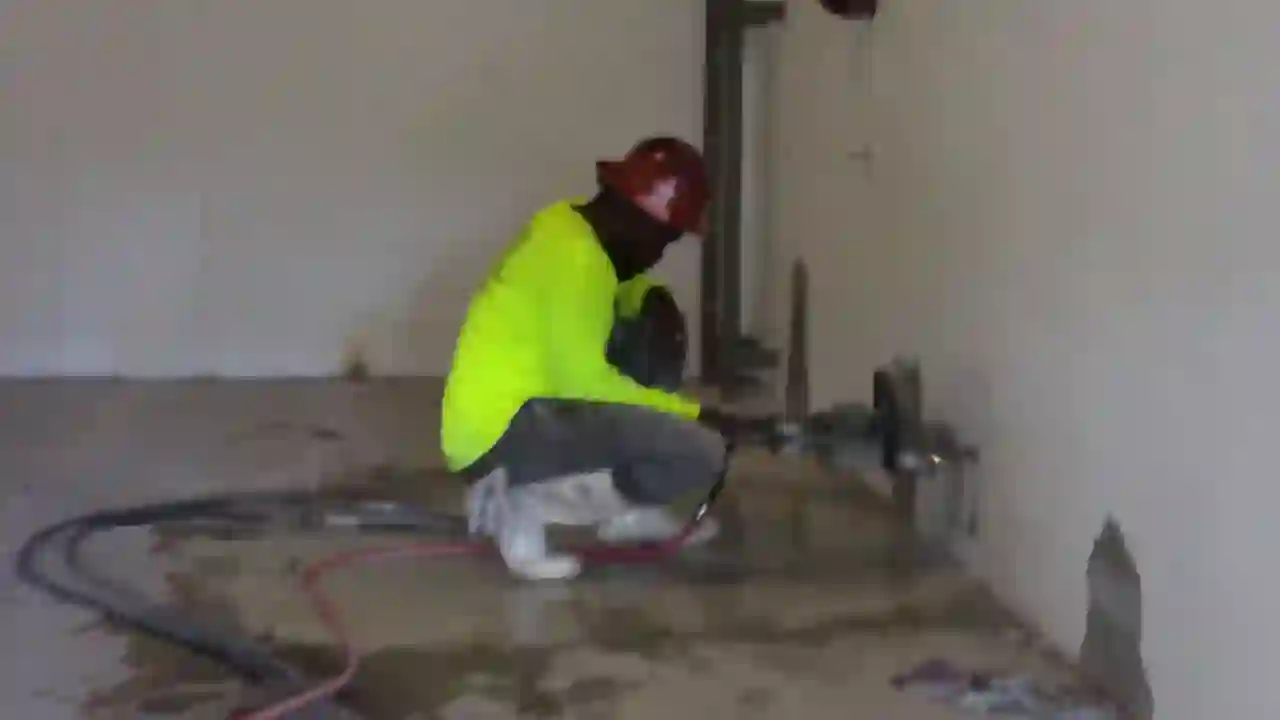
Wall saws for Hollywood projects typically run on hydraulic power packs in the 20–30 GPM flow range at 2,500–3,000 PSI operating pressure. The track-mounted wall saw head must be rated for the blade diameter in use. For openings in 12-inch reinforced concrete walls — a common spec in Hollywood’s older concrete block and poured-wall structures — a 30-inch wall saw blade is the minimum diameter to achieve full-depth clearance in a single-sided cut. The blade must carry a minimum of 20–24 diamond segments with a segment height of at least 15mm to provide adequate depth reserve for the full cut cycle.
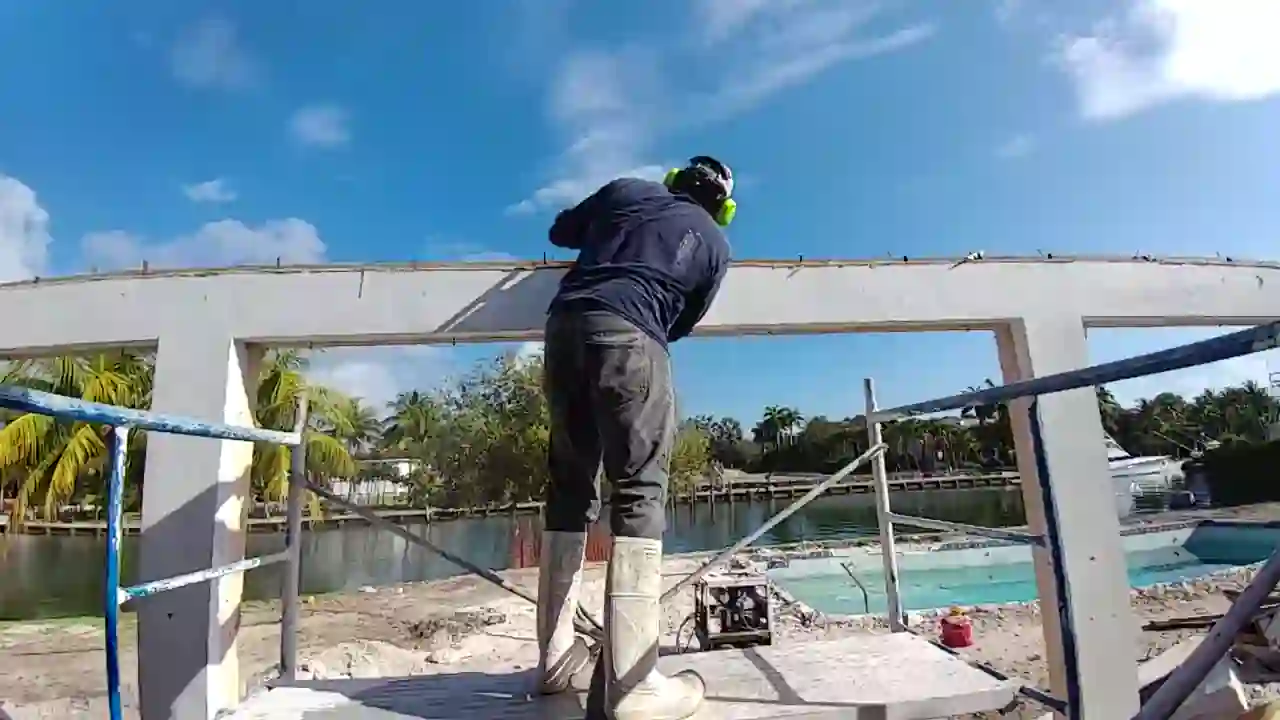
Wire sawing applies when geometry makes blade access impossible — think curved cuts, full-column removal, or mass concrete demolition. Hollywood bridge and seawall work occasionally requires wire saw deployment. The wire itself is a 10.5mm to 11.5mm diamond-beaded wire with bead spacing matched to the concrete hardness. Tighter bead spacing (6.5mm center-to-center) suits softer concrete; wider spacing (8mm+) is appropriate for high-strength mixes. Wire tension must be maintained within the manufacturer’s specified range — typically 150–250 N for production wire saws — because under-tension causes wire whip, and over-tension causes premature wire fatigue fracture.
These technical demands connect directly to the broader safety and planning frameworks that govern complex Hollywood and Miami-area projects. The engineering rigor required for wall and wire sawing in occupied structures is covered in detail in our post on how Miami architecture projects demand next-level concrete cutting safety on every job site.
Core Drill Bit Specifications for Hollywood MEP and Utility Work
Core drilling is the highest-frequency concrete cutting service in Hollywood’s active construction market. MEP rough-in, anchor installation, and utility penetrations drive constant demand. Bit selection follows the same bond hardness logic as flat saw blades, but the geometry of core drilling adds a critical variable — bit wall thickness and segment kerf.
For standard 4-inch to 6-inch penetrations through 6,000 PSI Hollywood commercial slabs, a laser-welded segment core bit with a 3.5mm segment kerf is the production standard. Laser welding (versus silver-solder attachment) is mandatory for wet drilling in reinforced concrete; the heat generated at the bit face during rebar contact will delaminate silver-soldered segments in one drilling cycle. Bit length must account for the full slab depth plus at least 2 inches of clearance below the bottom face — a 12-inch slab requires a minimum 14-inch effective cutting length.
Drill motor torque ratings matter as much as RPM. For bits 4 inches and above in hard concrete, a drill motor producing at least 450 ft-lbs of torque at the spindle is required to prevent stalling under load. Stalling generates catastrophic heat at the bit face and can fuse segments to the concrete, resulting in bit loss and potential injury. Operators should verify that the drill stand anchor system is rated for the lateral forces generated at this torque level — particularly when drilling at angles or into overhead surfaces.
Hollywood’s residential renovation sector — a market explored in depth in our guide on revitalizing home spaces with innovative concrete cutting and demolition solutions — often involves thinner slabs and lighter aggregate, which shifts the bit spec toward smaller-diameter, higher-RPM configurations on handheld drill motors in the 2,500–3,500 RPM range.
Matching Equipment to the Full Scope of Hollywood Demolition Work
No single piece of equipment handles the full range of concrete cutting Hollywood projects. A well-equipped contractor operating in Hollywood maintains a fleet that covers flat sawing, wall sawing, wire sawing, and core drilling — each with tooling inventories calibrated to the local aggregate and mix design profiles. The decision tree starts with concrete strength and aggregate type, moves through reinforcement density and cut geometry, and ends with a specific blade bond, segment height, arbor size, and water flow specification for every single cut.
Operators who treat blade selection as an afterthought — grabbing whatever is on the shelf — consistently underperform on cut speed, blade life, and surface quality. In Hollywood’s competitive commercial renovation and new construction market, those inefficiencies translate directly into lost margins and blown schedules. For projects that cross into structural demolition territory, the equipment and planning requirements scale up significantly, as detailed in our concrete demolition Miami resource library.
Getting the tooling right before the blade hits the concrete is what separates production-grade concrete cutting from expensive trial and error. Every Hollywood job deserves that level of technical preparation.