Why Equipment Specifications Drive Every Concrete Sawing Decision Before the Blade Even Touches the Slab
Walk onto any serious concrete sawing job in Miami-Dade or Broward County and the first thing an experienced technician evaluates is not the slab — it’s the machine. Power output, water delivery capacity, blade arbor size, and drive system type all dictate what diamond tooling will perform optimally and what cutting depth is realistically achievable in a single pass. Skipping this equipment audit before blade selection is one of the most expensive mistakes a cutting crew can make. Undersized horsepower causes blade glazing. Oversized segments on underpowered machines create torque stall and premature segment loss. The relationship between machine and tooling is symbiotic, and understanding it at a technical level separates productive crews from ones burning through blades on every job.
Flat Saw Specifications and Their Direct Impact on Diamond Segment Performance
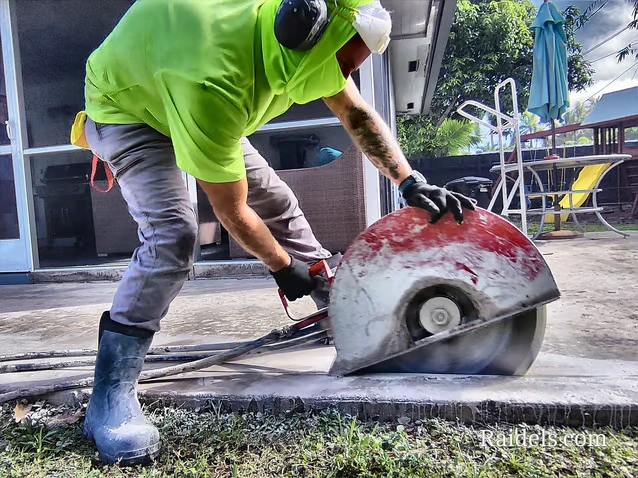
Flat saws — also called slab saws or road saws — are the workhorses of horizontal concrete sawing. In a high-aggregate, high-PSI environment like South Florida construction, where concrete mixes routinely reach 5,000 to 6,000 PSI with crushed limestone or hard silica aggregate, machine specs matter enormously. A professional-grade flat saw for production cutting should deliver a minimum of 25 horsepower at the blade shaft, though 35–65 HP gas or hydraulic units are standard for cutting depths beyond 6 inches.
Blade shaft RPM directly governs the peripheral speed (surface feet per minute, or SFPM) of the diamond blade. Most 14-inch to 18-inch flat saw blades operate optimally between 4,500 and 5,500 SFPM. Running a blade significantly above or below this range accelerates wear or causes the diamond crystals to polish over rather than self-sharpen. The formula is straightforward: SFPM = (blade diameter in inches × π × shaft RPM) ÷ 12. Knowing this, a technician can back-calculate the correct blade diameter for a given machine’s RPM output rather than guessing.
Water delivery is equally non-negotiable. A minimum of 3–4 gallons per minute (GPM) at the blade face is required for blades 14 inches and larger. Inadequate water causes thermal stress fractures in the steel core, segment debonding, and core warping — all catastrophic failure modes. For jobs in Oakland Park and surrounding Broward corridors where utility work demands tight cut tolerances, a warped core mid-job means lost time and potential rework costs that dwarf the cost of a quality blade.
Wall Saw and Wire Saw Equipment Ratings for Vertical and Overhead Concrete Sawing
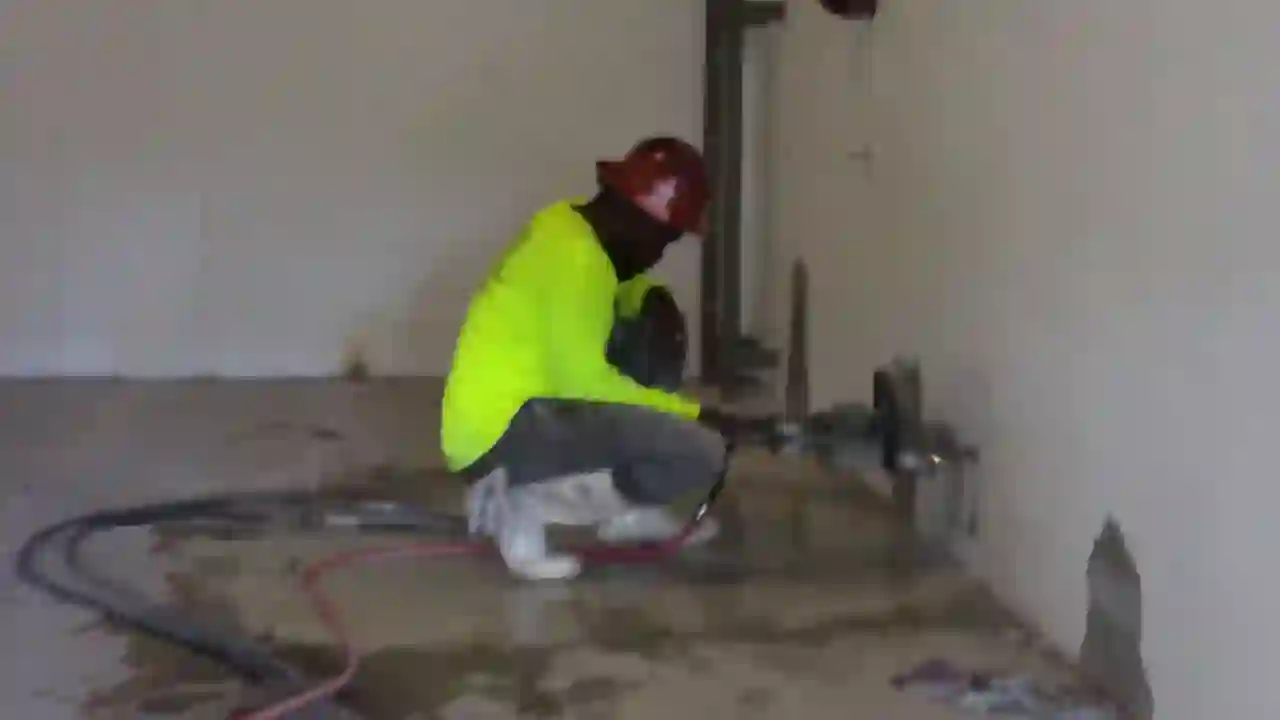
Wall saws introduce a different set of mechanical variables. These track-mounted systems use hydraulic power packs rated in kilowatts (kW) or horsepower and must be matched to blade diameter and the concrete’s aggregate hardness. A standard hydraulic power pack for wall sawing delivers between 18 and 30 kW. Larger diameter blades — 24 inches up to 60 inches — require higher hydraulic flow rates, typically 30–45 liters per minute (LPM) at 200–250 bar operating pressure.
The arbor bore size on wall saw blades is standardized but critical. Most professional wall saw blades use a 1-inch or 20mm bore with drive pin configurations specific to the manufacturer’s track system (Husqvarna, Tyrolit, and Hilti each use proprietary flange systems). Using an incorrect flange fit introduces lateral blade wobble, which widens the kerf unpredictably and accelerates segment side wear. On structural cuts — penetrations through reinforced shear walls or post-tensioned beams — this precision matters both for structural integrity and for subsequent form-fitting of sleeves or mechanical penetrations.
Wire saws, used for mass concrete removal and bridge deck demolition, operate on entirely different performance metrics. The diamond wire itself is rated by diamond bead count per meter (typically 30–40 beads/meter), bead diameter (usually 10–11mm), and the steel cable tensile strength. Hydraulic wire saw units must maintain consistent wire tension — generally 1,500 to 2,500 Newtons — to prevent wire oscillation, which causes uneven cutting and premature bead wear. Feed rate is controlled in millimeters per second and must be calibrated against the concrete’s compressive strength and reinforcement density.
Diamond Blade Bond Matrix Selection Based on Concrete Hardness and Aggregate Type
The bond matrix — the metallic powder compound holding the diamond crystals within each segment — is the single most misunderstood variable in concrete sawing tooling selection. Bond hardness is inversely related to the hardness of the material being cut. Cutting soft, green concrete or asphalt requires a hard bond matrix to prevent premature diamond exposure and segment erosion. Cutting hard, cured concrete with dense aggregate demands a soft bond matrix that wears away steadily to continuously expose fresh diamond crystals.
In practical terms for South Florida concrete sawing, here is the standard bond selection matrix:
- Soft bond (10–20 Mohs equivalent matrix hardness): Best for hard aggregate concrete above 5,000 PSI, flint, quartz, or hard river gravel aggregate. Allows consistent diamond exposure throughout segment life.
- Medium bond: General-purpose for 3,000–5,000 PSI concrete with mixed aggregate — limestone, coral rock, or recycled concrete aggregate (RCA). The most common specification for Miami metro flatwork.
- Hard bond: Reserved for abrasive, soft materials — green concrete under 2,000 PSI, asphalt overlays, brick, or block. Prevents rapid segment undercutting.
- Ultra-hard bond (electroplated or brazed single-layer): Used for precision cutting of tile, masonry, and thin-section concrete where segment geometry must remain geometrically consistent throughout the blade’s life.
Diamond concentration within the segment — expressed as a percentage of diamond volume relative to total segment volume — ranges from 15% to 40% in commercial blades. Higher concentration increases cost and is justified for deep cuts in reinforced concrete where segment longevity per linear foot of cut matters more than initial blade cost. For production cutting operations, a mid-concentration blade at 25–30% diamond volume typically delivers the best cost-per-cut metric. You can explore more about concrete cutting tools and their specifications in our dedicated resource library.
Segment Geometry and Kerf Width Specifications for Precision Concrete Sawing Applications
Segment geometry — height, width, and gullet configuration — controls cutting speed, heat dissipation, and slurry evacuation. Standard segment heights for flat saw blades range from 10mm to 15mm. Taller segments (15mm+) are specified for deep cuts exceeding 12 inches, where the additional diamond depth is needed to maintain cutting efficiency as the segment wears. Segment width must exceed the steel core thickness by 0.4mm to 0.8mm on each side to prevent core-to-concrete contact, which causes core overheating and potential stress fracture.
Gullet depth and configuration determine how effectively slurry and concrete debris evacuate from the cut. U-gullets are standard for general concrete sawing. Keyhole gullets improve slurry clearance in deep cuts. Turbo segment profiles — featuring angled diamond layers — increase cutting speed in soft to medium concrete but generate more heat and require higher water flow rates. For precision utility cuts or control joint sawing where kerf width tolerance is specified at ±1/16 inch, a continuous rim or turbo-continuous hybrid blade delivers the cleanest edge geometry.
The industry’s shift toward larger diameter blades for single-pass deep cutting is well-documented, and our team has covered how these advances are reshaping Miami’s concrete cutting landscape in 2024. Single-pass cuts to 18 inches or deeper reduce job time, minimize vibration cycles on adjacent structures, and lower cumulative water usage — a meaningful operational advantage on urban infill sites.
Operator PPE Requirements and Their Connection to Sawing Equipment Configuration
Equipment specification decisions directly influence the PPE requirements for the cutting crew. High-horsepower flat saws operating at full depth in silica-bearing concrete generate respirable crystalline silica (RCS) at concentrations that exceed OSHA’s PEL of 50 micrograms per cubic meter within seconds of dry cutting. Wet-cutting systems with adequate GPM flow reduce airborne silica by over 90%, but even wet-cutting operations require half-face respirators with P100 particulate filters when working in confined or partially enclosed spaces. Reviewing proper PPE protocols for concrete cutting operations is mandatory for any crew before mobilizing on a new job site.
Beyond respiratory protection, blade guard specifications are non-negotiable. ANSI B7.1 and OSHA 29 CFR 1926.303 require blade guards that enclose at least half the blade diameter. For wall saws, the track system’s integrated blade guard must be inspected for cracks or deformation before each use — a damaged guard on a 36-inch wall saw blade spinning at 1,200 RPM is a catastrophic injury risk. Anti-vibration handles, cut-resistant gloves rated to EN 388 Level D, and steel-toed boots with metatarsal guards complete the standard PPE matrix for concrete sawing operations.
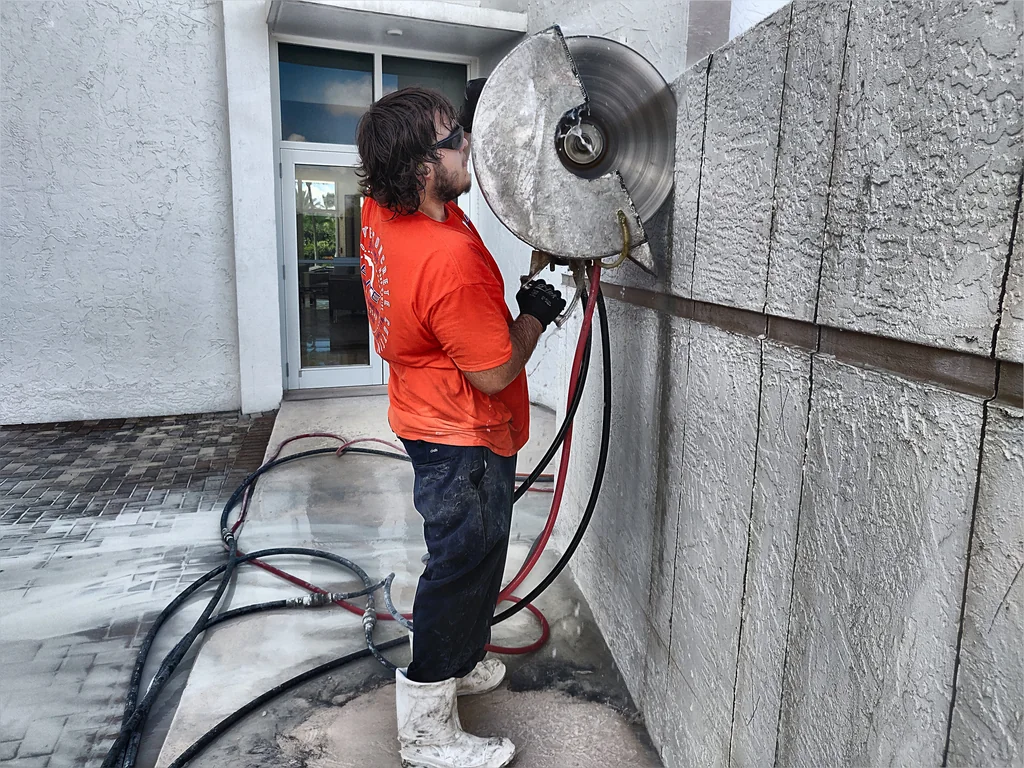
Matching the Full Equipment and Tooling Package to the Specific Job Conditions
Every concrete sawing job presents a unique intersection of variables — concrete age, compressive strength, aggregate type, reinforcement density, required cut depth, site access, water reclamation requirements, and structural sensitivity of adjacent elements. There is no universal blade specification that performs optimally across all these conditions. A 14-inch medium-bond turbo blade that excels on a 4,000 PSI parking deck will glaze over and stall within minutes on a 6,000 PSI industrial floor with hard silica aggregate.
The professional approach is systematic: obtain concrete mix design data or core sample results when available, confirm machine horsepower and RPM output, calculate required SFPM, select bond hardness based on aggregate hardness, verify segment geometry against required kerf tolerance, and confirm water delivery capacity before the first cut. This process takes less than 20 minutes on a job site and eliminates the reactive troubleshooting — and wasted tooling costs — that result from uninformed blade selection. For complex projects in the Miami metro area, consulting with a senior technician before mobilizing is always the most cost-effective first step.