Why Hydraulic Sawing in Clearwater Demands a Higher Safety Standard Than Most Markets
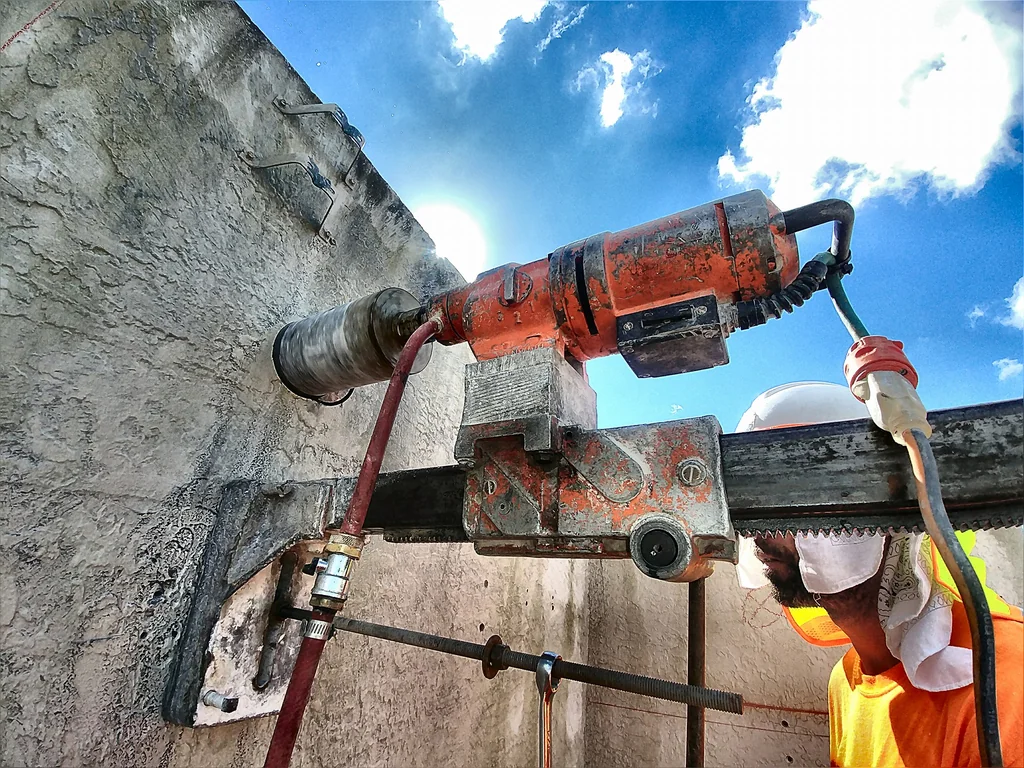
Clearwater’s construction environment is not forgiving. You’re dealing with high ambient humidity, coastal soil conditions, aging infrastructure in active commercial zones, and a mix of residential and industrial concrete substrates that behave unpredictably under hydraulic pressure. When you bring a hydraulic concrete saw onto a Clearwater job site, you are introducing a system capable of generating blade tip speeds exceeding 60 meters per second and hydraulic line pressures in the range of 2,000 to 3,500 PSI. That combination, in the hands of an undertrained crew, is a liability waiting to materialize. This post addresses the specific safety protocols, OSHA compliance frameworks, and hazard avoidance strategies that define professional-grade concrete hydraulic sawing in Clearwater.
OSHA 29 CFR 1926 Compliance Requirements Specific to Hydraulic Saw Operations
OSHA’s construction safety standards under 29 CFR 1926 Subpart Q (Concrete and Masonry Construction) and Subpart I (Tools — Hand and Power) are the baseline regulatory framework governing hydraulic sawing work. But compliance is not a checklist exercise — it is an operational discipline. Here’s what OSHA actually requires on a hydraulic sawing site and where most contractors fall short.
- Machine Guarding (1926.300(b)): Every hydraulic saw must have blade guards that cover the non-cutting arc of the diamond blade at all times. Removing guards for “better visibility” during a cut is a direct OSHA violation and a leading cause of blade contact injuries.
- Hydraulic Hose Inspection (1926.302): All hydraulic lines must be inspected before each shift for abrasion, kinking, coupling integrity, and pressure rating compliance. A hose rated at 2,500 PSI must never be used in a circuit operating at 3,000 PSI.
- Silica Dust Control (1926.1153): OSHA’s respirable crystalline silica standard mandates that employers either implement an engineering control (wet cutting with continuous water supply) or use an HEPA-filtered vacuum system. The permissible exposure limit (PEL) is 50 micrograms per cubic meter of air as an 8-hour TWA.
- Lockout/Tagout (1910.147 applied by reference): When blades are being changed, equipment is being serviced, or hydraulic connections are being made or broken, the power unit must be fully de-energized and locked out.
- Operator Competency Documentation: OSHA requires that workers operating hydraulic saws be trained and that training records be maintained on site or accessible on demand.
For a deeper look at how these requirements integrate with broader precision and safety standards in concrete cutting operations, that resource covers the full scope of compliance expectations across multiple cutting methods.
Pre-Cut Hazard Assessment Protocol for Clearwater Hydraulic Sawing Projects
Before any blade touches a concrete surface, a structured hazard assessment must be completed and documented. In Clearwater specifically, this means accounting for embedded utilities, post-tensioned tendons, and rebar density that varies significantly across the city’s mixed-age building stock.
Utility Scanning and Tendon Detection Before Every Hydraulic Cut
Ground-penetrating radar (GPR) scanning is not optional — it is a mandatory pre-cut step on any slab, wall, or structural element where the embedded content is unknown. Hydraulic saws cut deep and fast. A 20-inch blade running at full depth can sever a post-tensioned tendon in milliseconds, releasing stored energy equivalent to a small explosive event. In Clearwater’s commercial corridors and older residential zones, post-tensioned slabs are common and not always documented in original construction drawings.
Scan depth, scan grid spacing, and data interpretation must all be performed by a certified GPR technician. The scan results must be marked directly on the concrete surface using a consistent color-coding system (APWA Uniform Color Code) before the hydraulic saw operator begins setup. This is non-negotiable on any concrete structure where structural integrity is a factor.
Exclusion Zone Establishment and Barricade Specifications
A hydraulic sawing exclusion zone must be established that accounts for the maximum blade diameter, the hydraulic hose run length, and the potential trajectory of a blade segment in the event of a catastrophic blade failure. Industry best practice sets the minimum exclusion zone radius at 35 feet from the cutting point. In Clearwater’s tighter urban job sites, this may require negotiating lane closures, pedestrian rerouting, or temporary structural barriers. OSHA 1926.202 requires that barricades used for this purpose meet ANSI/ISEA 107 high-visibility standards.
Hydraulic Power Unit Placement and Hose Management for Slurry-Heavy Environments
Clearwater’s wet-cutting operations generate significant volumes of concrete slurry — a mixture of water, fine silica particles, and cement paste that creates both a slip hazard and an environmental compliance issue. Proper concrete slurry management is a safety and regulatory requirement, not an afterthought.
The hydraulic power unit (HPU) must be positioned uphill or upslope from the cutting zone to prevent slurry ingestion into the cooling system. Hydraulic hoses must be routed and secured to prevent trip hazards, and all hose crossings at walkways must be covered with rated hose bridges. Slurry containment berms using absorbent socks or portable dams must be deployed before wet cutting begins to prevent slurry migration into storm drains — a violation of Clearwater’s municipal stormwater ordinances and EPA Clean Water Act provisions.
PPE Requirements Specific to Hydraulic Saw Operators and Ground Personnel
Personal protective equipment for hydraulic sawing operations goes beyond the standard hard hat and safety glasses. Operators and all personnel within the exclusion zone must be equipped with the following at minimum:
- NIOSH-approved half-face respirator with P100 and OV cartridges — required when wet suppression is insufficient or when cutting in enclosed or semi-enclosed spaces.
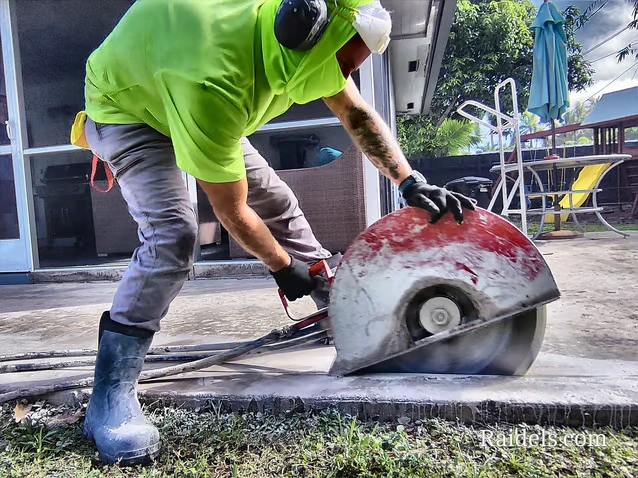
- ANSI Z87.1-rated face shield over safety glasses — blade segment ejection and slurry splash are both credible hazards during hydraulic sawing.
- Cut-resistant gloves rated to EN 388 Level 4 — for handling diamond blades during changes and for managing hydraulic fittings under residual pressure.
- Hearing protection rated to NRR 25 or higher — hydraulic saws operating at full load generate noise levels between 95 and 105 dB at the operator position.
- Steel-toed, puncture-resistant boots with metatarsal guards — required under OSHA 1926.96 for all concrete cutting operations.
- High-visibility vest (ANSI Class 2 minimum) — required whenever hydraulic sawing is conducted in or adjacent to active traffic lanes, which is common in Clearwater road and utility work.
These PPE requirements apply equally to cement slab cutting operations and to specialized applications like concrete window cutting in structural walls, where close-quarters work increases exposure risk significantly.
Blade Failure Recognition and Emergency Response Procedures
A diamond blade does not fail gradually — it fails suddenly, and the consequences are severe. Operators must be trained to recognize the precursor signs of blade distress before catastrophic failure occurs. These include blade wobble or lateral deflection during the cut, unusual harmonic vibration transmitted through the saw frame, visible segment loss or cracking on the blade perimeter, and overheating indicated by discoloration of the blade core (blue or black heat marks).
When any of these signs appear, the correct response is immediate: reduce feed pressure, allow the blade to decelerate to a full stop without applying braking force, power down the HPU, engage lockout, and remove the blade for inspection. Never attempt to continue a cut with a blade showing distress indicators. The cost of a replacement blade is trivial compared to the cost of a blade failure injury or a workers’ compensation claim.
Emergency response procedures must be posted at the job site entrance and reviewed during the pre-task safety briefing. First aid kits rated for laceration and blast injuries must be on site, and the nearest Clearwater emergency medical facility address must be known by all crew members before work begins.
Documentation, Daily Safety Briefings, and Incident Reporting Obligations
OSHA requires that all construction employers maintain a written safety program, conduct documented pre-task safety analyses (PTAs) for high-hazard operations, and report any work-related fatality within 8 hours and any in-patient hospitalization, amputation, or eye loss within 24 hours (OSHA 1904.39). Hydraulic sawing qualifies as a high-hazard operation under any reasonable risk matrix.
Daily safety briefings — sometimes called toolbox talks — must cover the specific hazards of that day’s hydraulic sawing scope. Generic briefings that do not address site-specific conditions are inadequate and will not provide a defense in an OSHA inspection. Document the briefing, the attendees, and the specific hazards discussed. Keep those records for a minimum of five years.
Professional hydraulic sawing crews in Clearwater who operate at this level of safety rigor are not just protecting their workers — they are protecting project timelines, client relationships, and their own operating licenses. Safety is not overhead. It is the foundation of every profitable concrete cutting operation.