Why Slab Thickness Determines Your Entire Slurry Management Protocol
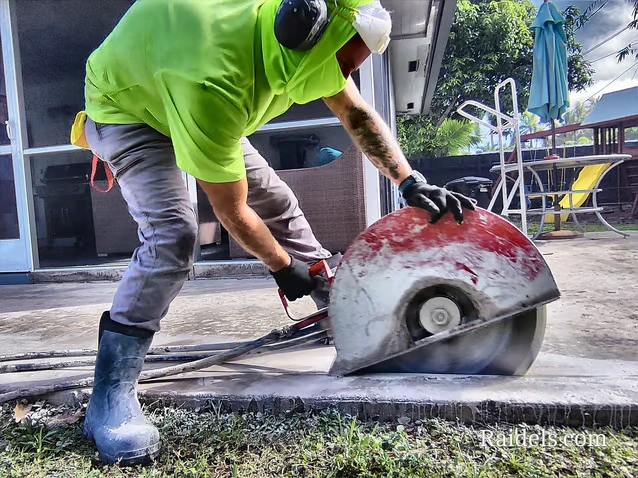
When a homeowner or general contractor asks about the thickness of concrete slab for house construction, the conversation almost always stays in the structural lane — load-bearing capacity, soil bearing pressure, frost depth, rebar spacing. Those are legitimate concerns. But in Miami-Dade County, where environmental compliance is enforced aggressively and stormwater ordinances carry real teeth, slab thickness is also a slurry management variable. The deeper the slab, the more diamond tooling time, the more water volume used for blade cooling, and the more silica-laden slurry that must be contained, collected, and disposed of according to NPDES and local MS4 permit requirements. If your cutting contractor isn’t factoring slab depth into their environmental containment plan before the first blade spins, you’ve already got a compliance problem.
Standard Residential Slab Thickness in South Florida and What It Means for Water Volume
In conventional South Florida residential construction, monolithic slabs typically run between 4 and 6 inches thick. Post-tension slabs — extremely common in Miami-Dade due to the expansive clay soils and high water table — often push to 8 inches or beyond, with thickened edge beams reaching 12 to 16 inches. Each additional inch of slab thickness translates directly into increased blade exposure time per linear foot of cut, which means more water is required to keep the diamond segment below its thermal threshold.
A wet-cut flat saw operating on a 4-inch slab might consume 1.5 to 2 gallons of water per minute. That same saw cutting through an 8-inch post-tension slab with embedded tendons can push water consumption to 3 gallons per minute or higher, especially when the operator is forced to make multiple passes to avoid severing live tendons. Over a 100-linear-foot cut, you’re generating anywhere from 150 to 400 gallons of slurry — a gray, alkaline, fine-particulate mixture with a pH that can exceed 12. That is not something you allow to sheet-flow into a storm drain, a swale, or a neighbor’s property.
pH Levels, Suspended Solids, and Why Slurry Is a Regulated Discharge
Concrete slurry is classified as a non-stormwater discharge under EPA regulations. The high pH is a direct result of calcium hydroxide leaching from freshly cut Portland cement paste. Suspended solids — primarily calcium silicate hydrates and unhydrated cement particles — can exceed 10,000 mg/L in fresh slurry, compared to the 30 mg/L effluent limit typically required for permitted discharges. In Miami-Dade County, discharging untreated slurry into the MS4 (Municipal Separate Storm Sewer System) can trigger violations under Chapter 24 of the County Code of Ordinances, which governs environmental protection.
This is not a theoretical risk. Inspectors from Miami-Dade DERM (Department of Regulatory and Economic Resources) actively monitor construction sites, and concrete cutting operations on residential slabs are not exempt from scrutiny. The thicker the slab, the longer the operation, the greater the slurry volume, and the higher the exposure to a compliance incident if containment is inadequate.
Containment Engineering for Different Slab Thickness Scenarios
Professional concrete cutting contractors in Miami deploy containment strategies that are scaled to the specific slab profile on site. This is not a one-size-fits-all setup. A 4-inch garage slab with a simple door opening cut requires a different containment footprint than an 8-inch post-tension slab being cored for a new HVAC penetration in a high-rise residential podium. Understanding these distinctions is what separates a compliant operation from a liability event.
Berms, Vacuum Systems, and Containment Geometry for Thin Slabs (4 to 5 Inches)
For standard 4 to 5-inch residential slabs, a perimeter berm system using foam dam material or sand bags is typically sufficient to contain slurry within the immediate cut zone. A wet-dry vacuum with a slurry tank attachment runs continuously alongside the flat saw, pulling water and fine particulate before it can migrate. The collected slurry is transferred to sealed poly drums for off-site disposal at an approved facility. On projects with challenging site access, the vacuum system must be staged carefully to ensure the hose run doesn’t exceed the unit’s suction capacity, which degrades containment effectiveness.
High-Volume Recovery Systems for Post-Tension and Structural Slabs (8 Inches and Above)
Post-tension slabs demand a significantly more robust containment infrastructure. At 8 inches or greater, the slurry volume generated per cut is high enough that passive berm systems can be overwhelmed, particularly if the cut is long or the work area has any grade to it. In these scenarios, a dedicated slurry recovery system — either a trailer-mounted vacuum unit or an inline slurry pump feeding into a holding tank — is the appropriate tool. The holding tank allows for pH adjustment using carbon dioxide injection or citric acid dosing before the water fraction is discharged or reused. Solids settle out and are removed separately.
Proper safety measures in concrete cutting also require that slurry containment doesn’t create secondary hazards — a wet floor in a residential space is a slip risk, and a slurry spill that migrates into electrical conduit or under finished flooring creates damage claims that dwarf the cost of proper containment from the start.
Site Grading, Drainage Patterns, and Pre-Cut Environmental Assessment
Before any cutting operation begins on a residential slab in Miami, a competent contractor performs a site drainage assessment. This means physically walking the perimeter, identifying low points, locating storm drain inlets, and mapping the natural sheet-flow direction of the site. South Florida’s flat topography means that even minor grades — 1% or less — can direct slurry toward a street, a swale, or an adjacent property surprisingly quickly.
For driveway concrete removal projects where site access creates logistical constraints, the drainage assessment becomes even more critical because the work area is often directly adjacent to the public right-of-way and storm drain infrastructure. A driveway apron cut that sends slurry into a curb inlet is a direct MS4 violation, regardless of the volume involved.
The assessment should document the following before work begins:
- Slab thickness confirmed by core sample or as-built drawings — estimating thickness leads to underprovisioning containment equipment
- Location of all storm drain inlets within 50 feet of the work zone
- Soil type and permeability adjacent to the slab edge — sandy soils absorb slurry rapidly but can still transport contaminants to groundwater
- Proximity to any water body, including canals, retention ponds, or Biscayne Bay tributaries
- Available power for vacuum and pump equipment — generator placement affects containment layout
Post-Cut Slurry Disposal and Documentation Requirements in Miami-Dade
Collecting slurry is only half the compliance equation. Disposal must follow a documented chain of custody. In Miami-Dade, concrete slurry waste is typically managed as a Class III solid waste or, if the pH-adjusted water fraction is discharged to sanitary sewer, under a local pretreatment agreement with Miami-Dade Water and Sewer. Contractors operating across Miami residential and commercial projects should maintain disposal manifests for every load, including the originating site address, estimated volume, pH at time of collection, and receiving facility. This documentation protects both the contractor and the property owner in the event of a regulatory inquiry.
Solid slurry cake — the dewatered residue after settling — is typically disposed of in a lined dumpster and transported to a permitted C&D (construction and demolition) debris facility. It cannot be spread on-site as fill without testing, and it cannot be discharged to surface water in any form.
How Slab Thickness Affects Project Bidding and Compliance Budgeting
A technically accurate bid for residential concrete cutting in Miami must account for slab thickness as a direct cost multiplier for environmental compliance. Thicker slabs mean more water, more slurry, more containment equipment, more disposal volume, and more labor time managing the environmental controls. Contractors who underbid by ignoring these variables either cut corners on compliance — creating liability for themselves and the property owner — or absorb losses that make the project unsustainable.
When you’re evaluating proposals for any residential slab cutting project, ask specifically how the contractor is accounting for slurry volume based on your slab thickness. If they can’t answer that question with specificity, they haven’t done the environmental planning that the work requires.

The Practical Takeaway for Miami Homeowners and General Contractors
The thickness of concrete slab for house construction is a number that lives at the intersection of structural engineering, environmental compliance, and field operations. In Miami-Dade’s regulatory environment, treating it as a purely structural variable is an incomplete approach. Every inch of slab depth adds to the slurry equation, and every gallon of slurry generated on your property is your contractor’s legal and ethical responsibility to contain and dispose of properly. Demand documentation, demand a containment plan scaled to your actual slab profile, and work with a cutting contractor who treats environmental compliance as a technical discipline — not an afterthought.