Why Driveway Concrete Removal Is Never as Simple as It Looks from the Street
Every driveway removal job starts with the same basic physics — you’re breaking a rigid concrete slab into manageable pieces and hauling the debris off-site. But the moment you walk the property, the real variables reveal themselves. Gate widths that won’t pass a skid steer. Overhead utilities running directly above the work zone. Irrigation lines buried two inches below the slab with no as-built drawings to reference. In Miami’s dense residential corridors, these site conditions aren’t edge cases — they’re the norm. Understanding how experienced contractors plan around confined access, equipment limitations, and debris logistics is the difference between a clean three-day pull and a project that drags on for a week with collateral damage to the surrounding landscape.
Reading the Site Before a Single Blade Touches the Slab
A proper site assessment for driveway and flatwork removal begins well before equipment mobilization. The crew lead needs to answer several critical questions during the walk-through. What is the gate clearance — both width and height? Is there a single point of ingress, or can the property be accessed from multiple sides? What is the slope gradient from the street to the garage pad, and does that slope affect how debris will be staged? Are there mature trees with root systems that have already compromised the slab edge, and will those roots limit where breaking equipment can be positioned?
In South Florida specifically, the proximity of neighboring structures creates additional constraints. Zero-lot-line properties are common in Coral Gables, Coconut Grove, and Hialeah. When a driveway runs within 18 inches of a neighbor’s stucco wall, you cannot swing a hydraulic breaker freely without risking vibration damage to that adjacent structure. That constraint immediately shifts the approach from impact demolition to a cut-and-lift methodology — a fundamentally different operation with different equipment requirements and a different timeline.
Equipment Selection Driven Entirely by Access Width
The single biggest site logistics variable in driveway concrete removal is equipment access. A standard skid steer with a hydraulic hammer attachment requires a minimum gate opening of roughly 60 to 66 inches to pass through without modification. Many residential properties in Miami have ornamental iron gates or masonry pillar entries that measure 48 to 54 inches clear. That gap eliminates the most efficient mechanical breaking option from the equation entirely.
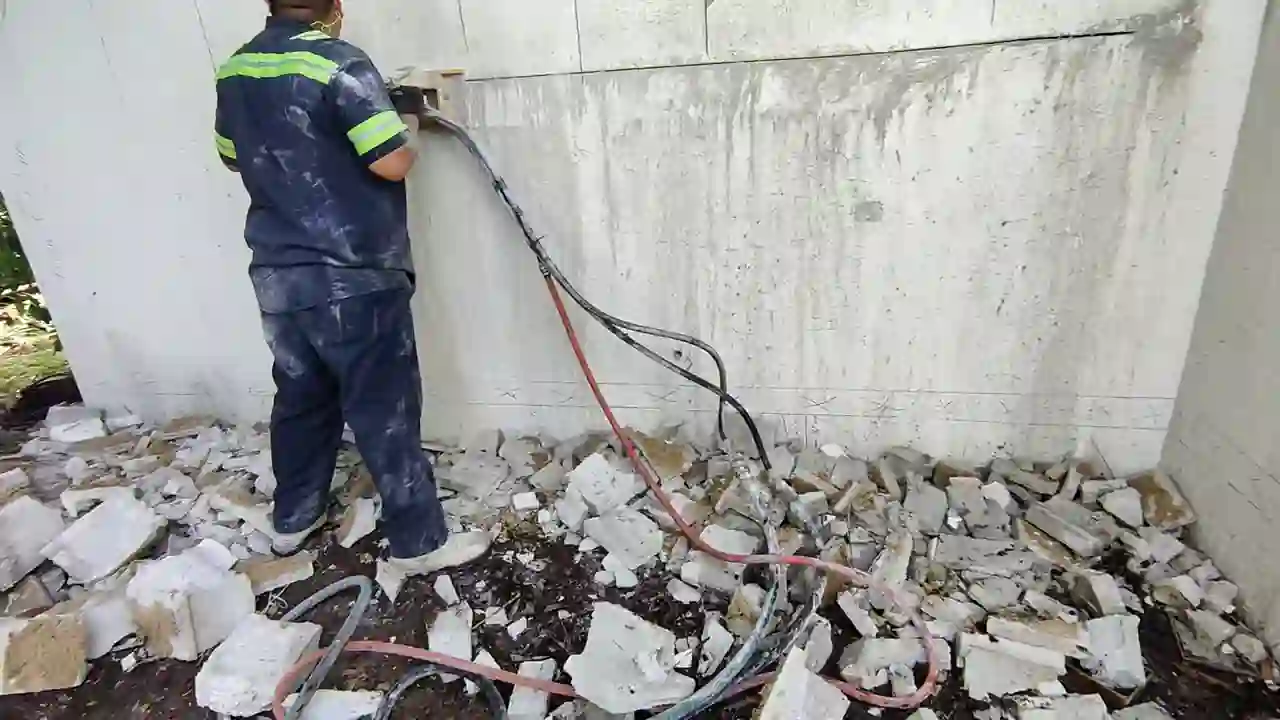
When full-size equipment can’t enter the work zone, contractors pivot to one of several scaled-down alternatives. Compact track loaders with narrower footprints — some as slim as 36 inches — can access tighter corridors, though their breakout force is significantly reduced compared to full-size machines. Electric micro-excavators, increasingly common in urban demolition work, offer another option with the added benefit of zero exhaust emissions in enclosed or semi-enclosed spaces. For the most restricted sites, hand-held hydraulic breakers paired with electric jackhammers become the primary breaking tools, with all debris removal done by wheelbarrow and manual labor.
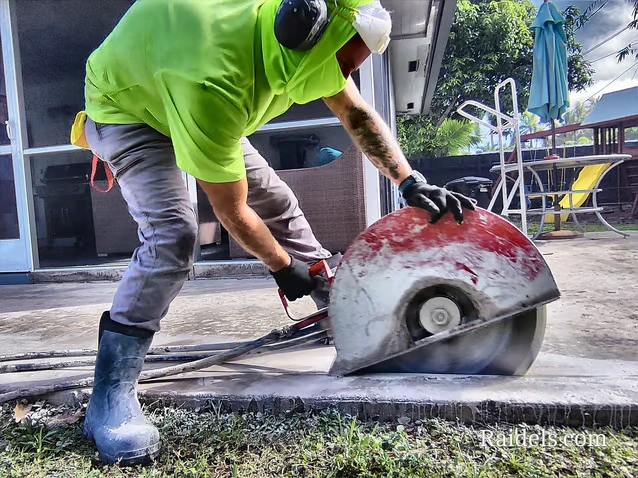
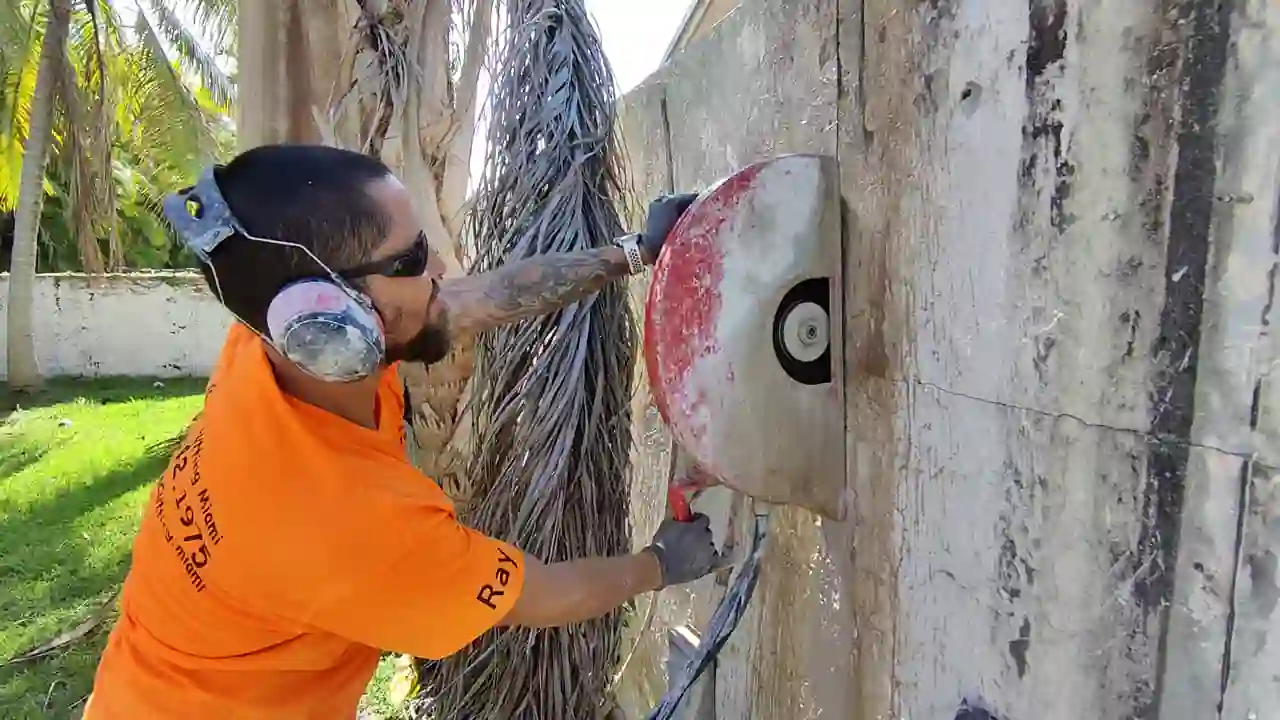
The concrete breaking method chosen directly affects how the slab is sectioned. When mechanical equipment is available, crews typically score the slab with a walk-behind flat saw at 24 to 36-inch grid intervals before breaking, giving the machine clean fracture lines to exploit. When breaking is entirely manual, those grid cuts become even more critical — smaller panel sizes reduce the lifting weight per piece and make manual extraction manageable without risking worker injury.
Slab Thickness Surprises and What They Mean for Your Timeline
Residential driveways in Miami were poured across many decades with wildly inconsistent specifications. A driveway installed in the 1960s might be a nominal 4-inch unreinforced slab sitting on a sandy sub-base. A driveway poured in the 1990s might be 6 inches thick with #4 rebar on 18-inch centers. A recently poured driveway for a heavy vehicle application could be 8 inches with welded wire mesh and fiber reinforcement throughout. None of this is visible from the surface.
The age and service history of the concrete gives experienced estimators clues about what’s underneath, but ground-penetrating radar (GPR) scanning provides actual data. For any driveway removal where rebar presence is suspected, GPR scanning before flat saw cutting prevents blade damage and protects the operator from unexpected kickback when a diamond blade contacts embedded steel at speed. It also identifies conduit runs — electrical feeds to detached garages are frequently embedded in driveway slabs rather than run underground separately, a detail that can halt a job entirely if discovered mid-demolition.
Managing Debris Staging in Confined Site Conditions
Even when breaking and cutting go smoothly, debris management in a confined site is a genuine operational challenge. A standard two-car driveway — roughly 20 feet wide by 40 feet deep — contains approximately 800 square feet of slab. At 4 inches thick, that’s roughly 267 cubic feet of concrete, which translates to approximately 10 to 12 tons of broken material. Getting that volume off a property with limited staging area requires careful sequencing.
The preferred approach is to break and load in progressive sections rather than demolishing the entire slab before hauling begins. Crews establish a working face at the street end of the driveway, break a section, load it directly into the haul truck or roll-off container, then advance deeper into the property. This eliminates the need for large debris piles on-site and keeps the access path clear for equipment movement. When a roll-off container is the chosen debris vessel, its placement must account for the truck’s approach angle, the container’s footprint relative to the sidewalk and any tree lawns, and local right-of-way permit requirements — all of which add pre-job coordination time.
Utility Conflicts Beneath the Slab Surface
South Florida’s utility infrastructure is notoriously shallow. Water mains, irrigation laterals, low-voltage landscape lighting conduit, and even gas lines can run at depths that put them in direct conflict with flat saw blades during driveway removal. Before any mechanical cutting begins, demolition safety protocols require utility locates through Sunshine 811, but that service only marks public utility infrastructure. Private irrigation systems, secondary electrical feeds, and propane lines serving outdoor kitchens are not covered under 811 and must be identified through direct communication with the property owner and, when necessary, manual probing.
When a known utility conflict exists beneath the slab, the standard resolution is to hand-excavate a reveal trench along the utility’s path before any powered cutting begins. This exposes the utility, allows the crew to assess its depth and condition, and establishes a no-cut buffer zone around it. Flat saw cutting can then proceed on either side of that buffer, with the remaining concrete over the utility broken manually using hand tools to avoid any risk of contact.
Slope and Grade Challenges That Complicate Equipment Stability
Miami’s topography is generally flat, but individual properties — particularly those with elevated pads, coastal berms, or rear-yard grade changes — can present meaningful slope challenges. A hydraulic breaker mounted on a mini-excavator operates safely on grades up to approximately 15 degrees depending on the machine’s rated stability envelope. Beyond that threshold, the equipment must be repositioned with blocking, or the work method must change entirely.
Sloped driveways also affect debris handling. Concrete chunks broken on an uphill section will roll and shift during loading, creating a hazard for crew members working below. Establishing physical stops — typically timber blocking or compacted debris piles used intentionally as barriers — prevents uncontrolled movement during the break-and-load sequence. This is a standard field adaptation that experienced crews implement without being told, but it’s worth verifying during the pre-job safety briefing that everyone on site understands the hazard and the control measure in place.
What Proper Site Logistics Planning Actually Saves You
Homeowners and general contractors who treat driveway concrete removal as a commodity service — selecting vendors purely on price — frequently discover the hidden costs of poor site logistics planning after the job begins. Damaged irrigation systems require repair. Cracked stucco on adjacent structures generates liability disputes. Incomplete debris removal because the haul truck couldn’t access the rear section of the driveway leaves the property owner managing the remainder independently. These outcomes are entirely preventable when the contractor invests real time in pre-job site analysis and builds a work plan that accounts for every access constraint before mobilization day.
The technical complexity of confined-space driveway removal is precisely why it demands a contractor with direct experience in Miami’s residential site conditions — not a general demolition crew that handles commercial work and treats residential projects as simplified versions of the same task. The scale is smaller, but the precision required is higher, and the margin for collateral damage is far lower when you’re working 18 inches from someone’s home.