Why Concrete Slab Sawing Gets Complicated Fast on Real Job Sites
Every concrete slab sawing project looks manageable on paper. You’ve got a slab, you’ve got a saw, and you’ve got a line to follow. But the moment you walk onto an actual job site — a basement with 6-foot clearance, a parking garage with active traffic lanes, a backyard hemmed in by pool equipment and landscaping — the theoretical simplicity evaporates. What you’re left with is a logistics puzzle that demands as much planning as it does cutting skill. At Concrete Cutting Miami, LLC, we’ve run flat saw operations in conditions that would make most contractors turn around and drive home. This post breaks down exactly how site logistics, confined space challenges, and access limitations shape every decision we make before a blade ever touches concrete.
The Pre-Cut Site Assessment That Most Crews Skip
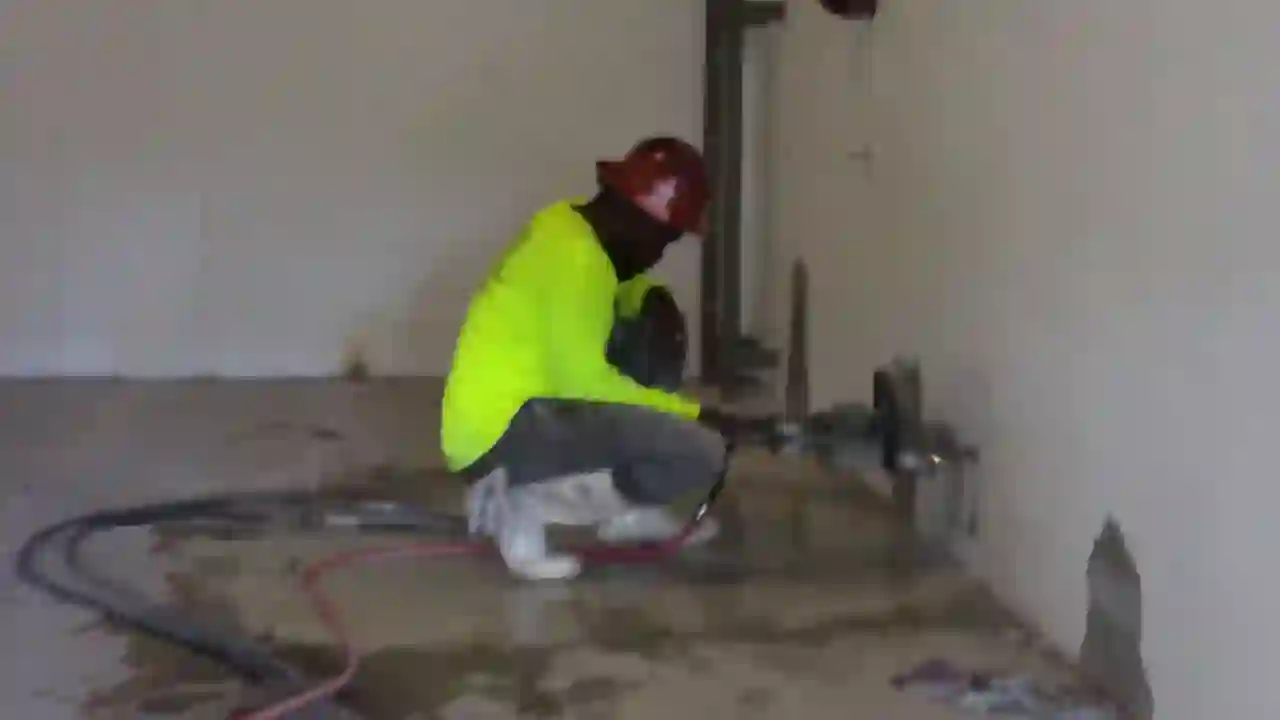
Before a flat saw rolls onto any slab, a thorough site logistics assessment has to happen — and it goes well beyond marking cut lines. We’re evaluating equipment ingress and egress, slurry containment feasibility, power source proximity, ventilation adequacy, and structural load capacity of the floor itself. In Miami’s dense urban environment, this often means navigating commercial kitchens, mechanical rooms, underground parking decks, and residential properties where the only access point is a 36-inch side gate.
The questions we ask on every pre-cut walkthrough include the following. What is the ceiling height, and will a walk-behind flat saw physically fit without modification? Is there a floor drain or designated slurry discharge point within a workable distance? Are there active utilities — electrical conduit, plumbing, post-tension cables — embedded in the slab that require GPR scanning before any cut commences? What is the ambient ventilation situation, and will diesel-powered equipment require a swap to electric or hydraulic alternatives? Each answer drives equipment selection, crew size, and timeline in a direct and measurable way.
Equipment Downsizing for Low-Clearance Slab Environments
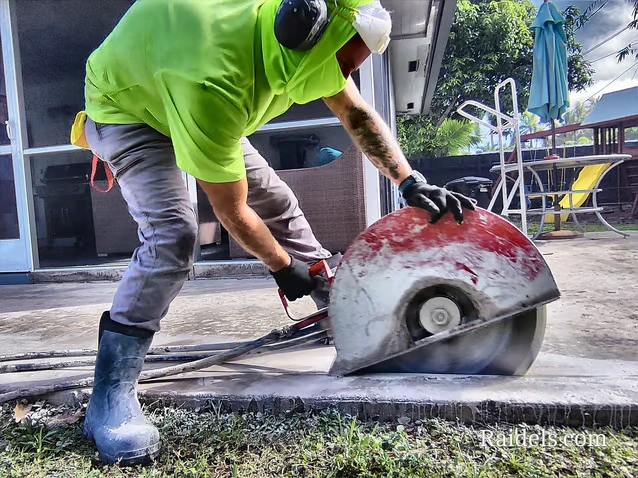
Standard walk-behind flat saws run blade guards that extend 18 to 24 inches above the slab surface at peak operation. In a basement or crawl space with 5-foot clearance, that geometry creates an immediate conflict. Our response is to deploy low-profile flat saw configurations — machines purpose-built with reduced guard heights and compact operator controls — that allow productive cutting in environments where conventional equipment simply cannot function.
Beyond vertical clearance, horizontal maneuverability is equally critical. A 20-inch blade flat saw has a total machine footprint that may prohibit turning radius in a corridor narrower than 4 feet. In those scenarios, we transition to hand-held cut-off saws for depth-limited passes, or we sequence cuts from multiple access points to eliminate the need for the machine to turn at all. This kind of adaptive equipment strategy is what separates a crew that can execute from one that shows up, realizes the machine won’t fit, and reschedules.
Hydraulic flat saws powered by remote power packs represent another critical tool in confined space operations. By separating the engine from the saw head, we eliminate exhaust emissions inside enclosed structures and dramatically reduce the machine’s operating footprint. This is particularly relevant in concrete demolition scenarios inside occupied commercial buildings where air quality and noise ordinances are non-negotiable constraints.
Slurry Management When There Is Nowhere for Water to Go
Wet cutting is the industry standard for diamond blade flat sawing — it suppresses silica dust, extends blade life, and improves cut quality. But wet cutting produces slurry, and slurry has to go somewhere. On open exterior slabs with positive drainage, this is a minor logistical consideration. In a confined basement, a sealed parking structure, or a finished interior space, slurry management becomes one of the most operationally demanding aspects of the entire job.
Our approach involves portable slurry containment berms placed ahead of the saw’s water discharge zone, wet vacs running in tandem with the cut to capture slurry in real time, and designated holding tanks for slurry that cannot be discharged on-site. Depending on the municipality, concrete slurry discharge to storm drains is prohibited — a fact that has significant implications for water damage prevention and environmental compliance on every job we run in Miami-Dade County.
In extreme cases — interior slab cuts in high-end residential properties, for example — we shift to dry cutting with continuous HEPA-filtered vacuum extraction. This eliminates slurry entirely but demands a different blade specification and more aggressive dust collection capacity. The tradeoff in blade wear is accepted as a cost of protecting the surrounding finish surfaces and maintaining air quality inside an occupied space.
Staging and Material Handling When Access Is the Bottleneck
Removing cut slab sections is often harder than making the cuts themselves. A 4-inch thick concrete slab weighs approximately 50 pounds per square foot. A 3-foot by 3-foot cut section — a modest removal — comes in at 450 pounds. In an open exterior environment, a skid steer or mini excavator handles that without drama. In a confined space with no mechanical access, that weight becomes a manual handling problem with serious crew safety implications.
Our standard protocol for confined space slab removal involves cutting sections sized to manual carry capacity — typically no larger than what two workers can safely transport with slab tongs through the available egress path. This means more cuts, more time, and more precise layout planning upfront. It also means the cut layout itself is driven by extraction logistics, not just the structural requirements of the opening being created.
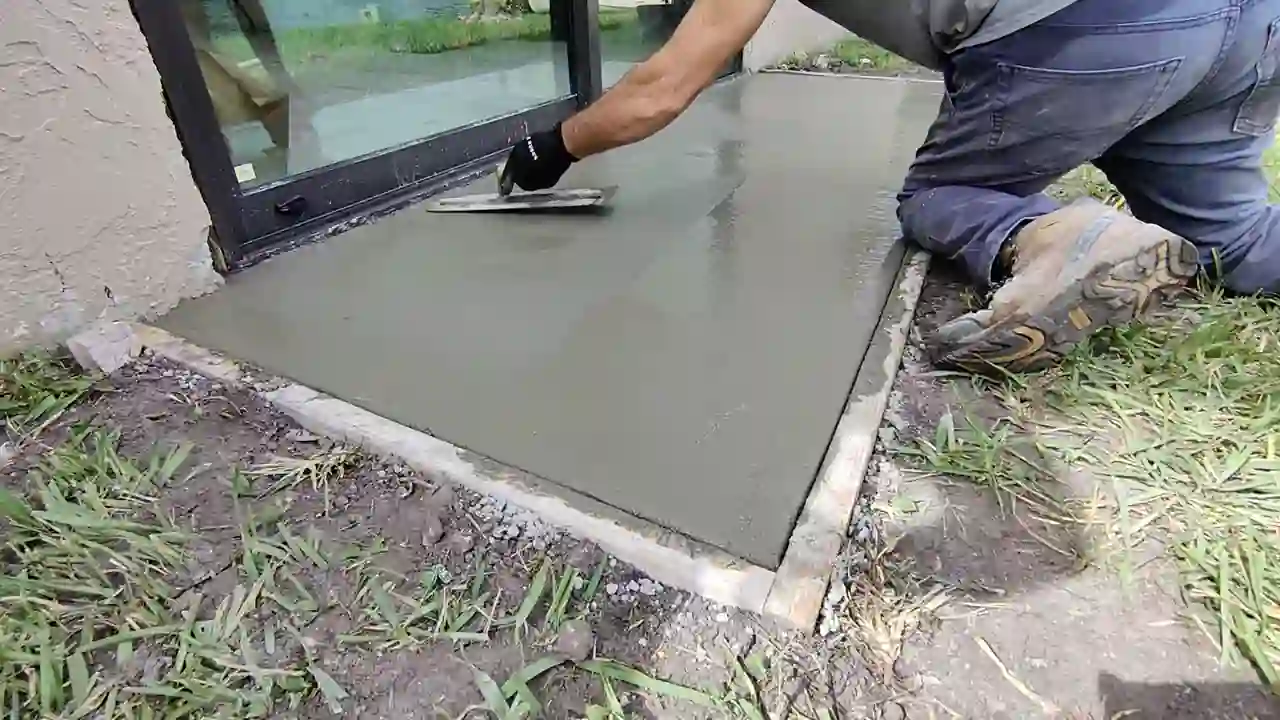
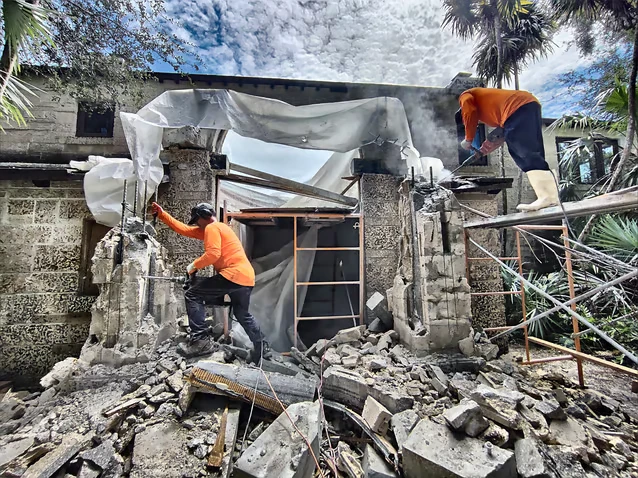
For projects where the work is part of a larger backyard oasis transformation — pool installations, outdoor kitchen slabs, patio reconfiguration — the access constraints are different but equally real. Narrow side yards, mature landscaping, and existing hardscape all limit equipment movement and debris staging. We routinely use conveyor systems, debris chutes, and staged stockpile zones to keep the work moving without compromising the surrounding property.
Post-Tension Slab Detection and the Non-Negotiable Role of GPR Scanning
Post-tensioned concrete slabs are common throughout Miami’s commercial and high-rise residential construction. Cutting a post-tension tendon without proper detection and management is one of the most dangerous events that can occur on a concrete cutting job site — the stored energy in a stressed tendon releases explosively upon severance. This is not a theoretical risk. It is a documented cause of serious injury and structural failure.
Every slab sawing project we undertake begins with a ground-penetrating radar scan of the cut zone. GPR identifies tendon layout, rebar positioning, conduit runs, and other embedded obstructions with sufficient resolution to allow precise cut path planning that avoids critical elements. Where tendons must be managed as part of the project scope, we coordinate with a licensed structural engineer to establish a de-tensioning sequence before any cutting begins.
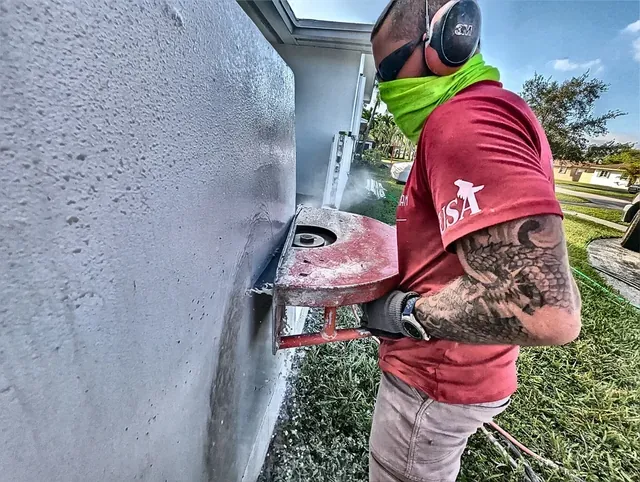
This same discipline applies to wall sawing techniques when vertical elements adjacent to the slab are part of the scope — a common scenario in structural opening creation where both horizontal and vertical cuts define the finished opening geometry.
Ventilation Planning for Enclosed Slab Cutting Operations
Silica dust generated by concrete cutting is a Class 1 carcinogen under OSHA’s Respirable Crystalline Silica Standard (29 CFR 1926.1153). In confined spaces, the risk is amplified by limited air exchange and the concentration of airborne particulate in a small volume. Wet cutting reduces — but does not eliminate — silica exposure. Dry cutting in an enclosed space without engineered ventilation and continuous vacuum extraction is not a compliant or safe operating condition.
Our confined space slab sawing protocol includes pre-job ventilation assessment, placement of directional air movers to create positive pressure flow away from the operator and toward an exhaust point, and mandatory respiratory protection for all personnel within the work zone. Air monitoring during the cut verifies that our engineering controls are performing as designed. This level of rigor is not optional — it is the baseline for responsible slab sawing in any enclosed environment.
Coordinating with Other Trades on Active Construction Sites
Concrete slab sawing rarely happens in isolation on a commercial job site. Mechanical, electrical, and plumbing trades are often working in adjacent areas, and the noise, vibration, water, and dust generated by flat saw operations create real conflicts that require active coordination. We schedule our cuts around adjacent trade activities, establish clear exclusion zones around the saw operation, and communicate cut timing with the general contractor to minimize interference with work that cannot be paused.
Vibration from flat sawing can transmit significant energy through the slab to adjacent structural elements. On sensitive sites — hospitals, data centers, occupied residential buildings — we use vibration monitoring instrumentation to verify that our operations remain within acceptable thresholds throughout the cut. If levels approach limits, we adjust blade speed, water flow, and advance rate accordingly.
The operational complexity of confined space and access-limited slab sawing is exactly why experience and pre-job planning determine outcomes more than any other factor. Equipment is a tool. The knowledge of how to deploy it in conditions that deviate from the textbook — that’s what actually gets the job done right.