Why Equipment Specification Is the Most Underrated Variable in Professional Concrete Sawing Services
Walk onto any commercial jobsite in Miami-Dade and you’ll find contractors debating mix designs, rebar schedules, and pour sequences. What rarely gets the same rigorous attention is the equipment and diamond tooling stack being used to cut that same concrete. In professional concrete sawing services, blade selection, machine horsepower, and segment bond hardness aren’t afterthoughts — they are the primary variables that determine cut quality, cycle time, blade life, and total cost per linear foot. Getting these specifications wrong on South Florida’s notoriously hard limestone-aggregate concrete means burning through blades in a single shift, overheating spindles, and producing ragged, structurally compromised cuts. This post breaks down the full technical picture, from machine classifications to diamond concentration ratings, so you can make informed decisions before the first saw ever touches a slab.
Flat Saw Power Classifications and When Each Class Actually Applies
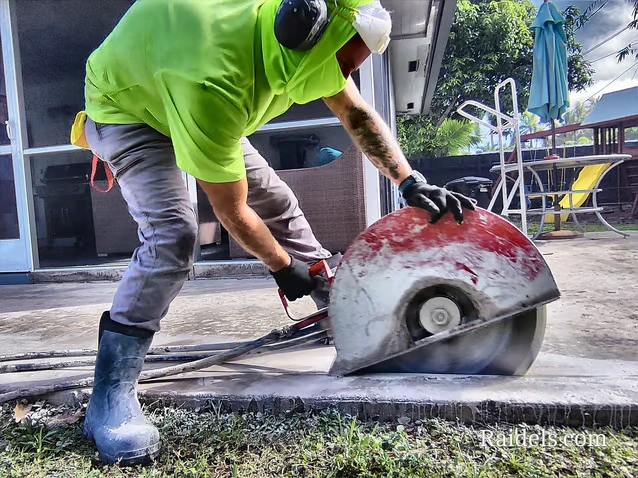
Flat saws — also called slab saws or road saws — are the workhorse of most concrete sawing services on horizontal surfaces. They are classified primarily by engine output, and that output directly dictates the maximum blade diameter and practical cutting depth achievable without lugging the engine or glazing the blade.
- Light-duty class (13–25 HP): Suitable for decorative scoring, control joint cutting in green concrete, and thin residential slabs up to 4 inches. Typical blade diameter range is 12–18 inches. These machines are not appropriate for reinforced structural concrete.
- Mid-range class (35–65 HP): The most common class for commercial slab work. Handles 4–10 inch cuts in 3,000–5,000 PSI concrete. Blade diameters from 18–24 inches. Adequate for lightly reinforced slabs with #4 rebar at 12-inch spacing.
- High-production class (65–120 HP): Required for post-tensioned slabs, heavily reinforced structural decks, and deep utility trenching. Supports blade diameters up to 36 inches with cutting depths approaching 14 inches in a single pass. Machines in this class — like the Husqvarna FS 7000 D or the Stihl BTS 800 derivatives — demand experienced operators and precise water management.
For projects across Miami-Dade County, the density and hardness of local concrete mixes — frequently incorporating oolitic limestone aggregate — pushes most commercial jobs into the mid-to-high-production class even when slab thickness alone might suggest otherwise. Aggregate hardness is as important as slab depth when selecting machine class.
Diamond Segment Geometry and Bond Hardness Matched to Concrete Aggregate Type
The diamond blade is where the science gets granular. A diamond blade is not a monolithic tool — it is an engineered system comprising a steel core, a segment bond matrix, and synthetic diamond crystals embedded at a specific concentration and grit size. Each of these variables must be matched to the concrete being cut.
Segment Bond Hardness and the Inverse Relationship with Aggregate Hardness
This is the single most misunderstood principle in blade selection. Soft bond segments are used for hard aggregate concrete. Hard bond segments are used for soft aggregate concrete. The logic is straightforward: in hard aggregate material, the diamond crystals dull quickly. A soft bond allows worn crystals to shed rapidly, continuously exposing fresh, sharp diamond to the cutting face. In soft aggregate material — like the limestone-heavy mixes common in South Florida — the aggregate itself acts as a natural bond-wearing agent. A hard bond holds the diamond longer because the material won’t wear the bond prematurely.
Mismatching bond to aggregate is the leading cause of premature blade failure in professional concrete sawing services. A hard-bond blade in hard granite aggregate will glaze over within minutes. A soft-bond blade in soft limestone will undercut, causing segment loss and potential core damage.
Diamond Concentration Ratings and Their Effect on Cut Speed Versus Blade Life
Diamond concentration is expressed as a percentage of diamond volume relative to the total segment volume, with 100 concentration equaling approximately 4.4 carats per cubic centimeter. Common commercial blades run between 25 and 50 concentration.
- Low concentration (25–30): Faster cutting, shorter blade life. Best for abrasive, softer materials where cutting speed is prioritized over longevity.
- Medium concentration (35–40): Balanced performance. Appropriate for general reinforced concrete sawing on commercial projects.
- High concentration (45–50): Slower cut rate but dramatically extended blade life. Used on extremely hard aggregates, heavily reinforced slabs, or when job economics favor blade longevity over cycle time.
Wet Cutting Flow Rates and Cooling System Requirements for Deep Structural Cuts
Water serves two functions in wet-cut concrete sawing services: it cools the blade and flushes slurry from the cut kerf. Both functions are critical, and both are frequently under-resourced on jobsites. The minimum recommended flow rate for blades up to 18 inches in diameter is 1.5 gallons per minute delivered directly to both sides of the blade. For blades 24 inches and above, that rate increases to 3–5 gallons per minute.
Insufficient water flow on deep cuts — particularly in the 10–14 inch range — creates a condition called thermal stress cracking in the steel core. The core expands unevenly, the blade begins to wobble laterally, and the cut quality degrades immediately. In post-tensioned slab work, a wandering blade presents a serious safety hazard, not just a quality issue. Operators should verify water pressure at the blade guard, not just at the supply tank, to account for line losses.
For enclosed or interior cutting environments where slurry management is critical — hospital renovations, occupied commercial spaces, or pool deck modifications — vacuum-assisted wet cutting systems are the professional standard. These systems capture slurry at the blade guard, preventing contamination of adjacent surfaces and maintaining OSHA silica exposure compliance. If you’re planning a pool renovation project, understanding how precision sawing integrates with the broader scope is worth reviewing in detail at this guide on pool reshaping and renovation.
Wall Saw and Wire Saw Equipment Specifications for Vertical and Irregular Cuts
Flat saws handle horizontal surfaces, but a significant portion of professional concrete sawing services involves vertical walls, bridge abutments, and geometrically complex structural elements. Wall saws and wire saws are the correct tools for these applications, and their specifications differ substantially from flat saw systems.
Wall Saw Track Systems and Blade Diameter Limits
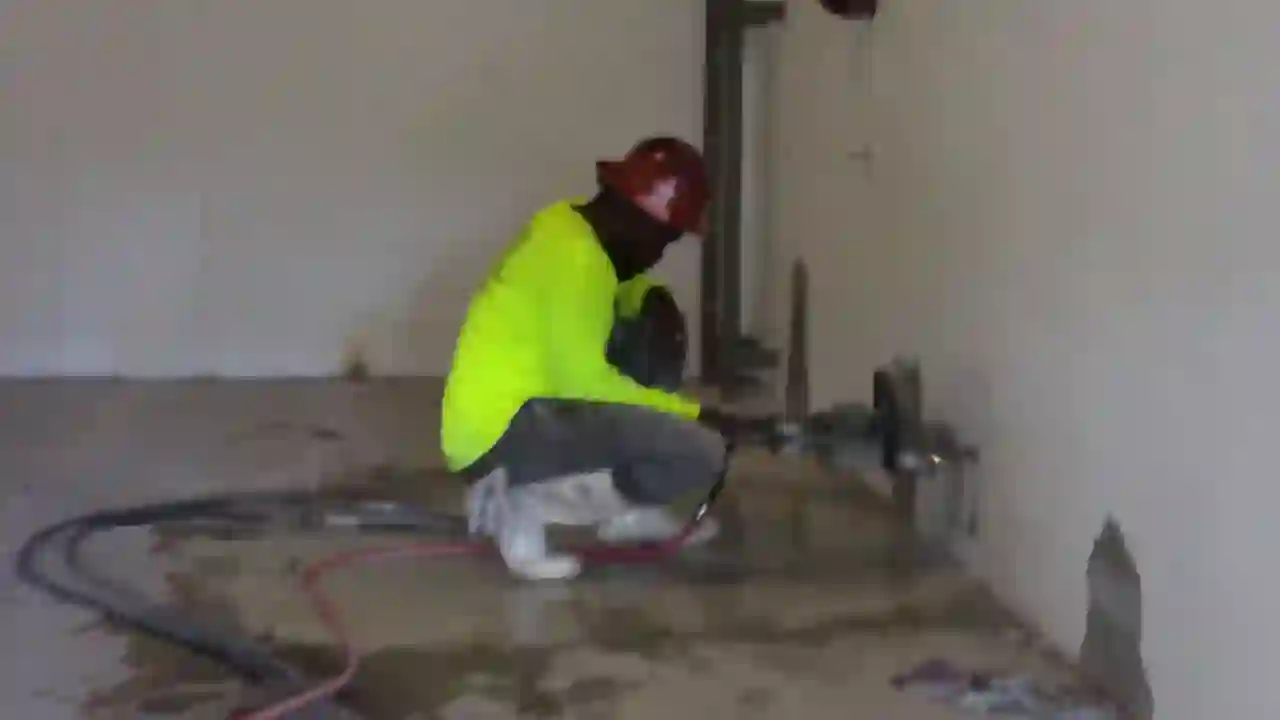
Hydraulic wall saws operate on a track system anchored to the concrete face. The hydraulic power unit — typically producing 20–30 GPM at 2,000–3,000 PSI — drives both the blade rotation and the carriage traverse. Blade diameters for wall saws commonly range from 16 to 48 inches, with cutting depth equal to approximately 40% of blade diameter. A 36-inch blade cuts to roughly 14 inches of depth from one face, meaning through-cuts on walls exceeding 28 inches require cuts from both faces.
Segment selection for wall saws follows the same bond hardness principles as flat saws, but the geometry of the cut introduces additional variables. Vertical cutting means slurry drains by gravity away from the cut face, reducing the cooling efficiency of the water supply. Flow rates for wall saw applications should be increased by 20–30% relative to equivalent flat saw operations to compensate.
Diamond Wire Saw Specifications for Complex Structural Demolition
Wire saws represent the highest capability tier in concrete sawing services. A diamond wire saw uses a continuous loop of steel cable embedded with diamond beads at regular intervals, driven by a hydraulic or electric flywheel at speeds of 20–30 meters per second. Wire diameter typically ranges from 6.3mm to 11mm depending on the application.
Wire saws are the correct choice when geometry prevents blade access, when cut profiles are curved or irregular, or when the cross-sectional area being cut exceeds what any blade diameter can address. For large-scale structural demolition and reshaping work in South Florida, the technical demands of wire saw operation are covered in depth at this resource on mastering concrete cutting and demolition for next-level construction.
How Post-Tensioned Slab Detection Changes the Entire Equipment and Blade Protocol
Post-tensioned concrete is present throughout Miami’s commercial and residential building stock, particularly in parking structures and high-rise foundations built after the 1980s. Cutting into an active post-tensioned tendon releases stored energy instantaneously — a catastrophic event that has caused fatalities on jobsites nationally.
The equipment protocol for suspected post-tensioned slabs begins before any blade touches concrete. Ground-penetrating radar (GPR) scanning must map tendon layout, rebar, conduit, and any embedded utilities. This scan data is overlaid onto the cut plan, and blade entry points are adjusted to avoid tendon paths. When cuts must pass near tendons, shallow scoring passes at 1-inch depth are used to visually confirm the scan data before proceeding to full depth.
From a blade selection standpoint, post-tensioned slabs often combine high-strength concrete (5,000–7,000 PSI) with both conventional rebar and steel tendons. This demands a medium-to-hard bond blade with high diamond concentration — prioritizing blade integrity over cut speed. The economic implications of blade selection in these scenarios are significant; for a detailed cost breakdown by cut type and material, this 2025 cost-per-linear-foot analysis provides current market data.
Storm damage scenarios add another layer of complexity — compromised slabs with unknown rebar corrosion or tendon stress loss require additional GPR verification before any sawing commences. The intersection of structural damage and cutting operations is explored further at this post on hurricane impact and pool removal, which addresses post-storm concrete assessment in a South Florida context.
Matching the Full Equipment Stack to Job Conditions Before Mobilization
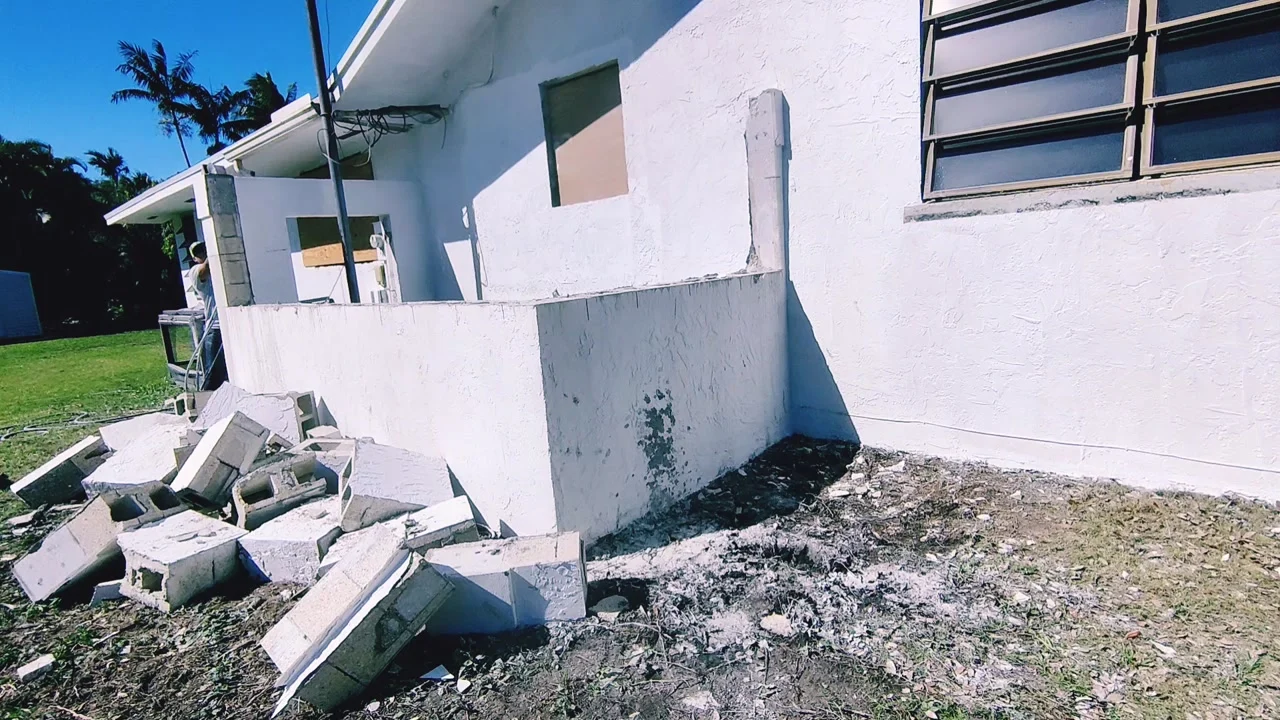
Professional concrete sawing services are not a commodity. The difference between a correctly specified equipment and tooling package and a generic one is measured in blade failures, machine downtime, cut quality, and ultimately project cost. Before any mobilization, the following specifications must be confirmed: concrete compressive strength and aggregate type, slab thickness and reinforcement schedule, presence of post-tensioning or embedded utilities, environmental constraints on slurry management, and access geometry that determines whether flat, wall, or wire saw systems are required.
Every one of these variables feeds directly into blade bond selection, diamond concentration, machine power class, and water supply requirements. Experienced concrete sawing contractors treat this pre-job specification process with the same rigor an engineer applies to a structural calculation — because the consequences of getting it wrong are just as real.