Why Site Logistics Expose the Real Capability Gap Between Concrete Saw Cutting Companies
Walk onto a straightforward flatwork slab job and almost any concrete saw cutting company can get the work done. Bring in a flat saw, run a straight line, collect a check. But the moment you introduce a parking garage ramp with a 7-foot clearance, a mechanical room buried three floors below grade, or a residential addition where the only access is a 36-inch side gate — that’s when you find out exactly what a contractor is made of. Site logistics, confined space constraints, and access limitations are the great equalizers in this trade, and the companies that master them are the ones worth calling when the stakes are high.
Pre-Job Site Assessment Is Not Optional — It Is the Entire Strategy
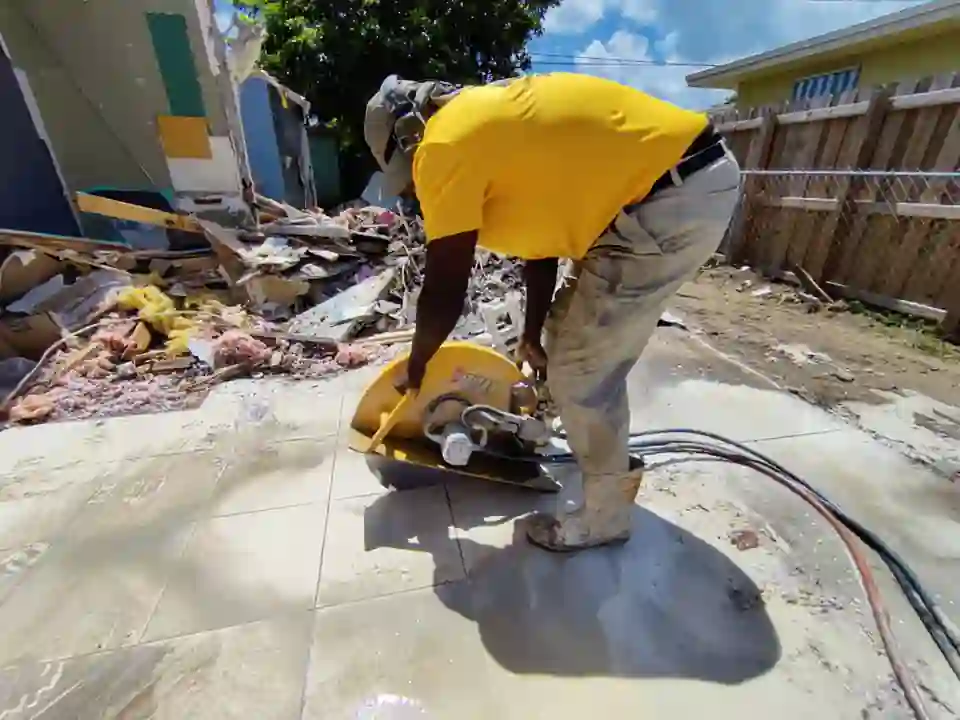
Before a single blade spins, elite concrete saw cutting companies conduct a thorough site logistics assessment. This isn’t a five-minute walkthrough. It’s a systematic evaluation of every factor that could compromise cut quality, worker safety, or project timeline. Experienced crews are looking at ceiling height clearance relative to saw handle arc, floor load ratings for equipment staging, proximity to live utilities, structural reinforcement patterns, and the availability of water supply for blade cooling and slurry control.
In Miami’s dense urban construction environment, this pre-job phase often determines whether a project is feasible with standard equipment or requires a specialized tool swap. A 65-horsepower walk-behind flat saw is useless in a mechanical room with a 5-foot-6-inch ceiling. The same cut gets executed with a hydraulic hand saw or a ring saw rated for the confined geometry. Companies that skip this assessment phase consistently underperform on complex jobs — and sometimes create dangerous conditions that delay entire projects.
For property owners considering modifications to existing slabs, understanding what’s possible before cutting begins is critical. Our detailed breakdown on cutting existing concrete patios walks through the feasibility assessment process in detail.

Confined Space Concrete Cutting Protocols That Protect Crews and Structural Integrity
OSHA’s confined space regulations (29 CFR 1910.146) apply directly to many concrete cutting scenarios — and most general contractors are surprised to learn that a below-grade mechanical room, a crawl space over 18 inches deep, or an enclosed parking structure with limited ventilation can all qualify as permit-required confined spaces. Concrete saw cutting companies operating in these environments must have documented confined space entry programs, atmospheric testing equipment, and rescue plans in place before work begins.
From a technical standpoint, confined space cutting introduces several compounding challenges:
- Exhaust and ventilation management — Gas-powered saws are categorically prohibited in enclosed spaces without forced-air ventilation systems. Electric and hydraulic-powered saws are the standard solution, but they require a power pack or hydraulic power unit staged outside the confined area, with hose runs that can extend 50 feet or more.
- Slurry containment and removal — In a confined space, wet cutting slurry has nowhere to drain naturally. Crews must use wet-dry vacuums, slurry pumps, and containment berms to prevent the silica-laden water from pooling around workers or migrating toward electrical panels.
- Dust suppression under restricted airflow — Even with water cooling, fine concrete dust accumulates rapidly in low-ventilation environments. Respiratory protection at N95 minimum is mandatory, and many professional crews use powered air-purifying respirators (PAPRs) for extended confined space operations.
- Vibration and structural monitoring — In tight spaces adjacent to load-bearing elements, saw vibration can transfer unexpectedly through the slab matrix. Experienced operators use reduced feed rates and monitor for cracking beyond the cut line.
Equipment Selection for Access-Restricted Job Sites in South Florida
The tool selection process for access-limited sites is where technical knowledge separates competent concrete saw cutting companies from truly capable ones. There is no universal solution — the right equipment depends on the intersection of slab thickness, reinforcement density, ceiling height, available power source, and the geometry of the required cut.
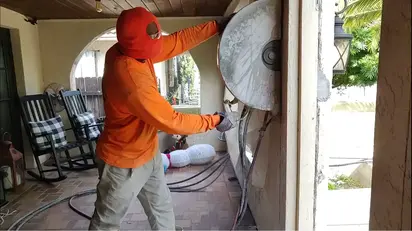
For door enlargements and wall openings in confined residential or commercial spaces, the 20-inch hydraulic hand saw has become the industry standard for good reason. It delivers the torque needed to cut through 8-inch reinforced concrete walls while maintaining a compact footprint that operators can maneuver in corridors as narrow as 4 feet. We’ve documented the operational specifics of this tool extensively in our post on mastering door enlargements with the 20-inch hydraulic hand saw.
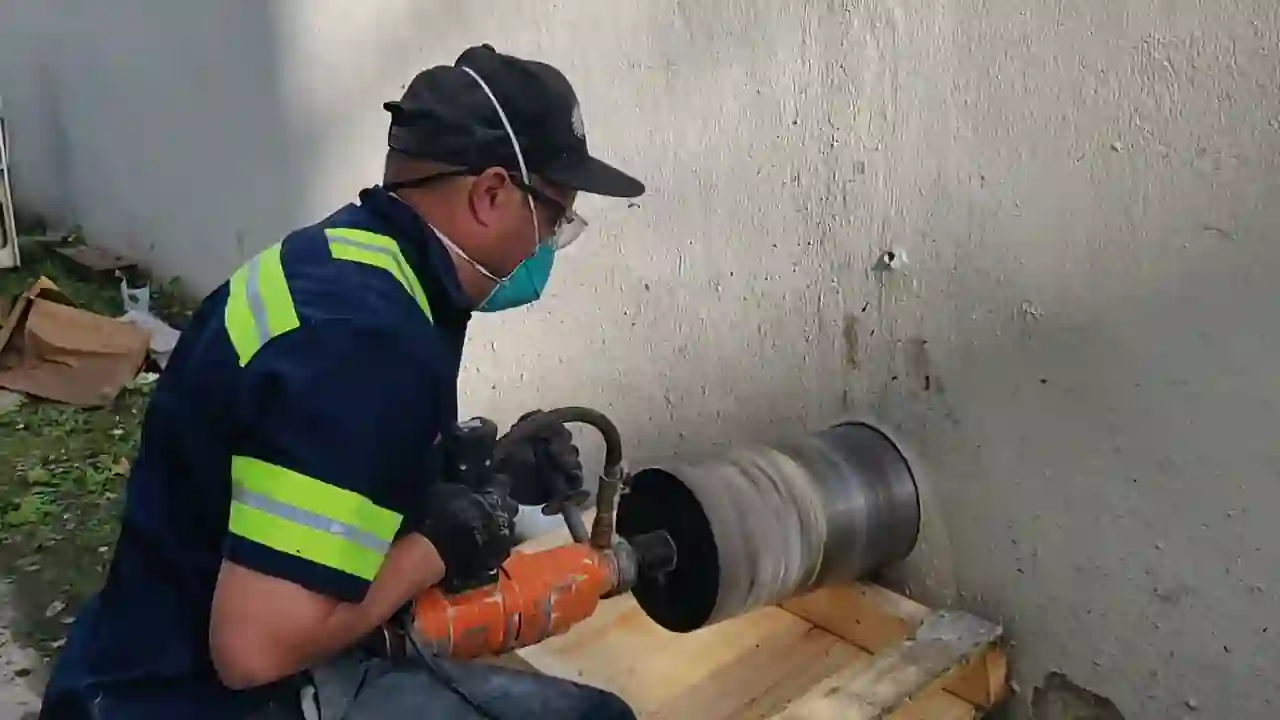
For horizontal slab cuts in below-grade environments, the electric flat saw with a variable-speed drive controller allows operators to dial in blade RPM based on aggregate hardness and reinforcement spacing without relying on combustion power. Core drill rigs with magnetic base mounts become essential when floor-mounted anchoring isn’t possible due to existing utility penetrations or surface finishes that cannot be damaged.
Slurry Management and Environmental Compliance on Tight Urban Sites
Miami-Dade County stormwater regulations prohibit concrete slurry from entering storm drains, and the fines for non-compliance are substantial. On open job sites with adequate staging area, slurry management is straightforward — containment berms, settling tanks, and vacuum trucks. On access-restricted urban sites, the logistics become considerably more complex.
Professional concrete saw cutting companies operating in tight urban environments use a combination of portable slurry containment systems, high-capacity wet-dry vacuums with HEPA filtration, and on-site solidification agents that convert wet slurry into a solid waste that can be bagged and disposed of as construction debris rather than liquid waste. This approach is particularly critical in high-rise renovation projects where the nearest floor drain may be 200 feet from the cut location.
Understanding the common pitfalls in slurry management and overall site preparation is something every project manager should review before mobilization. Our post on common mistakes to avoid when concrete cutting covers several slurry-related errors that cause project delays and regulatory headaches.
Coordinating With Structural Engineers on Load-Bearing Cut Sequences
When access limitations force cuts near or through load-bearing elements, the sequence of cuts matters as much as the method. Removing too much concrete from a structural element without temporary shoring in place can trigger immediate deflection or, in worst-case scenarios, progressive collapse. Elite concrete saw cutting companies maintain working relationships with licensed structural engineers and understand how to read structural drawings to identify post-tensioned tendons, rebar cage configurations, and shear transfer zones before committing a blade to concrete.
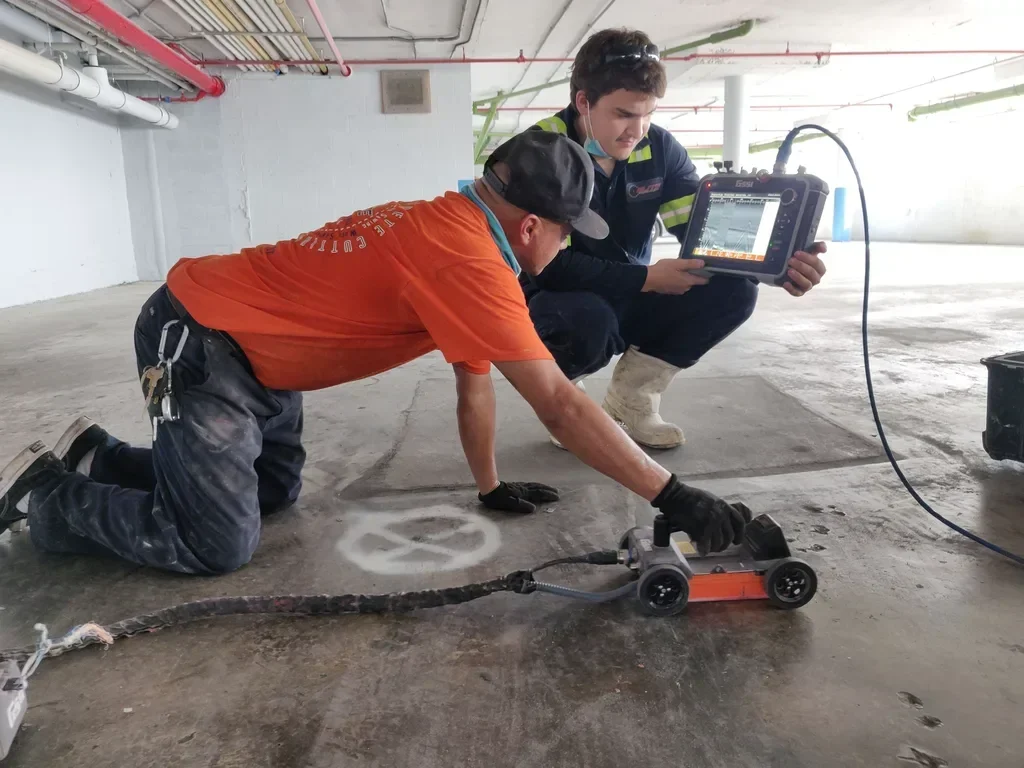
In post-tensioned slabs — common in Miami’s mid-rise residential construction — a blade contacting a live tendon releases stored energy violently. The saw operator, the equipment, and surrounding structural elements are all at risk. Ground-penetrating radar (GPR) scanning prior to cutting is non-negotiable on any post-tensioned slab, regardless of how straightforward the cut appears on paper. Companies that treat GPR scanning as an optional upsell rather than a standard safety protocol are operating below the acceptable threshold of professional practice.
Speed Versus Precision When Site Conditions Demand Both
General contractors frequently ask concrete saw cutting companies to prioritize speed — and on straightforward open-site work, production rates are a legitimate metric. But on access-restricted, confined-space, or logistically complex jobs, the fastest method is rarely the most appropriate one. The fastest method and the most controlled method diverge significantly when you’re working in a 6-foot-wide mechanical corridor adjacent to active electrical conduit.
For those who want to understand the full spectrum of cutting speed options and where each method fits in the production hierarchy, our analysis of the fastest ways to cut concrete provides a detailed method comparison. The key takeaway for complex sites is that speed is a function of preparation — crews that invest time in proper setup, equipment staging, and hazard mitigation consistently outperform crews that rush mobilization and encounter avoidable delays mid-cut.
What to Demand From Any Concrete Saw Cutting Company Before Signing a Contract
If your project involves any of the site conditions discussed here — confined spaces, restricted access, post-tensioned slabs, or proximity to active utilities — the vetting process for your concrete saw cutting contractor should be rigorous. Here’s the minimum standard:
- Documented confined space entry program — Ask to see it. If they don’t have one in writing, they aren’t equipped for confined space work.
- GPR scanning capability or established scanner partnership — In-house or subcontracted, the capability must exist before mobilization.
- Equipment inventory appropriate for the site geometry — Verify they own or have access to hydraulic hand saws, electric flat saws, and ring saws — not just gas-powered walk-behind units.
- Slurry containment and disposal plan — This should be site-specific, not a generic statement about “following best practices.”
- Proof of liability insurance and workers’ compensation — Standard requirement, but verify the coverage limits are appropriate for the project value.
- References from comparable confined-space or access-restricted projects — Generic references from open-site flatwork jobs don’t demonstrate the specific capability set you need.
The difference between a concrete saw cutting company that can handle your job and one that will struggle through it is almost always visible before the first cut is made. It shows up in how they assess the site, how they answer technical questions, and what equipment rolls off their truck. In Miami’s competitive construction market, the right contractor isn’t always the lowest bid — it’s the one whose operational sophistication matches the complexity of what your project actually demands.