Why Your Concrete Cutting Price Sheet Reflects Far More Than Equipment and Labor Hours
When a project manager or general contractor requests a concrete cutting price sheet, the instinct is to scan straight to the bottom line. That’s understandable — budgets are tight, timelines are compressed, and concrete cutting is rarely the glamorous line item anyone wants to linger on. But here’s what separates experienced contractors from those who get burned mid-project: every figure on a professionally generated concrete cutting price sheet is a direct reflection of the safety infrastructure, OSHA compliance overhead, and hazard mitigation protocols that a legitimate cutting crew brings to your site. Strip those out to chase a lower number, and you’re not saving money — you’re buying liability.
At Concrete Cutting Miami, LLC, we build every price sheet from the ground up — starting with a job-site hazard assessment, not a rate card. What follows is a detailed breakdown of the safety and compliance factors that shape our pricing, so you can evaluate any quote you receive with the technical confidence of someone who actually understands the work.
Pre-Cut Hazard Assessment and Its Direct Impact on Quoted Rates
Before a single diamond blade touches reinforced concrete, a qualified crew chief must conduct a formal pre-cut hazard assessment. This isn’t a walkthrough — it’s a structured evaluation that covers embedded utilities, post-tension cable locations, structural load paths, ambient silica dust exposure risk, and proximity to occupied spaces. Under OSHA 29 CFR 1926 Subpart Q, concrete and masonry construction operations carry specific pre-task planning requirements, and failure to document them exposes both the subcontractor and the GC to citation and stop-work orders.
On a concrete cutting price sheet, this assessment typically appears as a mobilization or site evaluation line item. Crews that skip it and offer a flat rate based on linear footage alone are cutting corners — literally and figuratively. For projects involving complex site access challenges, that pre-assessment cost can escalate significantly, particularly when equipment staging, overhead clearance, and confined-space entry protocols are involved.
GPR Scanning as a Non-Negotiable Safety Line Item
Ground-penetrating radar (GPR) scanning is one of the most misunderstood line items on a concrete cutting price sheet. Clients sometimes push back on it as an “optional” add-on. It is not optional — it is a risk-control measure that OSHA’s general duty clause effectively mandates when cutting into slabs or walls where utility strikes or post-tension cable severance could cause serious injury or death. A GPR scan of a 10-foot wall section can take 20–45 minutes and requires a trained operator reading real-time data on a screen while marking the surface. That labor and equipment cost is non-negotiable on any safety-compliant price sheet.
Post-tension cable severance is particularly dangerous in South Florida construction, where PT slabs are standard in high-rise and commercial builds. A severed cable under tension can recoil with lethal force. Any price sheet that doesn’t account for GPR scanning in PT slab environments should be rejected outright.
Silica Dust Control Protocols Under OSHA 29 CFR 1926.1153
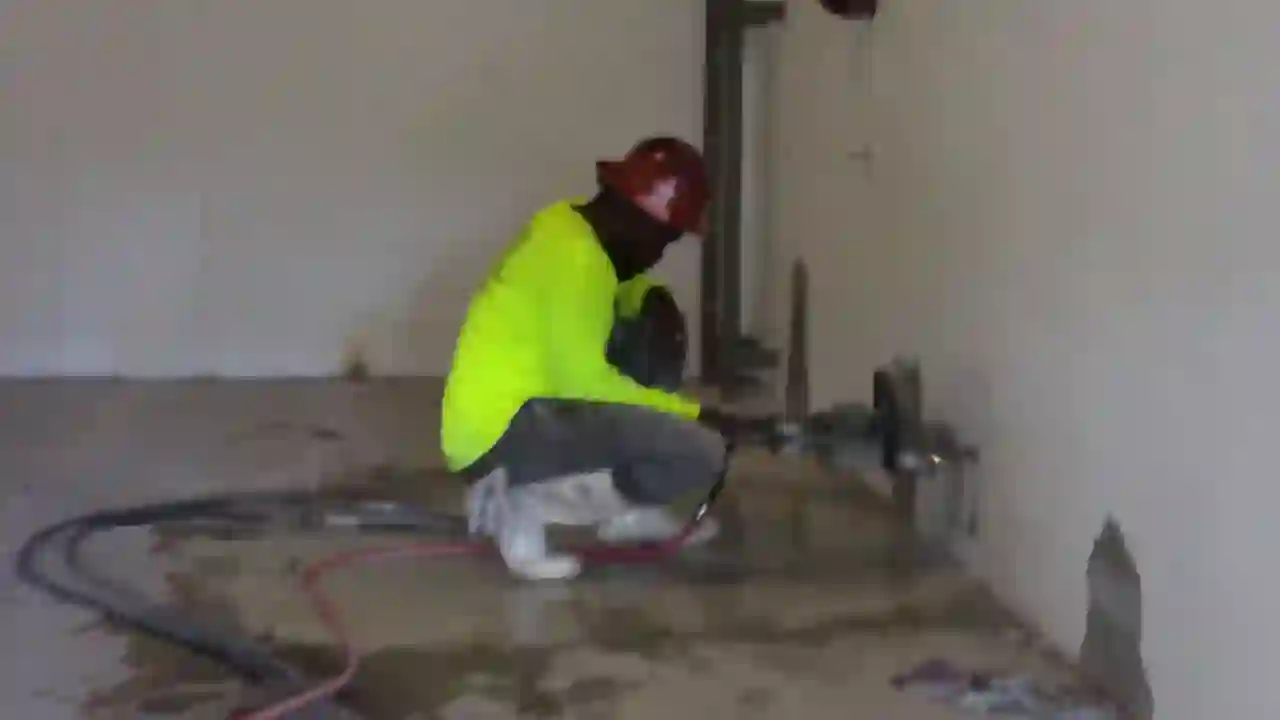
The OSHA respirable crystalline silica standard for construction — 29 CFR 1926.1153 — fundamentally changed the cost structure of concrete cutting operations when it took full effect. The permissible exposure limit (PEL) is now 50 micrograms per cubic meter of air as an 8-hour time-weighted average, with an action level of 25 µg/m³. Compliance requires one of three approaches: engineering controls (wet cutting or integrated vacuum shroud systems), air monitoring, or a combination of both.
On a concrete cutting price sheet, silica control shows up in several ways. Wet cutting operations require water supply logistics, slurry containment, and disposal — all of which carry cost. Dry cutting with HEPA-filtered vacuum systems requires equipment that represents a significant capital investment. Respirator programs, medical surveillance for workers with silica exposure, and written exposure control plans all add overhead that legitimate contractors build into their rates. If a quote seems unusually low, ask the contractor directly how they achieve OSHA 1926.1153 compliance. The answer will tell you everything.
Slurry Management and Environmental Compliance in Miami-Dade County
Wet cutting generates concrete slurry — a high-pH waste stream that cannot be discharged into storm drains under Miami-Dade County environmental regulations or EPA guidelines. Proper slurry management involves containment berms, vacuum extraction, neutralization agents, and licensed disposal. On projects near waterways, additional NPDES permit compliance may apply. These aren’t bureaucratic nuisances — they’re real costs that appear on a compliant concrete cutting price sheet as waste management or environmental compliance line items. For Miami pool excavation and deck work near drainage systems, this cost can be substantial.
Structural Load Monitoring and Shoring Requirements During Active Cuts
Core drilling and wall sawing in load-bearing applications require more than just skilled operators — they require a temporary works strategy. OSHA 29 CFR 1926.701 prohibits work on concrete structures unless the concrete has achieved sufficient strength and temporary support is in place where required. On a price sheet, this translates to shoring and bracing labor, engineer-stamped temporary works drawings in some cases, and extended setup time that gets billed at crew-hour rates.
For window opening enlargement projects in Miami’s existing residential and commercial stock, this is especially relevant. Enlarging an opening in a concrete masonry unit (CMU) or cast-in-place wall requires a lintel installation sequence that must be coordinated with the cutting scope. A price sheet that doesn’t include shoring labor for structural cuts is either assuming the GC handles it — which needs to be explicitly stated — or it’s omitting a critical safety requirement.
Confined Space Entry Protocols and Their Billing Structure
Any concrete cutting operation conducted in a permit-required confined space — defined under OSHA 29 CFR 1910.146 — requires an entry permit, an attendant stationed outside the space, atmospheric monitoring equipment, and a rescue plan. This applies to utility vaults, tunnels, mechanical pits, and certain below-grade applications. The attendant alone represents a full labor unit that does no cutting — their sole function is worker safety and emergency response. That cost appears on a price sheet as confined space entry compliance, and it’s non-negotiable.
For concrete drilling services in below-grade or enclosed environments, always verify that the contractor’s price sheet explicitly addresses confined space protocols. Omission is a red flag.
Noise, Vibration, and Neighbor Notification Requirements
Miami-Dade County noise ordinances and OSHA’s occupational noise exposure standard (29 CFR 1926.52) both impose requirements on concrete cutting operations. Wall saws and wire saws operating in close proximity to occupied structures generate noise levels that can exceed 100 dB at the operator position, requiring hearing protection programs and engineering controls. In occupied commercial buildings or residential high-rises, after-hours work scheduling to minimize occupant exposure adds overtime labor costs to the price sheet.
Whole-body vibration and hand-arm vibration from handheld cutting equipment are also regulated under general duty clause provisions, and progressive contractors account for operator rotation schedules that limit daily exposure — which affects crew sizing and, therefore, pricing. For a deeper technical review of hydraulic equipment safety on active job sites, our detailed guide on hydraulic concrete saws and OSHA compliance covers the operational protocols every crew chief should have memorized before mobilizing.
Reading a Concrete Cutting Price Sheet Like a Safety Professional
A well-structured concrete cutting price sheet should itemize the following safety-related cost categories separately from raw cutting rates:
- Pre-task hazard assessment and GPR scanning fees — typically billed per mobilization or per scan zone
- Silica exposure control method — wet cutting water logistics or HEPA vacuum system deployment
- Slurry containment and disposal — especially critical for concrete surface repair and resurfacing scopes
- Shoring and temporary works coordination — billed per structural cut sequence
- Confined space entry compliance — attendant labor and atmospheric monitoring equipment
- PPE and respiratory protection program overhead — amortized across crew hours
- After-hours or noise-restricted scheduling premiums — overtime or weekend rates
- OSHA-required documentation and recordkeeping — exposure control plans, entry permits, safety data sheets
If a price sheet you receive is a single-line quote with a footage rate and nothing else, ask for the safety compliance breakdown. Any contractor who can’t produce it is either not compliant or is planning to transfer that risk to your project.
The True Cost of Choosing a Non-Compliant Cutting Contractor
OSHA citations for concrete cutting violations — particularly silica exposure failures and confined space non-compliance — carry penalties that now reach $15,625 per serious violation and up to $156,259 for willful or repeat violations. General contractors can be cited for the acts of their subcontractors under the multi-employer worksite policy. That means a $500 savings on a cutting subcontract can expose a GC to six-figure OSHA liability. Beyond fines, a worker injury on a non-compliant site triggers workers’ compensation claims, project delays, and potential civil litigation that dwarfs any line-item savings.
When you evaluate a concrete cutting price sheet from Concrete Cutting Miami, LLC, you’re looking at a document built on documented hazard controls, OSHA-compliant procedures, and the operational infrastructure of a crew that has been doing this work safely in South Florida’s demanding construction environment for years. The numbers reflect real compliance costs — and they protect you as much as they protect our workers.
Request your detailed, itemized concrete cutting price sheet from our team today, and get the technical breakdown your project deserves.