Why Hydraulic Concrete Saws Demand a Different Safety Mindset Than Electric or Gas Units
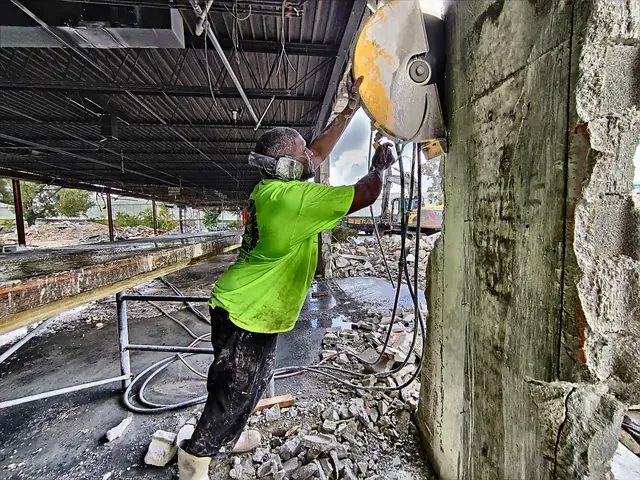
Hydraulic concrete saws operate at a fundamentally different power level than their electric or gas-powered counterparts. Driven by a hydraulic power unit (HPU) capable of delivering anywhere from 8 to 30 gallons per minute at pressures exceeding 2,000 PSI, these machines generate torque figures that can overwhelm an unprepared operator in a fraction of a second. The blade doesn’t just spin — it stores rotational energy that, under a kickback event, can launch material or torque the saw body violently. On South Florida job sites, where we’re cutting through post-tensioned slabs, reinforced grade beams, and high-density aggregate mixes, that power density is exactly what the work demands. But it also means the margin for error is effectively zero.
Most jobsite incidents involving hydraulic saws don’t happen because operators are careless — they happen because the hazard assessment was incomplete before the blade ever touched the slab. This post breaks down the specific safety protocols, regulatory requirements, and hazard-avoidance strategies that experienced concrete cutting crews use every single day. If you’re a general contractor, project manager, or crew chief overseeing cutting operations, this is the technical grounding you need.
Understanding the OSHA Regulatory Framework for Hydraulic Concrete Cutting Operations
OSHA doesn’t have a single dedicated standard for hydraulic concrete saws, but that doesn’t mean the regulatory landscape is thin. Multiple overlapping standards apply simultaneously, and enforcement officers are increasingly sophisticated about how they apply them to concrete cutting operations.
- 29 CFR 1926.57 (Ventilation) — Governs airborne contaminant control in construction environments, directly applicable to silica and slurry mist generated during wet cutting.
- 29 CFR 1926.1153 (Respirable Crystalline Silica in Construction) — The most consequential standard for concrete cutting crews. Establishes a Permissible Exposure Limit (PEL) of 50 µg/m³ as an 8-hour TWA and an Action Level of 25 µg/m³.
- 29 CFR 1926.302 (Power-Operated Hand Tools) — Applies to saw guarding, operator training, and tool inspection requirements.
- 29 CFR 1910.217 and 1910.147 (Lockout/Tagout) — Critical when servicing hydraulic lines, swapping blades, or clearing blade jams. The HPU must be de-energized and pressure bled before any maintenance contact.
The silica standard deserves special emphasis. Under Table 1 of 1926.1153, hydraulic handheld saws used for cutting concrete must be operated with integrated water delivery systems supplying a minimum flow rate to the blade. OSHA’s compliance hierarchy places engineering controls — specifically wet cutting and local exhaust ventilation (LEV) — above respiratory protection. Running a hydraulic saw dry, even briefly, is a Table 1 violation that can trigger immediate citation.
Hydraulic Fluid Injection Injuries — The Hidden Hazard Nobody Talks About Enough
Every safety briefing covers blade contact and kickback. Far fewer cover hydraulic fluid injection injuries, and that gap costs people fingers, hands, and sometimes entire limbs. A pinhole leak in a high-pressure hydraulic hose — even one invisible to the naked eye — can inject fluid through skin at pressures sufficient to cause deep tissue destruction, nerve damage, and systemic toxicity. The entry wound is often so small that workers dismiss it as a minor cut, delaying treatment until necrosis has already begun.
The protocol is non-negotiable: never use bare hands to locate hydraulic leaks. Use a piece of cardboard or a dedicated leak-detection wand. Inspect hoses before every shift for abrasion, kinking, and fitting integrity. Any hose showing outer braid exposure must be pulled from service immediately — not tagged for later, not wrapped with tape. The hydraulic system on a concrete saw runs hot and at sustained high pressure; degraded hoses fail catastrophically, not gradually.
If a fluid injection injury occurs, it must be treated as a surgical emergency. Instruct workers during toolbox talks that these injuries require immediate emergency room care — not a bandage and an ice pack.
Pre-Cut Site Assessment Protocols That Prevent Blade Contact With Embedded Hazards
Cutting into an unknown slab is one of the most dangerous acts in the concrete trades. Post-tensioned tendons, live electrical conduit, active water lines, and gas piping are all routinely embedded in slabs across Miami’s residential and commercial building stock. A hydraulic saw blade contacting a live post-tension tendon releases stored energy equivalent to a rifle shot — the tendon snaps outward with lethal force.
Mandatory pre-cut protocols include:
- GPR (Ground Penetrating Radar) scanning — Required on any slab where structural drawings are unavailable or unverified. GPR identifies rebar layout, conduit runs, and PT tendon placement to a depth of 18–24 inches in most concrete mixes.
- Utility locates — Call 811 and obtain a written clearance ticket. For interior work, coordinate with the building’s MEP subcontractors directly to identify active runs not captured in as-builts.
- Structural consultation — On load-bearing slabs, a structural engineer must approve the cut layout and confirm that the proposed kerf path won’t compromise slab integrity or redistribution of loads. This is especially critical in wall opening projects where header loads are a concern.
- Depth gauge calibration — Set blade depth to the minimum required for the cut. Overcutting into substrates below the target slab is a leading cause of utility strikes.
PPE Requirements Specific to Hydraulic Saw Operation — Beyond the Basics
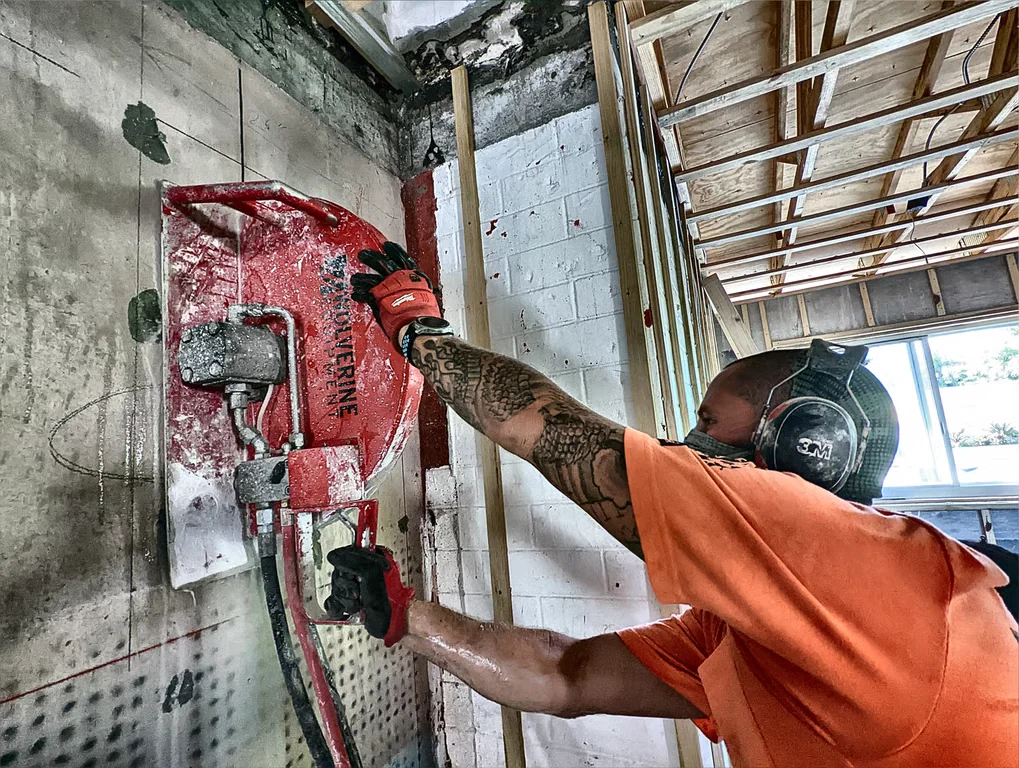
Standard PPE checklists — hard hat, safety glasses, steel-toed boots — are a starting point, not a complete picture for hydraulic saw operators. The following PPE is specifically required for this equipment category:
- Face shield (ANSI Z87.1 rated) — Safety glasses alone are insufficient. Blade fragmentation events and slurry ejection require full-face protection. The shield must be worn over safety glasses, not instead of them.
- Half-face respirator with P100 and OV cartridges — Required when wet cutting is insufficient to suppress silica levels below the Action Level, or during any dry cutting operation. Fit testing is mandatory under 1926.1153.
- Cut-resistant gloves (ANSI A4 minimum) — Protects against blade contact during positioning and against hydraulic hose abrasion.
- Hearing protection (NRR 25 or higher) — Hydraulic saws operating at full load generate 95–105 dB at the operator position. Sustained exposure without protection causes permanent hearing loss within months, not years.
- Wet-weather rated non-slip boots — Wet cutting creates a slick slurry surface. Boot traction is a critical fall-prevention measure, particularly on elevated slabs or during residential construction projects where work surfaces are irregular.
Heat Stress Management During Extended Hydraulic Saw Operations in South Florida
Miami’s climate introduces a compounding hazard that crews in northern states rarely contend with at the same intensity: heat stress. Operating a hydraulic saw in full PPE — face shield, respirator, gloves, hearing protection — in direct sun at 92°F with 85% humidity creates a physiological load that can incapacitate an operator within two hours without proper management. Core body temperature elevation impairs judgment and reaction time before the worker feels significantly distressed, which is what makes it so dangerous with high-powered equipment.
Our crews follow a structured heat stress prevention protocol on every job. For detailed guidance on how we implement this on South Florida sites, review our resources on heat stress prevention in concrete cutting operations. Key field measures include mandatory shade rest cycles (minimum 10 minutes per hour in ambient temps above 90°F), electrolyte replacement beyond plain water, and a buddy system requiring operators to visually check each other for early heat illness signs — confusion, cessation of sweating, and skin flushing.
Slurry Management and Environmental Compliance on the Job Site
Wet cutting is the primary engineering control for silica suppression, but it creates a secondary compliance obligation: slurry containment. Concrete cutting slurry has a pH of 11–12 — highly alkaline — and contains suspended crystalline silica, heavy metals from aggregate, and potentially petroleum residue from prior floor coatings. Allowing slurry to enter storm drains is a Clean Water Act violation that can result in fines exceeding $25,000 per day per incident.
Proper slurry management requires berms or vacuum recovery systems positioned at all drainage points before cutting begins. On projects like indoor pool removal, where large volumes of concrete are being cut and the work area is a contained basin, slurry volumes can be substantial and must be pumped into approved waste containers for off-site disposal through a licensed concrete slurry hauler.
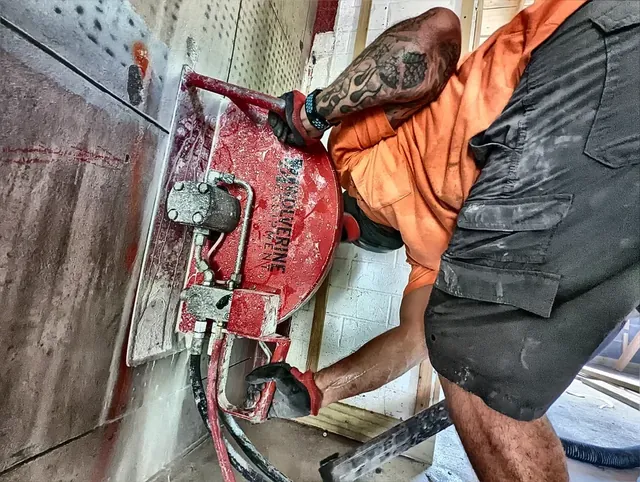
Blade Guard Integrity and Hydraulic Saw Inspection Checklists Before Every Shift
OSHA 1926.302 requires that power-operated tools be maintained in safe operating condition. For hydraulic concrete saws, this translates to a documented pre-shift inspection covering the following critical points:
- Blade guard coverage — The guard must cover at least 180° of the blade arc. Any guard that is cracked, bent, or missing fasteners must be replaced before operation.
- Diamond segment integrity — Visually inspect all segments for cracks, missing material, or unusual wear patterns. A segment separating at operating speed becomes a projectile with energy comparable to a high-caliber round.
- Arbor bolt torque verification — Use a calibrated torque wrench. Under-torqued arbor bolts allow blade wobble that accelerates segment wear and increases kickback risk.
- Water delivery system function — Verify that water ports are clear and delivering flow to both sides of the blade before the first cut of the day.
- Hydraulic line inspection — Check all connections, hose runs, and couplings as described in the fluid injection hazard section above.
These inspections must be logged. OSHA compliance officers increasingly request inspection records during site audits, and the absence of documentation is treated as evidence of non-compliance regardless of actual equipment condition.
Operator Certification and Training Requirements That Actually Reduce Incident Rates
There is no federally mandated certification specific to hydraulic concrete saw operation, but that does not mean training is optional. OSHA’s general duty clause (Section 5(a)(1)) requires employers to provide training sufficient to protect workers from recognized hazards. In practice, this means hydraulic saw operators must demonstrate documented competency in equipment operation, hazard recognition, emergency response, and silica exposure controls before working independently.
Programs from the Concrete Sawing and Drilling Association (CSDA) provide the most technically rigorous operator training available in the industry. CSDA’s ST-100 and ST-102 standards cover equipment-specific safety protocols and are recognized by OSHA as evidence of good-faith compliance effort. Beyond certification, experienced crew chiefs conduct site-specific orientations before every new project — because the hazards at a high-rise core drill are categorically different from those at a residential slab cut, and operators need to understand the specific risk profile of each environment they enter.
The data is consistent across the industry: crews with documented training programs and pre-task safety planning have incident rates 60–70% lower than those relying on informal on-the-job instruction alone. When you’re working with equipment capable of the force output that hydraulic concrete saws deliver, that gap isn’t a statistic — it’s the difference between a crew that goes home whole and one that doesn’t.