Why Pool Deck Cutting in Miami Demands a Different Equipment Conversation Entirely
Pool decks in Miami are not standard flatwork. Anyone who has pulled a blade through a 30-year-old poured-in-place deck surrounding a residential pool in Coral Gables or a commercial aquatic facility in Doral knows immediately that the mix designs, aggregate compositions, rebar density, and surface coatings create a cutting environment that punishes generic tooling fast. Miami’s subtropical humidity, proximity to saltwater, and the prevalence of locally sourced limestone aggregate combined with hard silica river rock create wildly inconsistent hardness profiles within a single slab. Choosing the wrong diamond blade or running the wrong flat saw RPM range on a Miami pool deck doesn’t just slow the job — it destroys tooling, generates dangerous heat, and compromises the precision of every expansion joint, control joint, or demolition cut you’re trying to execute. This post is a deep technical breakdown of the equipment specifications, diamond segment configurations, and blade selection logic that experienced concrete cutting contractors apply specifically to pool deck work in South Florida.
Reading the Slab Before a Single Blade Touches the Surface
Pre-cut slab assessment is non-negotiable on Miami pool decks. Before specifying any tooling, a competent crew runs a ground-penetrating radar (GPR) scan to map rebar placement, post-tension cables if present, and embedded conduit — all common in commercial pool surrounds built after the 1990s. The slab thickness on residential pool decks in Miami typically ranges from 3.5 inches to 5 inches, while commercial aquatic facility decks can run 6 to 8 inches with #4 or #5 rebar on 12-inch centers. That thickness and rebar density directly dictates your blade diameter selection and the horsepower rating of the saw you’re mounting it on.
Equally important is performing a quick Mohs hardness field test on exposed aggregate. Miami pool decks frequently contain a blend of oolitic limestone (relatively soft at 3–4 Mohs) and quartz-bearing river gravel (6.5–7 Mohs). This bi-modal hardness profile is where most blade selection errors happen. Contractors familiar with advanced concrete cutting techniques in Miami understand that a blade optimized for pure limestone will glaze over instantly when it hits a quartz cobble pocket. You need a hybrid segment specification, and we’ll get into exactly what that looks like.
Flat Saw Specifications for Pool Deck Cutting in South Florida Conditions
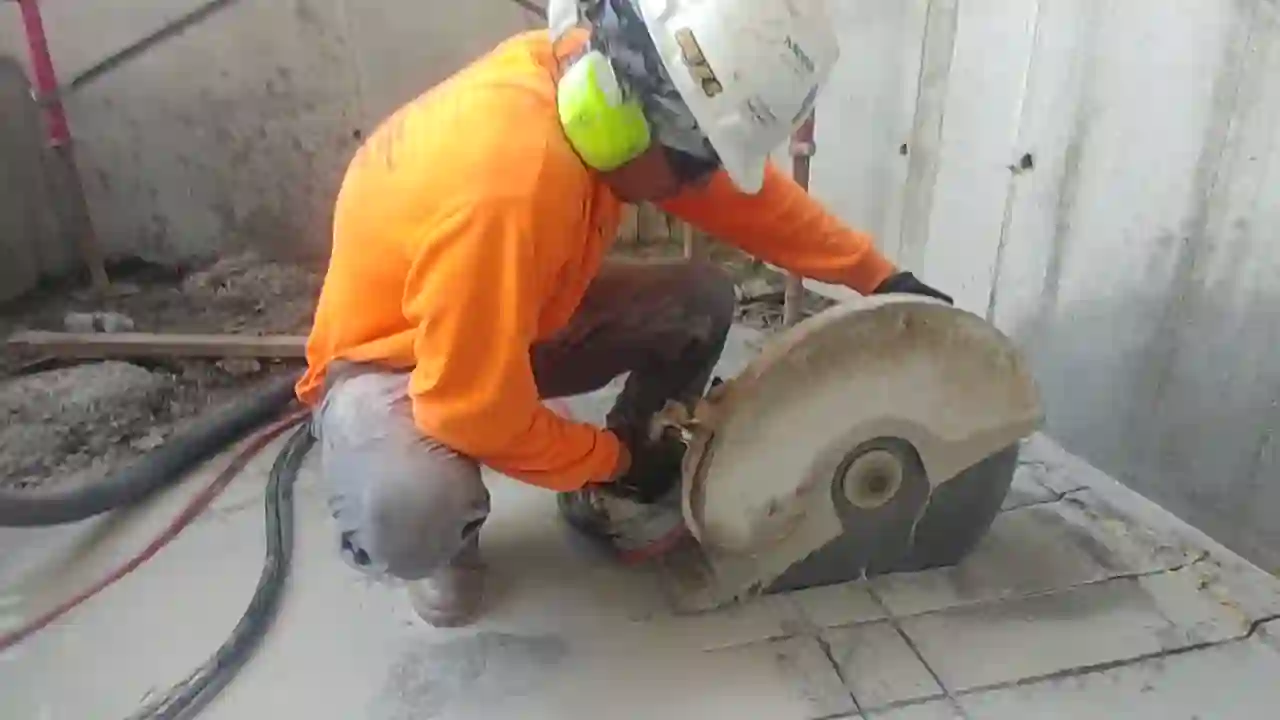
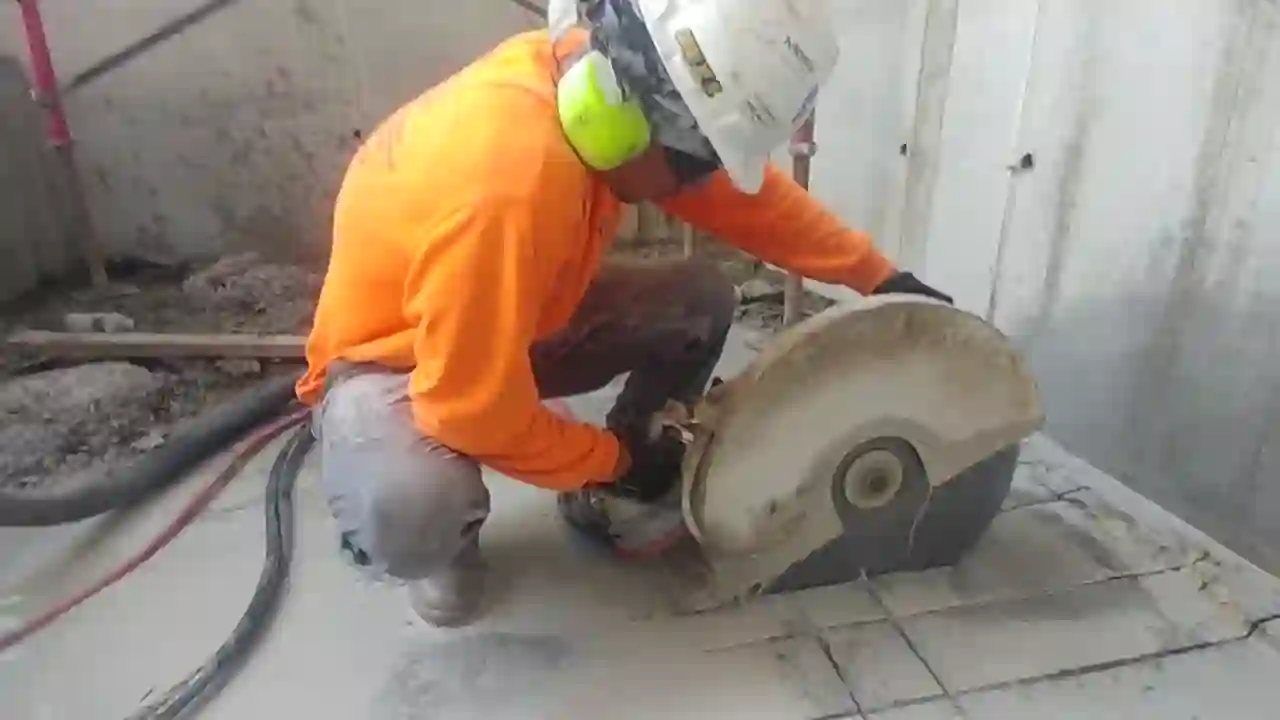
The walk-behind flat saw is the primary tool for pool deck joint cutting, partial demolition cuts, and resurfacing prep work. For Miami pool deck applications, the following machine specifications represent the professional standard:
- Engine output: Minimum 25 HP (gasoline) or 20 HP equivalent (electric, where available for indoor natatorium work). Underpowered saws stall in hard aggregate pockets and cause blade wobble that widens kerfs beyond spec tolerance.
- Blade shaft speed: Variable RPM capability between 1,450 and 2,800 RPM. Hard aggregate conditions require lower surface feet per minute (SFPM) to prevent diamond matrix overheating. Target SFPM of 9,000–11,000 for mixed-hardness Miami pool deck aggregate.
- Blade guard water delivery: Dual-port flood cooling delivering a minimum of 2.5 gallons per minute at the blade contact zone. Miami’s ambient temperatures regularly exceed 90°F, which accelerates blade core thermal stress. Inadequate water flow is the single fastest way to crack a blade core on a hot August afternoon in Hialeah.
- Depth capacity: For 4-inch slabs, a 14-inch blade diameter provides adequate depth with safety margin. For 6-inch commercial decks, step up to an 18-inch blade on a saw rated for that diameter — do not push a 14-inch blade to its maximum depth on a hard-aggregate slab.
- Blade arbor size: 1-inch bore is standard for most professional flat saws in this range. Verify arbor compatibility before sourcing blades — this is a surprisingly common field error on multi-contractor job sites.
Diamond Segment Specifications for Mixed-Hardness Miami Aggregate
Diamond blade segment engineering is where the real technical differentiation happens. For Miami pool deck cutting, the following segment specifications consistently outperform generic construction blades:
- Diamond concentration: Medium-high concentration (40–50 on the industry concentration scale) is appropriate for the mixed aggregate profile described above. High-concentration segments designed for pure hard granite will under-expose diamonds in softer limestone zones. Low-concentration segments designed for soft masonry will wear catastrophically when hitting quartz pockets.
- Bond hardness: Medium bond (M-grade equivalent). A soft bond in hard aggregate causes accelerated segment wear. A hard bond in limestone causes glazing — the diamonds polish over without fracturing to expose fresh cutting edges. Medium bond allows the matrix to release worn diamonds at a controlled rate across both material types.
- Segment height: Minimum 10mm segment height for pool deck work. Miami’s abrasive aggregate eats through 7mm segments faster than most contractors budget for. The additional segment material extends blade life significantly enough to justify the upfront cost difference.
- Segment geometry: Turbo or sandwich segment configurations outperform standard straight segments on Miami pool decks. The interrupted cutting pattern created by turbo geometry improves slurry evacuation from the kerf, which is critical when cutting through the fine limestone dust that accumulates rapidly in wet cutting operations.
- Core thickness: 0.110–0.130 inches for 14-inch blades. Thinner cores reduce cutting resistance but sacrifice lateral stability. On pool deck cuts where precision joint width matters for sealant installation, a slightly thicker core maintains kerf consistency across the full cut length.
Blade Selection for Specific Pool Deck Cut Types
Not every cut on a pool deck is the same, and tooling should be matched to the specific cut type. Expansion joint re-cutting for sealant replacement requires a different blade profile than full demolition cuts for drain relocation or pool coping replacement.
For joint re-cutting and widening — a common task on Miami pool decks where original joints have been over-filled or have heaved — a narrow kerf blade (0.125-inch kerf) with a continuous rim or very fine turbo segment is preferred. You’re cutting a precise channel, not removing bulk material. Aggressive segmented blades create micro-fractures along the joint edges that compromise the sealant bond. Understanding proper joint spacing and geometry is essential before executing these cuts.
For full-depth demolition cuts on pool deck sections being removed for drain work or underground utility access, a premium segmented blade with 12mm segment height and medium-soft bond performs best. These cuts prioritize cutting speed over kerf precision. Pair this blade with maximum water flow and a slower feed rate through hard aggregate zones.
For decorative scoring cuts on existing pool decks being prepped for overlay systems — a common resurfacing approach in Miami — a diamond blade with a very thin kerf (0.090 inches) and continuous rim configuration produces clean, shallow score lines without generating the micro-cracking that would telegraph through a thin overlay.
Angle Grinder and Hand Tool Specifications for Pool Deck Edge Work
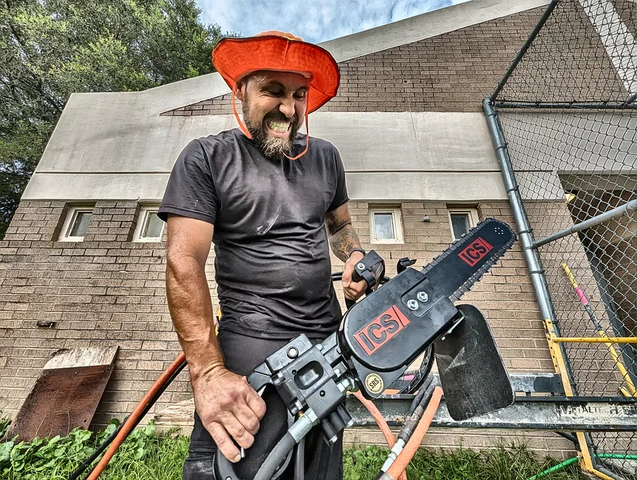
Flat saws can’t reach every area of a pool deck. Coping edges, step nosings, and the tight radius cuts around pool light conduit boxes require angle grinder work with appropriate diamond cup wheels and turbo blades. For Miami pool deck applications:
- Angle grinder rating: Minimum 7-inch, 15-amp corded grinder. Cordless units lack sustained torque for extended concrete cutting in hard aggregate. On a commercial pool deck job, battery drain becomes a productivity issue quickly.
- Turbo cup wheel specification: Double-row turbo cup, 7-inch diameter, medium bond for the same mixed-hardness reasons described above. Single-row cups clog with limestone slurry rapidly in wet conditions.
- Blade guard and water attachment: Wet cutting shrouds for angle grinders are mandatory on Miami pool decks, both for silica dust compliance under OSHA Table 1 and for blade thermal management in the heat.
Contractors looking to optimize costs on larger pool deck projects without sacrificing tooling quality should review strategies for reducing costs on large-scale concrete cutting and demolition projects — the tooling selection principles outlined there apply directly to pool deck scope management.
Blade Maintenance and Field Inspection Protocols That Extend Tool Life in Miami’s Climate
Salt air accelerates blade core corrosion in Miami faster than in inland markets. Steel blade cores that sit in a wet saw tray overnight in a coastal environment will show surface rust within 24 hours. While surface rust on the core doesn’t immediately compromise cutting performance, it is an early indicator of accelerated fatigue that can lead to core cracking under operational stress. After every pool deck job, blades should be removed from the saw, rinsed with fresh water, and stored dry. Inspect segment-to-core welds after every 8–10 hours of cutting. Any segment showing lateral movement relative to the core is a retirement indicator — do not return that blade to service on a Miami pool deck where dense aggregate can turn a fatigued segment into a projectile.
Field dressing a glazed blade — running it through an abrasive dressing stick or a soft brick — is a standard technique to re-expose diamond cutting edges when a blade has glazed over in soft limestone. This is a legitimate and effective practice, but it should be documented. A blade that requires dressing more than twice in a single day is signaling that the bond hardness is mismatched to the aggregate, and the tooling specification needs to be revisited. For specialized cutting scenarios involving underground infrastructure adjacent to pool decks, the pipeline cutting methodology provides additional context on precision tooling management in constrained environments.
Matching Equipment to Miami Pool Deck Project Scope
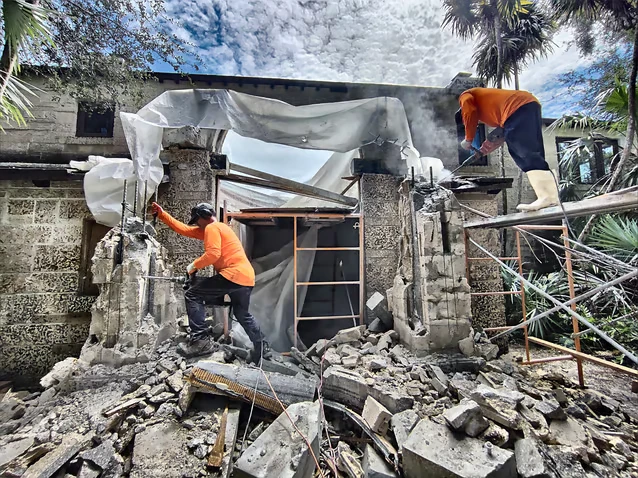
Every pool deck cutting project in Miami carries a different equipment mobilization calculus. A residential pool deck re-joint project in Pinecrest — 400 square feet, 4-inch slab, no rebar — can be executed with a mid-range 25 HP flat saw and a single 14-inch medium-bond blade. A commercial aquatic facility demolition in Miami Beach — 8,000 square feet, 7-inch slab, #5 rebar on 12-inch centers, post-tension cables in the perimeter beam — requires a high-horsepower flat saw, GPR pre-scan, a 20-inch blade rated for post-tension environments, and a dedicated water supply connection rather than a tank system. Matching the equipment specification to the actual site conditions — not to a generic “pool deck” category — is what separates productive, profitable pool deck cutting from expensive blade destruction and rework. That discipline, applied consistently across Miami’s diverse concrete stock, is what defines professional-grade concrete cutting at the trade level.