Why Chipping of Concrete Surface Work Gets Misbid More Than Almost Any Other Scope
Walk into any pre-bid meeting in Miami-Dade and you’ll hear the same overconfident line: “It’s just chipping.” That phrase has killed more project margins than bad weather and supply chain delays combined. Chipping of concrete surface material is a precision-driven, equipment-intensive operation that varies wildly in cost depending on substrate condition, reinforcement density, access constraints, and the specific performance standard required after removal. Before you sharpen your pencil on a bid, you need a technical foundation that most estimators simply don’t have. This post gives you that foundation — with real numbers, real timelines, and the variables that actually move the needle on your bottom line.
Defining the Scope — Surface Chipping Is Not a Single Operation
The term “chipping of concrete surface” covers a broad family of removal operations, and conflating them in a bid document is where estimators lose money fast. At the most basic level, you have scarification — a mechanical abrasion process that removes 1/16 to 3/16 inches of surface laitance. Then there’s pneumatic chipping, which uses breaker tools to remove delaminated or deteriorated concrete to a depth typically ranging from ½ inch to 3 inches. Finally, hydrodemolition chipping uses high-pressure water jets to selectively remove deteriorated material while leaving sound concrete and rebar intact. Each method carries a completely different cost profile, production rate, and equipment mobilization burden.
In Miami’s coastal construction environment — where chloride-induced rebar corrosion is endemic — you’re almost always dealing with selective removal that must expose corroded steel without damaging the remaining substrate. That narrows your method selection considerably and drives costs upward. Projects near the waterfront, including those tied to Miami waterfront living developments, frequently require hydrodemolition or pneumatic chipping in combination with corrosion inhibitor application, which adds both time and material cost to every square foot.
Production Rates and Labor Hours — The Numbers That Drive Your Estimate
Let’s get specific. For pneumatic chipping using a 30-pound electric or pneumatic breaker on standard 3,000–4,000 PSI residential or light commercial slabs, a skilled operator working in open conditions can reasonably achieve 15 to 25 square feet per hour at a removal depth of 1 to 1.5 inches. That rate drops sharply — sometimes to 8 to 12 square feet per hour — when you’re working around congested reinforcement, in confined spaces, or on elevated deck structures.
Hydrodemolition production rates are faster in terms of material removal but carry significant setup costs. Expect mobilization and equipment costs starting at $2,500 to $4,500 per day before a single square foot of concrete is removed. Water management, containment, and slurry disposal add another layer of cost that many contractors forget to include. For jobs under 500 square feet, hydrodemolition rarely pencils out unless the substrate condition absolutely demands it.
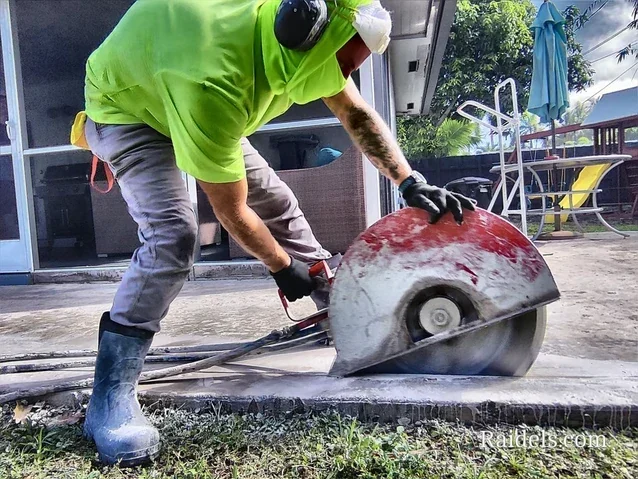
For driveway-scale chipping work tied to repair and resurfacing programs, reviewing how sectioning and repair cuts are priced gives you a useful cost anchor. Our detailed breakdown of driveway sectioning repair cuts shows how removal depth, joint spacing, and substrate variability interact to shape final per-square-foot costs.
Material Hardness, Rebar Density, and the Factors That Blow Up Your Labor Budget
The single biggest source of bid error in concrete chipping scopes is underestimating the effect of compressive strength and reinforcement density on production rates. A 6,000 PSI high-strength slab chips at roughly 40 to 60 percent the rate of a standard 3,000 PSI pour. If your estimate assumes a standard residential mix and you’re actually cutting into a high-performance industrial or marine structure, you’ll burn through your labor budget in the first week.
Rebar density compounds this problem. Tight grid reinforcement — common in post-tension structures and structural slabs — requires the operator to work around steel constantly, repositioning the chisel tip to avoid damaging tendons or bar coatings. Speaking of post-tension, any chipping scope that approaches or intersects a post-tension system demands a completely separate risk protocol. The consequences of nicking a live tendon are catastrophic. Our resource on post-tension slab cutting and coring outlines the detection, marking, and clearance procedures that must be priced into any bid touching these systems.
Additional Bidding Variables That Estimators Routinely Undervalue
- Ambient temperature and humidity: Miami’s summer heat significantly affects operator productivity and equipment duty cycles. Factor in reduced daily output from June through September. See our detailed look at concrete cutting under Miami’s summer conditions for production adjustment guidelines.
- Debris removal and haul-off: Chipped concrete generates significant volume. A 2-inch removal depth over 1,000 square feet produces roughly 1.5 to 2 tons of material. Dumpster rental, loading labor, and disposal fees must be line items, not afterthoughts.
- Surface profile requirements: If the chipped surface must meet ICRI CSP 5 or higher for overlay bonding, that requires additional hand work and profile testing — add 10 to 20 percent to your labor estimate.
- Vibration-sensitive adjacencies: Pneumatic chipping in occupied buildings or near sensitive equipment requires low-vibration tools and slower production rates. This is especially relevant in infrastructure construction services projects near transit or utility corridors.
- Emergency and rescue-related scopes: Rapid concrete removal for structural access or emergency response carries a premium. Work associated with rescue operations requires 24/7 availability, specialized equipment staging, and crew fatigue management — all of which must be reflected in mobilization and standby rates.
Realistic Timeline Estimations for Common Chipping Scopes
Here’s a practical timeline framework based on scope size and access conditions for Miami-area projects:
- Under 200 SF, open access, standard slab: 1 to 2 days including cleanup and debris removal.
- 200–1,000 SF, open access, standard slab: 3 to 6 days with a two-person crew.
- 1,000–5,000 SF, mixed access, variable substrate: 2 to 4 weeks depending on reinforcement density and depth requirements.
- Over 5,000 SF, elevated deck or marine structure: 4 to 10 weeks with full crew and hydrodemolition equipment. Permitting and environmental compliance add pre-construction time.
These are working timelines, not padded ones. If your GC or owner is pushing for compression, you need to price the additional crew, equipment, and overtime explicitly — not absorb it into your base number and hope for the best.
Building a Defensible Bid for Concrete Surface Chipping in Miami
A defensible bid starts with a thorough pre-bid site investigation. Pull existing structural drawings, confirm concrete mix design if available, use a rebound hammer or Windsor probe to verify in-place strength, and mark any post-tension tendons or embedded utilities before you write a single number. Photograph everything. Your bid qualifications section should explicitly state the assumed removal depth, concrete strength, access conditions, and debris disposal responsibility.
Price your work using unit rates tied to verified production data — not industry averages pulled from a national estimating guide that has never seen Miami’s substrate conditions, heat index, or coastal corrosion profiles. Build in a 10 to 15 percent contingency for subsurface surprises on any repair-focused chipping scope. On new construction surface prep, that contingency can drop to 5 percent if you have solid pre-bid data.
Finally, clarify the acceptance criteria in writing before you start. Who determines when enough material has been removed? What profile standard is required? Who pays for additional removal if the inspector rejects the surface? These questions, answered before mobilization, are what separate contractors who make money on chipping scopes from those who don’t.
The Bottom Line on Pricing Chipping Work Correctly
Chipping of concrete surface material is a technical discipline with real cost drivers that reward preparation and punish assumptions. In Miami’s demanding construction environment — high heat, coastal exposure, complex substrates, and tight project schedules — the margin for estimating error is thin. The contractors who consistently win profitable chipping work are the ones who invest in pre-bid investigation, apply verified production rates, and write airtight bid qualifications that protect their scope. Get those fundamentals right, and chipping becomes one of the more predictable line items in your project budget. Get them wrong, and it becomes the one that keeps you up at night.