Why a Per-Foot Price for Concrete Saw Cutting Is Never the Whole Number
When a property owner or general contractor asks “what does concrete saw cutting cost per linear foot,” they are usually holding a bid that says something like $3.50 per linear foot and wondering whether that number is fair, inflated, or suspiciously low. The honest answer — the one I give after 15 years of pricing concrete cutting work across Miami-Dade, Broward, and Palm Beach counties — is that per-foot pricing is the least reliable number on any concrete cutting bid until you understand what it includes. A $3.50 per foot quote that excludes slurry containment, depth charges beyond 4 inches, and blade wear on rebar-heavy slabs is not cheaper than an $8.00 per foot quote that includes all three. It is simply a narrower number that will expand the moment cutting begins and the contractor discovers — or claims to discover — conditions that were “unforeseeable” at the time of the bid. Real pricing transparency does not come from a lower number. It comes from knowing what the number actually covers.
The Real Cost Variables That Drive Per-Foot Pricing
Concrete saw cutting costs per linear foot vary from roughly $0.50 on the extreme low end — a shallow control joint cut in a fresh residential slab with a walk-behind early-entry saw — to $15 or more per foot for a 12-inch deep wall cut through heavily reinforced structural concrete using a hydraulic wall saw with wire-assisted guidance. The spread between those two numbers represents everything that matters about pricing transparency. Here is what bridges that gap.
Cut Depth and the Single-Pass Limitation
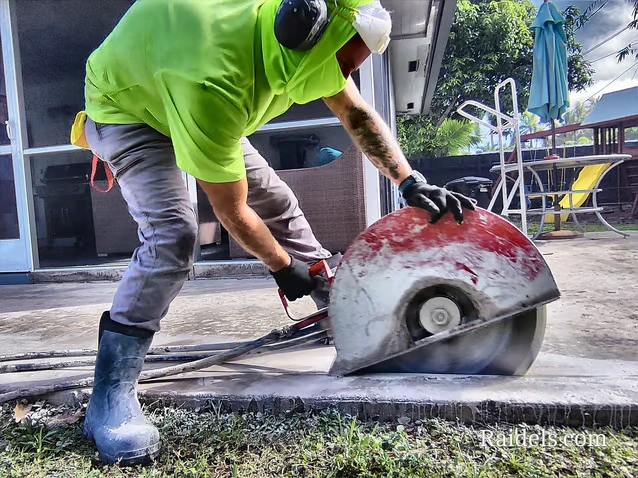
The single largest cost driver in linear-foot pricing is whether the cut can be completed in a single pass. A 14-inch diamond blade cuts approximately 5 inches deep in one pass. A 20-inch blade cuts 8 inches. A 36-inch blade cuts approximately 15 inches but requires a completely different saw platform — a hydraulic wall saw mounted on a track system rather than a hand-held gas saw — and that platform change triples the hourly equipment rate. If your slab is 6 inches thick and the contractor shows up with a 14-inch blade on a hand saw, you are paying for two passes. Two passes means double the labor time, double the blade wear, and — critically for compliance — double the slurry volume. A contractor who prices per foot but does not specify blade diameter is pricing an assumption, not a scope.
Rebar Density and Diamond Segment Wear
Cutting through concrete that contains rebar or post-tension cables changes the economics of blade life. A premium diamond blade rated for 1,200 linear feet of clean concrete may wear to failure in 400 feet when cutting through #4 rebar at 12-inch spacing — a common reinforcement pattern in Miami-Dade commercial slabs. Diamond blades cost $150 to $600 depending on diameter, bond hardness, and segment height. A contractor who knows the slab contains rebar will factor blade wear into the per-foot price. A contractor who does not will discover it during the cut and send you a change order for “unforeseen conditions” that were entirely foreseeable to anyone who read the structural drawings — or simply looked at the age of the building and knew Miami construction practices.
Wet-Cut vs Dry-Cut and the Slurry Compliance Gap
Dry cutting is cheaper per foot by roughly 20 to 30 percent because it eliminates slurry management, water supply logistics, and vacuum recovery equipment. It is also illegal for any depth beyond a shallow scoring cut on any Miami-Dade job site within 500 feet of a waterway, drainage canal, or stormwater inlet — which covers essentially every job site in the county. Contractors who quote dry-cut pricing for wet-cut work are pricing a violation. The difference between a compliant wet-cut price and a non-compliant dry-cut price is almost exactly the cost of slurry containment. That cost is not optional, and it is never “included” in a suspiciously low per-foot number. It is simply being deferred into your liability as the property owner.

How Mobilization Costs Distort Per-Foot Pricing on Small Jobs
Per-foot pricing collapses as a useful metric on small jobs. A 10-foot cut priced at $8 per foot is $80 in cutting work, but no contractor in South Florida will send a crew, a truck, a saw, and a slurry vacuum to your job site for $80. Mobilization — the cost of getting equipment, labor, insurance verification, and site assessment to your address — typically runs $250 to $750 for any job within Miami-Dade County, regardless of cut length. On a 200-foot cut, that mobilization cost spreads to $1.25 to $3.75 per foot. On a 10-foot cut, it contributes $25 to $75 per foot. This is why small residential jobs appear wildly overpriced per linear foot compared to large commercial jobs — the pricing is correct, but the metric is wrong. Commercial cutting projects benefit from mobilization cost amortization across thousands of linear feet. Residential jobs do not, and quoting a residential per-foot price without the mobilization line item is simply a different way of arriving at the same total number — typically by inflating the per-foot rate to absorb the mobilization cost silently.
What a Transparent Concrete Cutting Quote Should Include
Every contractor in Miami-Dade who bids concrete cutting work by the foot should be able to produce these numbers on request. If they cannot — or if they claim “it is all built into the price” without specifying how — you are not looking at a bid. You are looking at a starting point for the change orders that will follow.
- Blade diameter and cut depth per pass: Determines single-pass vs multi-pass labor. A 14-inch blade cutting 6 inches deep means two passes — and double the labor cost, regardless of the per-foot rate on paper.
- Wet or dry with containment method: Wet cutting requires vacuum recovery or berm containment and a disposal pathway. Dry cutting requires HEPA dust extraction if performed indoors. Neither is free.
- Rebar allowance or exclusion: Most Miami slabs built after 1992 contain rebar or welded wire mesh. A bid that excludes blade wear from rebar contact is excluding the single most predictable cost variable on a South Florida cutting job.
- Mobilization as a separate line item: This is the honest way to price small jobs. A per-foot cutting rate that actually reflects the cutting work, plus a mobilization charge that covers getting the equipment to your site. Lump-sum quotes that claim to “include” mobilization are just per-foot rates with mobilization baked in — and you are paying that baked-in mobilization on every foot of a 10-foot cut at the same rate as a 200-foot cut.
- Minimum charge: Most contractors have a minimum job charge of $500 to $1,200 regardless of scope. Anything below the minimum is priced at the minimum — not at the per-foot rate. This is standard industry practice. A contractor who quotes a $250 job at $3 per foot for 10 linear feet is simply not showing up.
- Slurry disposal fee: Should be stated as a separate line item or explicitly noted as included in the per-foot rate. If it is not mentioned at all, assume it is not included — and that the contractor plans to let slurry pool on-site or drain into the nearest catch basin, both of which trigger DERM enforcement.
A $3.50 per foot quote that excludes half of these items is not a better price than an $8 per foot quote that includes all of them. It is a narrower scope at a lower transparency level. The real question to ask any contractor quoting per-foot concrete saw cutting rates is not “can you go lower” but “what exactly does this rate include.” Understanding what concrete saw cutting rates actually include when slurry management and environmental compliance are done right is the difference between a fair contract and an expensive misunderstanding. Contractors who can answer that question at the level of detail above are the ones who finish jobs without surprise change orders, without environmental violations, and without clients who feel — often correctly — that the per-foot price they were quoted was never the per-foot price they actually paid.