Why Per-Foot Pricing in Concrete Cutting Is Never a Single Number
When contractors and property owners call us asking for a price per linear foot, the honest answer is always the same: it depends on at least six variables before we can give you a defensible number. The cost of concrete cutting per foot in Miami typically ranges from $4 to $18 per linear foot for standard flatwork, but that range is nearly meaningless without context. A 4-inch sidewalk panel cut with a walk-behind saw is a completely different job than a 12-inch post-tension slab in a parking garage. Treating them as equivalent will blow your budget or your bid. This guide walks you through every factor that moves that number so you can evaluate quotes intelligently, plan your project accurately, and stop getting surprised on invoice day.
The Five Technical Variables That Drive Per-Foot Concrete Cutting Costs
Every legitimate concrete cutting estimate is built on five core technical inputs. Miss any one of them and the number you’re quoting — or accepting — is a guess. Here is how each variable moves the per-foot price in practical, measurable terms.
1. Slab Thickness and Required Cut Depth
Cut depth is the single biggest cost driver. Diamond blades wear faster and generate more heat as depth increases. A 2-inch control joint cut on a residential driveway might run $4 to $6 per linear foot. That same saw making a full-depth cut through a 6-inch reinforced slab will push into the $9 to $13 range. At 10 to 12 inches — common in commercial foundation walls or thick industrial slabs — expect $14 to $18+ per foot, especially if multiple passes are required. Each additional inch of depth adds blade segment wear, slows feed rate, and increases water cooling demand, all of which translate directly into labor time and consumable cost.
2. Concrete PSI and Aggregate Hardness
High-strength concrete, typically 5,000 PSI and above, destroys blade segments faster than standard 3,000 PSI residential mix. Harder aggregate — particularly Miami’s local limestone-heavy mixes — compounds this. A contractor who quotes you a flat per-foot rate without asking about your concrete spec is either guessing or padding heavily. On high-PSI slabs, blade consumption can increase by 30 to 50 percent, and that cost gets passed through. Always provide your concrete spec sheet if you have it. If you don’t, ask for a core sample or request that the estimator factor in a worst-case aggregate scenario. For a deeper look at how blade selection interacts with concrete hardness, see our technical resource on diamond blade selection for varying concrete compositions.
3. Reinforcement Type — Rebar, Wire Mesh, or Post-Tension Cables
Unreinforced concrete cuts faster and cheaper. The moment you introduce steel, the math changes. Standard wire mesh adds modest resistance and modest cost. Rebar — particularly #5 and larger — significantly increases blade wear and slows feed rate. Post-tension slabs are in a category of their own. Cutting through an active post-tension tendon is catastrophic and potentially fatal. Proper PT slab cutting requires GPR scanning, careful tendon mapping, and deliberate routing to avoid cables entirely. That scanning and planning adds $200 to $600 to a job before the saw runs a single foot. Factor it in or pay for it in emergency repairs.
4. Equipment Access and Job Site Constraints
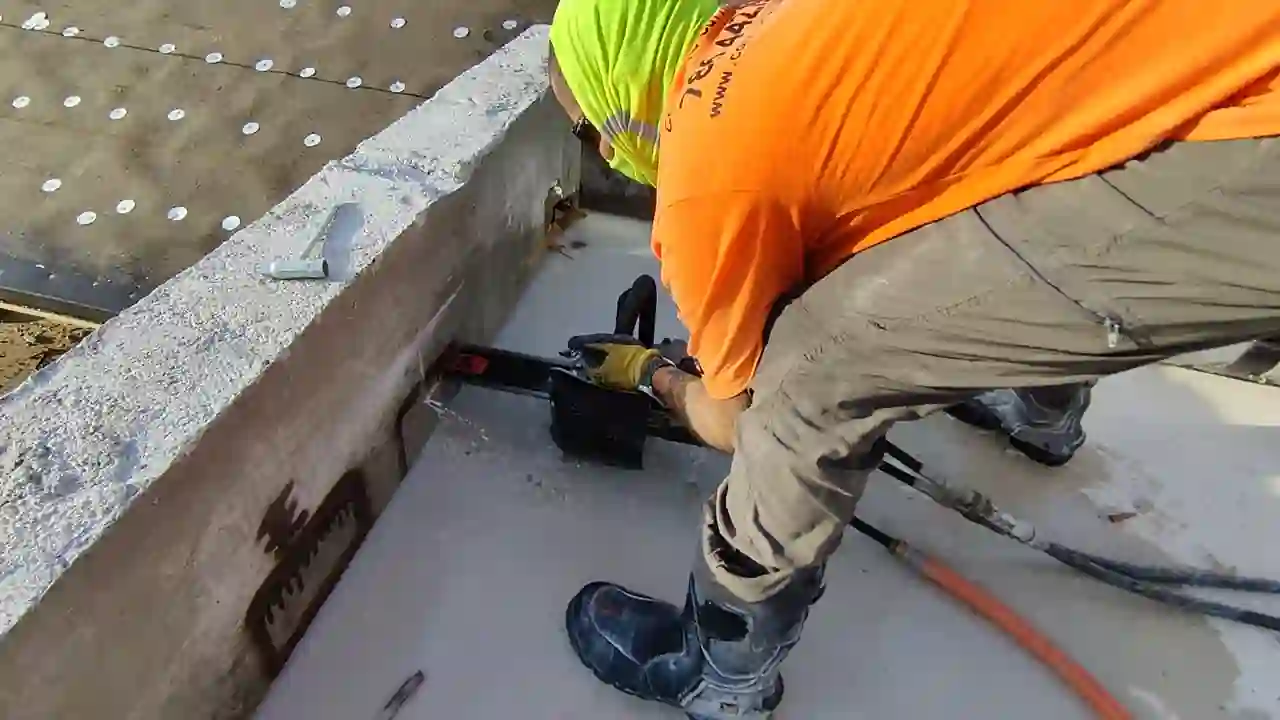
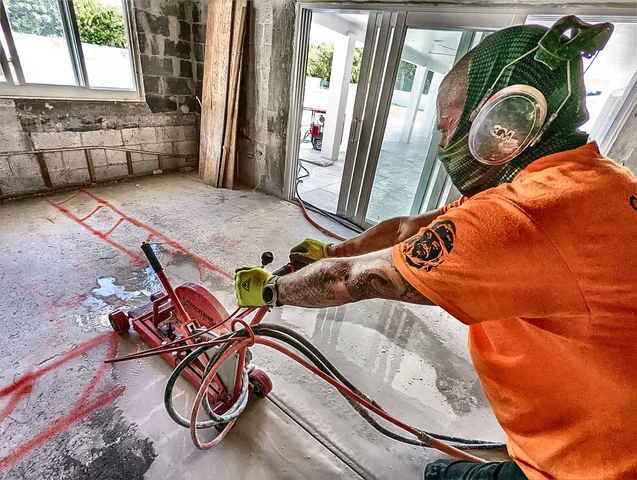
A walk-behind flat saw on an open slab is the cheapest scenario. The moment you introduce restricted access — interior rooms, low ceilings, stairwells, or confined crawl spaces — you shift to smaller hand-held or ring-saw equipment that cuts slower and requires more operator time per foot. Equipment mobilization also matters. If your job is a single 20-foot cut in a residential backyard, you’re paying a minimum mobilization charge that effectively inflates your per-foot cost dramatically. Jobs that use skid steer-mounted cutting attachments for large-scale demolition work can actually reduce per-foot cost on high-volume projects. Learn more about how skid steer applications affect concrete cutting efficiency and pricing on larger commercial sites.
5. Slurry Management and Environmental Controls
Wet cutting is standard for diamond blades — it extends blade life and controls silica dust. But that water has to go somewhere. On exterior flatwork near storm drains, slurry containment and vacuuming is legally required under EPA and Miami-Dade stormwater ordinances. Proper slurry management with a wet-vac system and containment berms adds $1.50 to $3.00 per linear foot on contained job sites. Interior cuts in occupied buildings require full HEPA dust control systems, which add further cost. Any quote that doesn’t mention slurry or dust control on an interior job is a red flag — either the contractor doesn’t know the regulations or they plan to ignore them.

How to Build an Accurate Per-Foot Budget for Your Specific Project
Now that you understand the variables, here is a practical framework for building your own pre-quote estimate so you can evaluate bids with confidence.
Step 1 — Define Your Cut Inventory
List every cut by type: total linear footage, required depth, and location (interior vs. exterior, accessible vs. confined). Group cuts by depth tier — under 4 inches, 4 to 6 inches, 6 to 10 inches, 10 inches and above. This breakdown lets you apply the right per-foot range to each segment rather than averaging everything together and getting a distorted total.
Step 2 — Identify Your Concrete Specification
Pull your structural drawings or contact your GC for the concrete mix design. Note the PSI, the aggregate type, and whether any post-tension or high-tensile reinforcement is present. If the structure is older than 20 years and records are unavailable, budget for a GPR scan. For residential home improvement projects involving slab modifications, our home improvement concrete demolition services page covers standard residential slab specs commonly found in Miami-Dade construction.
Step 3 — Apply Range Pricing by Tier
- Shallow cuts (under 3 inches), unreinforced: $4 – $6 per linear foot
- Standard depth (4 to 6 inches), wire mesh or light rebar: $7 – $11 per linear foot
- Deep cuts (6 to 10 inches), heavy rebar: $11 – $15 per linear foot
- Extra-deep or wall cuts (10+ inches), post-tension or high-PSI: $15 – $20+ per linear foot
- Add for interior slurry containment: $1.50 – $3.00 per linear foot
- Add for GPR scanning (post-tension or unknown reinforcement): $200 – $600 flat per mobilization
- Minimum mobilization charge (small jobs under 50 linear feet): $350 – $600 flat
Step 4 — Verify Contractor Credentials and Equipment
In Miami, concrete cutting is not a licensed trade in isolation, but contractors operating in the right-of-way or on permitted structures must carry general contractor licensing, liability insurance, and workers’ compensation. Ask for certificates before work begins. A low per-foot quote from an uninsured operator is not a deal — it is a liability transfer onto your property. For work anywhere in Miami-Dade, verify that your contractor has specific experience with local concrete mixes and local regulatory requirements. Our team at Concrete Cutting Miami operates fully licensed and insured on every project, with equipment calibrated for South Florida’s specific aggregate and humidity conditions.

What a Legitimate Quote Should Include Line by Line
A professional concrete cutting quote is not a single number. It should itemize mobilization, linear footage by depth tier, blade and consumable allowance, slurry management method, and any scanning or pre-cut prep work. If a quote arrives as a single lump sum with no breakdown, ask for the line items. Any contractor confident in their pricing will provide them. Those who won’t are either unsure of their own costs or planning to negotiate upward once the saw is already on site — a classic low-ball tactic that costs project owners far more than a properly scoped quote ever would.
Understanding the cost of concrete cutting per foot is not about finding the cheapest number. It is about understanding what that number actually covers and whether the contractor delivering it has the technical competence to execute without surprises. Use this framework, ask the right questions, and you will budget accurately every time.