The Critical Role of Slab Thickness in Two-Story Construction
Pouring the wrong slab thickness under a two-story structure invites catastrophic failure. As Miami’s high humidity and sandy soil interact with live loads, undersized slabs crack, settle, or shear. Most residential disasters trace back to foundation miscalculations during initial pours. This technical walkthrough dissects load physics, material science, and Miami-Dade County amendments to the Florida Building Code. You’ll learn precise calculation methodologies used by professional engineers – no guesswork, no shortcuts.
How Building Codes Dictate Minimum Slab Requirements
Florida Building Code Section 1808.6 mandates minimum 4-inch slabs, but that’s merely a starting point for single-story sheds – not occupied two-story structures. Miami-Dade amendments add seismic and hurricane load factors requiring 25-40% greater thickness in coastal zones. The IRC Table R404.1(2) specifies:
- 4″ minimum for non-bearing interior walls
- 6″ minimum under load-bearing points
- 8″ minimum at column bases and perimeter beams
These are absolute minimums – inadequate for dynamic residential loads. We recently corrected a Coral Gables project where a 5-inch slab cracked under staircase point loads. Always cross-reference with ASCE 7-16 live load tables.
Calculating Live and Dead Loads for Residential Floors
Dead loads (static weight) and live loads (occupancy forces) determine your thickness baseline. For two-story homes, calculate separately then combine:
- First floor dead load: Slab weight (150 pcf) + flooring (5 psf) + partition walls (20 psf)
- Second floor dead load: Joists (10 psf) + subfloor (5 psf) + finish floor (8 psf)
- Live loads: 40 psf bedrooms / 50 psf living areas / 100 psf garage per FBC 1607.1
Example calculation: Master bedroom above garage. Garage live load (100 psf) + second floor dead load (23 psf) + first floor slab (50 psf for 4″) = 173 psf total. A 4-inch slab fails at ≈100 psf capacity – requiring minimum 5.5 inches with #4 rebar at 12″ spacing.
Soil Conditions and Their Impact on Slab Design
Miami’s porous limestone and sandy soils have low bearing capacity (1,500-3,000 psf vs. clay’s 4,000+ psf). This demands thicker slabs or soil stabilization. Before pouring:
- Order geotechnical boring reports identifying organic layers
- Test moisture content – saturated sand loses 60% bearing capacity
- Calculate allowable soil pressure: qa = (N/2.5) x k (N=SPT value, k=0.3 for sand)
In Key Biscayne projects, we’ve installed vapor barriers and compacted fill when qa fell below 2,000 psf. Undiagnosed soil issues caused 37% of slab failures we repaired last year.
Step-by-Step: Determining Your Two-Story Slab Thickness
Follow this field-tested methodology used by Miami structural engineers. Record all calculations – inspectors demand documentation.
Step 1: Assess Soil Bearing Capacity Through Geotechnical Reports
Engage a licensed geotech for Standard Penetration Tests (SPT). They’ll drill multiple boreholes, recording:
- N-values (blow counts) at 5-foot intervals
- Groundwater table depth
- Organic content percentage
In Hialeah’s clayey soils, N=15 yields qa=6,000 psf. Miami Beach sands at N=10 give only qa=1,200 psf – requiring soil replacement or slab thickening.
Step 2: Calculate Anticipated Loads for Both Floors
Use this formula for combined loading: Total Load (psf) = DL1 + DL2 + LL2 where:
- DL1 = First floor dead load (slab + finishes)
- DL2 = Second floor dead load (framing + flooring)
- LL2 = Second floor live load (occupancy)
Critical point: Brick veneer adds 40 psf dead load at perimeters. For Mediterranean-style homes, increase thickness by 1.5 inches along walls.
Step 3: Select Reinforcement Type and Spacing
Reinforcement directly reduces required thickness. Compare options:
- #3 Rebar @ 18″ o.c.: Adds 15% load capacity (minimal thickness reduction)
- #4 Rebar @ 12″ o.c.: Adds 40% capacity (allows 0.75″ thinner slabs)
- Post-tension cables @ 48″ o.c.: Adds 70% capacity (reduces thickness by 2+ inches)
In flood zones, specify epoxy-coated bars. Remember: saw cutting control joints within 12 hours prevents random cracking.
Step 4: Apply Engineering Formulas for Thickness Calculation
Input your variables into the modified Westergaard equation for residential slabs:
t = ∛[(3 x P x l²) / (4 x E x k)]
- t = slab thickness (inches)
- P = concentrated load (lbs) – e.g. column weight
- l = radius of relative stiffness (inches)
- E = modulus of elasticity (4,000,000 psi for 3,500 psi concrete)
- k = subgrade modulus (pci) from soil report
For whole-slab design, use Meyerhof’s method: t = √(M / (0.138 x f’c)) where M is bending moment. Software like RISA-3D automates this.
Step 5: Verify with Local Building Authority Requirements
Miami-Dade amendments require:
- Minimum 6″ slabs in High-Velocity Hurricane Zones (HVHZ)
- Edge beams: 12″ depth x 16″ width with (4) #5 bars minimum
- Concrete strength: 3,500 psi at 28 days with
Submit calculations to Building Department Plan Review – their comments often catch overloaded sections. Never proceed without stamped approval.
Common Slab Thickness Mistakes and How to Avoid Them
Forensic data from our repair division shows recurring errors:
- Uniform thickness fallacy: Garage driveways under bedroom corners need 7-8 inches, not standard 4-6 inches. Vary thickness based on load maps.
- Vapor barrier omission: Miami’s 80% RH causes 0.25+ inch slab curl without polyethylene underlayment.
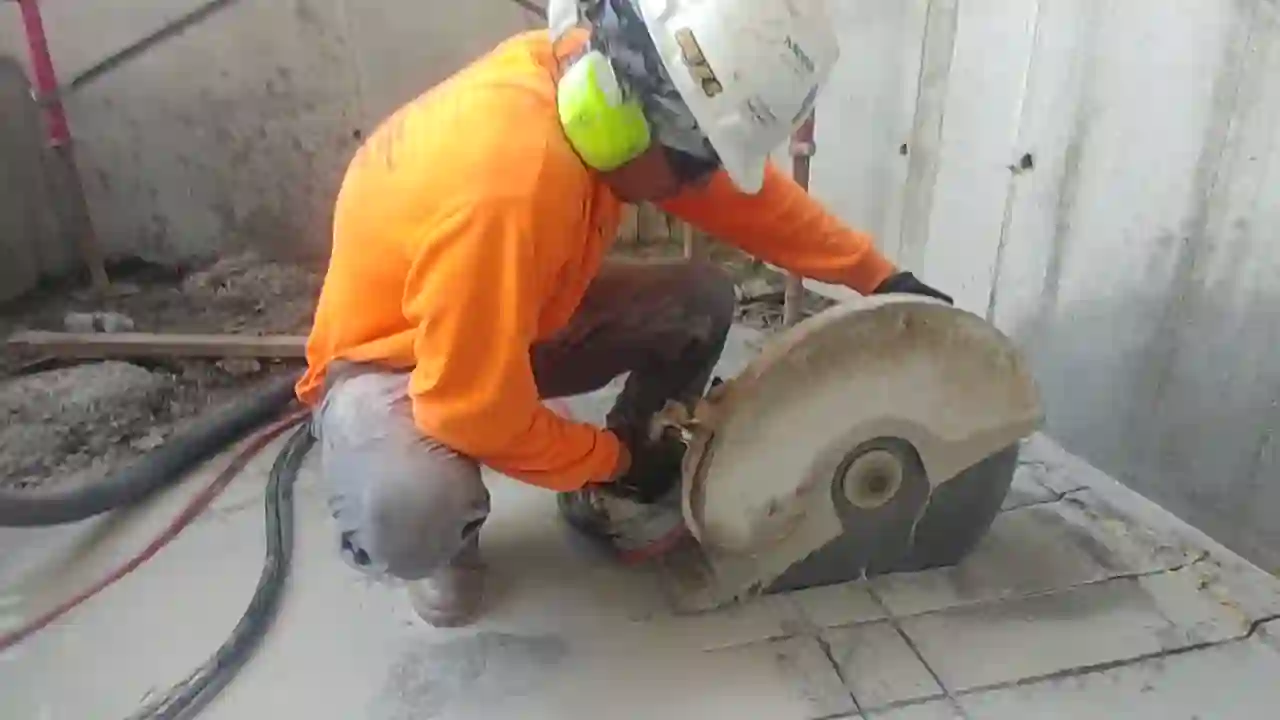
- Control joint neglect: Cut joints at 24x slab depth intervals (e.g., 10 feet for 5-inch slab). Blade selection matters – use 14″ diamond segments for clean edges.
- Rebar chair failures: Steel sinking during pour creates weak upper zones. Use ASTM A615-compliant chairs every 32 inches.
Inspect deliveries: Reject concrete with >4-inch slump – excess water reduces final strength 20%.
When to Call in Concrete Cutting Professionals
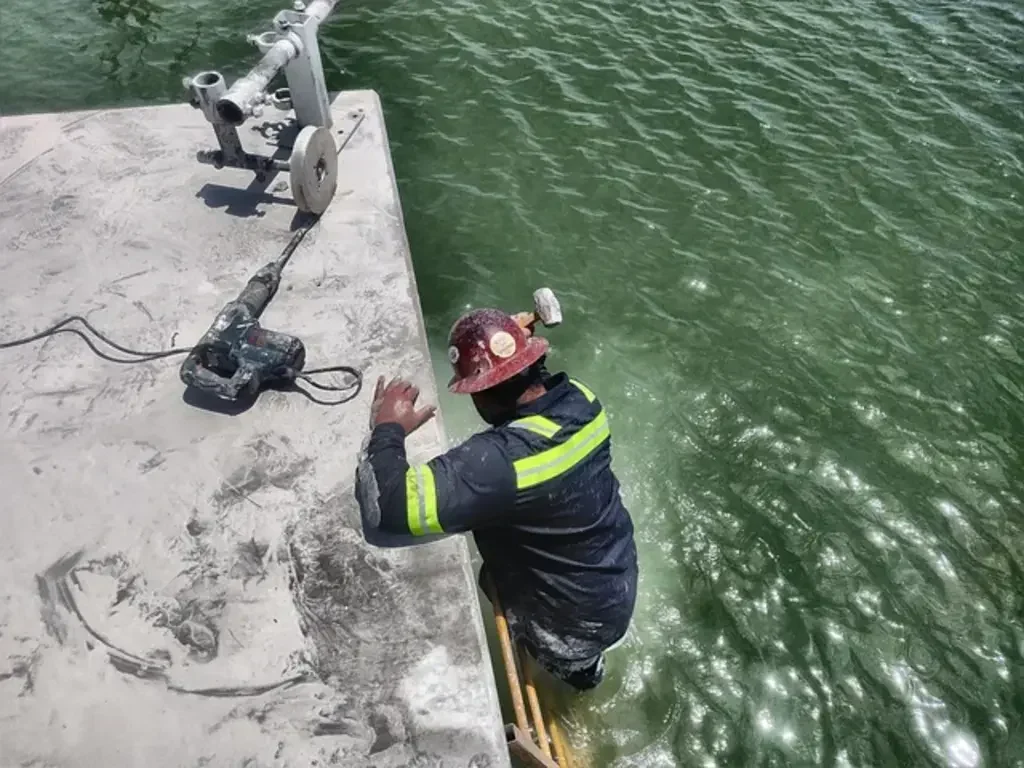
Discovering insufficient thickness post-construction demands immediate intervention. Our wall sawing equipment creates precise openings for:
- Steel piers through slabs (requires 8-inch cores)
- Grout injection ports for slabjacking
- Utility trenching with 0.5mm tolerance
In Aventura high-rises, we’ve retrofitted 200+ slabs with post-tension cables through 3-inch coring. Pro tip: Schedule cutting during low-humidity mornings – thermal expansion complicates afternoon cuts.
Document every calculation. Verify material certifications. Inspect subgrades twice. With Miami’s environmental stressors, your slab thickness decisions echo for decades. Build once. Build right.