Concrete Chainsaw Fundamentals for Constrained Environments
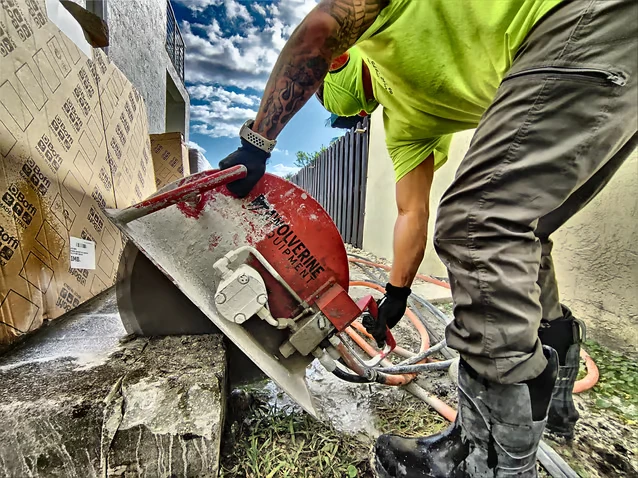
When walls close in and access points shrink, traditional concrete cutting equipment becomes impractical. In Miami’s dense urban landscape and aging infrastructure, we routinely deploy concrete chainsaws where other tools can’t physically fit. Unlike standard saws requiring clearance for blade guards and operator stance, chainsaws operate in direct contact with the material. Their compact profile allows cuts in elevator shafts, between structural members, or under low-clearance decks where even the smallest walk-behind saw won’t maneuver. The key lies in understanding torque curves and hydraulic dynamics – these aren’t lumber-cutting tools but precision demolition instruments engineered for reinforced concrete.
Hydraulic vs Electric Power Systems in Confined Operations
Selecting the right power source dictates success in tight quarters. Electric chainsaws generate zero emissions – critical when cutting in poorly ventilated basements or mechanical rooms. However, hydraulic models deliver superior torque for rebar-dense concrete, essential when encountering Miami’s over-engineered mid-century foundations. We prioritize hydraulic systems in seawater-exposed structures like seawalls where cutting resistance increases exponentially. The trade-off? Hydraulic hoses require careful routing through access ports, while electric cords demand GFCI protection in damp environments common to Florida job sites.
Site Logistics: Orchestrating the Impossible Cut
Pre-cut planning separates successful operations from abandoned projects. We start with millimeter-precise mapping of access pathways – measuring stairwell clearances, doorway angles, and overhead obstructions. For a recent Art Deco hotel renovation in South Beach, we disassembled a 16-inch chainsaw bar and reassembled it inside a second-floor bathroom to avoid damaging historic tiles in hallways. Material staging becomes equally critical: diamond chains, lubrication systems, and spare parts must be positioned within arm’s reach when operators can’t exit freely.
Debris Management in Zero-Clearance Zones
Concrete slurry and spillage create immediate hazards in confined spaces. We implement triple-containment protocols: vacuum-shrouded chainsaw bars capture 60% of particulates, with secondary HEPA filters and negative-air systems handling residual dust. For wet cutting operations in occupied buildings, moisture barriers prevent water migration through floor penetrations. Removed sections require strategic sizing – cuts are designed for manageable removal through existing openings, often coordinating with specialized concrete disposal teams who handle fragments in constrained sites.
Conquering Confined Space Complexities
OSHA-defined confined spaces demand engineered solutions beyond standard chainsaw operation. We deploy continuous air monitoring when cutting below grade or in tank interiors, where carbon monoxide from gasoline engines or argon from curing compounds accumulates dangerously. Communication systems switch to hard-wired headsets when radio signals fail in steel-reinforced vaults. Perhaps most critically, chainsaw kickback patterns change dramatically when operators can’t maintain standard stance – our bars feature reduced-kickback geometries and chain brakes calibrated for awkward positions.
Ergonomic Adaptations for Sustained Operations
Human factors dominate when working in positions mechanics call “impossible.” We modify handles for single-handed operation when bracing against walls, and implement rotational crew schedules limiting continuous cutting to 20-minute intervals. Vibration damping systems reduce white-finger risks during extended overhead cutting common in parking garage soffit modifications. For the infamous Miami River sewage tunnel project, we developed shoulder-mounted harnesses allowing operators to cut vertically while suspended – a technique now standard for our marine access operations.
Access Limitation Workarounds: Beyond the Obvious
Standard access solutions fail daily in Miami’s complex builds. When floor penetrations are required beneath existing mechanical systems, we’ve deployed chainsaws on custom articulated booms reaching 8 feet horizontally from access hatches. For cuts between tightly spaced columns, guide rails mount directly to concrete surfaces with epoxy anchors, enabling straight cuts where freehand operation proves impossible. In historic districts where façade preservation prevents equipment entry through windows, we’ve cut new access points internally using chainsaws launched from pilot holes created by core drilling – a technique requiring millimeter precision.
Marine Access Challenges: Cutting Where Land Meets Water
Bulkhead and seawall repairs present unique constraints where tides dictate operating windows. Chainsaws mounted on floating platforms require stabilization systems countering wave action. Saltwater immersion demands daily component flushing and specialized corrosion inhibitors. During a recent seawall cap replacement in Biscayne Bay, we developed a tidal-compensation jig allowing cuts to proceed as water levels fluctuated 14 inches during operations.
Structural Considerations in Tight Quarters
Precision matters exponentially when cutting near critical structural elements in confined spaces. We employ digital modeling to identify rebar congestion points before cutting – striking embedded steel with chainsaws causes catastrophic chain failure. Load monitoring during cutting detects deflection in adjacent members, with operations halting if readings exceed 0.002L/360. For cuts near post-tension cables, we use non-conductive fiberglass guide bars and ground-fault monitored equipment to prevent catastrophic energy release.
Vibration Mitigation in Sensitive Environments
Concrete chainsaws generate harmonic frequencies that can damage delicate architectural features or disturb精密 equipment in occupied buildings. Our protocols include installing accelerometers on adjacent walls and modifying chain speed to avoid resonant frequencies. In hospital retrofits, we’ve suspended chainsaws on vibration-damping rigs resembling camera stabilizers, reducing transmitted energy by 82% compared to standard mounting.
Integrated Cutting Approaches for Complex Projects
Rarely does a chainsaw operate alone in access-challenged projects. We frequently combine techniques: chainsaws make initial plunge cuts, then wire saws complete larger sections where space permits only after initial access creation. In a recent high-rise mechanical room retrofit, chainsaws cut access trenches allowing insertion of wall saws for larger openings. This hybrid approach maximizes efficiency while respecting site limitations. Discover more about our integrated concrete cutting solutions for multifaceted projects.
Emergency Response Protocols for Entrapment Scenarios
When operating in high-risk confined spaces, equipment redundancy becomes lifesaving. We mandate secondary escape routes for all confined entries, with chainsaws equipped with emergency oxygen supply hooks for operators. Cutting attachments can be rapidly detached, abandoning equipment if structural instability occurs. Communication includes hard-wired emergency signals independent of voice systems – three tugs on the safety line halts all operations immediately.