Cutting Concrete Slab With Rebar: The Hidden Hazards of Miami’s Reinforced Substrates
When you’re cutting concrete slab with rebar on a Miami jobsite, you’re not just dealing with a homogeneous material. You’re engaging with a composite system where the steel reinforcement dictates the failure mode, the tool selection, and the safety envelope. I’ve spent decades on slabs from Brickell to Hialeah, and I can tell you that the moment that diamond blade hits a #4 rebar, the physics of the cut changes entirely. This post is about what happens at that interface and how to keep your crew out of the emergency room.
The Physics of the Cut: Why Rebar Changes Everything
Concrete is a brittle material. It fractures, it chips, and it abrades. Steel is ductile. It grabs, it pulls, and it generates heat. When you’re cutting concrete slab with rebar, the saw blade must transition between these two mechanical responses in microseconds. A standard abrasive blade designed for green concrete will glaze over and potentially shatter when it encounters rebar. This is not a theoretical risk. I’ve seen the aftermath of blade fragmentation on a Doral site—it’s a kinetic event that sends shrapnel at velocities that can penetrate a hard hat.
The correct approach is a diamond blade with a hard bond matrix designed for reinforced concrete. The bond must wear away at a rate that exposes fresh diamonds to cut the steel, while the diamond grit itself must be of a size and quality to shear through the rebar without excessive heat generation. This is where concrete cutting services that understand material science separate themselves from the guys renting a saw from a big box store.
Blade Stall and Kickback Dynamics
One of the most dangerous moments in cutting concrete slab with rebar is the blade stall. The rebar can catch the segment, stop the rotation, and transfer all that kinetic energy into the saw body. This creates a violent kickback that can throw the operator off balance or into the blade path. OSHA 29 CFR 1926.304 specifically addresses saw safety, but it doesn’t cover the specific hazard of rebar-induced kickback. Your site safety plan must account for this.
Mitigation requires a saw with a clutch system that disengages the blade before the torque can transfer to the handle. I also insist on a secondary handle grip that allows the operator to maintain a two-handed hold even during a stall event. If you are using a walk-behind slab saw, the blade guard must be in place and the depth stop set so the blade does not exceed the slab thickness by more than 1/4 inch. Over-cutting into the subgrade can cause the blade to bind on gravel or rebar chairs, creating another kickback scenario.
Dust Control and Silica Compliance: The Invisible Threat
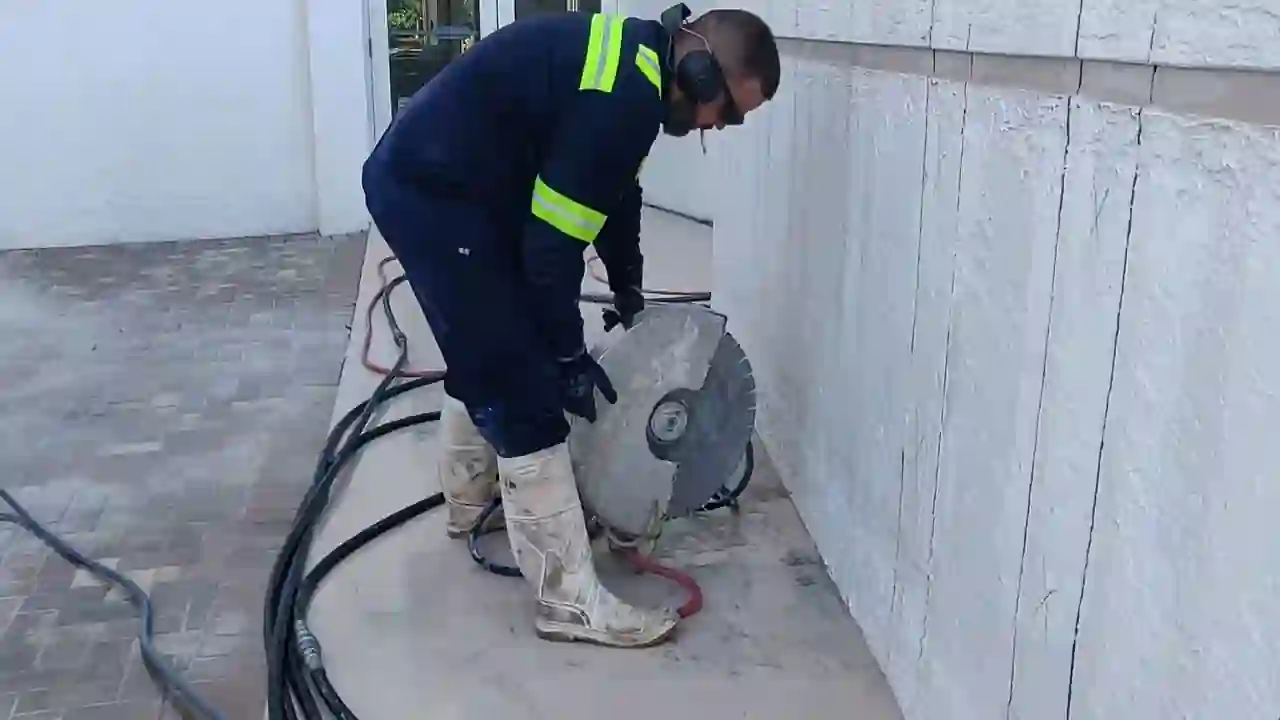
Cutting concrete slab with rebar produces respirable crystalline silica. The rebar itself does not generate silica dust, but the concrete matrix does. OSHA’s Silica Standard (29 CFR 1926.1153) requires an engineering control method—either wet cutting or a HEPA-filtered vacuum system. In Miami’s humidity, wet cutting is the preferred method because it also cools the blade and reduces the risk of thermal stress on the rebar.
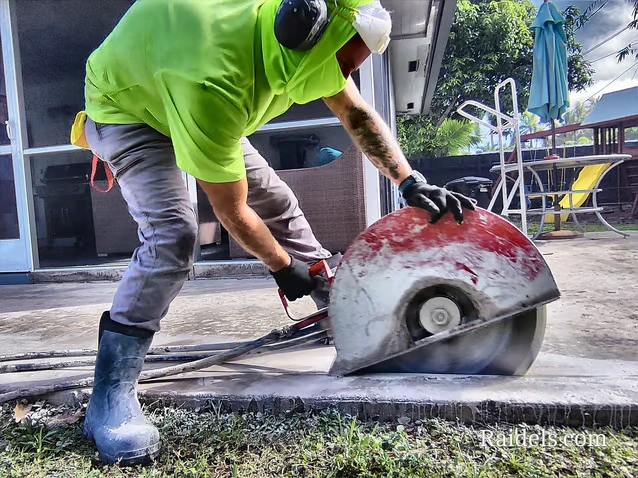
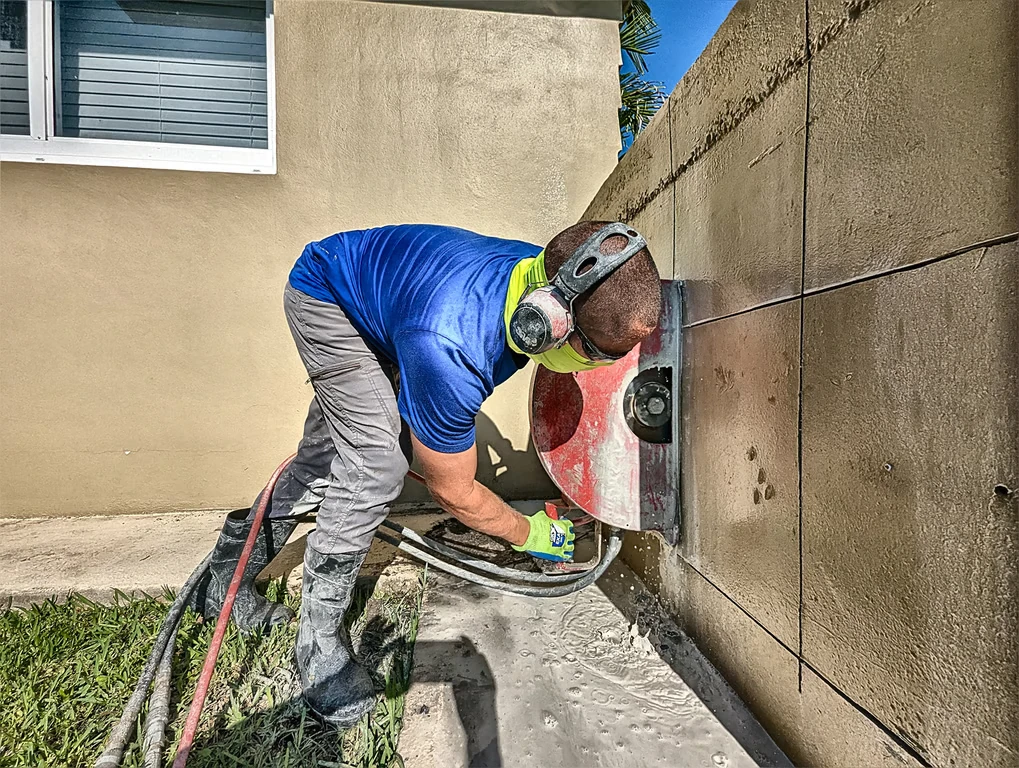
However, wet cutting introduces its own hazard: slurry management. The water mixed with concrete dust creates a highly alkaline slurry that can cause chemical burns on contact. I require full rain gear, rubber boots, and gloves for any operator engaged in wet cutting of reinforced slab. The slurry must also be contained and disposed of properly. You cannot let it run into the storm drains. Miami-Dade County’s environmental regulations are strict, and a violation can shut down a project.
Dry cutting is permissible if you use a vacuum system that achieves 99.97% efficiency at 0.3 microns. But I have found that dry cutting rebar generates sparks that can ignite combustible dust if the vacuum system is not properly grounded. This is a fire hazard that many site inspection concrete protocols overlook.
Rebar Exposure and Tension Release: A Structural Safety Issue
When you cut through a concrete slab, you are severing the rebar that provides tensile reinforcement. This can cause a sudden release of stored energy if the slab is under load. I have seen slabs that were supporting heavy equipment or formwork shift violently when the rebar was cut. This is not a cutting hazard; it is a collapse hazard.
Before you begin cutting concrete slab with rebar, you must identify the load path. A demolition strategies plan should include shoring or temporary bracing if the cut is in a load-bearing section. The rebar itself can also act as a tension tie. Cutting a single rebar in a post-tensioned slab can cause the entire tendon to release, which is a catastrophic event. You must use a rebar locator or ground-penetrating radar to map the reinforcement before any cut. I do not let a saw touch the slab until I have a verified rebar map in hand.
The “Snap-Back” Hazard of Cut Rebar
Once you cut through the rebar, the two ends are no longer connected. If the rebar is under tension from the concrete’s shrinkage or from external loads, the cut ends can snap outward. I have seen a piece of #5 rebar fly 15 feet across a jobsite after a cut. This is a projectile hazard. The solution is to use a saw with a blade that cuts a kerf wide enough to allow the rebar to relax without pinching the blade. A 1/4-inch kerf is usually sufficient, but for heavily reinforced slabs, I prefer a 3/8-inch kerf.
Additionally, the operator must stand to the side of the cut line, not directly behind the blade. This is a basic rule of saw safety that is often ignored when cutting concrete slab with rebar because the operator is focused on the cut line. A spotter should be positioned to watch for rebar movement and to signal an immediate stop if any unexpected displacement occurs.
Blade Selection and Cooling for Rebar-Heavy Slabs
Not all diamond blades are created equal. For cutting concrete slab with rebar, you need a blade with a segment height of at least 15mm and a bond hardness rated for “hard” concrete. The rebar will wear the bond faster than the concrete, so the blade must be designed to release the diamonds at a rate that matches the steel’s abrasiveness. I use a blade with a laser-welded segment attachment because the heat from cutting rebar can melt the solder on cheaper blades.
Cooling is critical. A blade that overheats will lose its diamond retention and “glaze over,” meaning the bond becomes smooth and stops cutting. This forces the operator to push harder, which increases the risk of kickback. For wet cutting, the water flow must be directed at the blade’s cutting edge, not just the side of the blade. A flow rate of 4-6 gallons per minute is typical for a 14-inch blade. For dry cutting, you must cut in short passes to allow the blade to cool. I do not allow dry cutting of rebar for more than 30 seconds without a 60-second cooling period.
Segment Loss and Inspection Protocols
After every cut through rebar, the operator must inspect the blade segments for cracks, missing diamonds, or undercutting of the steel core. A blade with a missing segment is a bomb waiting to go off. The imbalance will cause vibration that can crack the arbor flange or throw the blade off the saw. I require a visual inspection after every three cuts when cutting concrete slab with rebar. This is documented in the slab sawing services log that we maintain for every job.
Fire Watch and Hot Work Permits
Cutting rebar with a diamond blade generates sparks. In Miami, where many construction sites are near dry vegetation or have combustible materials stored nearby, this is a fire risk. OSHA 29 CFR 1915.504 requires a fire watch for any hot work, including cutting. The fire watch must be maintained for at least 30 minutes after the cutting is completed. I have seen a smoldering piece of rubber from a saw’s water hose ignite a pile of debris 20 minutes after the cut was finished.
The fire watch must have a fire extinguisher rated for Class A, B, and C fires. A water extinguisher is not sufficient for a metal fire. You need a dry chemical or CO2 extinguisher. The fire watch must also have a means of communication to call 911 immediately. This is not optional. I have had to shut down a job in Coral Gables because the general contractor refused to assign a fire watch. The risk is not worth the schedule.
Personal Protective Equipment for Rebar Cutting
The standard PPE for concrete cutting is not enough when rebar is involved. The operator needs cut-resistant gloves (ANSI A5 level or higher) because the sharp ends of cut rebar can slice through standard work gloves. Eye protection must be a full-face shield, not just safety glasses, because the sparks and concrete chips can come from any angle. Hearing protection is mandatory because the noise level of cutting rebar can exceed 110 dB, which is above the OSHA permissible exposure limit of 90 dB over an 8-hour shift.
I also require steel-toed boots with a puncture-resistant sole. The rebar ends that are left after cutting can be sharp enough to pierce a standard sole. And if you are cutting overhead slab with rebar, you need a hard hat with a chin strap and a face shield that covers the neck. The debris from an overhead cut falls straight down, and a standard face shield will leave your neck exposed.
Emergency Response Planning for Rebar Cuts
Despite all precautions, injuries happen. The most common injury when cutting concrete slab with rebar is a laceration from the cut rebar end. The second most common is a burn from the hot blade or from the rebar itself, which can reach temperatures of 300°F during cutting. Your emergency response plan must include a first aid kit with burn dressings and tourniquets. The jobsite must have a designated person trained in first aid and CPR.
For more complex injuries, such as a blade fragment embedded in a limb, the plan must specify that the object is not removed at the jobsite. The paramedics need to stabilize the object and transport the victim to a trauma center. I have a direct line to the nearest trauma center for every job we work. This is part of our Miami service protocol.
Final Operational Check for Cutting Concrete Slab With Rebar
Before the saw starts, I run a final checklist. The blade is correct for reinforced concrete. The water supply is adequate and the flow is directed properly. The rebar map is reviewed and the cut line is marked. The fire watch is in position with an extinguisher. The operator has the correct PPE and has been briefed on the specific hazards of this cut. The emergency response plan is posted and the first aid kit is stocked.
Cutting concrete slab with rebar is a high-risk operation. It requires respect for the material, the tool, and the environment. If you are not prepared to manage these hazards, do not make the cut. Call someone who does this every day. For specific guidance on drainage or plumbing cuts through reinforced slab, see our detailed walkthrough on how to cut concrete for drainage or plumbing repairs.