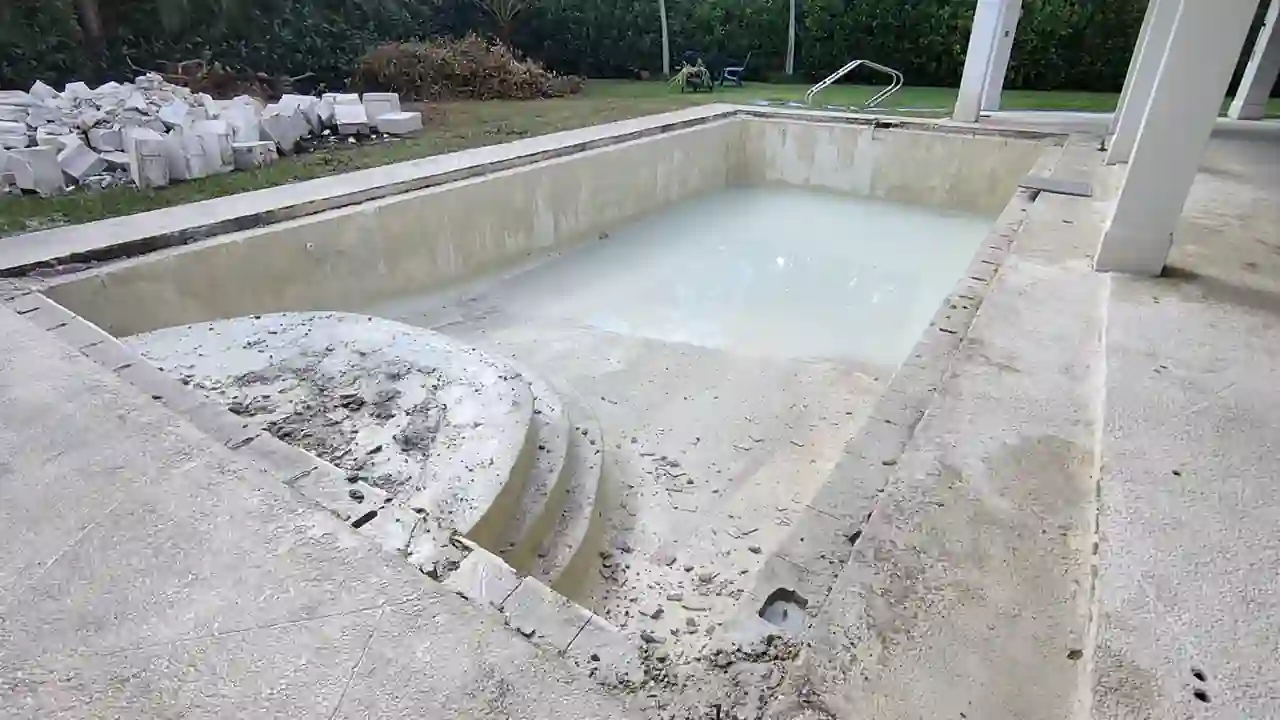
Why Lauderdale Lakes Demolition Sites Demand a Higher Safety Standard
Lauderdale Lakes sits in the dense urban corridor of Broward County, where aging commercial strips, mid-century residential blocks, and active municipal infrastructure exist in tight proximity. When construction and demolition operations kick off in this environment, the margin for error compresses dramatically. You’re not working on an isolated greenfield site — you’re cutting, breaking, and removing concrete structures within feet of occupied buildings, live utility corridors, and high-traffic roadways. That reality demands a safety posture that goes well beyond minimum compliance. It demands a systematic, trade-level understanding of every hazard vector present on a Lauderdale Lakes job site.
From a senior contractor’s perspective, the most dangerous assumption on any demolition project is that standard operating procedures written for one site type will translate cleanly to another. Lauderdale Lakes has its own soil composition challenges, its own utility mapping inconsistencies from decades of piecemeal development, and its own municipal permitting requirements that interact directly with OSHA’s 29 CFR 1926 Subpart T demolition standards. Understanding the intersection of these local and federal requirements is not optional — it is the baseline.
Pre-Demolition Engineering Surveys and Structural Assessment Protocols
Before a single blade touches concrete in Lauderdale Lakes, OSHA 29 CFR 1926.850 mandates a written engineering survey of the structure. This is not a walkthrough — it is a documented structural analysis that identifies load-bearing elements, identifies hazardous materials including asbestos and lead-based paint (both common in pre-1980s Broward County construction), and maps out the sequence of demolition to prevent unintended progressive collapse.
For projects involving urban infrastructure demolition, this survey must account for adjacent structures and shared foundation systems. In Lauderdale Lakes, party walls and shared utility trenches are common in older commercial strips along State Road 7 and Oakland Park Boulevard. A structural engineer of record must sign off on the demolition sequence before any mechanical or manual work begins.
- Survey deliverables must include: Structural load path diagrams, hazardous material inventory, utility isolation confirmation, and a written sequence-of-operations plan.
- Soil bearing capacity assessment is required when heavy demolition equipment will be staged near excavations or existing slabs.
- Adjacent structure monitoring protocols — including crack gauges and settlement pins — should be installed before work begins on any site within 10 feet of an occupied structure.
Silica Dust Control Under OSHA 1926.1153 — The Non-Negotiable on Every Concrete Cut
Respirable crystalline silica is the single most underestimated hazard in concrete demolition work. In Lauderdale Lakes, where many demolition projects involve cutting through decades-old reinforced concrete slabs, block walls, and CMU foundations, silica exposure is a constant threat. OSHA’s Table 1 under 1926.1153 specifies engineering controls for every concrete cutting and demolition task — and compliance is not discretionary.
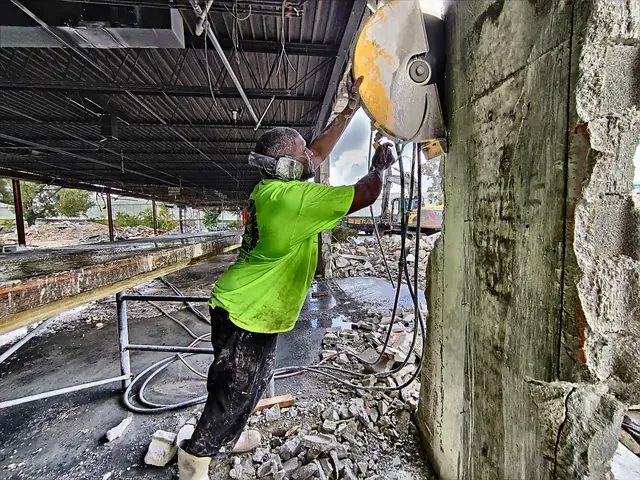
For handheld angle grinders and concrete saw cutting operations, wet cutting methods or integrated vacuum shroud systems with HEPA filtration are required when cutting for 4 or more hours per shift. Dry cutting without engineering controls is a direct OSHA violation and a serious health liability. Workers exposed to silica dust above the action level of 25 µg/m³ as an 8-hour TWA must be enrolled in a medical surveillance program within 30 days of initial exposure.
- Wet cutting systems must deliver a continuous water flow to the blade-material interface — intermittent application does not meet the engineering control standard.
- Vacuum shroud systems must achieve a minimum capture velocity of 100 FPM at the point of generation.
- Air monitoring is required whenever new tasks, materials, or work conditions are introduced that may increase silica exposure beyond previously assessed levels.
- Respirator selection — at minimum an N95 for short-duration tasks, escalating to a half-face APF-10 respirator for extended cutting operations.

Utility Strike Prevention and Underground Hazard Mapping in Broward County
Lauderdale Lakes has a complex underground utility network that reflects decades of incremental development without consistent as-built documentation. Before any excavation, saw cutting of slabs on grade, or core drilling through foundations, Sunshine 811 (Florida’s one-call notification system) must be contacted a minimum of two business days in advance. However, experienced contractors in this market know that 811 locate marks represent a best-effort estimate — not a guarantee of accuracy.
Ground-penetrating radar (GPR) scanning should be deployed as a secondary verification layer on any slab penetration or trench excavation within developed parcels. GPR can identify conduit runs, rebar placement, post-tension cables, and anomalies in sub-slab fill that utility locates will miss entirely. For projects involving advanced concrete demolition techniques, GPR scanning is not an upgrade — it is standard practice for any contractor serious about hazard avoidance.
Electrical Hazard Zones and Lockout/Tagout Requirements
In mixed-use demolition scenarios common in Lauderdale Lakes commercial corridors, live electrical infrastructure may remain energized in adjacent bays or floors during phased demolition. OSHA 29 CFR 1926.416 requires that all electrical circuits in the demolition zone be de-energized and locked out before work begins. This includes verifying that panel disconnects have been confirmed dead with a calibrated voltage tester — not assumed dead based on a breaker position.
Fall Protection and Elevated Work Platform Requirements for Multi-Story Demolition
When demolition work extends to elevated slabs, roof decks, or upper floors of structures being taken down in Lauderdale Lakes, OSHA 29 CFR 1926.502 fall protection standards apply at any working surface 6 feet or more above a lower level. The specific challenge in demolition — as opposed to new construction — is that the fall protection anchor points themselves may be compromised as the structure is progressively removed.
Competent persons must re-evaluate fall protection anchor integrity at the start of each shift. Horizontal lifeline systems installed on deteriorating concrete or steel that has been subjected to demolition loading are not reliable anchors without engineering certification. In practice, this means mobile elevated work platforms (MEWPs) or properly designed scaffold systems are often the safer alternative to personal fall arrest systems anchored to the demolition structure itself.
- Floor opening covers must be capable of supporting twice the weight of workers, equipment, and materials that may be imposed on them — and must be secured against displacement.
- Perimeter guarding on elevated demolition decks must be maintained until the deck itself is removed — not removed in advance to facilitate demolition access.
- Debris chutes for material removal from elevation must be enclosed and discharge into a controlled area inaccessible to unauthorized personnel.
Noise and Vibration Hazard Management During Mechanical Demolition
Hydraulic breakers, jackhammers, and high-frequency concrete saws generate both occupational noise exposure and ground-borne vibration that can affect adjacent structures and utilities. OSHA’s noise standard at 29 CFR 1926.52 requires hearing conservation measures when noise levels reach or exceed 90 dBA as an 8-hour TWA. In practice, hydraulic breaker operations routinely exceed 105 dBA at the operator position — requiring double hearing protection (foam plugs plus earmuffs) and strict time-in-noise limits.
Vibration monitoring is equally critical on Lauderdale Lakes sites near older masonry structures. Peak particle velocity (PPV) thresholds for adjacent occupied structures typically cap at 0.5 in/sec for sensitive structures and 2.0 in/sec for commercial construction — but these limits should be confirmed with the project structural engineer based on the specific condition of adjacent buildings. Seismograph monitoring with real-time alerts should be deployed on any mechanical demolition project within 25 feet of an occupied or structurally sensitive structure.
Selecting the Right Demolition Equipment to Match Broward County Site Conditions
Equipment selection is itself a safety decision. The wrong tool for the substrate creates unpredictable force transfer, accelerates operator fatigue, and increases the probability of both structural and personnel incidents. For reinforced concrete demolition in Lauderdale Lakes, the choice between hydraulic breaking, diamond wire sawing, and controlled explosive demolition depends on slab thickness, reinforcement density, proximity to utilities, and vibration sensitivity of adjacent structures.
Our detailed resource on choosing the right demolition hammer provides a technical framework for matching tool specifications to substrate conditions — a critical step in both productivity and hazard control. For waterfront or canal-adjacent demolition projects in Broward County, the additional considerations of aquatic contamination control and marine access logistics require specialized planning covered under marine construction protocols.
OSHA Competent Person Requirements and Site Safety Hierarchy
Every demolition project in Lauderdale Lakes — regardless of scale — must have a designated competent person on site during all phases of work. OSHA defines a competent person as someone capable of identifying existing and predictable hazards and who has the authority to take corrective action immediately. This is not a title assigned to the most senior laborer on site — it is a role that requires documented training in demolition hazard recognition, fall protection, confined space identification, and emergency response.
The competent person must conduct a documented site safety inspection at the start of each shift, after any significant weather event, and after any incident or near-miss. These inspections must be recorded in writing and retained for the duration of the project. In Broward County, local building department inspectors and OSHA compliance officers have been increasingly active on demolition sites — and the absence of documented safety inspections is one of the first deficiencies cited during enforcement visits.
Operating in Lauderdale Lakes means operating in one of South Florida’s most densely developed urban environments. The contractors who build lasting reputations in this market are those who treat job-site safety not as a compliance burden but as a core technical competency — because in demolition work, the difference between a controlled operation and a catastrophic incident is almost always a matter of preparation, protocol, and professional discipline.