Why Pinecrest Concrete Removal Projects Require a Precision Equipment Strategy
Pinecrest is not a forgiving market for sloppy concrete removal work. The municipality enforces strict property standards, the residential lots are dense with mature landscaping and utility corridors, and the slab stock in this area — much of it poured between the 1960s and 1990s — ranges from 3,500 PSI standard residential mix all the way up to 6,000 PSI post-tension commercial grade. If you show up with the wrong blade bond, the wrong machine class, or a segment geometry that doesn’t match your aggregate profile, you’re going to burn through tooling, blow your schedule, and potentially damage adjacent structures. This post breaks down exactly how our team at Concrete Cutting Miami, LLC selects equipment and diamond tooling for concrete removal jobs across Pinecrest — from driveway slabs to pool decks to commercial pad demolition.
Reading the Slab Before You Select a Single Blade
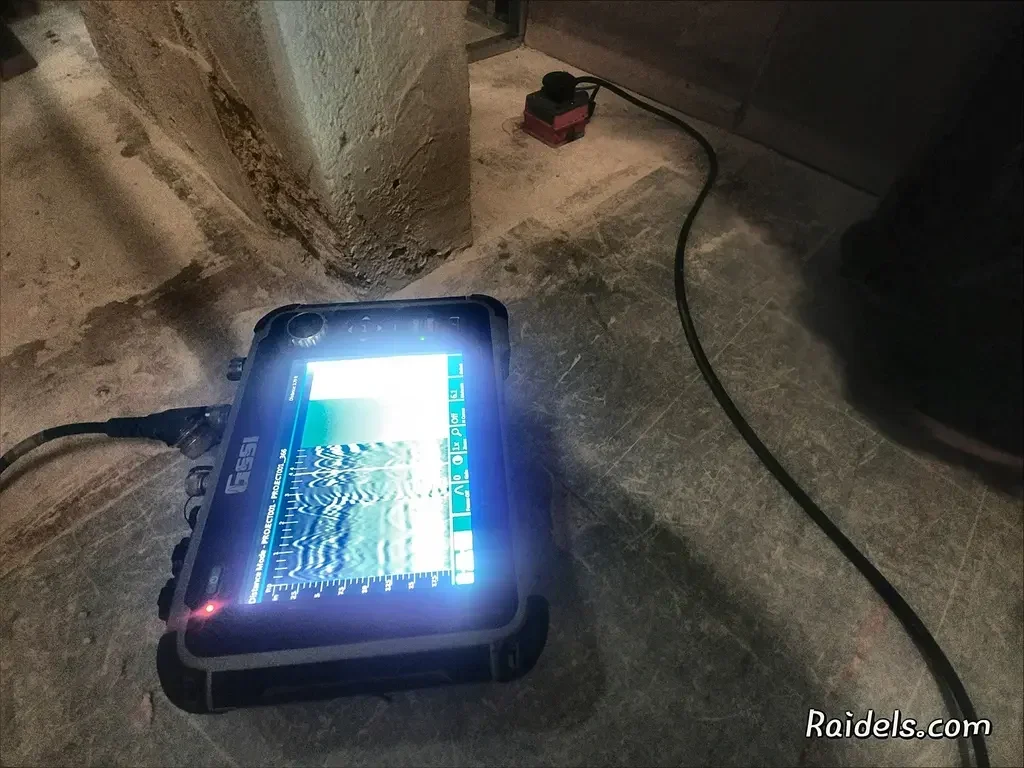
Before any tooling decision gets made, we perform a substrate assessment. In Pinecrest, this means pulling permit records when available to identify pour dates and mix designs, using a rebound hammer (Schmidt hammer) to estimate surface hardness, and scanning with ground-penetrating radar (GPR) to locate rebar, post-tension cables, conduit, and void pockets beneath the slab. A 4-inch residential driveway slab with #3 rebar on 18-inch centers is an entirely different animal than a 6-inch commercial pad with #5 rebar on 12-inch centers and a vapor barrier below. These variables directly determine your blade segment height, diamond concentration, bond hardness, and the horsepower rating your saw needs to deliver at the spindle.
Pinecrest’s soil profile — primarily Miami Limestone and oolitic limestone fill — also affects how slabs cure and crack over time. Many slabs in this area have micro-fracture networks from ground settlement and Miami’s seasonal moisture cycling, which changes how the concrete fractures under saw load. A blade that performs beautifully on a monolithic pour may chatter and skip on a slab with internal stress fractures. That’s not a machine problem — it’s a tooling selection problem.
Flat Saw Specifications for Pinecrest Slab Removal Cuts
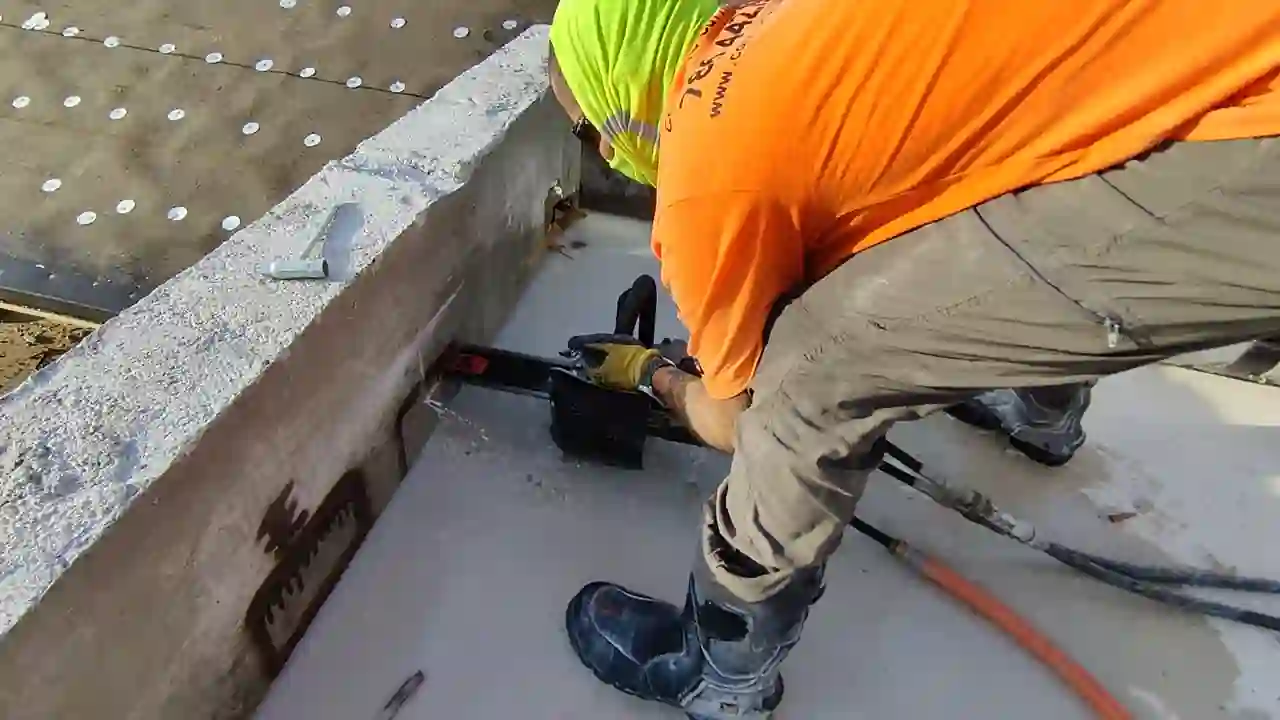
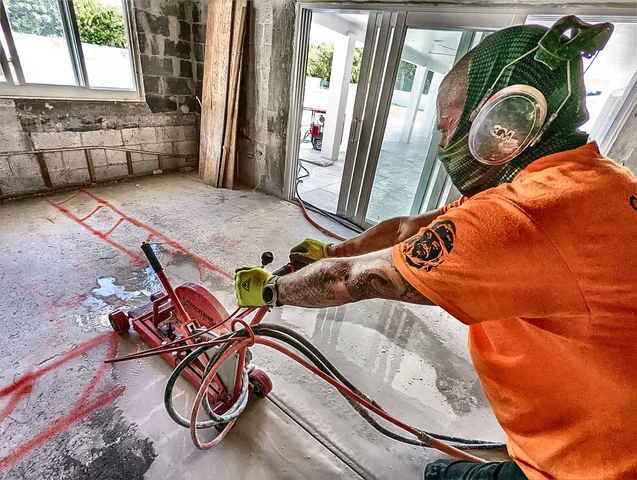
For full-depth removal cuts on residential and light commercial slabs in Pinecrest, we run self-propelled flat saws in the 25 to 65 horsepower range depending on slab depth and reinforcement density. The workhorse for standard 4-to-6-inch residential slab removal is a 35 HP gas-driven flat saw with a 14-inch blade arbor, capable of achieving cut depths to 5 inches in a single pass. For thicker commercial slabs — anything above 8 inches — we step up to a 65 HP hydraulic flat saw running a 20-inch blade, which gives us a maximum single-pass cut depth of approximately 7.5 inches.
Blade speed (surface feet per minute, or SFPM) is a critical spec that most non-technical operators overlook. Our 35 HP units run blade speeds in the 5,200 to 5,800 SFPM range at full RPM. Dropping below 4,800 SFPM on a hard aggregate mix causes the diamond segments to glaze over — the bond matrix hardens without releasing spent diamond crystals, and cutting efficiency drops to near zero. Maintaining proper SFPM requires matching blade diameter to arbor RPM, which is why we don’t swap blade diameters arbitrarily on a given saw head without recalculating the RPM-to-SFPM ratio first.
Diamond Segment Bond Hardness Matched to Pinecrest Aggregate
This is where the real technical expertise lives. Diamond blades are not interchangeable commodities. The bond matrix — the metallic powder mixture that holds diamond crystals in the segment — must be matched to the abrasiveness and hardness of your specific aggregate. Use a blade that’s too hard for your aggregate and the bond won’t wear fast enough to expose fresh diamond crystals; the blade glazes and stalls. Use a blade that’s too soft and the bond wears faster than the diamonds, causing premature segment loss and potential blade failure.
Pinecrest concrete typically incorporates Miami Limestone coarse aggregate, which is a relatively soft, porous limestone with a Mohs hardness of approximately 3 to 4. This soft aggregate profile calls for a hard bond segment — typically in the 40 to 55 Rockwell HRC range — to ensure the bond wears slowly and keeps diamonds exposed and cutting. If you’re working a Pinecrest slab that used hard silica river gravel as aggregate (common in some 1980s commercial pours), you’d flip to a soft bond segment in the 25 to 35 HRC range to allow faster bond erosion and continuous diamond exposure.
Segment geometry matters equally. For removal cuts where we’re prioritizing speed over edge finish, we use a turbo segment profile — the angled, wave-cut geometry increases slurry evacuation and reduces segment loading. For precision removal cuts near footings or post-tension tendons where edge quality and control are paramount, we switch to a straight segmented blade with a higher diamond concentration (typically 40 to 60 carats per cubic centimeter of segment volume) for slower, more controlled cutting.
Wall Saw and Wire Saw Applications for Deep or Vertical Pinecrest Cuts
Flat saws handle horizontal slab work efficiently, but Pinecrest removal projects frequently involve vertical cuts through grade beams, retaining walls, pool shells, and foundation stems. For these applications, we deploy electric wall saws with track-mounted blade heads. Our primary wall saw units run 15 to 30 HP electric motors paired with 24-inch to 36-inch diamond blades, achieving cut depths from 10 to 16 inches per pass. Electric drive is preferred in Pinecrest’s dense residential areas because it eliminates exhaust emissions in enclosed or semi-enclosed spaces and significantly reduces noise — a real compliance factor in this municipality.
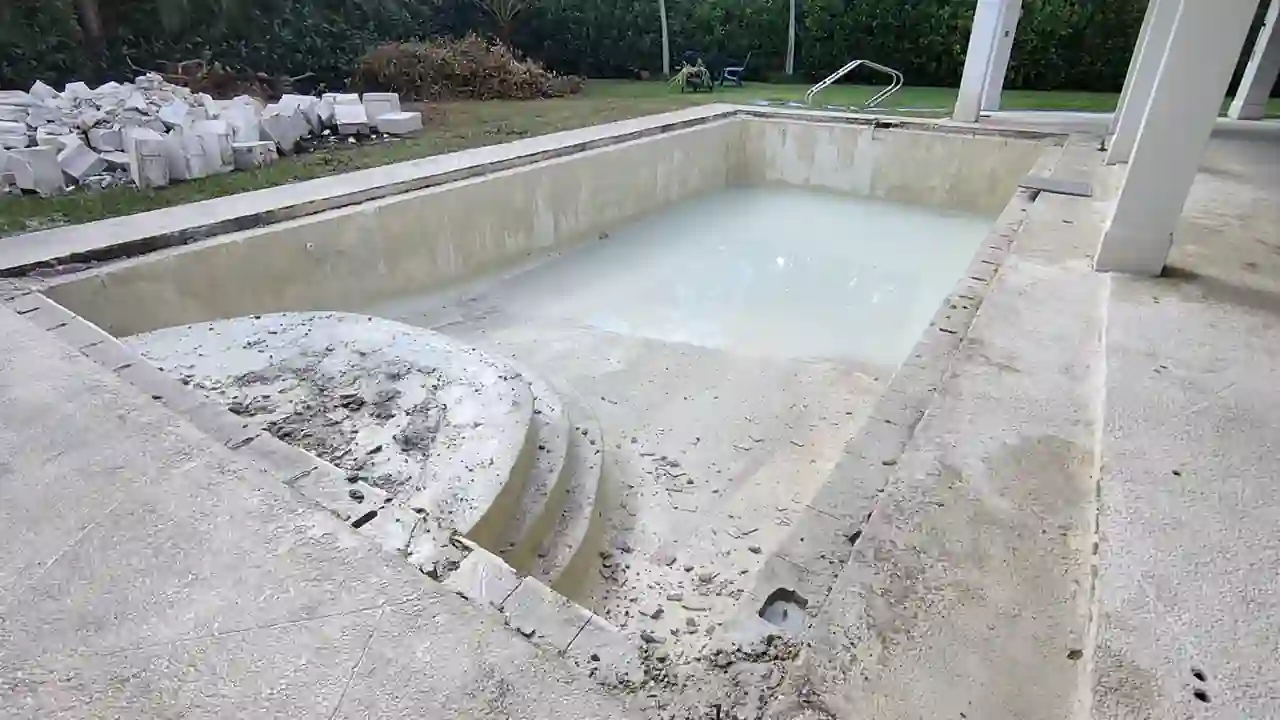
For extremely thick sections — pool shells above 12 inches, or grade beams exceeding 18 inches — diamond wire saws become the correct tool. Wire saw systems use a continuous loop of steel cable embedded with diamond beads (typically 40 beads per meter at 10.5mm bead diameter for concrete applications). The wire is threaded through a pilot hole drilled with a core drill, tensioned to approximately 2,000 to 3,000 Newtons of working tension, and driven by a hydraulic or electric flywheel unit at wire speeds of 18 to 25 meters per second. Wire saws have no depth limitation — they cut purely by wire length and geometry — making them the only practical solution for monolithic sections that exceed wall saw capacity.
Proper wire tensioning is non-negotiable for both cut quality and operator safety. Under-tensioned wire deflects under load, causing curved cuts and potential wire snap. Over-tensioned wire fatigues the bead crimps and accelerates wire breakage. We always reference the manufacturer’s tension specification for the specific wire diameter and bead spacing in use, and we monitor tension continuously throughout the cut with an inline load cell. This is a core component of our jobsite safety protocol on every wire saw operation.
Core Drill Specifications for Pinecrest Removal Prep Work
Almost every concrete removal sequence in Pinecrest begins with core drilling — whether it’s creating pilot holes for wire saw threading, drilling anchor points for hydraulic splitter wedges, or producing utility access cores ahead of demolition. Our core drill fleet spans 1.5 HP handheld units for cores up to 4 inches in diameter, up to 20 HP rig-mounted electric units capable of producing 24-inch diameter cores in reinforced concrete.
Core bit selection follows the same bond hardness logic as flat saw blades. For Pinecrest’s limestone aggregate, we run hard-bond core bits with laser-welded segments — the laser weld provides a stronger segment-to-steel-tube bond than sintered attachment, which is critical when drilling through rebar. Bit diameter selection is straightforward, but RPM calibration is not. A 4-inch core bit should run at approximately 900 to 1,100 RPM for optimal diamond exposure. A 12-inch core bit drops to 300 to 400 RPM. Running any core bit too fast generates heat that can delaminate segments from the barrel; running too slow causes glazing. We use variable-speed rigs with tachometer readouts, not fixed-speed drills, for any core over 3 inches in diameter.
Hydraulic Breaker and Splitter Specs for Slab Lifting After Saw Cuts
Once saw cuts define the removal panel geometry, we use one of two methods to lift and break the concrete panels for hauling. For panels under 200 square feet, hydraulic splitters inserted into pre-drilled holes (typically 1.5-inch diameter on 12-inch centers) apply 800 to 1,200 tons of splitting force per unit — enough to fracture a 6-inch slab cleanly without the shock loading that damages adjacent structures. This is the preferred method in Pinecrest’s residential zones where vibration tolerance is low.
For larger commercial panels, we deploy skid-steer-mounted hydraulic breakers in the 500 to 900 foot-pound impact energy class. These are not jackhammer-class tools — they’re precision demolition instruments when operated correctly, with impact frequency tuned to the resonant frequency of the slab section being removed. Understanding OSHA regulations around vibration exposure limits for operators is mandatory on any extended breaker operation, and our crew rotates operators on 30-minute intervals to stay within ACGIH hand-arm vibration exposure thresholds.
Matching Machine Class to Project Scale and Pinecrest Site Constraints
Pinecrest lots frequently have access constraints — narrow side yards, low-clearance carports, and mature ficus root systems that limit where heavy equipment can travel. Our equipment selection process always accounts for machine footprint and weight. A 65 HP flat saw weighs approximately 1,800 pounds and has a footprint of roughly 48 by 72 inches — it fits through a standard 36-inch gate only when disassembled, which adds mobilization time. For tight-access Pinecrest jobs, we default to our 25 HP walk-behind units (approximately 650 pounds, 24-inch width) and accept the tradeoff of multiple passes on deeper slabs.
Curious about what this level of precision and equipment investment means for your project budget? Our detailed breakdown of concrete cutting costs in Miami gives you real numbers tied to machine class and project scope — not guesswork.
The Technical Difference Between a Competent Crew and an Expensive Mistake
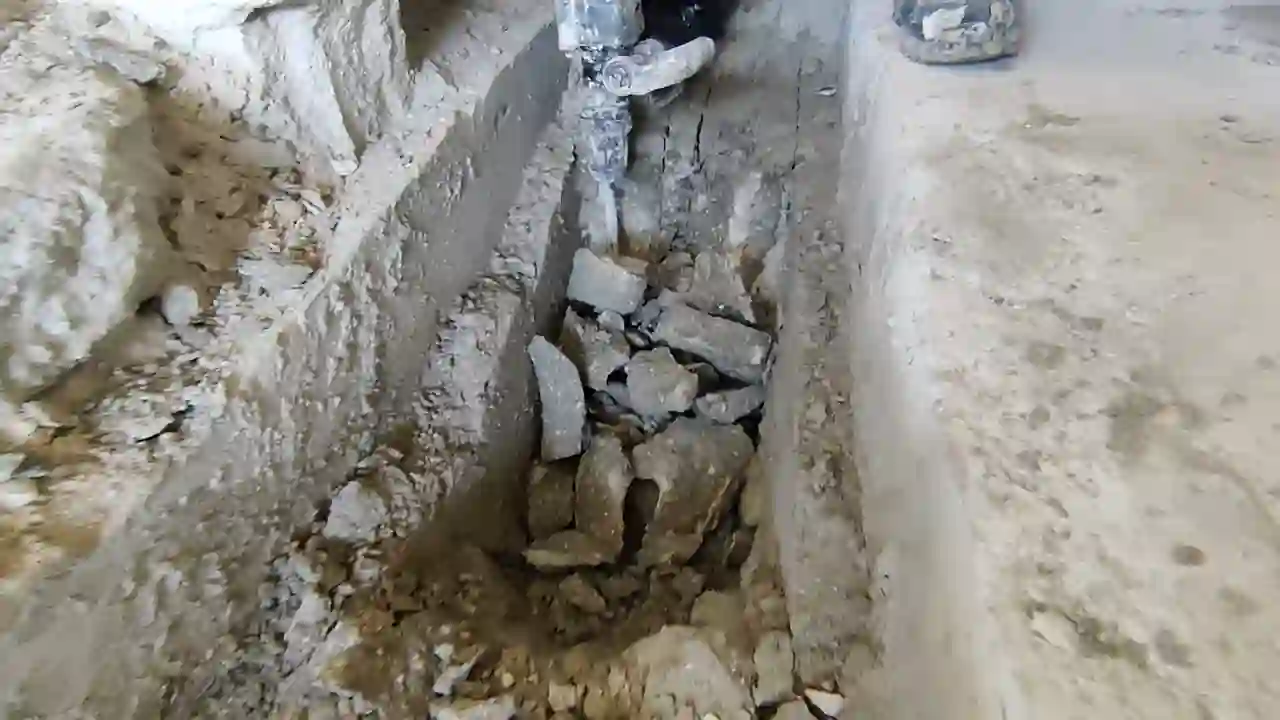
Concrete removal in Pinecrest is not a commodity service. The combination of aging slab stock, variable aggregate profiles, tight site access, and demanding municipal standards means that every equipment and tooling decision carries real consequences. A glazed blade costs you time and tooling. A wrong bond hardness costs you a blade. A miscalibrated wire saw tension costs you an injury and a project shutdown. The technical depth required to make these decisions correctly — bond hardness matching, SFPM calculation, wire tension calibration, RPM-to-diameter ratios — is exactly what separates a senior concrete cutting operation from a general demolition contractor with a rented saw.
At Concrete Cutting Miami, LLC, every Pinecrest removal project begins with a substrate assessment and a documented equipment and tooling plan before the first blade ever touches concrete. That’s not overhead — that’s how you protect your client’s property, your crew, and your schedule.