When concrete hand sawing is the only tool that fits
Walk-behind flat saws cut slabs efficiently. Track-mounted wall saws cut vertical surfaces with precision. But both require space — space for the saw frame, space for the operator, space for the track or the walk-behind platform. On many Miami job sites, that space does not exist. The corner cuts for a door opening where the wall saw track cannot reach. The pipe cut inside a trench box that is 18 inches wide. The detail work around an embedded steel column that extends floor to ceiling with six inches of clearance on each side. The overhead cut in a utility tunnel with four feet of headroom. These are the jobs that require concrete hand sawing — diamond-blade handheld sawing that brings the cutting power to spaces where no other tool fits.
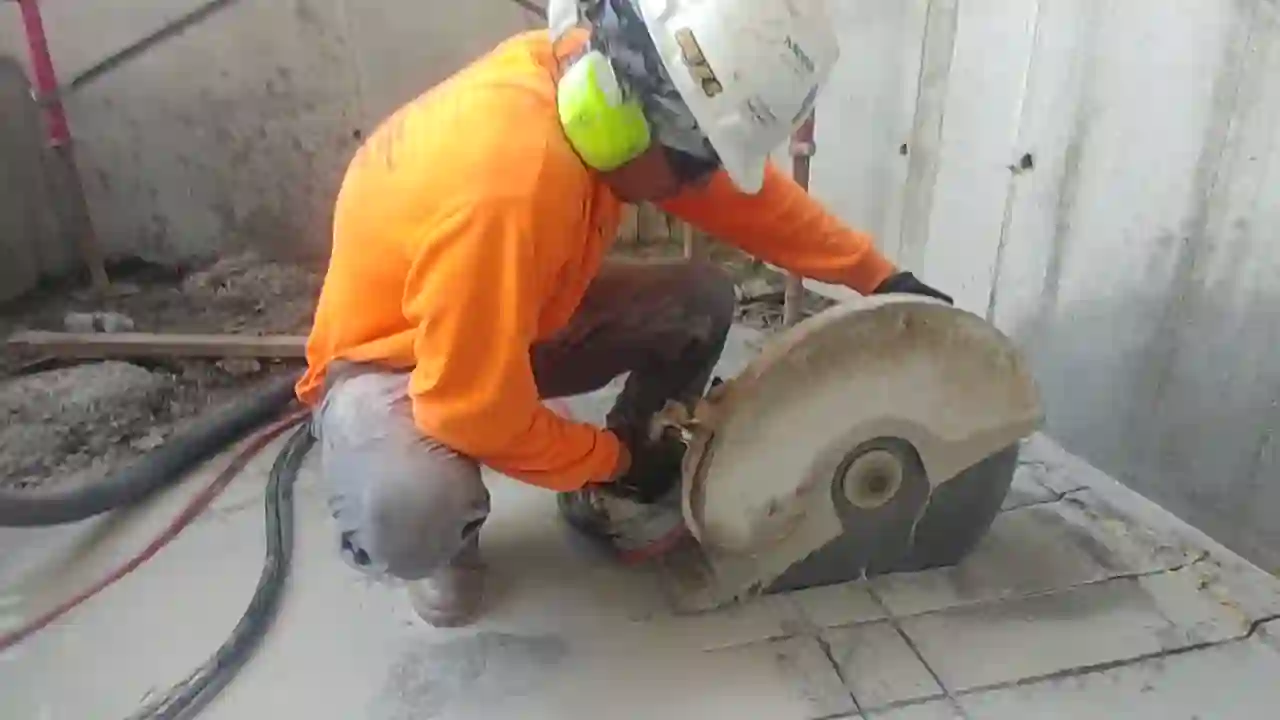
Handheld concrete saws — also called cut-off saws, quick-cut saws, or demo saws — are the most versatile tool in the concrete cutting arsenal, and the one that requires the most operator skill. Unlike a track-mounted wall saw that follows a mechanical guide, a hand saw is guided entirely by the operator’s hands and eyes. The cut quality — straightness, depth consistency, and surface finish — depends on operator skill, not machine settings. A skilled operator with a hand saw can produce a cut that looks machine-guided. An inexperienced operator with the same saw can produce a cut that wanders, varies in depth, and requires cleanup work to salvage. In concrete hand sawing, the tool matters, but the hands holding it matter more.
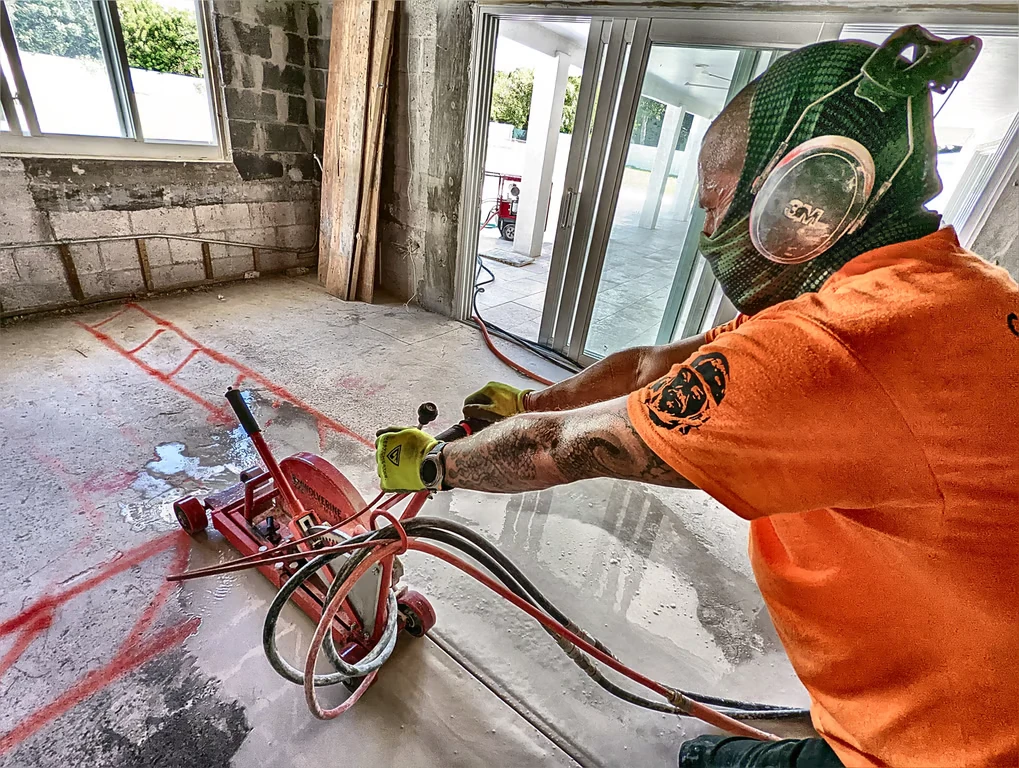
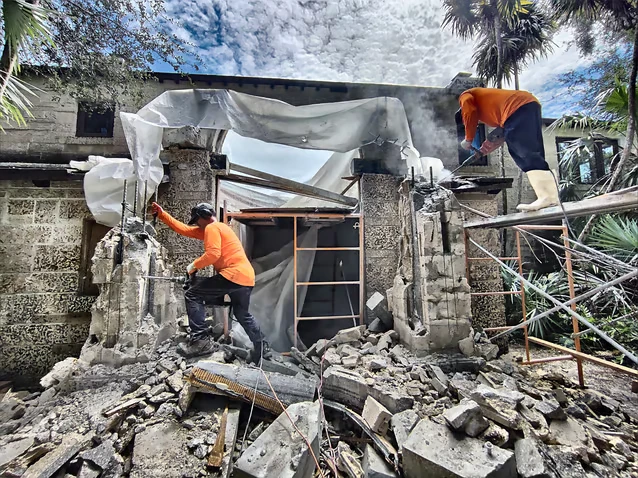
We use handheld concrete saws on nearly every job we run in Miami-Dade County. Even jobs that are primarily flat sawing or wall sawing require hand saw work — corner overcuts, trim cuts, notching around obstructions, cutting rebar stubs, or finishing a cut where the main saw cannot reach because of an adjacent wall or an overhead obstruction. Hand sawing is not a substitute for larger saws — it is a complement that fills the gaps in their capability envelope.
Types of hand saws used in concrete cutting
The term concrete hand sawing covers several tool categories, each suited to different applications:
Gas-powered cut-off saws
The most common handheld concrete saw, powered by a two-stroke gasoline engine. Blade sizes range from 12 to 16 inches, providing a maximum cutting depth of 4-6 inches (the blade arbor reduces the effective depth, which is less than the blade radius). These saws are powerful, portable, and independent of external power sources — ideal for exterior work where power access is limited. The downsides: they produce exhaust emissions that restrict their use indoors or in confined spaces, they are noisy (typically 100+ decibels), and they have significant vibration that limits continuous operation time.
Electric cut-off saws
Electric-powered versions of the cut-off saw, available in both corded and battery-powered configurations. Electric saws eliminate exhaust emissions, enabling indoor use with proper ventilation. They are quieter than gas-powered saws and have less vibration. The trade-off: corded saws require power access and the cord creates a trip hazard and a reach limitation. Battery-powered saws have limited run time — typically 20-40 minutes of continuous cutting per battery charge. For short-duration cuts in confined indoor spaces, electric hand saws are often the best option.
Hydraulic hand saws
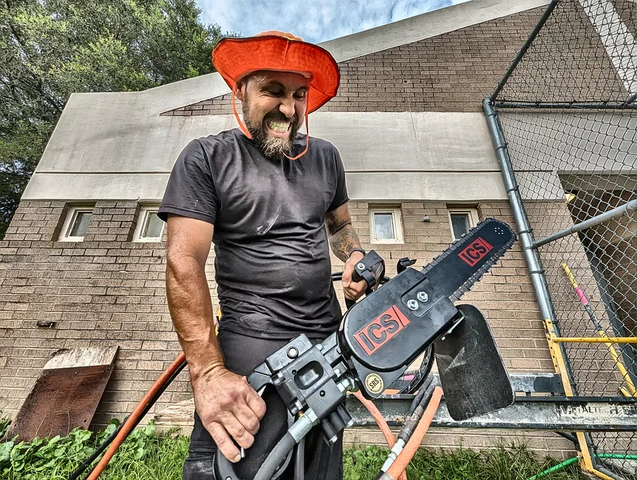
Hydraulic hand saws are powered by an external hydraulic power unit — the same unit that drives wall saws and core drills. The saw head is lighter than a gas or electric saw because the motor is in the power unit, not in the saw. Hydraulic hand saws provide the highest power-to-weight ratio and the most consistent cutting performance under load, but they require the hydraulic power unit and hoses to be set up on site. They are primarily used on commercial and industrial jobs where the power unit is already on site for wall sawing and core drilling.
Ring saws
A specialized handheld saw that uses a ring-shaped blade driven from its outer edge rather than a center arbor. This design allows cutting depths greater than the blade radius — a 14-inch ring saw can cut up to 10 inches deep, compared to about 5 inches for a standard 14-inch cut-off saw. Ring saws are used for cutting pipe, thick walls, and deep notches where the depth exceeds what a standard hand saw can reach. They are heavier and more expensive than standard hand saws, and they require specialized operator training.
Applications for concrete hand sawing in Miami
The specific Miami scenarios where hand sawing is essential:
Door and window opening corner overcuts
When cutting a door or window opening in a concrete wall using a track-mounted wall saw, the circular blade creates a curved cut that extends past the corner of the opening. The wall saw cannot cut a square corner because the blade is round. Hand saws are used to finish the corners — cutting the small remaining triangles of concrete that the wall saw blade could not reach. This is a precision task that requires a steady hand and good visibility of the cut line.
Pipe cutting in trenches
When cutting concrete pipe in a trench or excavation, the confined space prevents the use of a walk-behind saw or other larger equipment. A handheld cut-off saw, typically with a diamond blade designed for pipe material (concrete, ductile iron, or steel), makes the cut from within the trench. The operator must manage the blade angle, water application, and safety concerns of working in a confined space.
Notching and trim work
Notching concrete around existing structural elements — a steel beam that passes through a wall, an existing conduit that cannot be relocated — requires hand sawing because the saw must approach the cut from multiple angles. A wall saw track cannot be mounted in these irregular geometries. The operator uses a hand saw to cut the bulk of the notch, switching to a smaller blade or a grinder for final fitting as needed.
Slab edge cleanup and isolated sections
After a flat saw makes the primary cuts for a slab removal, there are often small sections at edges, around pipes, or adjacent to walls that the flat saw could not reach because of its frame size. Hand saws finish these isolated sections, ensuring complete separation before the breaking and removal phase begins.
Safety considerations unique to concrete hand sawing
Handheld concrete sawing presents safety challenges beyond those of track-mounted or walk-behind sawing:
- Kickback risk: If the blade binds in the cut — from uneven cutting pressure, a change in material, or the concrete shifting — the saw can kick back toward the operator. Proper stance, grip, and cutting technique are essential. The saw should never be forced through a cut; the operator applies steady, consistent pressure and lets the blade do the cutting.
- Vibration exposure: Handheld saws transmit vibration directly to the operator’s hands and arms. Extended use can cause hand-arm vibration syndrome (HAVS) — a condition affecting blood vessels, nerves, and joints. Job rotation, anti-vibration gloves, and limiting continuous sawing time are the controls.
- Fatigue and precision loss: Hand sawing is physically demanding. As the operator fatigues, cut quality declines — the blade wanders, depth becomes inconsistent, and the risk of a safety incident increases. For extended hand sawing, operators rotate or take regular breaks to maintain both quality and safety.
- Flying debris: Hand sawing generates concrete fragments and slurry at close range. Full face protection, not just safety glasses, is standard. The operator’s clothing, gloves, and boots all need to withstand slurry exposure and occasional fragment impact.
- Dust and slurry — closer to the operator: Unlike a walk-behind saw where the operator is several feet from the blade, a hand saw positions the operator directly above and behind the blade. Dust and slurry are generated inches from the operator’s breathing zone. Wet cutting or vacuum dust collection is mandatory. Respiratory protection is standard even with wet cutting in many applications.
When to choose hand sawing vs other cutting methods
The decision matrix for concrete hand sawing versus other methods:
- Use a hand saw when: The cut is in a confined space where other saws will not fit; the cut is short and setting up a track saw would take longer than the cut itself; the cut requires access from multiple angles or irregular positioning; the project requires corner finishing that a wall saw cannot complete; you are cutting pipe or other curved, non-planar concrete surfaces.
- Use a wall saw or flat saw when: The cut is long and straight, with adequate space for equipment setup; the cut requires precise depth control over an extended length; the cut is deep — beyond what a single pass of a hand saw can achieve; the project volume justifies the setup time for a track-mounted saw; the cut quality requirements exceed what even a skilled hand saw operator can consistently deliver.
Concrete hand sawing is not the primary cutting method on most jobs. But it is the method that rescues jobs when the primary saw cannot reach, cannot fit, or cannot finish. The right contractor arrives with both the big saws and the hand saws — and knows exactly when to use each one.