Why Pipeline Concrete Cutting Carries a Higher Risk Profile Than Standard Slab Work
Concrete cutting for pipelines isn’t a variation of standard flatwork cutting — it’s an entirely different risk environment. When crews cut through slabs, walls, or grade beams to access, install, or replace pipeline infrastructure, they’re operating in conditions where a single misjudgment can result in utility strikes, structural compromise, silica overexposure, or catastrophic worker injury. In Miami’s dense urban and residential corridors, where aging infrastructure runs beneath reinforced slabs, the stakes are compounded by unpredictable subsurface conditions, high water tables, and the sheer volume of utilities packed into tight easements. Every pipeline cutting job demands a layered safety framework — not a checklist, but a living protocol that adapts to what the ground is actually telling you.
Pre-Cut Hazard Assessment and Utility Verification Protocols
Before a single blade touches concrete, a thorough pre-cut hazard assessment must be completed and documented. On pipeline projects specifically, this means going well beyond a standard 811 call. Ground-penetrating radar (GPR) scanning should be deployed across the full cutting zone to map rebar density, post-tension cables, conduit runs, and any embedded utility lines that may not appear on as-built drawings. Miami’s infrastructure, particularly in older neighborhoods and historic Coral Gables estates, frequently contains undocumented utility routes that predate modern permitting systems.
The GPR scan data must be reviewed by a qualified operator — not just a field laborer handed a printout. Depth readings, anomaly flags, and signal reflections need to be cross-referenced against utility locates, structural drawings, and any available as-built records. This step is non-negotiable. A missed conduit or unlocated gas line doesn’t just create a delay; it creates a fatality risk.
- 811 Utility Locate: Required minimum 3 business days before cutting. Confirm all utilities are physically marked on-site before mobilizing equipment.
- GPR Scanning: Full-grid scan of the cutting zone. Document all anomalies with depth and location markers.
- Structural Review: Confirm no post-tension tendons run through the cut path. Severing a PT cable is an explosive hazard — treat it as such.
- Permit Verification: Ensure all Miami-Dade or municipal cutting permits are in hand before work begins. Unpermitted cutting near pipelines can result in project shutdowns and OSHA citations.
OSHA 1926 Subpart Q Compliance for Pipeline Excavation and Cutting Zones
OSHA’s 1926 Subpart Q governs concrete and masonry construction, but pipeline cutting jobs frequently trigger additional regulatory layers — particularly 1926 Subpart P (excavations) when cutting is performed in proximity to open trenches. Any trench adjacent to a pipeline cutting operation that exceeds 5 feet in depth requires either a protective system (shoring, sloping, or shielding) or a competent person determination that the soil type and conditions allow for an exception. In Miami’s sandy, high-moisture soils, that exception is almost never appropriate.
Beyond excavation rules, OSHA’s Silica Standard (29 CFR 1910.1053 for general industry, 1926.1153 for construction) is the most frequently violated regulation on concrete cutting sites. Pipeline work often requires extended cutting durations — cutting through thick foundation walls, grade beams, or reinforced slabs to access buried pipeline infrastructure. Prolonged dry cutting generates crystalline silica concentrations that can exceed permissible exposure limits (PEL of 50 μg/m³ as an 8-hour TWA) within minutes.
For projects involving foundation-level cutting in Miami, where pipeline access often requires breaching structural members, the silica exposure window is extended and the dust concentration is typically higher due to denser aggregate mixes and limited ventilation. Compliance is not optional — it’s the baseline.
Wet Cutting Standards and Engineering Controls for Silica Suppression
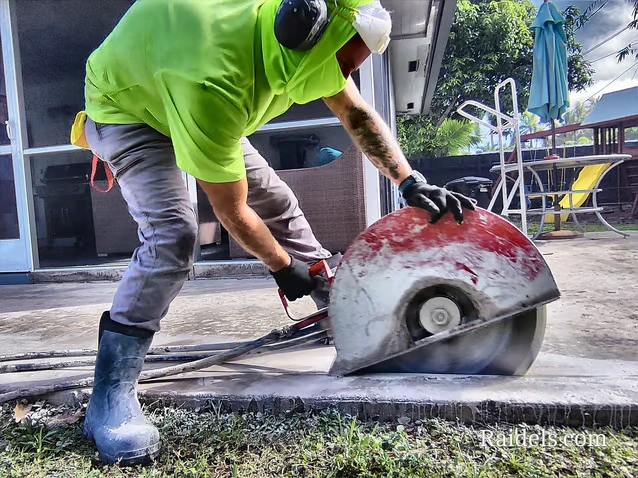
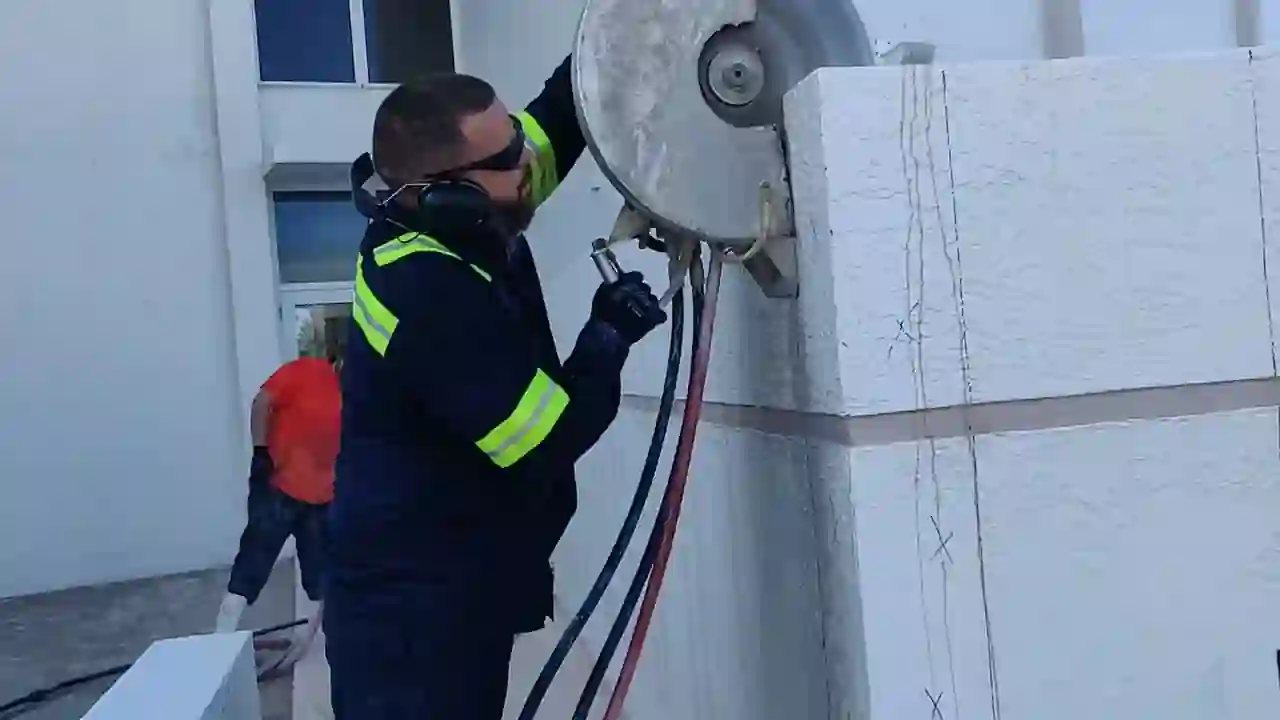
Wet cutting is the industry-standard engineering control for silica suppression during concrete cutting for pipelines. When properly executed, wet cutting reduces airborne respirable crystalline silica by up to 97% compared to dry cutting. However, “wet cutting” is frequently misapplied in the field — a trickle of water on the blade does not constitute adequate dust suppression. OSHA’s Table 1 for concrete cutting specifies that water delivery must be continuous and applied at the blade-concrete interface throughout the cut.
For pipeline cutting operations, this means equipping every saw — whether a walk-behind flat saw, a wall saw, or a core drill — with a properly functioning water delivery system that maintains adequate flow rate for the blade diameter and cutting depth. Blade size directly affects required water volume. A 14-inch blade cutting through a 10-inch reinforced wall requires significantly more water delivery than a 10-inch blade on a 4-inch slab. Field supervisors must verify flow rates before each shift, not just at the start of the job.
- Minimum water flow: 0.5 GPM for blades up to 10 inches; scale up proportionally for larger diameters.
- Slurry management: Wet cutting generates slurry that must be contained and disposed of per local environmental regulations. In Miami-Dade, slurry cannot be allowed to enter storm drains — containment berms and vacuum recovery are required. See our guide on proper material removal in Miami Beach for compliant slurry and debris handling procedures.
- Respiratory backup: Even with wet cutting, workers within 6 feet of the cut must wear N95 or higher respirators as a secondary control measure.
Diamond Blade Selection and Operational Safety for Pipeline Access Cuts
The blade is the most critical piece of equipment on a pipeline cutting job, and the wrong selection creates both safety and structural hazards. For pipeline access cuts through reinforced concrete slabs or walls, segmented diamond blades engineered for hard aggregate mixes are standard. However, when the cut path includes rebar-dense zones — as is common in concrete breaking and cutting operations near structural cores — a blade rated for high-steel content must be specified.
Blade speed (RPM) must match the saw’s rated RPM for the blade diameter. Overspeed is a catastrophic failure risk — a blade spinning beyond its rated RPM can fragment under load, sending segments at projectile velocities. All workers and bystanders must maintain a minimum 15-foot exclusion zone perpendicular to the blade plane during active cutting. Blade guards must be in place and properly adjusted before the saw is powered. Never remove a blade guard for “better visibility” — this is a common field shortcut that has resulted in serious lacerations and amputations.
Structural Monitoring During Active Pipeline Cutting Operations
When cutting for pipeline access involves removing sections of load-bearing slabs or walls, a structural monitoring plan must be in place before cutting begins. This is particularly critical in multi-story structures, where removing a section of a ground-floor slab for pipeline work can redistribute loads in ways that aren’t immediately visible. Crack monitoring gauges should be installed on adjacent structural members, and a qualified structural engineer should review the cutting plan and sign off on temporary shoring requirements before work starts.
In Miami’s high-humidity environment, temporary shoring systems must account for soil moisture and potential for settlement — especially in areas near the water table. Hydraulic shoring is often preferred over timber in these conditions due to its adjustability and load consistency. Any unexpected cracking, deflection, or audible stress indicators during cutting must trigger an immediate work stoppage and engineering reassessment.
Personal Protective Equipment Requirements Specific to Pipeline Cutting Sites
Standard PPE for concrete cutting — safety glasses, hearing protection, hard hat, steel-toed boots — is the floor, not the ceiling, on pipeline cutting jobs. The additional hazards present in pipeline environments require an elevated PPE matrix:
- Half-face respirator with P100 filters: Mandatory for all personnel within the dust zone, even with wet cutting active.
- Cut-resistant gloves (ANSI A4 or higher): Required when handling diamond blades, core samples, or broken concrete near exposed rebar.
- Face shield over safety glasses: Required during all active cutting operations to protect against slurry splash and concrete fragment projection.
- High-visibility vests: Required when pipeline cutting occurs in or adjacent to active traffic lanes or shared access areas.
- Non-conductive footwear: Required when cutting near any electrical conduit or in areas where energized utilities cannot be fully confirmed as de-energized.

Post-Cut Inspection and Hazard Close-Out Before Pipeline Installation Proceeds
Once the concrete cutting phase is complete, a structured post-cut inspection must be performed before pipeline crews enter the work zone. This inspection covers exposed rebar — which must be bent, capped, or cut flush to eliminate impalement hazards — as well as the verification that no utility lines were nicked or compromised during cutting. Any saw marks or scoring on adjacent conduit, pipe, or cable must be reported immediately and assessed by the relevant utility owner before work continues.
Slurry and debris removal must be completed before pipeline installation begins. Standing water in the cut zone creates both slip hazards and potential contamination issues for new pipe materials. In Miami Beach and coastal areas, this step is particularly important given the proximity to sensitive drainage systems. Refer to compliant debris removal protocols for coastal Miami projects to ensure your close-out process meets both OSHA and environmental standards.
Document everything. Photograph the pre-cut GPR scan results, the cutting setup, the PPE in use, and the post-cut inspection findings. OSHA inspections on pipeline projects are increasingly documentation-focused — if it isn’t recorded, it didn’t happen. A complete job file protects your crew, your license, and your client relationship when questions arise down the line.