Concrete core drilling services produce the cleanest holes in the hardest material — when done correctly
Of all the concrete cutting services performed on Miami construction sites, concrete core drilling services are the ones that most people see but few people understand. A plumber needs a 4-inch hole through a floor slab for a waste line. An electrician needs a 2-inch hole through a wall for conduit. An HVAC contractor needs a 12-inch hole through a foundation for ductwork. All of these are core drilling — rotating a diamond-impregnated cylindrical bit through concrete to extract a solid core, leaving a perfectly round hole behind.
The core drill uses a hollow cylindrical barrel with diamond segments bonded to the cutting edge. As the barrel rotates under pressure, the diamonds grind away a circular kerf. The center of the circle — the core — remains intact inside the barrel until the bit breaks through the opposite side. The result is a clean, cylindrical hole through reinforced concrete with smooth walls and precise dimensions.
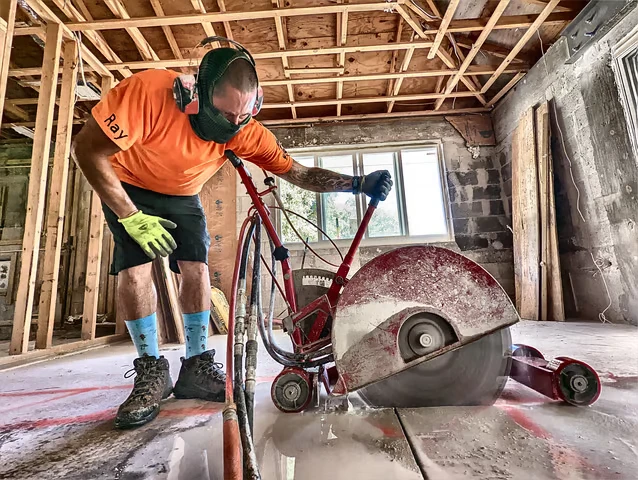
We perform core drilling across Miami-Dade County — from 1-inch penetrations to 18-inch openings — in walls, slabs, ceilings, and foundations. Here is how the process works and what Miami property owners should know before a core bit touches their concrete.
How a diamond core drill works — the physics inside the barrel
Wet drilling vs dry drilling
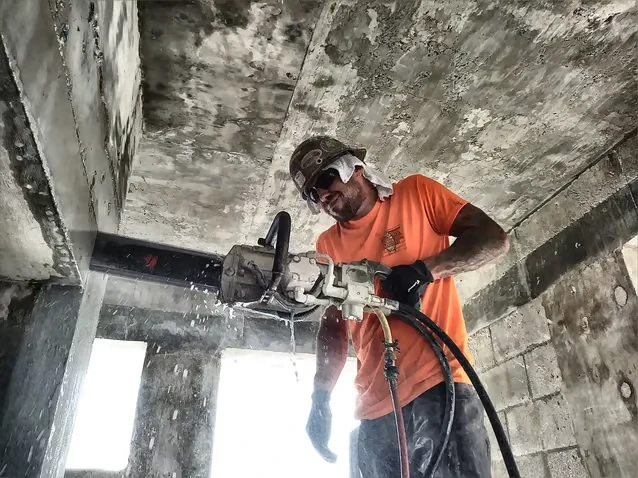
The vast majority of core drilling in Miami is wet drilling. Water is fed through the center of the drill spindle and flows down inside the core bit, cooling the diamond segments and flushing concrete cuttings out of the kerf. Without water, the bit would overheat within seconds. Dry core drilling is possible with specialized bits and vacuum dust collection, but it is slower and produces airborne silica dust.
Wet core drilling produces slurry — water mixed with concrete dust — that must be managed. On vertical surfaces, the slurry runs down the wall. On horizontal surfaces, it spreads across the slab. On overhead surfaces, it drips onto everything below. Professional core drilling services bring wet vacuums, floor protection, and containment berms to every job.
What happens when the bit hits rebar
Diamond core bits are designed to cut through rebar as part of the drilling process. The diamond segments grind through the steel just as they grind through the concrete — slower than through concrete alone, but in a single continuous operation. When the core is extracted, the rebar segments that were cut through are visible embedded in the core. The rebar ends in the hole wall are cut flush — smooth, not jagged — because the diamond segments grind rather than tear the steel.
Core drilling applications in Miami construction
Plumbing penetrations
Every building in Miami has plumbing lines passing through concrete floors and walls. Core drilling creates the holes for those penetrations — typically 2 to 6 inches in diameter for residential, larger for commercial. The holes must be sized precisely for the pipe and located accurately. Professional core drilling services use laser layout tools to position each hole precisely.
Electrical and low-voltage penetrations
Electrical conduit, data cables, fire alarm wiring — all of it passes through concrete. The hole sizes are smaller, typically 1 to 3 inches, but the quantity is larger. A commercial building might need dozens of core-drilled penetrations on every floor.
HVAC openings
Ductwork passing through concrete walls and floors requires larger holes — typically 8 to 18 inches in diameter. These are the most demanding core drilling applications because the bit size is large, the motor must be powerful, and the stand must be rigidly mounted.
Concrete sampling and testing
When a structural engineer needs to verify the compressive strength of existing concrete, core drilling extracts a sample — typically 3 or 4 inches in diameter — that is sent to a laboratory for compression testing. The quality of the extracted core matters as much as the quality of the hole left behind.
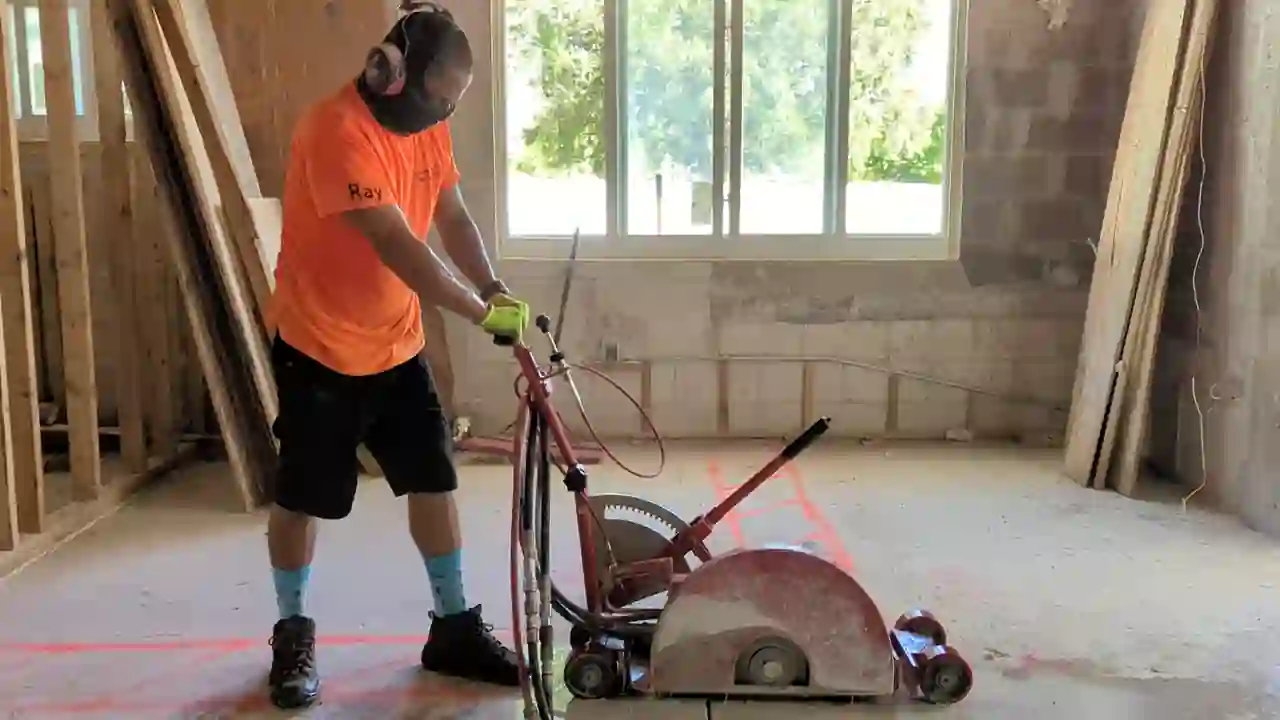
Core drilling equipment — rig-mounted vs handheld
The core drill is mounted to a stand or rig for almost all applications. The stand provides the stability that produces a straight, round hole. For wall and ceiling drilling, the stand is mounted with anchors and may be supplemented with bracing to counteract reaction torque. Ceiling drilling is the least pleasant core drilling application — the operator needs rain gear and the floor below requires comprehensive protection.
What concrete core drilling services cost in Miami
Core drilling is typically priced per hole, with the rate depending on hole diameter (the primary cost driver — a 12-inch hole costs significantly more than a 2-inch hole), concrete thickness, rebar density (heavily reinforced concrete slows drilling), orientation (floor drilling is fastest, wall slower, ceiling slowest), and access (holes in tight spaces add cost).
Questions to ask your core drilling contractor
- “Do you GPR scan before drilling?” If the concrete contains post-tension cables, scanning is mandatory.
- “What diameter range do you handle?” Many contractors can drill up to 6 or 8 inches. Larger diameters require larger rigs. Verify they own the equipment for your sizes.
- “How do you manage slurry for overhead drilling?” The answer should include comprehensive floor protection and vacuum collection.
- “Can you drill through rebar without changing bits?” Diamond core bits are designed to cut through rebar. The answer should be yes without qualification.
- “How do you verify hole location accuracy?” The contractor should describe using lasers, layout measurements, or both.
Concrete core drilling services produce holes that plumbing, electrical, and HVAC trades depend on to do their work. A hole that is the wrong size, in the wrong location, or drilled at the wrong angle creates problems that ripple through every subsequent trade. The right drilling contractor drills holes that the next trade can use without modification, questions, or complaints.