Concrete drilling services — the right method for the right hole changes everything
Not all holes in concrete are the same, and concrete drilling services cover a spectrum of methods that look similar from a distance but produce very different results. A hammer drill punching a 1/2-inch anchor hole and a diamond core drill cutting a 12-inch penetration use different physics, different equipment, and different levels of precision. The contractor who shows up with the wrong drilling method produces a hole that is oversized, out of round, or surrounded by spalled concrete — and that hole will cause problems for every trade that has to work with it.
We provide concrete drilling services across Miami-Dade County, from small anchor holes for equipment mounting to large-diameter core penetrations for mechanical systems. The question is never whether a hole can be drilled through concrete — it always can. The question is whether the right method is being used for the right hole. When it is, the hole is clean, round, and exactly where it should be. When it is not, the hole costs more to fix than it did to drill.
Concrete drilling methods — three different tools for three different jobs
Diamond core drilling — the precision method
Diamond core drilling uses a hollow cylindrical bit with diamond segments on the cutting edge. The bit rotates under pressure, grinding through concrete and rebar in a single operation. A solid cylinder of concrete — the core — is extracted from the center of the bit when the hole is complete. Core drilling produces the cleanest, roundest, and most accurately sized holes of any concrete drilling method.
Core drilling is used for plumbing penetrations (2 to 6 inches), electrical conduit (1 to 3 inches), HVAC ductwork (8 to 18 inches), and concrete sampling (3 to 4 inches for compressive strength testing). It is the standard method for any hole that must be round, clean, and precisely located. Professional core drilling services handle holes from 1/2 inch to 18 inches or larger.
Hammer drilling — the fast method for small holes
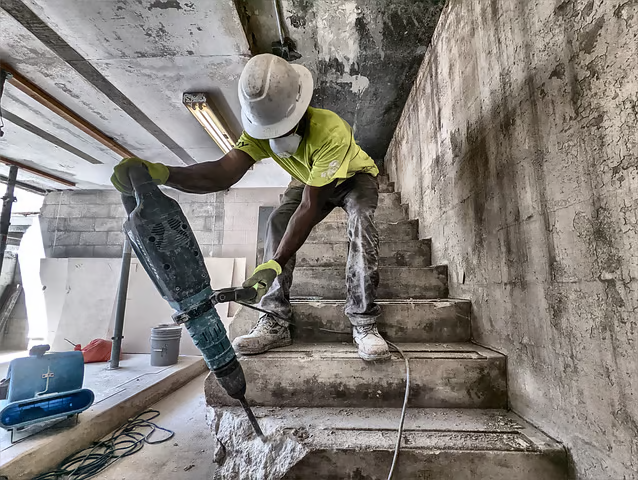
Hammer drilling combines rotary motion with a hammering action. The bit rotates while a piston mechanism delivers rapid impacts to the back of the bit, pulverizing the concrete at the bottom of the hole. The flutes on the bit carry the debris out of the hole. Hammer drilling is the most common method for small-diameter holes — anchor bolts, rebar dowels, expansion anchors — typically 1/4 inch to 1-1/2 inches in diameter.
Hammer drilling is faster than core drilling for small holes, but it produces a rougher hole wall, creates more dust, and cannot cut through rebar effectively — the bit deflects off rebar rather than cutting through it. For holes that will receive anchor bolts or dowels, the rougher wall is actually beneficial because it improves mechanical bond. For holes that must be smooth and precisely round, core drilling is the better choice.
Stitch drilling — the method for large irregular openings
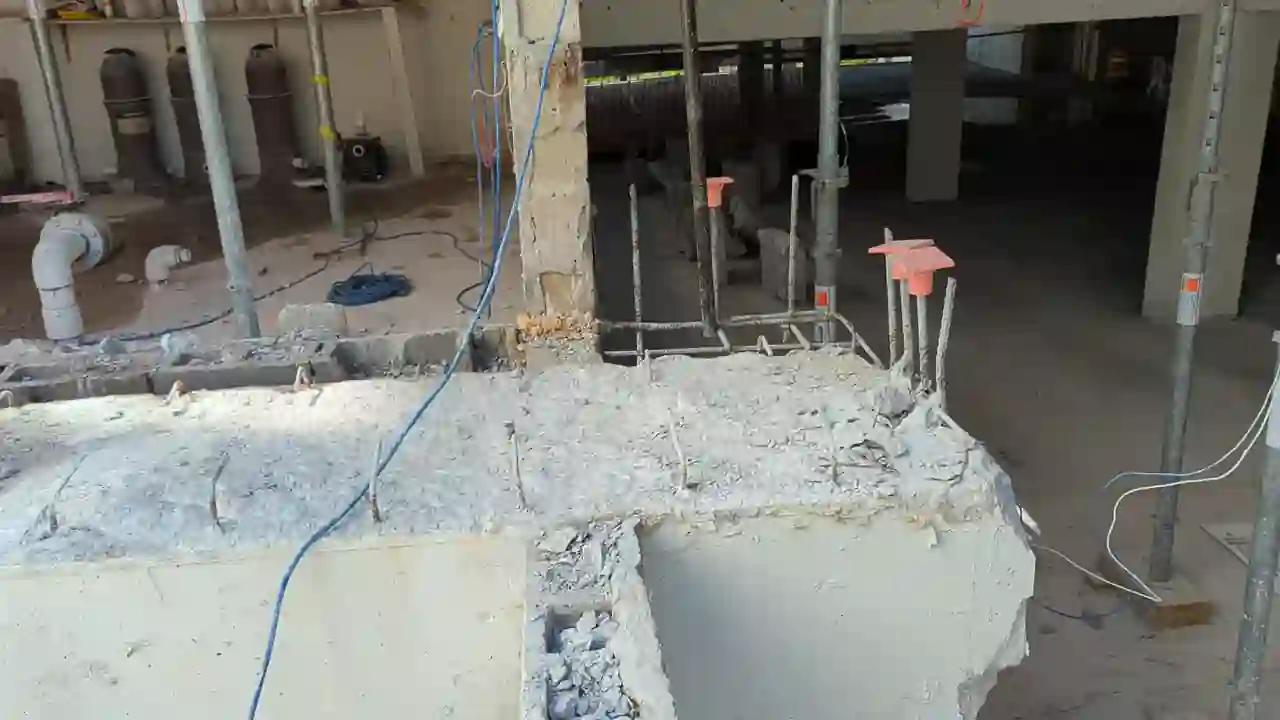
Stitch drilling creates large or irregular openings by drilling a series of overlapping core holes along the perimeter of the desired opening. When a single core bit is not large enough for the opening needed — or when the opening is not circular — stitch drilling provides a way to create the opening using standard core drilling equipment. The operator drills a series of holes that overlap each other, creating a continuous cut line. The center section is then removed.
Stitch drilling is used for large rectangular openings in concrete walls and floors where wall sawing is impractical because of access constraints, or where the required opening is an irregular shape that a circular blade cannot produce. Concrete cutting and drilling services combine stitch drilling with other methods to handle complex opening geometries.
When concrete drilling services are needed in Miami construction
Plumbing and mechanical rough-ins
Every new building and renovation in Miami requires concrete drilling for plumbing, mechanical, and electrical penetrations. The drilling contractor works from the MEP (mechanical, electrical, plumbing) layout drawings, positioning each hole precisely where the trades need it. The holes are drilled before the trades arrive so the pipe, conduit, or ductwork can be installed without delay.
Anchor and dowel installation
When new concrete is poured against existing concrete — a slab addition, a wall extension, a structural repair — rebar dowels must be drilled into the existing concrete to tie the new and old concrete together. Hammer drilling creates the dowel holes, typically 5/8 inch or 3/4 inch in diameter, to a depth specified by the structural engineer (usually 6 to 12 inches). The dowels are then epoxied into the holes before the new concrete is placed.
Structural testing and sampling
When the compressive strength of existing concrete must be verified — for renovation planning, structural assessment, or forensic investigation — core drilling extracts samples for laboratory testing. The cores are typically 3 or 4 inches in diameter and are extracted with care to avoid fracturing the sample. The testing results determine whether the concrete meets the specified strength and whether the structure can support planned modifications.
What concrete drilling services cost in Miami
Drilling cost depends on the method, hole size, concrete thickness, and rebar density. Hammer drilling is the least expensive per hole because it is fast and the equipment is simple. Core drilling costs more because the equipment is more specialized and the process takes longer, especially for large-diameter holes. Stitch drilling costs the most because it involves multiple overlapping core holes rather than a single penetration.
For core drilling specifically, the cost per hole increases with diameter and depth. A 2-inch hole through a 6-inch slab costs substantially less than a 12-inch hole through a 12-inch wall because the larger bit requires a larger drill motor, the drilling takes longer, and the bit cost is higher.
Questions to ask your concrete drilling contractor
- “Which drilling method is right for my holes and why?” The contractor should explain their method choice based on your specific hole size, concrete condition, and accuracy requirements.
- “Do you scan before drilling?” If post-tension cables or embedded utilities are possible, GPR scanning before drilling is mandatory.
- “How do you verify hole locations?” The contractor should use layout measurements, laser levels, or both to position each hole precisely.
- “How do you manage dust and slurry?” Wet core drilling produces slurry that must be contained. Hammer drilling produces dust that requires vacuum collection or respiratory protection.
- “What happens if you hit rebar at the hole location?” Core drilling can cut through rebar. Hammer drilling cannot — the hole location may need to shift. The contractor should explain their approach to rebar encounters.
Concrete drilling services are infrastructure for every other trade. The holes drilled today are the pathways for the pipes, conduits, and ducts installed tomorrow. Get the holes right — the right size, in the right location, drilled with the right method — and every subsequent trade works without interruption. Get them wrong, and every subsequent trade pays the price in delays, rework, and frustration. Hire the drilling contractor who understands that each hole matters because someone else’s work depends on it.