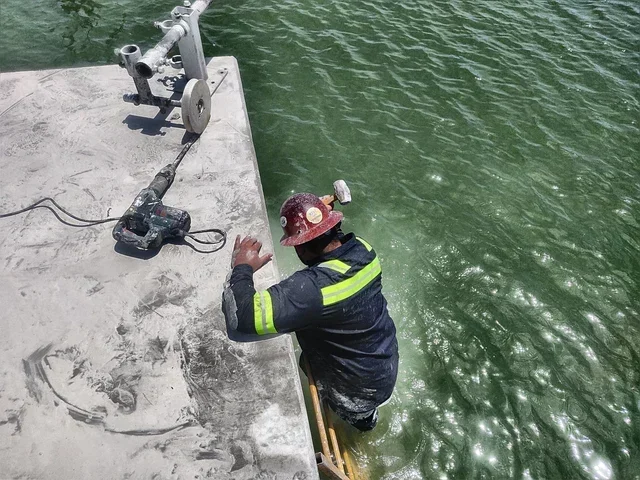
Diamond concrete cutting is not marketing language — it is materials science solving a real problem
The term diamond concrete cutting sounds like an upgrade — premium cutting for premium customers. In reality, diamond is not an upgrade. It is the only material hard enough to cut through cured concrete and embedded steel rebar efficiently. Before diamond blades became standard in the 1970s, concrete was cut with abrasive blades (silicon carbide or aluminum oxide) that wore down rapidly, or with nothing at all — the concrete was broken, not cut. Diamond changed everything about how concrete is modified, repaired, and demolished.
In Miami, where every slab contains rebar and most commercial walls are reinforced concrete, diamond concrete cutting is not optional. An abrasive blade cannot cut through steel rebar. It stops at the first bar and the operator reaches for a torch or grinder. A diamond blade — properly selected for reinforced concrete — cuts through the concrete and the rebar in a single pass. The difference in job duration between diamond cutting and abrasive cutting in reinforced concrete is measured in hours per linear foot, not minutes.
How synthetic diamond makes concrete cutting possible
The diamonds used in concrete cutting blades are synthetic — manufactured under high temperature and pressure to produce crystals with the hardness, shape, and size distribution optimized for cutting applications. Natural diamonds, aside from being prohibitively expensive, have inconsistent properties that make them unsuitable for industrial cutting. Synthetic diamond production allows manufacturers to specify the exact crystal characteristics needed for different cutting applications.
Diamond concentration
The amount of diamond in each blade segment — measured in concentration, with 100 concentration equaling 4.4 carats per cubic centimeter of segment volume — determines cutting speed and blade life. Higher concentration means more diamonds cutting simultaneously, which produces faster cutting but can also create excessive heat if the bond does not wear fast enough to expose fresh diamonds. Lower concentration means fewer diamonds cutting, slower cutting speed, but longer blade life because each diamond carries less load.
Blades for diamond concrete cutting in reinforced concrete typically use medium to high diamond concentration — enough diamonds to handle the dual load of concrete and steel without individual diamonds fracturing under the stress.
Diamond size and shape
Diamond crystal size affects how the blade cuts. Larger crystals (coarse grit, typically 30-40 mesh) remove material faster but leave a rougher surface. Smaller crystals (fine grit, 50-60 mesh) produce smoother cuts but cut slower. Most concrete cutting blades use a blend of crystal sizes optimized for the application — coarser crystals for bulk material removal, finer crystals for surface finish.
Diamond crystal shape matters too. Blocky, well-formed crystals are stronger and last longer than irregular or fractured crystals. Premium blade manufacturers specify crystal shape as part of their quality control, which is one reason professional-grade blades cost more and last longer than commodity blades.
Segment design — the engineering behind the cutting edge
The diamond particles are embedded in metal segments that are bonded to the steel core of the blade. The segment design — its shape, thickness, and internal structure — determines how the blade performs.
Bond matrix and wear rate
The metal bond that holds the diamonds must wear at a rate that continuously exposes fresh diamonds without releasing diamonds before they are fully used. This is the fundamental challenge of blade engineering. A bond that is too hard for the material being cut does not wear fast enough; the diamonds on the surface become dull and the blade stops cutting (glazes). A bond that is too soft wears too fast; diamonds are released before their cutting life is exhausted, and blade life is poor.
Miami concrete — with its limestone aggregate — tends to be softer and more abrasive than concrete with granite or river rock aggregate. This means Miami cutting typically requires a harder bond blade than would be used for the same work in markets with harder aggregate. The softer concrete wears the bond naturally, so the bond needs to be harder to resist that wear. A contractor who does not account for aggregate type in blade selection is wasting blade life or cutting slower than necessary.
Sandwich and layered segments
Premium blades for diamond concrete cutting often use layered or sandwich segments — alternating layers with different diamond concentrations and bond formulations. One layer may be optimized for cutting concrete, the next layer optimized for cutting steel. As the blade rotates, it encounters both materials, and the alternating layers ensure the blade maintains cutting efficiency regardless of whether it is passing through concrete or rebar at any given moment.
Undercut protection
The steel core of the blade is slightly thinner than the segments. As the segments wear during cutting, the bond material just above the core can wear faster than the rest of the segment, creating an undercut that exposes the core edge to wear. Undercut protection — typically a layer of wear-resistant material at the base of each segment — prevents this and extends blade life.
Diamond cutting methods in Miami
Diamond blades are used in every concrete cutting application:
- Wall sawing: Large-diameter diamond blades (18-36 inches) on hydraulic track-mounted saws cut vertical and overhead surfaces. Diamond wall sawing services produce openings for doors, windows, and mechanical penetrations.
- Slab sawing: Diamond blades on walk-behind or ride-on flat saws cut horizontal surfaces for trenching, demolition, and joint cutting. Diamond slab sawing cuts through slabs up to 12 inches thick.
- Core drilling: Diamond core bits — hollow cylinders with diamonds on the cutting edge — drill precise round holes through concrete for plumbing, electrical, and HVAC penetrations. Core drilling services use diamond bits from 1/2 inch to 18 inches in diameter.
- Hand sawing: Handheld diamond saws cut in tight spaces, for corner finishing, and for small-scale residential work.
- Wire sawing: Diamond-impregnated wire cables cut through massive concrete structures — bridge piers, thick foundations, large columns — where circular blades cannot reach.
Why diamond is worth the cost premium
Diamond blades cost more than abrasive blades — sometimes several times more. But the cost per foot of cut is lower with diamond because diamond blades last longer and cut faster. An abrasive blade might cut 100 linear feet of plain concrete before wearing out. A diamond blade of the same diameter might cut 1,000 linear feet or more. When you add the labor savings from faster cutting speed, the total cost per foot with diamond blades is significantly lower.
For reinforced concrete, the comparison is even more stark: abrasive blades cannot cut rebar at all. The labor cost of stopping at every rebar to switch tools, cut the steel separately, and then resume cutting makes abrasive blades economically unviable for any reinforced concrete application.
Diamond concrete cutting is the standard because it works, because it is cost-effective over the life of the blade, and because there is no alternative that can cut through modern reinforced concrete efficiently. The next time you see a concrete saw spinning, know that what is cutting through the concrete and steel is thousands of synthetic diamond particles, each one grinding away a microscopic amount of material with every revolution. That is what makes the clean cut possible.