Why Site Logistics Make or Break Every Core Drilling and Repair Project
Most project managers price a core drilling and repair scope based on diameter, depth, and concrete compressive strength. Those variables matter, but they rarely determine whether a job runs on schedule. What actually dictates crew productivity — and total cost — is site logistics. Can you get a full-size drill rig to the face of the slab? Is there enough overhead clearance to run a standard column stand? Are you drilling in a mechanical room with active gas lines two feet from your anchor point? In Miami’s dense urban construction environment, the answer to at least one of those questions is almost always “no.” Understanding the logistical constraints before mobilization is the difference between a clean, profitable core and a costly abort.
Confined Space Classification and What It Means for Your Drill Setup
OSHA’s definition of a permit-required confined space — limited means of entry or exit, not designed for continuous occupancy, and containing a recognized hazard — applies more often than crews admit on core drilling projects. Elevator pits, below-grade mechanical rooms, parking garage columns, and crawl spaces beneath post-tension slabs all qualify. Before a single anchor bolt gets set, the site supervisor must conduct an atmospheric test for oxygen deficiency, combustible gases, and toxic vapors. Diamond drilling generates slurry, and slurry in a confined space with inadequate ventilation creates a slip hazard and a respiratory exposure risk simultaneously.
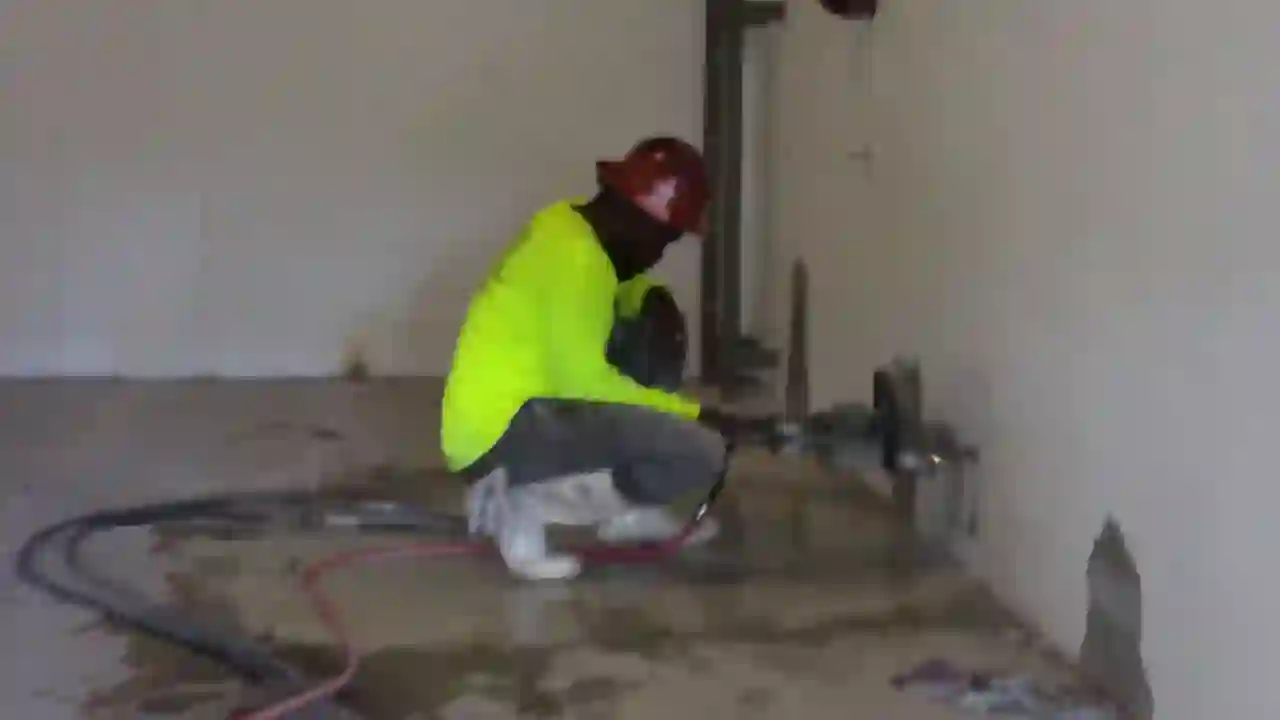
Beyond the safety classification, confined space geometry directly controls equipment selection. A standard hydraulic drill rig with a full column stand requires roughly 84 inches of vertical clearance. Drop that ceiling to 72 inches — common in parking structures and mechanical rooms — and you’re immediately looking at low-clearance rigs with shortened column assemblies. Drop it further to 60 inches, and the crew is likely working with a hand-held or track-mounted angle drill, which changes every downstream variable including water management, torque control, and core extraction method. Experienced Miami crews pre-measure every confined space with a laser distance meter and photograph the access path before quoting the job. See how professional construction techniques adapt to these constraints across different project types.
Access Path Engineering — Getting the Rig to the Work Face
The drill rig reaching the slab face is not automatic. In older Miami commercial buildings and the city’s growing inventory of adaptive reuse projects, doorways run as narrow as 26 inches, elevator openings rarely exceed 36 inches, and stairwells introduce 90-degree turns that defeat any rigid frame longer than 48 inches. Logistics planning for core drilling in these environments requires the same kind of disassembly-and-reassembly thinking that mechanical contractors use when rigging large HVAC equipment.
High-frequency electric rigs offer a meaningful advantage here over hydraulic units. The motor head, column, and base plate are separate components that can be carried independently and reassembled on-site. A hydraulic power pack, by contrast, is a single heavy unit that may weigh 300 pounds or more. In buildings without freight elevator access, that’s a manual carry up a stairwell — a crew safety and scheduling issue that must be budgeted explicitly. For foundation-level work, the logistics compound further because you’re often staging equipment through a basement access hatch with a fixed-width frame.
Slurry management is equally constrained by access. In an open exterior environment, a wet-vacuum and slurry containment berm handles water easily. In a confined mechanical room, every gallon of slurry must be vacuumed continuously and removed through the same narrow path the crew used to enter. Failing to plan for this creates a secondary hazard and can violate the building’s stormwater discharge permit if slurry migrates to a floor drain connected to the municipal system.

Core Diameter Selection Under Structural and Spatial Constraints
In unrestricted field conditions, core diameter is driven by the penetration’s end-use — a 4-inch core for a conduit sleeve, a 6-inch core for a pipe penetration, a 12-inch or larger core for structural investigation. In confined spaces, the available torque from a compact rig introduces a hard upper limit. Most low-clearance electric units top out at cores up to 6 inches in diameter at full concrete compressive strength. Pushing beyond that with an undersized motor means stalling the bit, overheating the segments, and potentially binding the barrel in the hole — a situation that can damage both the equipment and the surrounding slab.
When the required diameter exceeds what a compact rig can safely deliver, experienced crews use an intersecting-core technique, drilling a pattern of smaller cores whose perimeters overlap to produce a larger effective opening. This is slower and more labor-intensive, but it’s the technically correct solution when equipment constraints are non-negotiable. It’s also a method that requires precise layout — any deviation in the drill angle compounds across multiple cores and can leave uncut concrete webs that require chipping, which defeats the purpose of a clean diamond-cut opening. Understanding the reinforcement layout before drilling is critical here; our definitive guide to cutting through rebar and reinforced slabs covers how to read structural drawings and use scanning data to avoid hitting rebar mid-core.
Repair Integration — Closing Out the Core Without Creating New Problems
Core drilling and repair are one continuous scope on most projects, but they’re often treated as separate line items with separate crews. That disconnect creates real field problems. The drilling crew leaves a clean, cylindrical bore. The repair crew arrives later, installs the penetration sleeve or conduit, and then needs to grout or epoxy-inject the annular space. In a confined space, the grout mixing, placement, and curing sequence must account for the same ventilation and access constraints that governed the drilling phase.
Non-shrink hydraulic cement is the standard annular fill material for most penetration repairs. In confined spaces with limited air circulation, extended cure times apply — typically 72 hours before the penetration can be pressure-tested or loaded. Epoxy grout systems cure faster but generate exothermic heat and require strict temperature monitoring in enclosed environments. Either way, the repair crew needs a clear path in and out, adequate lighting, and a ventilation protocol that was established during the drilling phase, not improvised after the fact.
For structural core repairs — situations where a core was drilled for investigation and must be restored to full load-bearing capacity — the repair material specification typically comes from the engineer of record. In Miami’s coastal environment, that spec almost always includes a chloride-resistant cementitious matrix and, for any repair within 18 inches of the slab surface, a corrosion inhibitor admixture. These are not optional upgrades. They’re baseline requirements driven by the local exposure category. Coordinating the repair material procurement with the drilling schedule is a logistics task that falls squarely on the project manager, and it’s one of the most common sources of delay on confined-space core projects. Proper planning here is also a direct cost management strategy — last-minute material sourcing in Miami carries a premium.
Anchor Point Engineering in Restricted Slab Zones
Every drill rig column stand requires a secure anchor point in the concrete. In open conditions, a single drop-in anchor or sleeve anchor at the base of the column provides adequate reaction force. In confined spaces, the available anchor zone is often compromised by existing conduit, post-tension tendons, existing penetrations, or proximity to slab edges. Ground-penetrating radar scanning must precede every anchor installation — not as a best practice, but as a non-negotiable site requirement. Striking a post-tension tendon with an anchor bolt during a confined-space core drill is a catastrophic event that can cause immediate slab deflection and endanger anyone in the work area.
When anchor placement is severely restricted, vacuum-base systems provide an alternative. Modern vacuum rigs can hold against concrete surfaces with 2,000 pounds or more of suction force, eliminating the need for drilled anchors entirely. The trade-off is that vacuum systems require a clean, relatively smooth slab surface and a continuous power supply to maintain suction. In a dirty mechanical room with a rough broom-finished floor, vacuum adhesion drops significantly and must be tested before the drill is loaded. This is a detail that separates crews with genuine confined-space experience from those who only work in open environments. Explore more about the precision methods used in these scenarios through our diamond cutting techniques resource library.
Pre-Mobilization Checklist for Confined Space Core Drilling in Miami
- Atmospheric testing: Oxygen, combustible gas, and toxic vapor readings logged before crew entry on every shift.
- Clearance measurement: Laser-measured vertical and horizontal clearances at the work face and along the entire access path.
- GPR scan: Full scan of the drilling zone and all proposed anchor locations, with results reviewed by the lead driller before setup.
- Equipment disassembly plan: Written staging sequence for breaking down and reassembling the rig through the narrowest access point on the path.
- Slurry management protocol: Wet-vac capacity, discharge point, and containment berm confirmed before drilling begins.
- Ventilation setup: Forced-air or exhaust ventilation established and tested, with air changes per hour documented for permit compliance.
- Repair material staging: Grout or epoxy mix confirmed with the engineer of record, procurement lead time factored into the schedule.
- Emergency egress: Clear, unobstructed exit path maintained throughout the work — no equipment or slurry containers blocking the access point.
Confined space core drilling and repair in Miami’s built environment rewards preparation and punishes improvisation. The technical execution — diamond bit selection, RPM, water flow rate, torque management — is the part most crews handle competently. It’s the logistical envelope around that execution where projects succeed or fail. Crews that treat site access, equipment staging, slurry control, and repair sequencing as engineering problems rather than field-level afterthoughts consistently deliver faster, safer, and more cost-effective outcomes. For projects involving foundation repair in Miami, where confined space conditions are nearly universal, that logistical discipline isn’t a competitive advantage — it’s the baseline requirement for doing the work correctly.