Why Basement Window Cuts in Miami Are a Compliance-First Operation
When a homeowner or general contractor requests a basement window opening cut into an existing concrete foundation wall, the instinct is to think about blade selection, wall thickness, and rebar layout. Those are legitimate technical concerns — but in Miami-Dade County, the conversation has to start somewhere else entirely: environmental compliance, slurry containment, and water management. Cutting concrete for a basement window generates a significant volume of cementite slurry — a mixture of water, concrete particulate, and diamond tooling residue — that cannot be allowed to enter storm drains, soil, or adjacent water features. Miami’s proximity to Biscayne Bay, its shallow water table, and its aggressive municipal enforcement posture make slurry management a non-negotiable technical discipline, not an afterthought.
Understanding Slurry Generation Rates During Foundation Wall Cutting
A standard basement window opening in a residential foundation wall — typically 32 inches wide by 24 inches tall through an 8- to 12-inch thick concrete wall — will generate between 15 and 40 gallons of slurry depending on aggregate hardness, rebar density, and blade feed rate. That slurry carries a pH between 11 and 13, making it chemically caustic and classified as a regulated discharge under Miami-Dade County’s stormwater ordinance and Florida DEP Chapter 62-621. Contractors who allow this material to sheet-flow into yard drainage or street gutters face stop-work orders, fines, and potential remediation liability.
The slurry volume calculation must be performed before mobilization. For a wall-saw operation on a 10-inch-thick foundation wall with a 32×24-inch window rough opening, the cutting perimeter is approximately 112 linear inches. At a typical water feed rate of 1.5 to 2.5 gallons per minute for a 14-inch diamond blade, a 20-minute cut cycle produces 30 to 50 gallons of water input alone — before accounting for the concrete particulate suspended in that volume. This is why our concrete wall cutting operations always begin with a containment engineering assessment, not a blade-to-wall approach.
Containment System Engineering for Below-Grade Window Openings
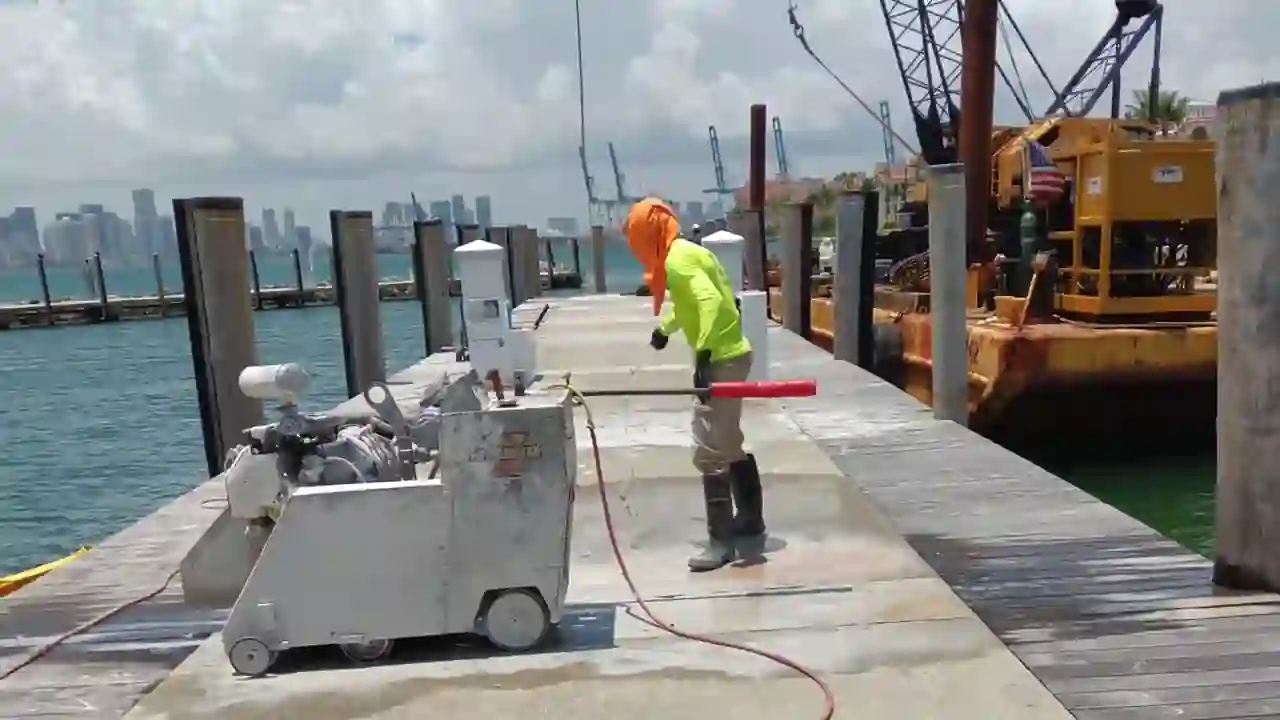
Below-grade cuts present a gravitational challenge that above-grade wall cuts do not: slurry pools. When you’re cutting a window opening at or near grade level — which is typical for basement egress windows — the slurry has nowhere to drain except toward the footing and into the surrounding soil. This is the scenario that triggers the most regulatory exposure.
A properly engineered containment system for this application includes the following components:
- Perimeter berm construction using hydraulic clay or polyethylene sheeting staked into the soil around the exterior cut zone, minimum 6 inches in height, creating a contained basin with a calculated volume exceeding the projected slurry output by 25 percent.
- Vacuum extraction system rated at a minimum of 150 CFM with a dedicated slurry tank — not a standard wet-dry vac — positioned to continuously evacuate slurry from the cut zone during blade operation.
- Interior catch pan installation on the opposite face of the wall, typically a formed polyethylene dam secured with hydraulic cement or foam backer rod, to intercept any slurry breakthrough on the interior side of the foundation wall.
- Slurry settling tank on-site to allow solids to settle prior to any water discharge, with pH adjustment using citric acid or CO₂ injection to bring effluent below pH 8.5 before disposal.
These aren’t optional upgrades. They are the baseline for any compliant cutting operation in Miami-Dade. Our work aligns with the same environmental discipline we apply across all demolition concrete cutting services, where slurry volumes are even larger but the containment principles are identical.
Diamond Blade Selection and Water Feed Rate Optimization for Minimum Slurry Volume
One of the most effective ways to reduce slurry management burden is to engineer the cut itself for minimum water consumption without sacrificing blade life or cut quality. This is a blade-science conversation that most crews skip.
For a Miami foundation wall — typically a 3,000 to 4,000 PSI concrete mix with #4 or #5 rebar on 12-inch centers — a 14-inch segmented diamond blade with a medium-hard bond matrix performs best. The critical variable is water feed rate. Many operators default to maximum water flow to protect the blade, but this generates unnecessary slurry volume. The correct approach is to dial water feed to the minimum rate that keeps blade segment temperature below 400°F, which can be monitored via thermal gun on the blade guard during operation.
In practice, this means starting at 1.0 GPM and monitoring blade temperature and cut speed. If glazing occurs — indicated by a drop in feed rate with no increase in temperature — bond hardness is too high for the aggregate and water rate should increase slightly to accelerate segment wear and re-expose diamond crystals. If segment temperature climbs above 380°F, increase water flow. This dynamic optimization can reduce total water input by 20 to 30 percent compared to fixed-rate operation, directly reducing slurry volume and containment system demand.
This same precision applies to slab cutting operations where slurry management is equally critical in occupied or near-water environments.
Rebar Interception Planning and Its Effect on Slurry Chemistry
When diamond blades cut through reinforcing steel, the slurry chemistry changes. Iron oxide particulate enters the mix, lowering pH slightly but introducing heavy metal content that may trigger additional disposal requirements under certain site classifications. In Miami-Dade, if the project site is within a designated wellfield protection zone — and many residential areas in western Miami-Dade are — iron-bearing slurry must be treated as a potentially regulated waste stream.
The mitigation strategy is straightforward but requires pre-cut planning: use GPR (ground-penetrating radar) scanning to map rebar layout before cutting, then position the window opening to minimize rebar interception. A window rough opening can typically be shifted 2 to 4 inches laterally without affecting egress compliance, and that shift may mean cutting between bars rather than through them — reducing rebar contact by 60 to 80 percent and keeping slurry chemistry cleaner.
This kind of pre-cut engineering is standard practice in our approach to slab and wall operations citywide, and it’s the difference between a clean project close-out and a regulatory entanglement.
Slurry Disposal Protocols Compliant with Miami-Dade and Florida DEP Standards
Once slurry is collected and settled, disposal must follow a defined protocol. The settled solids — the concrete fines and particulate — can be disposed of as construction debris in a licensed C&D landfill, provided they are not classified as hazardous. The supernatant water, after pH adjustment to between 6.5 and 8.5, can be discharged to a sanitary sewer with prior approval from Miami-Dade Water and Sewer, or transported off-site by a licensed liquid waste hauler.
Discharge to the sanitary sewer requires a non-domestic wastewater discharge permit for volumes above a site-specific threshold. For a single basement window cut, volumes are typically below the permit trigger, but documentation of pH testing and settling time must be maintained on-site and available for inspection. This is not bureaucratic theater — Miami-Dade Water and Sewer actively inspects construction sites near sensitive receiving waters, and the fines for non-compliant discharge start at $5,000 per incident.
Miami’s infrastructure evolution — explored in depth in our piece on redefining urban infrastructure in Miami — makes environmental discipline in cutting operations a civic responsibility, not just a regulatory checkbox.
Wall Saw vs. Core Drill Matrix Approach for Egress Window Openings
The tool selection for cutting concrete for a basement window affects both the technical outcome and the slurry management profile. Two primary methods are used in professional practice:
- Track-mounted wall saw — delivers straight, precise cuts on a guided track system. Produces a continuous slurry stream that is easier to contain with a single vacuum extraction point. Best for openings larger than 24 inches in any dimension.
- Core drill matrix method — uses a series of overlapping core holes to define the perimeter of the opening, followed by hand tool knockout of the remaining web. Produces intermittent slurry in smaller volumes per hole, but requires more containment points and more frequent vacuum repositioning. Better suited for tight access conditions where a wall saw track cannot be mounted.
The wall saw approach, when paired with proper containment, is the cleaner environmental option for standard basement window openings. The wire saw method is reserved for unusually thick walls or irregular geometries where standard wall saw geometry cannot achieve the required cut plane.
Field Verification and Post-Cut Environmental Clearance
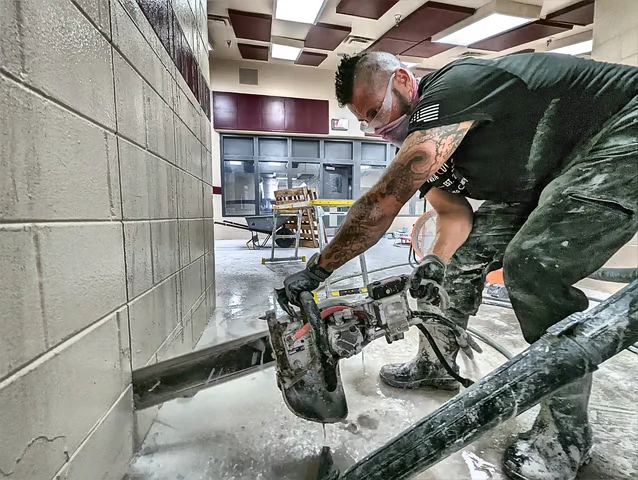
After the cut is complete and the window block is removed, a field verification checklist must be completed before demobilization. This includes pH testing of all collected slurry, photographic documentation of containment system integrity, inspection of the surrounding soil for any slurry migration, and confirmation that no material entered storm drainage infrastructure.
In Miami-Dade, projects within 500 feet of a canal, bay, or stormwater retention pond require a post-cut site inspection by the responsible contractor before containment systems are removed. This is not a permit condition on most residential projects, but it is best practice that protects both the environment and the contractor’s liability exposure.
Cutting concrete for a basement window is a technically demanding operation that sits at the intersection of precision cutting craft and environmental stewardship. The contractors who do it right — who engineer the containment before they ever mount a blade — are the ones building the kind of reputation that sustains a concrete cutting business in a market as competitive and compliance-conscious as Miami.