Why Site Logistics Are the Real Variable in Any Saw Cutting Concrete Operation
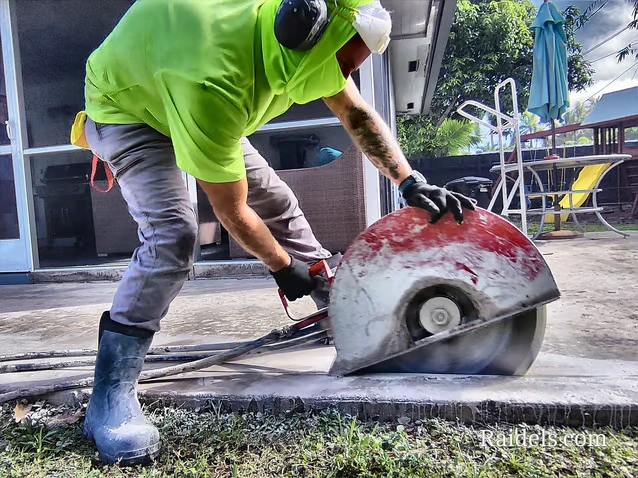
Every concrete cutting project starts the same way on paper — a set of dimensions, a blade spec, and a schedule. But the moment your crew rolls up to a job site with a flat saw, a wall saw, or a wire saw rig, paper meets reality. And reality, especially in dense urban environments like Miami, is almost never cooperative. Saw cutting concrete in the field is as much a logistics problem as it is a technical one. The crews that consistently deliver clean cuts on schedule aren’t just skilled with equipment — they’re expert problem solvers who can read a site before the first blade touches aggregate. Access limitations, confined spaces, overhead clearances, slab loading restrictions, and utility conflicts can turn a straightforward cut into a multi-day coordination exercise if you haven’t planned for them.
Equipment Selection When the Job Site Dictates the Terms
Standard flat saws are workhorses, but they have a non-negotiable footprint. A 35-horsepower walk-behind flat saw with a 14-inch blade needs room to operate, room to turn, and — critically — room to be transported to the cut location in the first place. When you’re working in a parking garage with a 6-foot 8-inch clearance, or inside a mechanical room with a 36-inch door, the equipment selection conversation changes immediately.
Smaller, electric-powered flat saws become the only viable option in many confined scenarios. Electric units eliminate exhaust concerns in enclosed environments — a non-negotiable requirement under OSHA confined space regulations — and their compact frames can navigate through standard doorways and down narrow corridors. The trade-off is cutting depth and blade diameter. Smaller machines typically max out at 5 to 6 inches of cutting depth per pass, which means deeper slabs require multiple passes or a different approach entirely.
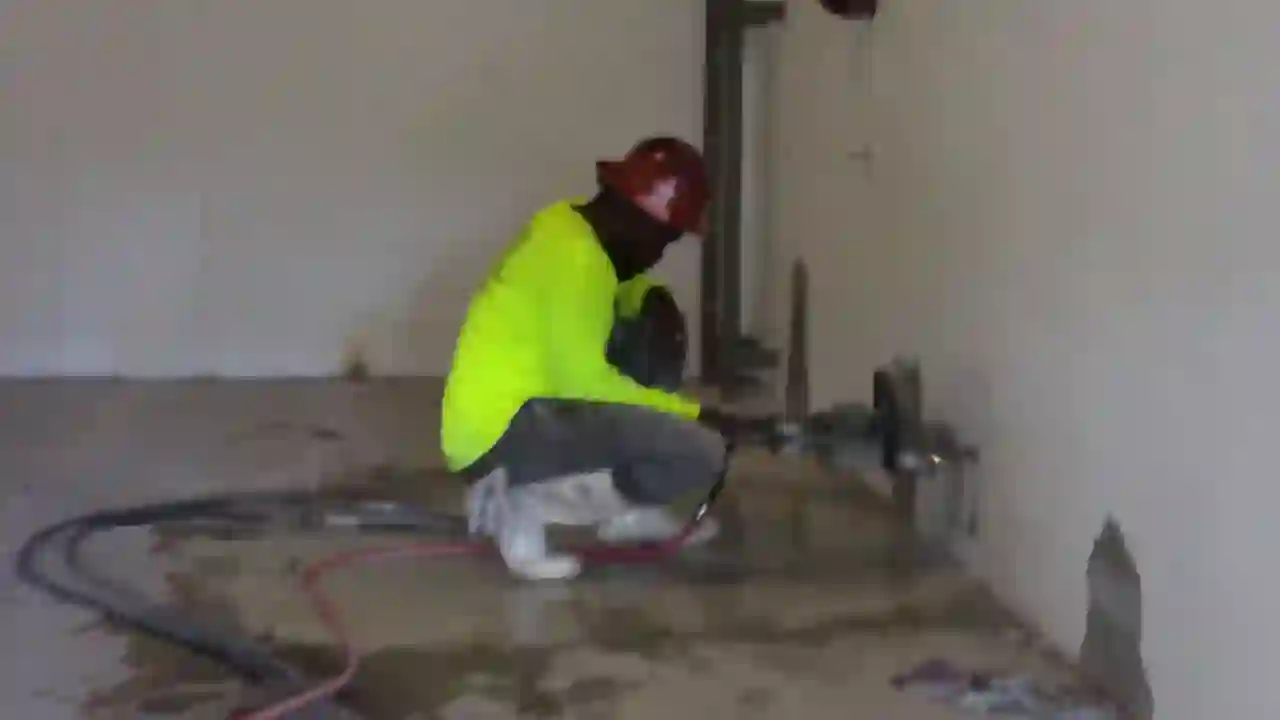
For vertical cuts in confined spaces, wall saws mounted on track systems offer precision that handheld tools cannot match. The track anchors to the concrete face and guides the blade along a fixed path, which is critical when you’re cutting a door opening or a utility penetration in a load-bearing wall with zero margin for deviation. Learn more about the technical demands of new window and door openings in concrete and why precision mounting matters in these applications.
Confined Space Classification and What It Means for Your Cutting Crew
Not every tight space is a confined space in the regulatory sense — but many saw cutting environments qualify as permit-required confined spaces under OSHA 29 CFR 1910.146. Crawl spaces, below-grade mechanical rooms, tunnels, and certain parking structures can all trigger confined space entry protocols depending on their configuration and ventilation status.
When saw cutting concrete occurs in a permit-required confined space, the operational complexity multiplies significantly. You now need an entry supervisor, an attendant stationed outside the space, a rescue plan, continuous atmospheric monitoring for oxygen levels and combustible gases, and a communication protocol between the entrant and attendant. Running gas-powered equipment in these environments is typically prohibited — not just inadvisable. Carbon monoxide accumulation in a poorly ventilated space can reach dangerous concentrations within minutes.
Slurry management in confined spaces is another layer of complexity that gets underestimated. Wet saw cutting generates significant volumes of water and fine concrete slurry. In an open environment, slurry flows to designated containment areas. In a confined space, it pools, creates slip hazards, and must be actively vacuumed during the cut. This requires a dedicated vacuum operator, additional hose runs, and a discharge plan for the collected material. The silica dust and respiratory health risks associated with concrete cutting are amplified dramatically in confined spaces where air exchange is limited.

Staging and Material Handling When Elevator Access Is Not an Option
High-rise construction and renovation projects introduce a vertical logistics challenge that flat site work never encounters. Getting a 400-pound flat saw to the 12th floor of a building under renovation — without a functioning freight elevator — requires rigging, crane coordination, or disassembly and manual carry. None of these options are fast, and all of them require advance planning that has to happen before the job is ever scheduled.
Concrete core sections removed during saw cutting operations present the same challenge in reverse. A 12-inch thick slab section cut to 3 feet by 4 feet can weigh over 1,200 pounds. Moving that section through a building without damaging adjacent finishes, without exceeding floor load ratings, and without injuring workers requires a material handling plan that’s as detailed as the cutting plan itself. Hydraulic pallet jacks rated for rough terrain, reinforced plywood spreader sheets to distribute point loads, and rigging anchors rated for the lift weight are all standard requirements on complex interior demolition projects.
Miami’s unique construction landscape — from below-grade parking structures to high-rise concrete frames — presents a full spectrum of these access challenges. For a deeper look at how the city’s built environment shapes concrete cutting operations, the overview of concrete cutting in Miami from skylines to underground covers the operational realities crews face across different project types.
Blade Specification for Restricted-Access Cuts Where Blade Changes Are Costly
In an open environment, swapping a worn diamond blade takes five minutes. In a confined space where the saw had to be partially disassembled to enter, blade changes can take 45 minutes or more — including the time to confirm the replacement blade is the correct spec and hasn’t been damaged in transport. This reality changes how experienced contractors approach blade selection for confined space saw cutting.
The goal is to select a blade that will complete the entire cut sequence without requiring replacement. This means specifying a premium segment bond matched precisely to the concrete hardness, aggregate type, and reinforcement density. Soft-bond segments cut faster through hard aggregate but wear quickly. Hard-bond segments last longer in abrasive conditions but can glaze over in soft concrete. Getting this wrong in a confined space doesn’t just cost time — it costs money, and it creates additional confined space entry cycles, each of which carries its own safety overhead. Explore the full technical range of diamond blade options to understand how segment specification affects performance under these conditions.
Utility Conflicts, Rebar Mapping, and Pre-Cut Scanning Protocols
Saw cutting into an unknown slab is never acceptable practice — but the consequences of hitting an embedded conduit or post-tension cable are especially severe in a confined space where emergency response is slower and the work area cannot be quickly evacuated. Ground-penetrating radar scanning should be treated as a mandatory pre-cut step, not an optional add-on, whenever the reinforcement layout or utility routing is not confirmed by original construction drawings.
Post-tensioned slabs are particularly common in Miami’s parking structures and high-rise residential buildings. Cutting a live post-tension tendon releases stored energy violently and can cause catastrophic slab movement. Identifying tendon locations through GPR scanning and marking exclusion zones on the slab surface before any blade touches concrete is a baseline safety requirement that no schedule pressure should override.
Budgeting Accurately for Access-Constrained Saw Cutting Projects
The single most common source of cost overruns in confined space concrete cutting is underestimating the time and labor associated with logistics rather than the cutting itself. Equipment staging, confined space entry protocols, slurry management, blade management, and material handling can collectively account for 40 to 60 percent of total project labor hours on a complex interior cut. Contractors who bid only on cutting time consistently lose money on these jobs.
Accurate budgeting requires a pre-bid site walk that specifically evaluates access routes, vertical transport options, ventilation capacity, utility conflicts, and available staging area. It also requires honest accounting of confined space compliance costs — PPE, atmospheric monitors, rescue equipment, and the labor hours for attendants who are not producing cuts but are legally required to be present. For guidance on structuring accurate estimates for complex concrete work, the resources in construction budgeting for concrete projects provide a practical framework.
It’s also worth evaluating whether saw cutting is the right method for every confined space application. In some scenarios where access is severely restricted and cut precision requirements are moderate, alternative methods may offer better cost-to-outcome ratios. The comparison of concrete chipping versus demolition is a useful reference when evaluating method selection for space-constrained projects.
The Pre-Mobilization Checklist That Separates Professional Crews from Everyone Else
Before any saw cutting concrete operation begins in a confined or access-restricted environment, a disciplined crew runs through a site-specific checklist that goes well beyond blade selection and saw calibration. That checklist includes confirmed utility locates, GPR scan results reviewed and marked, confined space entry permits issued if applicable, atmospheric monitoring equipment calibrated and tested, slurry containment and vacuum system staged, emergency egress routes confirmed and communicated to all personnel, and a material handling plan for removed concrete sections approved by the structural engineer of record.
Saw cutting concrete is a precision trade. In open, accessible environments, the margin for logistical error is wide enough that crews can adapt on the fly. In confined spaces and access-limited sites, that margin collapses entirely. The difference between a project that finishes on schedule and one that becomes a costly problem is almost always the quality of pre-mobilization planning — not the horsepower of the saw.