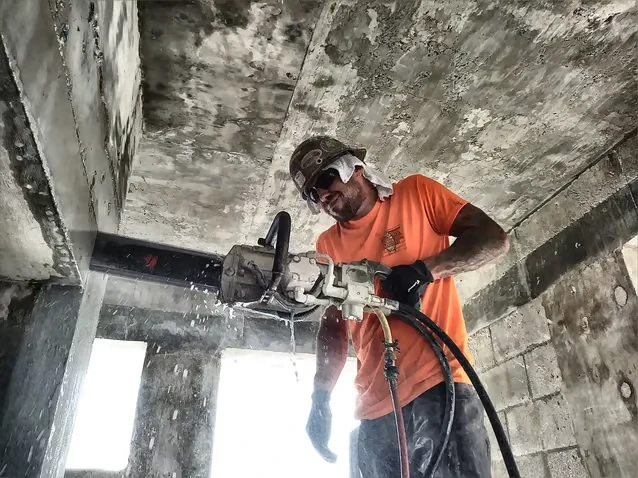
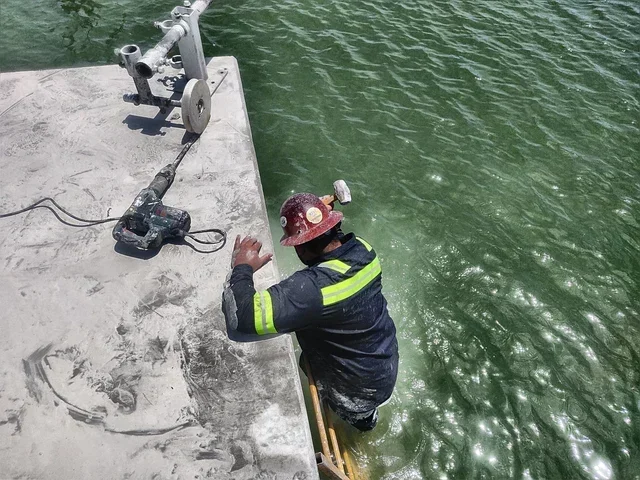
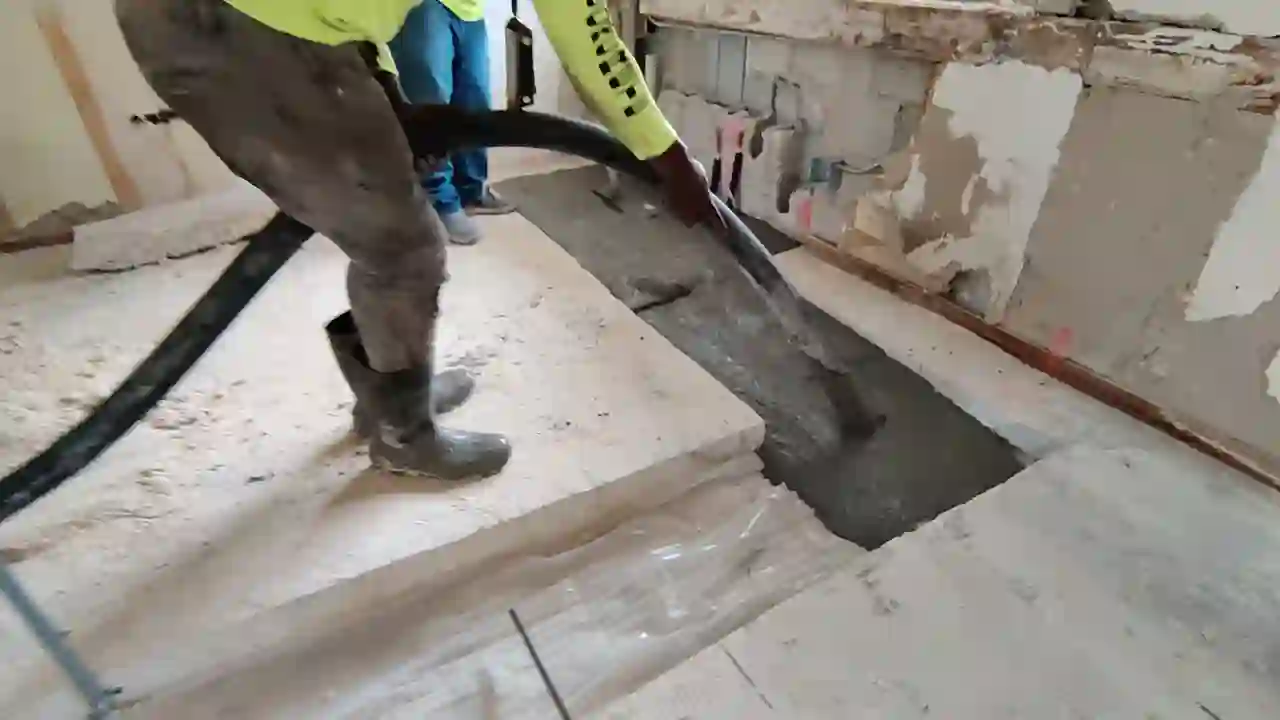
Wall sawing concrete is where the concrete cutting trade separates into those who can and those who should not
Of all the disciplines within concrete cutting, wall sawing concrete is the one that demands the most from both the equipment and the operator. Slab sawing is a walk-behind operation — gravity keeps the saw in the cut, and the operator controls direction and depth. Core drilling is a stationary operation — the drill is mounted to the surface, and the bit advances through the concrete along a fixed axis. But wall sawing is a vertical operation where the saw must be mechanically attached to the wall, advanced through the concrete against gravity, and guided along a precise path while cutting through rebar, aggregate, and sometimes unknown embedded materials. If slab sawing is like mowing a lawn, wall sawing is like performing surgery — on a wall, with a diamond blade, while water and slurry cascade down the surface.
In Miami, wall sawing is a daily necessity. Commercial buildings need door openings cut in tilt-up concrete panels. Parking garages need ventilation penetrations cut through shear walls. Residential foundations need window openings where none existed. Every one of these applications requires wall sawing concrete with hydraulic track-mounted equipment — there is no handheld alternative that produces a straight, square, through-wall cut in reinforced concrete.
The hydraulic wall saw system — how it works
The track — the foundation of accuracy
The wall saw track is a rigid aluminum or steel rail that mounts to the wall surface via concrete wedge anchors or vacuum pads. The track must be positioned parallel to the intended cut line and must be absolutely straight and secure. Any deviation in track alignment becomes a deviation in the cut. Track setup is the most time-consuming part of wall sawing. On a typical 6-foot vertical door opening, track setup might take 30 to 45 minutes. The cut itself might take 15 to 20 minutes.
The saw head — precision feed and traverse
The saw head rides on the track and contains the blade arbor, the depth feed mechanism, and the traverse mechanism. The blade advances into the wall incrementally — typically 1 to 2 inches per pass — while the traverse mechanism moves the saw along the track at a controlled speed. Each pass cuts deeper into the wall until the full thickness is through-cut.
The power unit — hydraulic consistency
Most wall saws are hydraulically powered because hydraulic motors provide consistent torque regardless of load variation. When the blade encounters rebar, the load spikes, but the hydraulic motor maintains RPM better than an electric motor of comparable size. The power unit sits remotely from the saw, connected by hydraulic hoses, allowing wall sawing in confined spaces.
The wall sawing process — step by step
Before the track goes on the wall, the wall gets scanned with ground-penetrating radar to identify the rebar layout, post-tension cables, embedded conduits, and wall thickness variations. Professional concrete cutting services perform GPR scanning as a standard pre-cut step. Then the opening dimensions are marked, the track is mounted and aligned, and the saw makes multiple passes along each cut line — a 6-inch wall might require 3-4 passes while a 12-inch wall might require 6-8 passes.
At each corner of a rectangular opening, the circular blade creates an overcut — the remaining uncut concrete in the corner is removed with a hand saw or chipping tool. Once all four sides are through-cut, the wall section is removed. A 3-foot by 7-foot section of 6-inch concrete weighs roughly 1,500 pounds, so controlled removal with lifting equipment prevents damage to adjacent structures.
When wall sawing concrete is the right tool for the job
- Straight cuts in flat walls: Wall sawing is the standard. The track system produces the straightest, cleanest cuts.
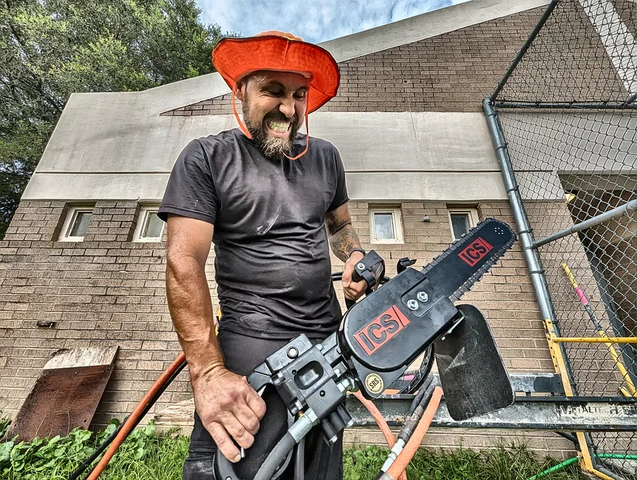
- Thick walls (8+ inches): Wall sawing handles thick walls that handheld saws cannot cut through. Hydraulic chain saws may be an alternative for very thick walls.
- Overhead cuts: Wall saws can cut overhead in horizontal mode. Very few other concrete cutting tools can do this.
- Walls with restricted access on one side: Wall sawing can cut from one side only, common in basement walls and retaining walls.
- Deep openings in corners: Wall saws can cut close to intersecting walls using specialized track setups.
What wall sawing concrete costs in Miami
Wall sawing is priced per square foot of cut surface, with the rate depending on wall thickness (the primary cost driver — an 8-inch wall takes roughly twice as many passes as a 4-inch wall), rebar density (heavily reinforced walls slow the cut and increase blade consumption), access and setup conditions (tight spaces and vacuum mounting increase setup time), number of openings (track setup time is amortized across the number of cuts), and slurry containment requirements (interior cuts in finished spaces require extensive protection).
Why you should not attempt wall sawing as a DIY project
Wall sawing concrete is not a DIY activity. Equipment is not available for consumer rental — wall saw systems are specialized industrial equipment. Structural risk is real and immediate — cutting an opening in a concrete wall without engineering review and proper shoring can cause settlement, cracking, or partial collapse. The learning curve is measured in wall damage — everyone who learns wall sawing ruins at least one opening before producing a clean one. And overcut corners require finishing skill — an opening with bad corners will not accept a standard door or window frame.
Wall sawing concrete is a professional service for a reason. The track system, the hydraulic power unit, the diamond blade selection, the scanning before cutting, the slurry containment during cutting, the corner finishing after cutting — these are skills developed over years of doing nothing but concrete cutting. When your project needs a wall opening, hire the company that brings a wall saw because that is what they do.