Why Pool Demo Is One of the Most Logistically Complex Residential Jobs in South Florida
Most homeowners picture pool demolition as a simple process — bring in a machine, smash the shell, haul it out, backfill the hole. In practice, especially across Miami-Dade and Broward County, inground pool removal is one of the most technically demanding residential demolition jobs a concrete crew will ever face. The combination of confined backyard access, high water tables, reinforced shotcrete shells, and neighboring structures packed within inches of the work zone turns every pool demo into a site-specific engineering challenge. Before a single blade touches concrete, a competent crew has already solved a dozen logistical problems that most contractors never even ask about.
Reading the Site Before Any Equipment Rolls In
The first thing an experienced demolition consultant does on a pool demo walkthrough is ignore the pool itself. The pool is the known variable. The unknowns are everything surrounding it — fence gate widths, overhead utility lines, deck elevation changes, irrigation systems, mature root systems from ficus or banyan trees, and the proximity of pool equipment pads to the structure being demolished. In Miami’s older neighborhoods like Coral Gables, Coconut Grove, and Pinecrest, you routinely encounter pools that were poured decades before the surrounding additions, pergolas, and screen enclosures were built around them. The pool is now essentially entombed.
Gate access is the first filter. A standard mini-excavator needs roughly 36 to 42 inches of clearance to pass through a residential gate. Many South Florida properties have 30-inch or even 28-inch access points, which means tracked equipment either can’t enter at all or requires disassembly and manual carry-in — a process that adds hours and changes the entire demolition sequence. When mechanical breaking isn’t feasible, the job shifts toward hand demolition and manual concrete removal techniques that most general contractors aren’t equipped to execute efficiently.
Shotcrete Shell Thickness and What It Means for Cutting Sequences
Residential pools in South Florida are almost universally built with shotcrete — pneumatically applied concrete that bonds directly to a rebar cage. Wall thickness typically runs between 6 and 10 inches depending on the pool’s age and the original engineer’s spec. Older pools from the 1970s and 1980s sometimes have inconsistent wall thickness because shotcrete application was less controlled. You’ll hit a section that’s 7 inches and then find a column area that’s 14 inches. That inconsistency matters enormously when you’re planning blade depth and cut sequencing.
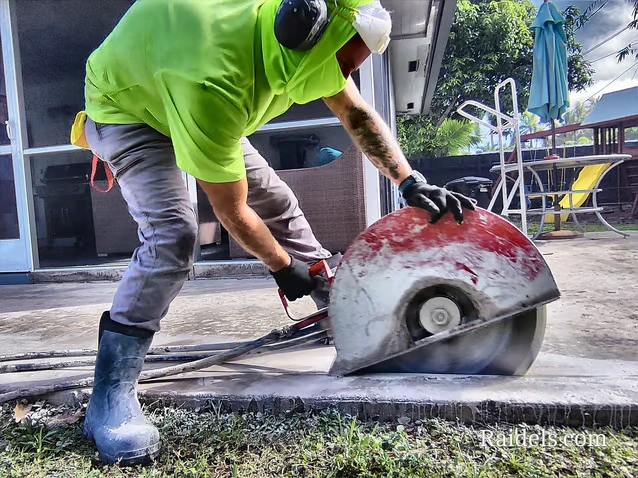
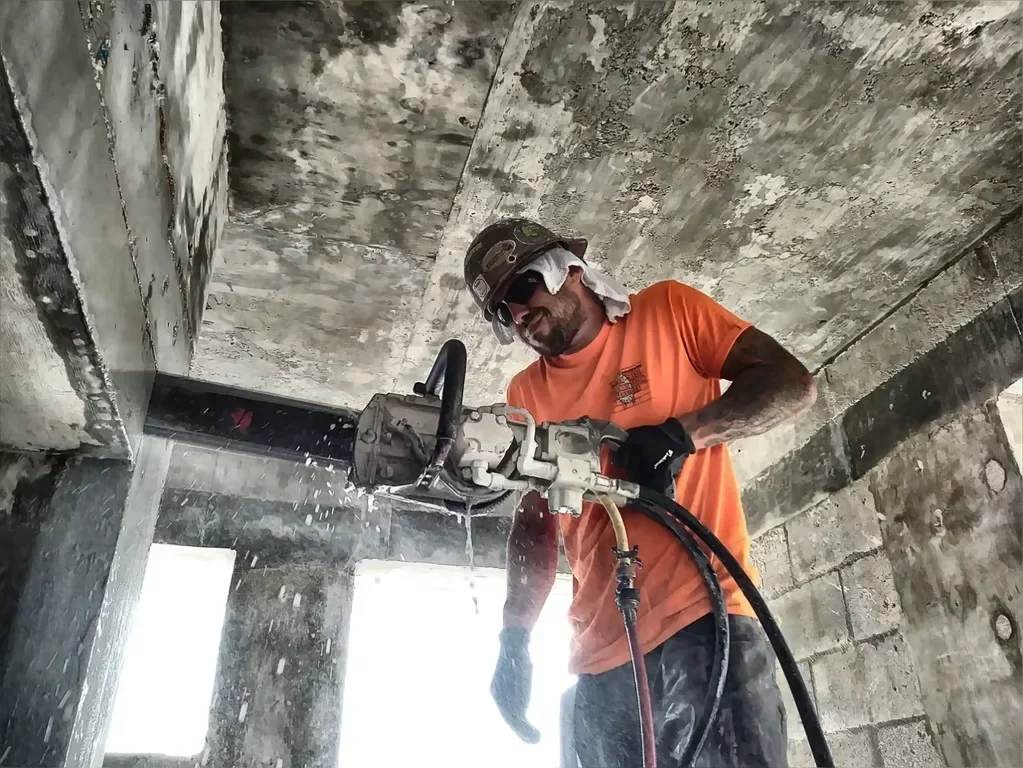
For pool demo in confined spaces, the standard approach is to section the shell into manageable panels using diamond blade flat saws or ring saws before any breaking begins. This is critical for two reasons. First, uncontrolled breaking with a hydraulic hammer in a tight space generates massive vibration that can crack adjacent pool decking, damage underground plumbing, and compromise fence footings. Second, sectioning the shell into defined panels allows debris to be manually staged and removed without requiring a machine to reach deep into the excavation. Understanding what makes certain concrete particularly difficult to cut — dense aggregate, heavy rebar, or high-strength mix designs — is essential before committing to a blade specification and cut depth.
Confined Space Entry Protocols During Pool Shell Removal
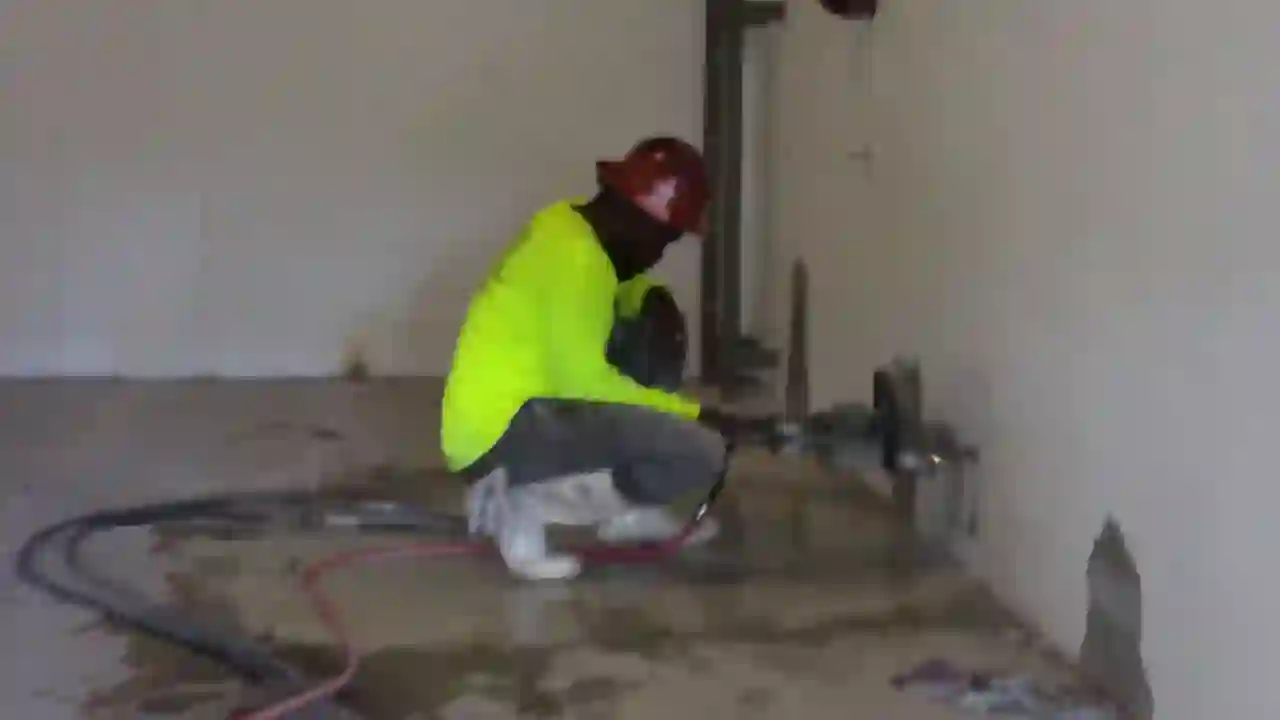
Once the pool is drained and cutting begins, workers are frequently required to enter the excavation to complete cuts along the pool floor, disconnect plumbing penetrations, and stage debris. This is where pool demo transitions from a demolition job into a confined space operation. OSHA defines a permit-required confined space as any space large enough for a worker to enter, with limited means of entry or exit, and not designed for continuous occupancy. An empty inground pool with workers inside, surrounded by walls being actively demolished, meets that definition in most interpretations.
Proper confined space protocols include atmospheric testing for oxygen deficiency, combustible gases, and carbon monoxide — particularly relevant when gas-powered equipment is operating nearby. Ventilation management becomes critical if any saw cutting is happening at grade level while workers are below. Silica dust generated by cutting reinforced shotcrete is a serious respiratory hazard, and in a confined pool excavation, dust concentrations can spike rapidly without forced air movement. Wet cutting with continuous water suppression is non-negotiable in these conditions, not optional.
Entry and exit points must be clearly identified and kept unobstructed at all times. In a pool with a single shallow-end step access point and debris being staged on the deck above, maintaining a clear egress path requires active coordination between the crew members above and below grade. This is the kind of operational detail that separates professional demolition teams from general contractors who treat pool removal as a weekend project. Cutting errors in confined demolition environments are covered extensively in our concrete cutting mistakes resource library — many of the worst outcomes happen precisely because confined space protocols were ignored.
Managing the Water Table During Excavation and Backfill
Miami-Dade County sits on porous oolitic limestone with a water table that can be as shallow as 18 to 24 inches below grade in many neighborhoods. During pool demo, once the shell is breached — particularly the floor — groundwater intrusion is immediate and can be rapid. This isn’t just a nuisance; it changes the structural dynamics of the excavation. Saturated sidewalls become unstable. Debris that was manageable dry becomes a slurry that’s nearly impossible to handle manually and problematic for disposal.
Experienced crews address this with continuous dewatering pumps staged before the floor is breached. The pump placement and discharge routing must be planned as part of the site logistics review — where does the water go? In tight urban lots, discharging to the street requires coordination with municipal stormwater guidelines. Discharging to adjacent landscaping can cause erosion and neighbor complaints. This is a detail that rarely appears in a standard demolition bid but consistently becomes a problem on job day if it hasn’t been addressed in advance.
Rebar Extraction and Steel Handling in Restricted Access Zones
After the concrete is sectioned and broken, the rebar cage remains. In a confined backyard with no machine access, that steel has to come out by hand. Shotcrete pools typically use #3 or #4 rebar on 12-inch centers, which means a standard residential pool contains several hundred linear feet of steel that must be cut, bundled, and extracted through whatever access point exists. Diamond saw cutting for steel-reinforced concrete is often the cleanest approach for separating heavily reinforced sections, particularly when torch cutting is restricted due to proximity to pool equipment, gas lines, or combustible screen enclosure materials.
Steel removal sequencing matters. Pulling rebar from one section before adjacent concrete panels are fully supported can cause unexpected collapse of the remaining shell. The cut sequence has to account for the structural interdependency of each panel — the pool walls act as a retaining system for the surrounding soil until they’re removed. Demolish them in the wrong order and you’ve created a cave-in risk that no amount of hustle will fix quickly enough.
Screen Enclosures, Pool Decks, and Structural Adjacency Concerns
South Florida pool demo almost always involves a screened enclosure. These aluminum structures are anchored to the pool deck, which is often a separate pour from the pool shell itself but may share a continuous footer in older construction. Removing the pool deck without understanding its relationship to the enclosure footer can destabilize the screen structure — a liability issue that goes well beyond the demolition scope. The deck removal sequence must be planned with the enclosure’s structural logic in mind, even if the enclosure itself is being retained.
In hurricane-prone South Florida, screen enclosures are engineered to specific wind load ratings. Disturbing their foundation during pool demo can void that engineering and create a code compliance issue for the homeowner. Our team’s experience navigating structural adjacency in South Florida’s extreme weather environment — detailed in our post on how we approach hurricane season demolition challenges — directly informs how we sequence pool deck removal relative to adjacent structures.
What a Professional Pool Demo Scope of Work Actually Looks Like
A properly scoped pool demo job in a confined South Florida backyard includes the following discrete phases, each with its own equipment list, safety protocol, and sequencing logic:
- Site access survey — gate measurement, overhead clearance, utility marking, and neighbor notification
- Deck removal and staging — sectioning the pool deck into liftable panels, managing footer adjacency
- Shell cutting and panel sequencing — flat saw or ring saw cuts defining extraction panels in the correct structural order
- Confined space entry setup — atmospheric testing equipment, ventilation, continuous dewatering, egress protocol
- Rebar extraction and steel disposal — diamond cutting for steel-reinforced sections, bundling, and staging for removal
- Debris extraction logistics — manual carry-out through restricted access points or crane lift over obstructions
- Backfill specification — engineered fill compaction to prevent future settlement, drainage layer installation above the breached shell floor
- Final grade and compaction verification — particularly critical if the area will be built over or used for a future structure
Every one of these phases is affected by the site’s specific access limitations. The difference between a pool demo that goes smoothly and one that becomes a two-week nightmare almost always comes down to how thoroughly the site was evaluated before the first tool was unloaded. In Miami’s dense residential neighborhoods, where lots are small, neighbors are close, and pools are often surrounded by years of added construction, that pre-job evaluation isn’t a formality — it’s the job.