Most people think cutting concrete means renting a gas saw from Home Depot — and that misunderstanding has destroyed more projects than any structural failure ever could
There is no single method called “concrete cutting.” The term covers at least seven distinct techniques, each with its own equipment, blade type, depth capability, and appropriate application. Using the wrong method does not just produce a bad cut — it can damage the surrounding structure, create silica dust hazards, and waste thousands in blade wear and labor. A concrete slab saw designed for flat horizontal cuts will not produce a clean opening in a vertical wall. A core drill that creates perfect round holes cannot cut a straight line for a door opening. Understanding which tool matches which task is the baseline competency for anyone who puts a blade to concrete, whether you are a general contractor supervising subs or a property owner trying to understand what your contractor is actually doing on your jobsite. This guide covers the major cutting methods, what each one does well, what it cannot do, and the safety realities that apply to every cut regardless of which tool you use.
The seven methods of cutting concrete — what each does and when to use it
1. Slab sawing (flat sawing)
A walk-behind or ride-on saw with a diamond blade cuts horizontal concrete surfaces — slabs, roads, bridge decks, floors. The machine rolls along as the blade plunges into the concrete, producing straight cuts for expansion joints, demolition sectioning, and trenching for utility lines. Depth capacity ranges from 6 to 24+ inches depending on blade diameter and machine power. Slab saws run wet or dry — wet cutting suppresses dust and cools the blade, while dry cutting is used in interior spaces where water containment is impractical.
2. Wall sawing (track sawing)
A hydraulic-powered diamond blade mounted on a track that bolts to a vertical or overhead concrete surface. The track guarantees a perfectly straight cut line, and the saw head advances at a controlled feed rate through the full depth of the wall — rebar included. Used for door openings, window enlargements, mechanical penetrations, and structural modifications. Wall saws produce the cleanest cut face of any method because the track eliminates blade wander. For more detail on applications and pricing, see our hydraulic chain saw page.
3. Core drilling
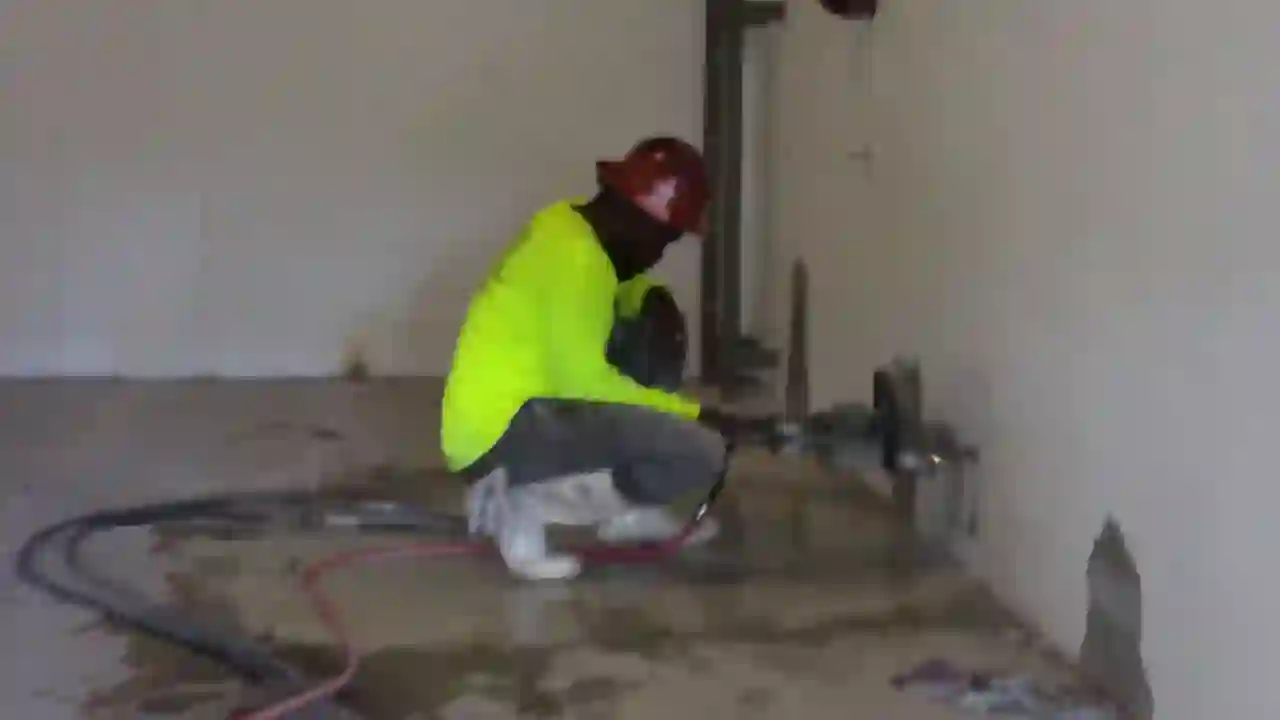
A cylindrical diamond bit rotating at high RPM cuts perfectly round holes from 1/2 inch to 48 inches in diameter. Core drills can operate handheld (for small holes) or rig-mounted (for large diameters and deep holes). Used for plumbing risers, electrical conduit banks, HVAC duct openings, anchor bolt holes, and any penetration requiring dimensional accuracy. The bit extracts a solid concrete core — useful for testing compressive strength or verifying slab thickness. Covered in depth on our core drilling services page.
4. Hand sawing (cut-off saws)
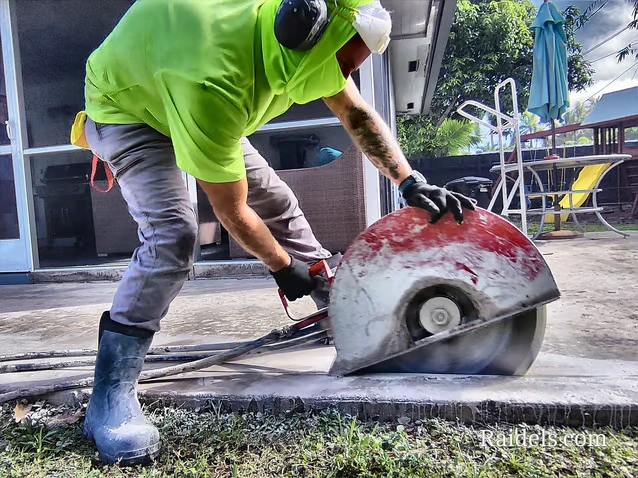
A gas-powered or electric handheld saw with a 12-16 inch diamond or abrasive blade. The most portable cutting method and the one with the most operator-dependent results. Hand saws cut 4-6 inches deep per pass and are useful for small cuts, touch-up work, and jobs where larger equipment cannot reach. The limitation is cut straightness and depth consistency — hand sawing produces rougher edges than track-mounted methods because the operator is the guidance system. Best used for demolition cuts, control joints in flatwork, and small openings where the edges will be covered by trim or patched.
5. Chain sawing
A diamond chain running on a guide bar, similar in concept to a chainsaw for wood but designed for concrete and masonry. Chain saws cut through walls, columns, and irregular shapes that track-mounted saws cannot reach. The bar can plunge through walls up to 24+ inches thick with exceptional control. Useful for cutting inside corners, cutting around obstacles, and making irregular openings that a round blade on a straight track cannot produce. See our hand saw and specialty equipment page for capabilities.
6. Wire sawing
A continuous loop of diamond-impregnated cable driven through pulleys cuts massive concrete structures — bridge piers, foundations, thick walls — that exceed the depth capacity of any blade. The wire wraps around the structure and cuts inward, producing a clean face through heavily reinforced concrete of virtually any thickness. Wire sawing is an industrial method for demolition and structural modification of large concrete masses.
7. Breaking (mechanical demolition)
Hydraulic breakers attached to excavators or handheld jackhammers destroy concrete by impact rather than cutting. Breaking is fast and cheap per square foot but produces ragged edges, micro-cracks in remaining concrete, and significant dust and noise. Used for bulk demolition where cut quality does not matter. Not appropriate for any opening that needs to accept a door, window, or finished trim.
” alt=”Professional concrete contractor using walk-behind slab saw to cut expansion joints in Miami parking garage floor” style=”max-width:100%;height:auto;”/>
Diamond blades are not all the same — and using the wrong blade bond on Miami concrete burns through money fast
The blade is where the cutting happens, and blade selection is more nuanced than “diamond blade for concrete.” The key variable is the metal bond matrix that holds the diamond segments together. The bond wears away during cutting to expose fresh diamond. If the bond is too hard for the concrete being cut, the diamonds glaze over without exposing new cutting surface and the blade stops cutting effectively — it just spins and generates heat. If the bond is too soft, it wears away too fast and the diamond segments are gone before their useful life is consumed.
For Miami’s high-PSI concrete (5,000-8,000 PSI) with dense rebar schedules, a softer bond matrix is appropriate. The harder aggregate in high-strength concrete wears the bond faster, so a softer bond keeps fresh diamond exposed. For asphalt or green concrete, a harder bond is appropriate because softer materials do not wear the bond as aggressively. For block and masonry, specialized blades with segmented rims and different diamond concentrations optimize cut speed in abrasive but low-strength material.
Water cooling is critical regardless of blade type. A dry-running diamond blade can lose cutting efficiency within seconds of overheating, and the silica dust produced by dry cutting is a serious respiratory hazard. Wet cutting cools the blade, extends its life, and suppresses the dust cloud at the source.
Silica dust is not just “concrete dust” — it is a regulated carcinogen that changes how cutting happens on every jobsite
Concrete contains crystalline silica. When you cut, grind, or break concrete, the dust cloud contains respirable silica particles small enough to lodge deep in the lungs. OSHA Standard 29 CFR 1926.1153 mandates that concrete cutting operations use engineering controls — water delivery systems or vacuum dust collection — to keep worker exposure below the permissible exposure limit (PEL) of 50 micrograms per cubic meter over an 8-hour time-weighted average.
On a practical level, this means:
- Wet cutting with a continuous water feed is the standard for slab sawing, wall sawing, core drilling, and chain sawing. The water captures dust at the cut point and turns it into slurry rather than airborne particulate.
- Vacuum shrouds with HEPA filters are used for handheld saws and grinders where water is impractical, such as interior finish work or electrical rooms.
- Respiratory protection — at minimum an N95 — is required when engineering controls cannot keep exposure below the PEL.
- Containment and cleanup: Slurry must be contained so it does not enter drains or run offsite. Once dry, slurry becomes airborne dust again, so it must be cleaned up while wet using a HEPA vacuum or wet methods.
Any contractor who shows up to cut concrete on your property without water or vacuum dust control is not complying with federal safety regulations. It is a liability for them and a health hazard for everyone on site.
Structural risks that turn a simple cut into an emergency — and how professional contractors prevent them
Cutting concrete is not just about the cut itself — it is about what is inside the concrete and what the concrete is holding up. Two risks dominate:
Post-tension cables
Post-tensioned (PT) concrete contains high-strength steel cables stretched to thousands of pounds of tension. The cables compress the concrete and give PT slabs their strength-to-thickness advantage. Cut one cable with a saw or drill bit and the cable snaps explosively, releasing stored energy. The concrete loses its compressive preload, and the structural capacity of the slab is compromised. Repair involves exposing the damaged cable, re-tensioning or replacing it, and re-pouring the affected area — typically a five-figure repair. This is why GPR scanning every cut location on a PT slab is mandatory, not optional.
Load-bearing elements
Cutting into a column, shear wall, or beam that carries structural load compromises the load path. Even a partial cut can reduce capacity below what the structure needs to resist gravity loads and hurricane wind forces (which govern structural design in Miami-Dade). Any cut into a structural element requires engineering review before the blade touches concrete, and temporary shoring may need to be in place before cutting begins.
For projects involving structural modifications, our concrete cutting services overview covers the full range of cutting methods and how they integrate with engineering requirements on Miami-Dade jobsites.
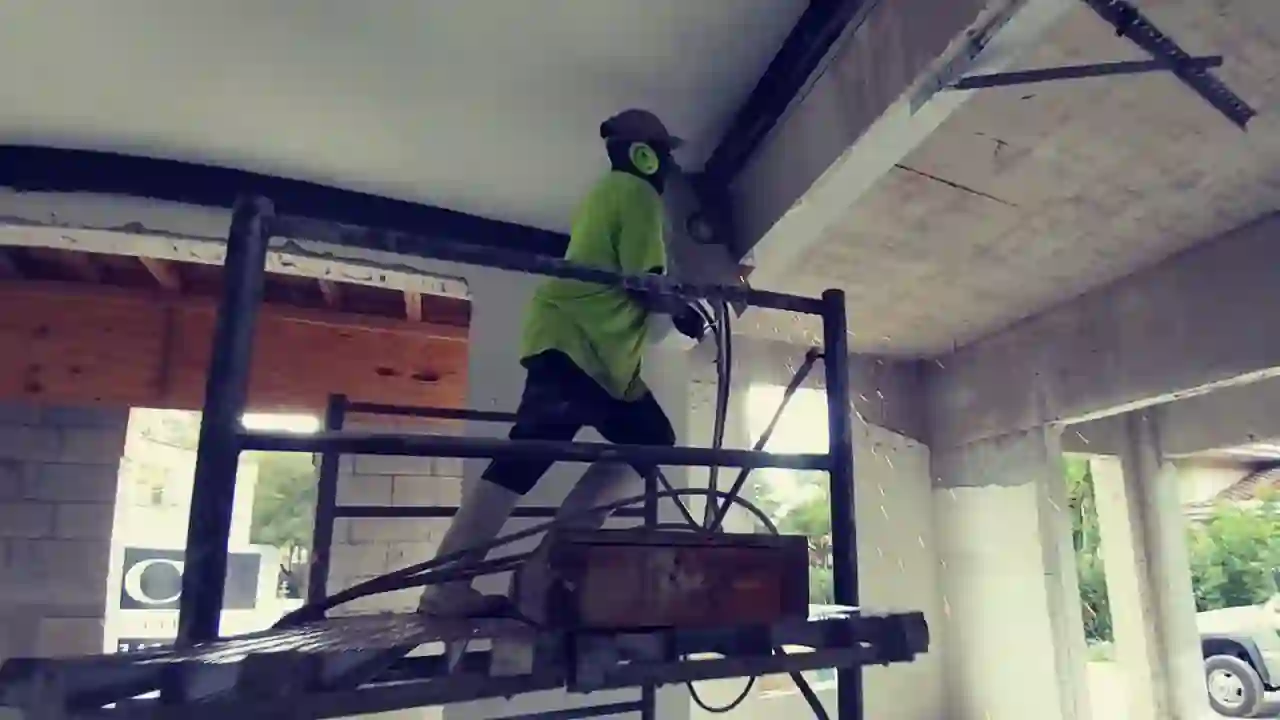
” alt=”Concrete cutting contractor in Miami using hand saw for precision cut on concrete wall with water dust suppression” style=”max-width:100%;height:auto;”/>
How to choose the right cutting method for your specific project
The decision tree is straightforward if you work through it methodically:
- What are you cutting? A horizontal slab requires a slab saw. A vertical wall requires a wall saw, chain saw, or hand saw. A round hole requires a core drill.
- How deep does the cut need to go? Full-depth structural cuts require equipment with the reach and power to go through the entire thickness in one pass. Partial-depth cuts (control joints, surface demolition) can use smaller equipment.
- How clean do the edges need to be? An opening that receives a door frame needs wall-sawn edges. A demolition cut that gets buried under new concrete can be rougher.
- What is inside the concrete? If the concrete contains PT cables, every cut location must be GPR-scanned. If it is heavily reinforced, blade selection and cut speed matter more than on lightly reinforced concrete.
- Where is water going to go? Wet cutting in a finished space requires slurry containment. Dry cutting with vacuum dust collection may be more practical in occupied interiors.
For site-specific recommendations or a quote on any concrete cutting project in South Florida, reach us through our contact page. We cover Miami-Dade, Broward, and the Florida Keys — see our Ft. Lauderdale service area for projects in northern Broward.