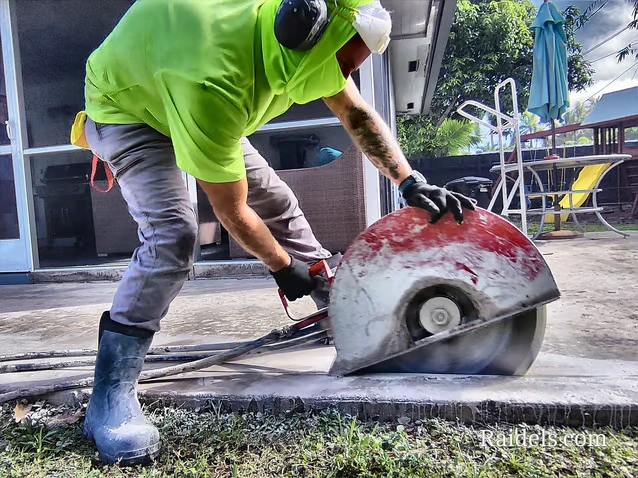
A hammer drill and a core drill are not the same tool and the difference shows up the moment you hit rebar
Every contractor owns a hammer drill. Very few own a diamond core drill rig, and the distinction matters the second the bit encounters reinforcing steel. A hammer drill uses carbide-tipped bits that rotate and hammer simultaneously — effective for small-diameter holes in block or unreinforced concrete, but completely useless against rebar. The bit stops, the motor overheats, and the hole ends up off-center with spalled edges. A core drill uses a cylindrical diamond bit spinning at high RPM with water cooling, and it cuts through rebar like it was more concrete. The result is a perfectly round, smooth-walled hole that matches the specified diameter — whether it is a 1-inch pipe penetration or a 36-inch mechanical riser. For any hole that matters — that carries plumbing, conduit, ductwork, or structural anchorage — core drilling is not optional. It is the only method that produces a dimensionally accurate penetration without damaging the surrounding structure.
The difference between handheld core drills and rig-mounted core drilling — and when each makes sense
Core drilling splits into two categories based on how the drill is supported, and the choice depends on hole size, location, and required accuracy.
Handheld core drilling
For holes up to about 6 inches in diameter, a handheld core drill operated by an experienced technician produces clean results. The operator braces against the wall or floor and controls feed pressure manually. Handheld drilling works well for small-diameter plumbing and electrical penetrations, anchor bolt holes, and dowel holes for rebar connections. The equipment is portable, the setup is fast, and the per-hole cost is low. The limitation is hole straightness over depth — a handheld bit can drift slightly on deep holes, especially when hitting rebar at an angle.
Rig-mounted core drilling
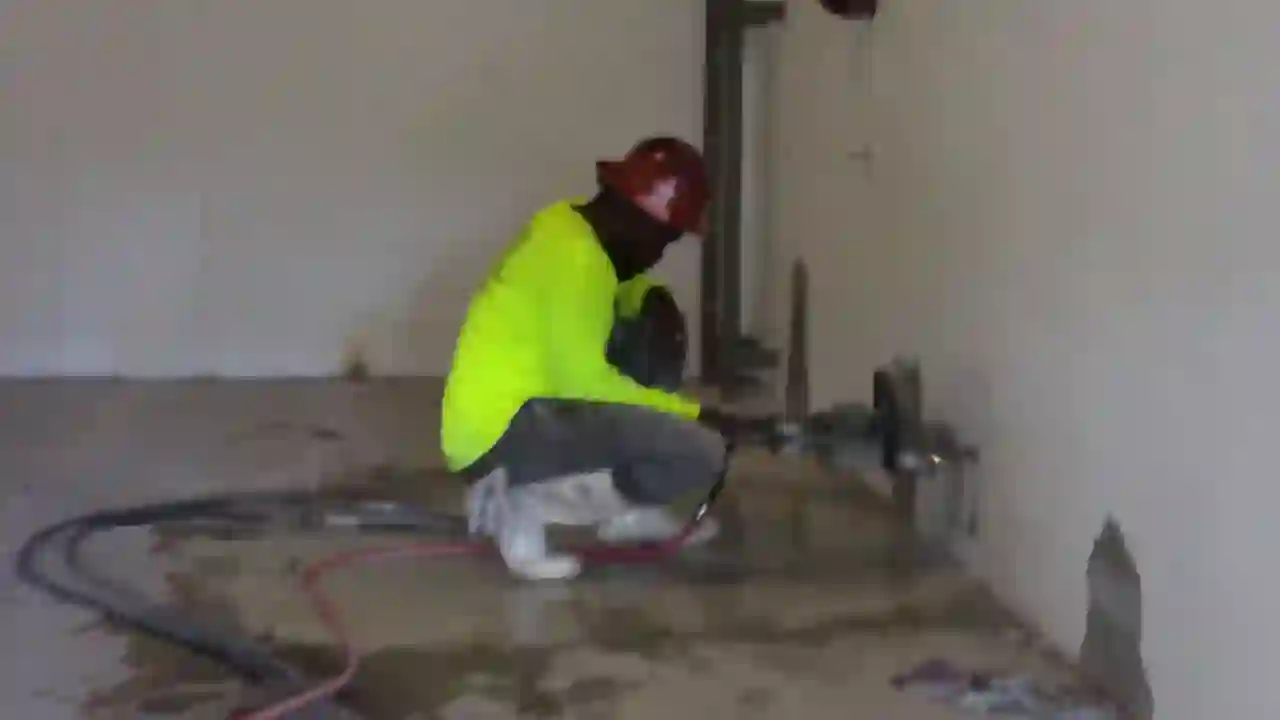
For holes larger than 6 inches, deeper than 12 inches, or requiring tight angular tolerance, the core drill mounts to a rig that bolts or vacuums to the floor or wall. The rig holds the motor and bit at a fixed angle and advances it at a controlled feed rate. This produces holes that are true to within fractions of a degree over the full depth — critical for mechanical risers that run through multiple floors, for large-diameter duct penetrations, and for any hole where misalignment will cause the pipe or conduit to bind. Rig-mounted setups also handle the torque of large-diameter bits (12-48 inches) that no human can control handheld.
For projects requiring both core drilling and other cutting methods — for example, drilling anchor holes then wall-sawing a new opening — see our full services overview for how these methods combine on a single jobsite.
” alt=”Rig-mounted diamond core drill cutting a large diameter hole through concrete floor in Miami commercial building” style=”max-width:100%;height:auto;”/>
The most common core drilling applications in South Florida construction
Core drilling touches nearly every trade on a commercial or residential construction site. These are the applications we handle most frequently across Miami-Dade and Broward counties:
- Plumbing risers and waste lines — Floor penetrations for PVC, cast iron, and copper plumbing stacks. These must be sized precisely because plumbing codes specify annular space around pipes passing through concrete.
- Electrical conduit banks — Grouped penetrations for multiple conduits through walls and floors. Accuracy matters because conduit spacing must match the panel layout on the other side of the penetration.
- HVAC duct and vent openings — Large-diameter holes for supply and return ducts, exhaust vents, and fresh air intakes. These are often 12-24 inches in diameter through 8-12 inch slabs.
- Anchor bolt and dowel installations — Drilling precise holes for epoxy-set anchor bolts, dowel bars connecting new concrete to existing, and structural steel base plate anchors.
- EV charger conduit runs — With Miami’s condo and apartment buildings adding EV charging infrastructure, core drilling through parking garage walls and floors to run conduit from electrical rooms to parking spaces has become a frequent request.
- Handrail and guardrail posts — Core-drilled holes for setting posts into existing concrete stairs, balconies, and walkways where surface-mount brackets are not acceptable.
For projects involving smaller penetrations like dryer vents or fence post holes, our core drilling page covers the full range of diameters and applications.
What a core drilling job actually costs and why hole diameter drives the price more than anything else
Core drilling is typically priced per hole rather than by the inch, with the diameter being the primary cost driver. A 2-inch hole might take 5 minutes and consume negligible diamond segment wear. A 24-inch hole through a 10-inch slab might take 2 hours and consume a significant portion of a bit that costs several thousand dollars.
The key variables:
- Hole diameter — The single biggest factor. A 12-inch bit costs to purchase and maintain than a 4-inch bit, and it requires a larger, more powerful drill motor.
- Material depth — Drilling through a 6-inch slab versus a 14-inch foundation wall. Deeper holes take longer and generate more heat that the water cooling system must manage.
- Rebar encounter probability — In heavily reinforced Miami concrete, most core holes will intersect at least one piece of rebar. The diamond bit handles it, but each rebar encounter slows the cut rate and increases bit wear.
- Location and access — Vertical drilling (down through a floor) is straightforward. Horizontal drilling (through a wall) requires rig mounting. Overhead drilling (up through a ceiling) requires different rigging and slurry containment since water runs down toward the operator.
- Slurry control requirements — Core drilling uses water continuously. On finished floors or occupied spaces, containing and cleaning up concrete slurry adds labor to every hole.
For a broader picture of how core drilling fits into the overall cost structure of concrete work in Miami, our concrete cutting cost guide covers pricing across all service categories.
Why Miami’s high-rise construction makes core drilling more demanding than ground-level work
Miami builds up. That means core drilling often happens on elevated decks, post-tensioned slabs, and shear walls — not just ground-supported slabs. Post-tensioned (PT) slabs contain high-strength steel cables under enormous tension. Cutting through a PT cable with a core bit is a structural failure — the cable snaps, the concrete loses its compressive preload, and the floor can crack or deflect. This is why GPR scanning before drilling is non-negotiable on any elevated deck.
GPR (ground-penetrating radar) scans the concrete before the drill touches it, identifying rebar patterns, PT cable locations, and embedded conduits. The scan produces a markout on the concrete surface showing safe zones for drilling. On PT slabs, the safe zone is typically the area between cable bundles, and the GPR technician works with the structural engineer to verify the proposed hole locations do not compromise the tensioning system.
Water management on elevated decks adds another layer. Slurry from core drilling on the 20th floor cannot simply drain onto the floor below. Containment systems — vacuum attachments on the drill, catchment trays, and wet vacuums — capture slurry at the source before it can migrate. Our Miami service area page covers how we adapt drilling procedures for the specific building types and conditions found across the county.
Questions to ask any core drilling contractor before the first hole is drilled
- Do you GPR-scan every hole location before drilling? If the answer is anything other than “yes, on every job, no exceptions,” find a different contractor. A single PT cable strike can cause six-figure structural repairs.
- Are your core bits diamond-segmented and water-cooled? Dry core bits exist for small holes in block or masonry, but wet diamond bits are the standard for reinforced concrete. Water cooling extends bit life, suppresses silica dust, and produces a cleaner hole.
- What diameter range can you actually drill? Some contractors max out at 12 or 14 inches. If your project requires 24-inch or larger penetrations, verify they have the rig and bits for it before they mobilize.
- What is the slurry containment plan? Especially on finished floors, occupied buildings, or elevated decks. The answer should include specific equipment, not just “we clean up after.”
- Can you drill at angles other than 90 degrees? Some penetrations — drainage lines, angled conduit runs — need holes drilled at a specific angle. Not all rigs support angle drilling.
For core drilling quotes or site evaluations anywhere in Miami-Dade, Broward, or the Florida Keys, reach us through the contact page with your project details.

” alt=”Close-up of diamond core drill bit extracting a perfect concrete core sample in Miami Florida” style=”max-width:100%;height:auto;”/>