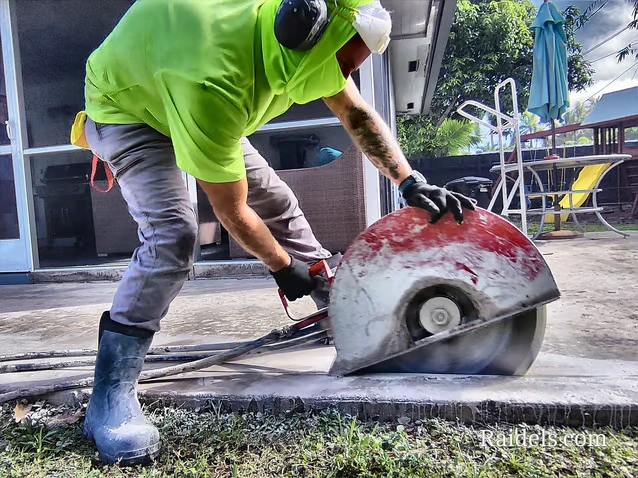
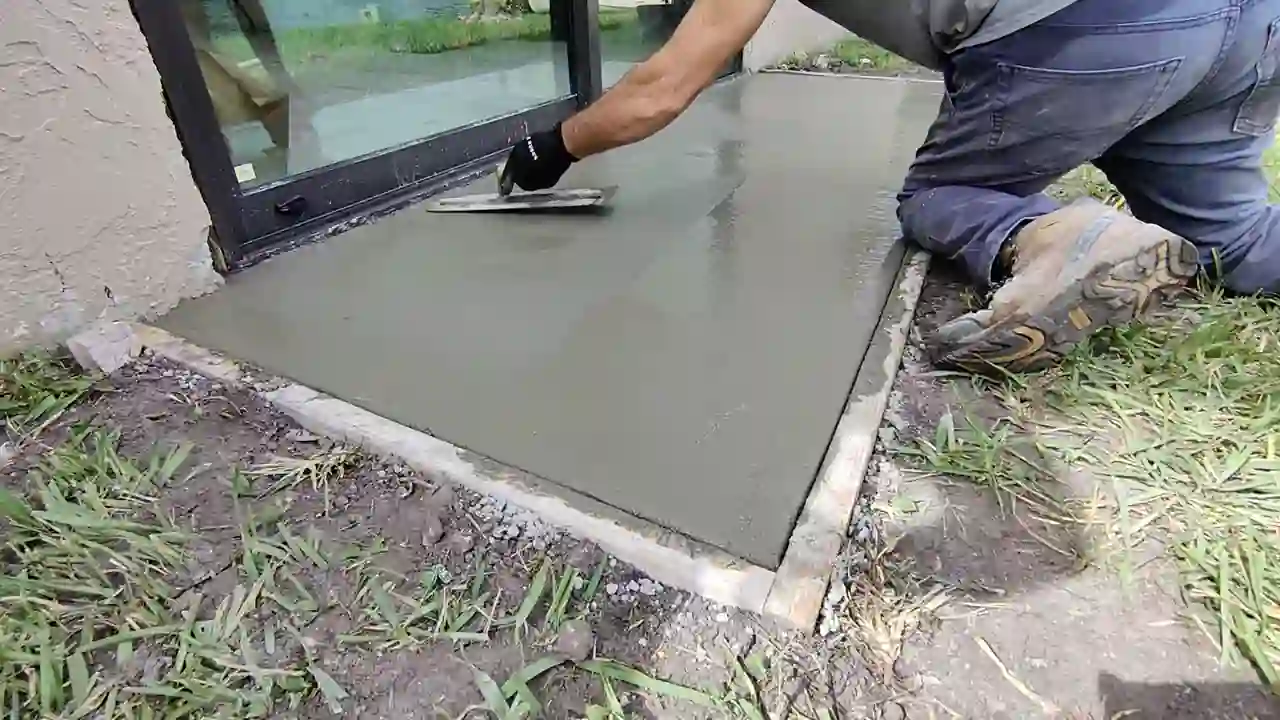
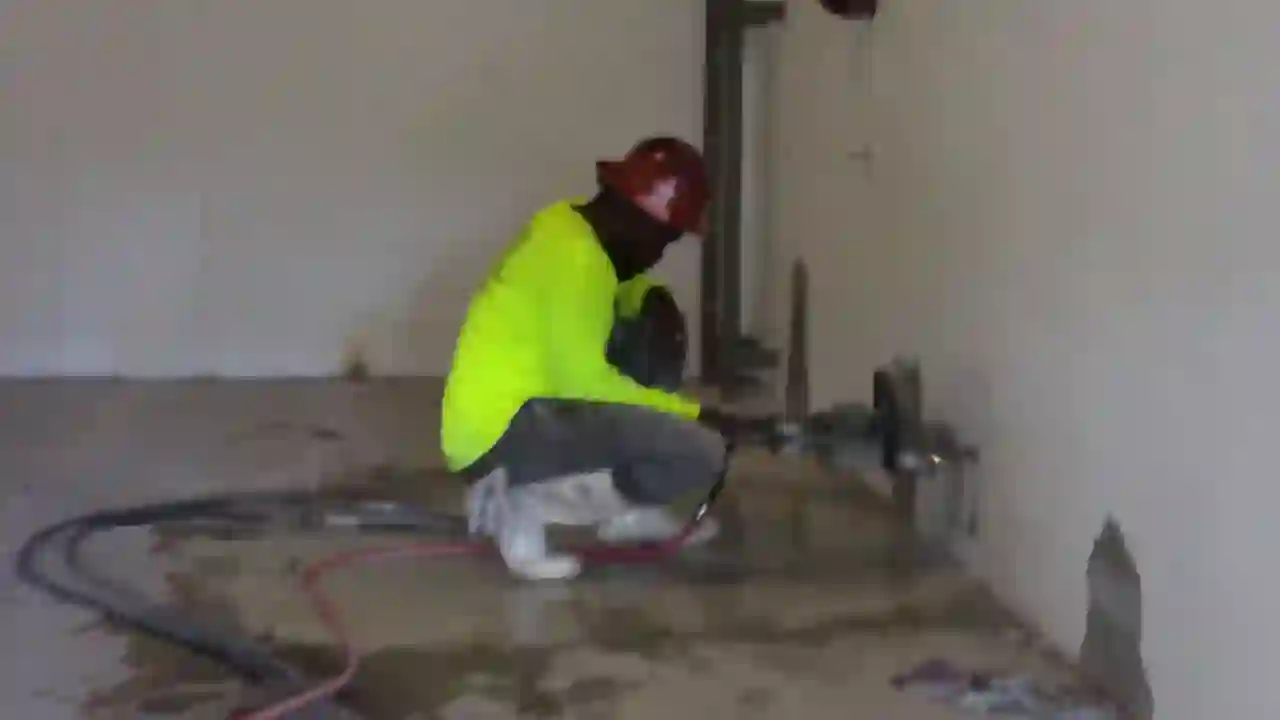
If you have ever seen a contractor try to cut a door opening in a concrete wall with a gas-powered hand saw you know exactly why wall sawing exists as its own trade
There is no substitute for a hydraulic track-mounted wall saw when the job is cutting a perfectly straight, square opening through a reinforced concrete wall. A track saw bolts to the wall and runs a diamond blade along a rigid rail, producing a cut that is plumb, square, and straight to within fractions of an inch — the kind of accuracy that a door frame, window unit, or HVAC duct actually fits into without shimming, grinding, and patching. Hand saws produce rough, wandering cuts. Breakers shatter edges. Core drills produce round holes, not rectangles. Only a track-mounted wall saw delivers a full-depth straight cut through concrete up to 24 inches thick — rebar included — with a cut face clean enough to receive door jambs, window frames, or exposed architectural finishes.
[VIDEO_PLACEHOLDER]
How a hydraulic wall saw actually works and why the track is the entire reason the cut comes out straight
Wall sawing starts with a track — an aluminum or steel rail that bolts or vacuum-anchors to the concrete wall at the cut line. The saw head, powered by a remote hydraulic power unit, rides along this track on geared rollers at a precisely controlled feed rate. Because the saw head is mechanically locked to the track, the blade follows the same plane for the full depth, producing a cut face that is flat, square to the wall surface, and dimensionally consistent from corner to corner.
Hydraulic wall saws dominate professional cutting because the power unit is separate from the saw head. The saw head stays light and maneuverable, and the hydraulic motor maintains consistent blade RPM under load — when the blade hits rebar, the system delivers more torque without slowing. Electric saws carry their motor on the head, adding weight and bogging down on rebar encounters.
Wall saw blades range from 24 to 60 inches in diameter, determining maximum cut depth of roughly 9 to 26 inches. The critical variable is the metal bond matrix holding the diamond segments. Miami’s structural concrete at 5,000 to 8,000 PSI with dense aggregate requires a softer bond that wears fast enough to keep fresh diamond exposed. A blade with the wrong bond glazes over in hard concrete — the diamonds stop cutting, the blade spins without progress, and forcing the feed warps the blade core.
The most common wall sawing applications in South Florida construction
These are the applications we handle most frequently across Miami-Dade and Broward:
- Door openings in concrete shear walls and foundation walls — New passageways, egress doors for code compliance, or connections between additions and existing buildings. The opening must be square to within 1/4 inch of the rough opening specification.
- Window openings and enlargements — Cutting new openings for natural light and ventilation, or enlarging existing ones for larger units. In Miami, this often means cutting through 8 to 12 inch tilt-up or CMU walls with bond beams.
- Mechanical and HVAC penetrations — Large rectangular openings for ductwork, air handlers, and equipment too big for core drilling. Wall sawing produces the straight edges that duct flanges require.
- Elevator shaft door openings — Precision openings for landing doors at each floor with extreme dimensional tolerance because the door assembly bolts directly to the opening edges.
- Wind retrofit and structural modifications — Cutting openings for shear wall additions, hold-down anchors, and lateral-force-resisting elements that building code updates mandate in Miami-Dade.
For a broader view of how wall sawing fits into a full concrete cutting project, our services overview covers how these methods combine on a single jobsite.
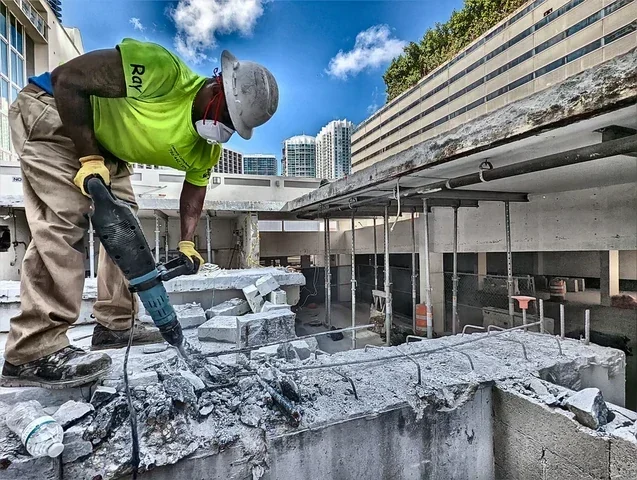
” alt=”Hydraulic track-mounted wall saw cutting a precise door opening through reinforced concrete wall in Miami commercial building” style=”max-width:100%;height:auto;”/>
Wall sawing versus the alternatives — when the track saw is the right tool and when another method makes more sense
Wall sawing versus hand sawing
A gas-powered hand saw is portable and fast to set up. For a 6-inch cut in a non-structural wall where edges get covered by trim, it works. The limitation is cut quality: hand-sawn cuts are only as straight as the operator’s hands, and on cuts deeper than 4 inches, the second pass from the opposite side rarely aligns with the first. Wall sawing is the answer when the cut must stay within 1/8 inch over the full length.
Wall sawing versus chain sawing
A diamond chain saw excels at inside corners and through-wall plunge cuts that a circular blade cannot reach. A round wall saw blade leaves an overcut at corners — a chain saw plunges cleanly. On complex openings, the two methods combine: the wall saw cuts the straight runs, the chain saw cleans up corners.
Wall sawing versus core drilling
For a small rectangular opening, stitch-drilling corners and connecting with a hand saw is sometimes faster than a full track saw setup. The threshold depends on edge quality requirements. One small opening with covered edges: stitch-drill. Multiple large openings with exposed edges: track saw. For round penetrations, our core drilling page covers the full range of capabilities.
Post-tension cables, load-bearing walls, and the structural risks that make GPR scanning mandatory
Cutting into a concrete wall is different from cutting a slab because walls carry vertical loads from above and lateral loads from wind. A wall saw cut through the wrong location creates a structural problem that may not appear until the building faces its design loads.
Post-tension cables in walls
PT cables appear in shear walls, transfer girders, and post-tensioned wall panels in high-rise construction. Cutting one releases the tension explosively — the cable snaps back, and the wall loses its compressive preload. A single cable strike can compromise the lateral resistance of an entire shear wall line. GPR scanning identifies cable locations before the track touches the wall, and cut lines are adjusted to safe zones between cable paths.
Load-bearing walls and temporary shoring
Any opening in a load-bearing wall changes the load path. The removed concrete’s load must be redirected through a lintel or header to the wall sections on either side. Before cutting, a structural engineer must calculate header size, verify remaining wall capacity, and specify temporary shoring. Cutting without engineering review produces sagging door frames, cracking above the opening, and a structural repair that costs ten times the original cut.
Embedded utilities and conduits
Commercial concrete walls frequently contain embedded electrical conduit, plumbing risers, and fire sprinkler piping. A blade hitting an energized conduit produces an arc flash and a destroyed blade segment. GPR identifies metallic utilities in the cut path, and as-built drawings plus cautious pilot cuts handle non-conductive lines like PVC drains.
For the full scope of pre-cut scanning and safety protocols, see our Miami service area page covering how we adapt procedures for building types and code requirements across Miami-Dade County.
What concrete wall sawing actually costs and the variables that drive the price
Wall sawing is priced by the linear foot of cut, with depth, access, and rebar density as primary cost modifiers. A ground-level opening in a 6-inch non-structural wall lands at the low end. A 14-inch heavily reinforced shear wall on the 15th floor with no elevator lands at the high end.
- Wall thickness and cut depth — A 6-inch wall uses a 20 to 24 inch blade. A 14-inch wall requires a 36 to 42 inch blade. Larger blades cost more to purchase, maintain, and replace.
- Rebar density and concrete PSI — Heavily reinforced walls with #5 or #6 rebar at close spacing slow feed rate and increase diamond wear. Lighter reinforcement cuts faster and costs less.
- Access and setup complexity — Ground floor with clear access is straightforward. Upper floors with no elevator mean carrying the power unit, track, saw head, and blades up stairs — or crane time. Confined spaces require short track sections and multiple setups.
- Interior versus exterior — Interior cuts require slurry containment: vacuum attachments, floor protection, wet vacuums. Exterior cuts where slurry can be hosed away are faster and cheaper.
- Number of openings — Mobilization cost spreads across all cuts. One opening carries the full setup cost. Ten openings on the same site drops per-linear-foot pricing significantly.
For wall sawing quotes in Miami-Dade, Broward, or the Florida Keys, contact us through our contact page with wall dimensions, opening sizes, and building type. For projects combining wall sawing with other cutting methods, our full services page covers how these methods coordinate on a single project.


” alt=”Close-up of diamond wall saw blade making clean vertical cut through heavily reinforced concrete wall in Miami Florida” style=”max-width:100%;height:auto;”/>