Why Equipment Specifications Dictate Every Cut You’ll Ever Make
Most contractors grab whatever concrete saw is on the truck and bolt on a blade that looks about right. That approach works until it doesn’t — and when it fails, it fails expensively. A mismatched blade bond, an underpowered drive motor, or the wrong segment geometry doesn’t just slow a job down. It destroys diamond tooling, overheats the arbor, and can turn a routine slab cut into a safety incident. Understanding how to use a concrete saw at a technical level means starting long before the blade ever touches aggregate. It means reading equipment spec sheets, matching horsepower to blade diameter, and selecting diamond tooling based on the actual hardness and abrasiveness of the material you’re cutting — not guessing.
Concrete Saw Drive Systems and Horsepower-to-Blade Diameter Ratios
Every concrete saw — whether it’s a walk-behind flat saw, a hand-held cut-off saw, or a wall-mounted ring saw — is built around a drive system rated for a specific blade diameter range. Running a 14-inch blade on a motor rated for 10-inch tooling is one of the most common field mistakes in this trade. The blade peripheral speed drops below the optimal cutting threshold, the diamond segments drag instead of cut, and the bond glazes over within minutes.
For walk-behind flat saws, the industry standard calls for approximately 3 to 4 horsepower per inch of cutting depth. A 20-inch blade cutting to 7 inches of effective depth needs a minimum of 25 HP at the arbor — not at the engine. Hydraulic and electric drive systems lose 10–15% efficiency through the transmission, so a 30 HP gas engine may only deliver 25–26 HP to the blade shaft under load. Always spec the drive system against shaft horsepower, not gross engine output.
Blade peripheral speed — measured in surface feet per minute (SFPM) — should fall between 9,000 and 12,000 SFPM for most diamond saw blades. Calculate it using the formula: SFPM = (RPM × blade diameter in inches × π) ÷ 12. A 14-inch blade spinning at 3,200 RPM delivers approximately 11,730 SFPM, which sits comfortably in the optimal window for most hard-aggregate concrete. Drop that RPM to 2,400 and you’re at 8,796 SFPM — below threshold, and your diamond is dragging.
Diamond Segment Geometry and What It Actually Controls in the Cut
The segment on a diamond saw blade is doing two simultaneous jobs: exposing fresh diamond crystals as the bond wears, and evacuating slurry from the kerf. Segment geometry — height, width, and profile shape — controls how efficiently both of those processes happen under load.
Segment height typically ranges from 7mm to 15mm for most commercial concrete cutting blades. Higher segments mean longer blade life, but they also increase the surface area in contact with the material, which raises cutting resistance and demands more horsepower. For production flat sawing on reinforced slabs, a 10mm to 12mm segment height with a 3.5mm to 4.2mm segment width is a reliable baseline. Narrower segments reduce drag and improve cutting speed in hard, low-abrasion concrete. Wider segments handle abrasive aggregate better because the bond wears more evenly across the face.
Turbo segments, segmented rims, and continuous rim profiles each serve different applications. Turbo rims use a serrated or wave-cut profile to increase slurry ejection velocity — ideal for wet cutting in confined space concrete demolition scenarios where water flow is restricted and heat buildup is a real risk. Segmented blades with gullets between each segment allow the most aggressive slurry clearance and are the standard choice for deep slab cuts on walk-behind saws. Continuous rims are reserved for tile work and decorative cuts where surface finish matters more than speed.
Bond Hardness Selection Based on Concrete Aggregate and PSI Rating
This is where most blade selection goes wrong on job sites. Diamond blade manufacturers rate bond hardness on a scale from soft to hard — typically expressed as a letter grade or numeric scale depending on the manufacturer. The rule that never changes: hard concrete requires a soft bond, and soft concrete requires a hard bond.
Here’s why. In hard, dense concrete (typically 5,000 PSI and above), the matrix wears the bond slowly. A soft bond allows the matrix to erode at a rate that keeps exposing fresh diamond crystals. If the bond is too hard, the diamonds wear flat and the blade glazes — it spins without cutting. In soft, highly abrasive concrete (under 3,000 PSI, or concrete with high silica sand content), the aggregate wears the bond aggressively. A hard bond resists that wear and keeps the segment geometry intact long enough to be cost-effective.
Miami-area concrete presents a specific challenge. South Florida aggregate is predominantly crushed limestone and oolitic limestone — materials that are moderately hard but highly abrasive. That combination calls for a medium-hard bond with a higher diamond concentration (40 to 50 concentration range) and a segment height of at least 10mm. Using a blade specced for granite or basalt in Miami limestone will burn through bond matrix in a fraction of the expected lifespan. For core drilling applications, the same principles apply — see our technical notes on concrete hole saw tooling for diameter-specific bond recommendations.
Arbor Specifications, Flange Torque, and Blade Mounting Precision
A diamond blade running out of true by even 0.003 inches introduces harmonic vibration that accelerates segment stress fractures and shortens blade life by 20–30%. Arbor condition and flange seating are not secondary concerns — they are primary specifications that directly affect tooling performance and operator safety.
Walk-behind flat saws use arbor diameters of 1 inch or 20mm as standard, with some heavy production machines running 25.4mm arbors for added rigidity. The inner and outer flanges must be clean, flat, and free of concrete slurry buildup. Torque the arbor nut to the manufacturer’s specification — typically 40 to 60 ft-lbs on production flat saws — and always use a torque wrench. Over-torquing crushes the blade core and introduces lateral runout. Under-torquing allows micro-slip under load, which scores the arbor bore and ruins both the blade and the shaft.
Blade core thickness matters for rigidity under lateral load. Standard production blades run a 3.0mm to 3.5mm core for 14-inch to 18-inch diameters. Thin-kerf blades drop to 2.2mm to 2.6mm cores for reduced material waste in precision cutting applications. Thin-kerf tooling demands a stiffer, higher-RPM drive system to prevent core deflection under side load — they are not interchangeable with standard-core blades on older, high-vibration machines.
Wet Versus Dry Cutting Specifications and Cooling Flow Rates
Wet cutting is the technical standard for any cut deeper than 2 inches in reinforced concrete. The water serves three functions: cooling the blade core to prevent thermal stress cracking, lubricating the segment-to-concrete interface to reduce friction heat, and flushing slurry from the kerf to prevent recutting. OSHA’s silica dust standard (29 CFR 1926.1153) mandates wet cutting or integrated vacuum systems for most production concrete sawing operations.
Water flow rate at the blade should be a minimum of 0.5 gallons per minute for hand-held saws and 1.0 to 1.5 GPM for walk-behind flat saws on blades 14 inches and larger. Flow rates below 0.3 GPM on a 14-inch blade under full load will cause segment overheating even if the blade is rated for wet cutting. Monitor the color of the slurry exiting the kerf — gray-white slurry indicates proper cooling; dark gray or black slurry with visible steam indicates thermal stress and requires immediate blade inspection.
For projects where water use is restricted — particularly in concrete recycling Miami operations where slurry management is a site requirement — dry-rated blades with laser-welded segments and enhanced gullet geometry are available. These blades use a higher-concentration diamond matrix and a harder bond to compensate for the absence of liquid cooling, but they are limited to intermittent cutting cycles of 30 to 45 seconds with mandatory cool-down periods.
Matching Saw Type to Application — Flat Saws, Ring Saws, and Hand-Held Cut-Off Units
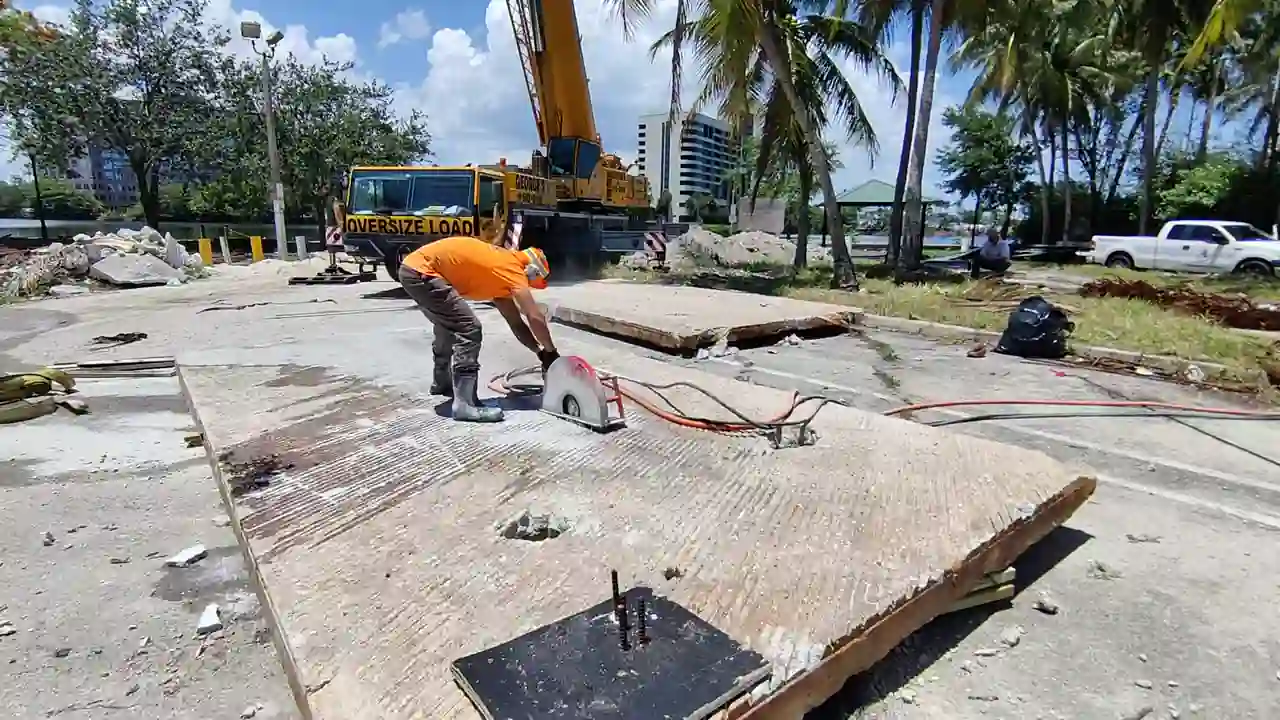
Walk-behind flat saws are the workhorse for horizontal slab cutting, road work, and expansion joint cutting. They deliver the most stable blade tracking, the highest available horsepower, and the deepest single-pass cut depth — up to 16 inches on heavy production machines. For large demolition scopes that also involve material handling, pairing flat saw operations with Bobcat service for debris removal significantly improves production rates.
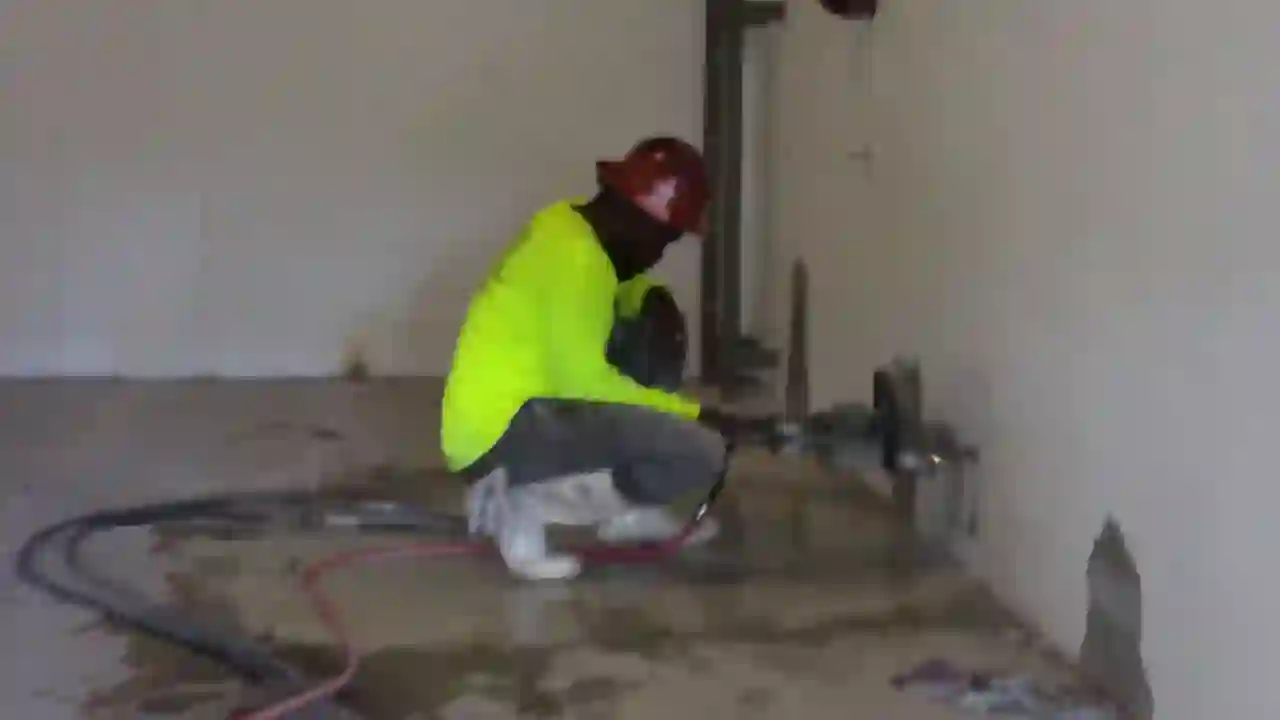
Ring saws — also called chain saws or ring-blade wall saws — use a circular blade mounted on a track system for vertical and overhead cuts. The blade runs on a ring drive rather than a central arbor, which allows the cutting depth to equal the full blade radius rather than just the radius minus the arbor. A 16-inch ring saw delivers up to 8 inches of cutting depth in a single pass on a vertical wall, compared to roughly 5.5 inches from a 14-inch arbor-mounted blade. Ring saws require hydraulic or electric power packs rated to the blade manufacturer’s specifications — typically 8 to 12 GPM hydraulic flow at 2,000 to 2,500 PSI for production ring saw blades.
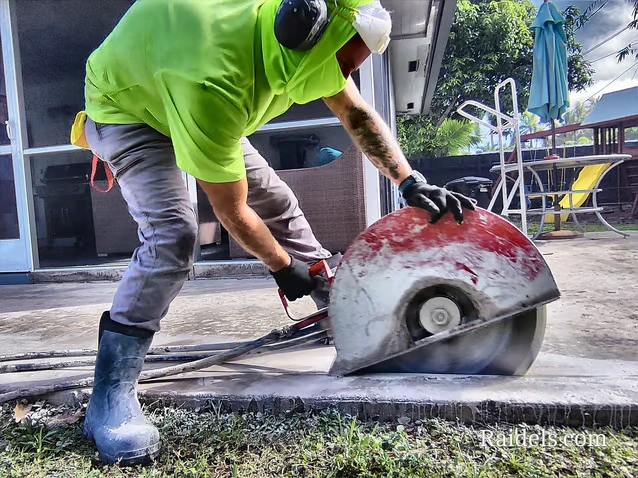
Hand-held cut-off saws — gas-powered or electric — are specced for blades from 9 inches to 14 inches in diameter. They are not designed for sustained deep cutting. Maximum effective depth on a 14-inch hand-held unit is approximately 4.5 inches, and that depth demands a high-torque engine (minimum 5 HP) with proper blade guard clearance. Running a 14-inch blade on a unit rated for 12-inch maximum diameter is a blade failure and liability waiting to happen.
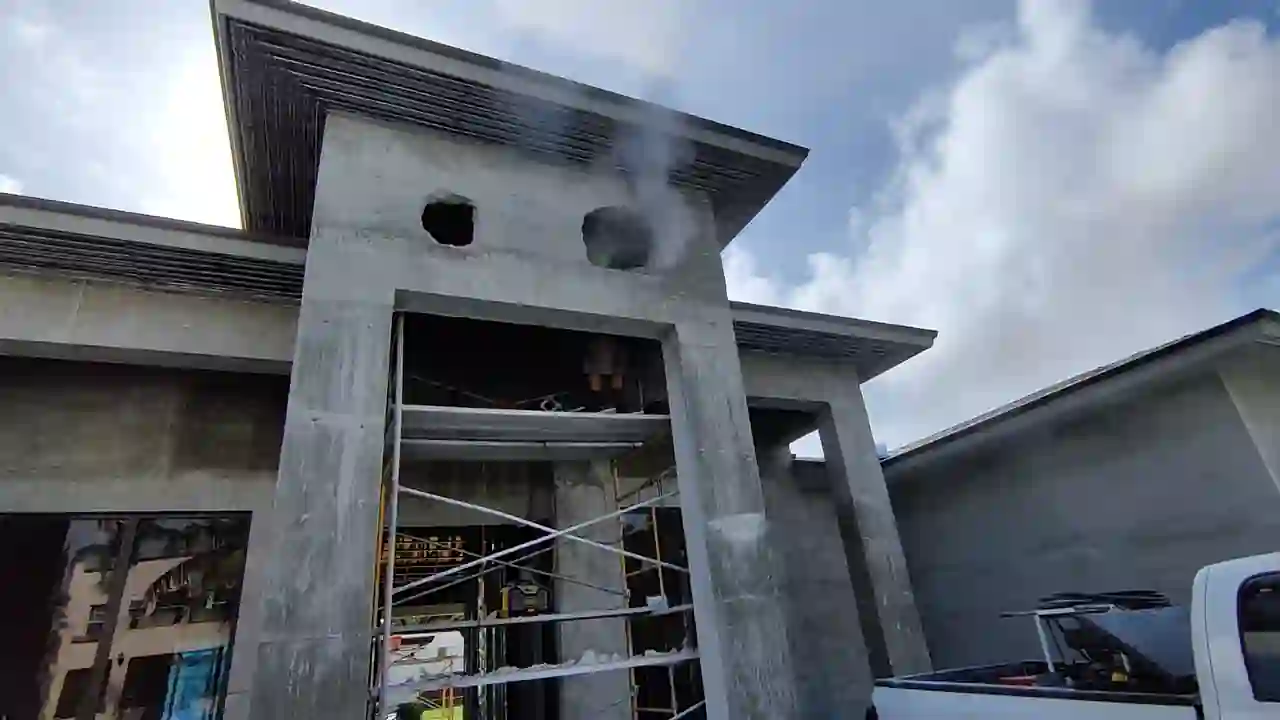
Every cut starts with a specification decision. The contractors who understand horsepower ratios, bond hardness selection, segment geometry, and arbor tolerances are the ones who hit production targets, protect their tooling investment, and deliver work that holds up under inspection. Concrete sawing is a precision trade, and the saw is only as good as the knowledge behind the operator choosing how to run it.