Technical Overview of Diamond Tooling Architecture in Modern Concrete Cutting
Specifying the correct diamond tool for a concrete cutting operation is not a matter of grabbing the nearest blade off the rack. It is a calculated decision involving bond hardness, diamond mesh size, segment geometry, peripheral speed, horsepower delivery, and the petrographic profile of the substrate itself. At Concrete Cutting Miami, LLC, our crews evaluate every job through this technical lens before a single segment touches concrete. The difference between a 40-hour blade life and a 4-hour blade life almost always traces back to tooling specification rather than operator skill.
This guide unpacks the equipment specifications, diamond matrix engineering, and blade selection logic that drive professional concrete cutting services. Whether you are scoping a flat saw cut on a Class 5 highway slab or planning wire sawing on a heavily reinforced bridge pier, the principles below dictate productivity, edge quality, and total cost per linear foot.
Bond Matrix Engineering and Diamond Concentration Ratios
The synthetic diamond segment is a sintered composite of metal powders—typically cobalt, iron, bronze, tungsten carbide, and nickel—holding industrial diamond crystals in a precisely engineered matrix. The bond’s job is to wear at exactly the rate required to expose fresh diamond as worn diamonds fracture or polish out. Mismatch the bond to the aggregate and you either glaze (bond too hard) or shed diamonds prematurely (bond too soft).
Soft Bond Specifications for Hard Aggregate
When cutting cured concrete containing dense aggregates such as basalt, trap rock, river gravel, or quartzite, a softer bond matrix is required. The harder the aggregate, the faster diamonds wear down—necessitating quicker bond release to keep sharp diamonds at the cutting face. Typical bond hardness for these conditions falls in the 25–35 HRB range, with diamond concentrations between 18 and 24 (where concentration 100 equals 4.4 carats per cubic centimeter).
Hard Bond Specifications for Abrasive Substrates
Conversely, green concrete, asphalt overlay, masonry block, and limestone aggregates abrade the metal bond aggressively. A harder bond—often a tungsten-rich matrix in the 45–55 HRB range—resists premature erosion. Concentrations climb to 30–35 to maximize segment life when the substrate itself is doing the bond’s work.

Segment Geometry and Its Effect on Cutting Performance
Beyond bond chemistry, the physical geometry of each diamond segment governs slurry evacuation, heat dissipation, and feed rate ceiling. Three geometries dominate professional concrete cutting services work.
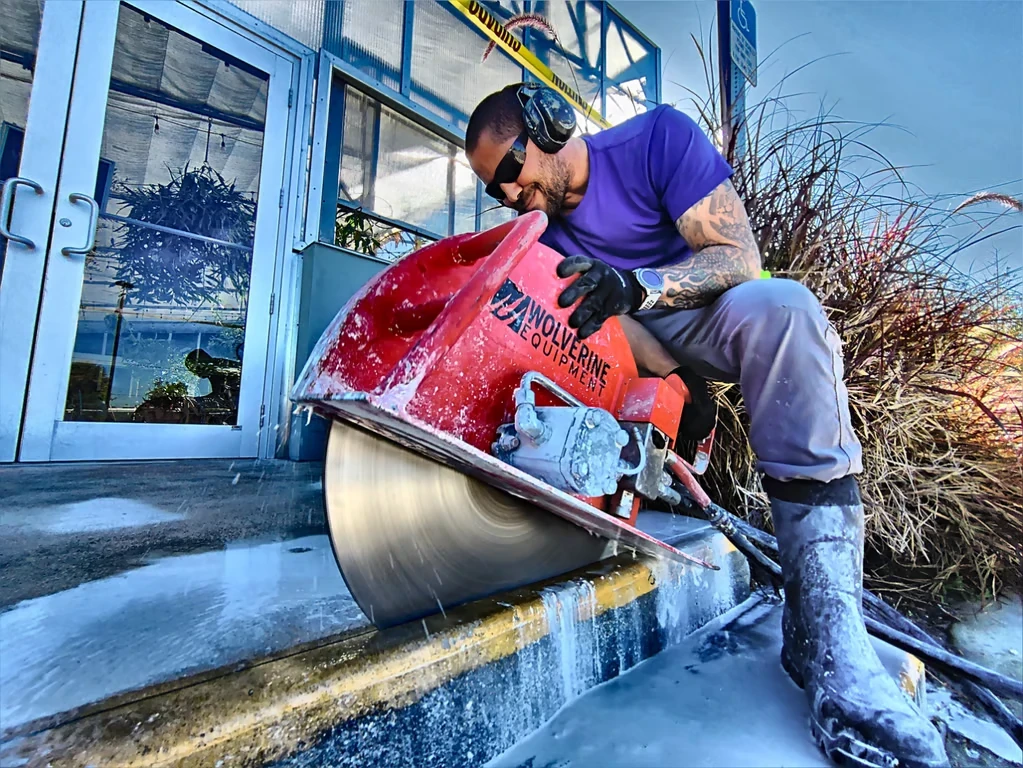
- Turbo segments feature serrated or undulated profiles that aggressively channel slurry away from the kerf. Ideal for hand-held wet cutting where fluid flow is operator-dependent.
- Sandwich (layered) segments alternate diamond-rich and diamond-poor layers, producing self-sharpening behavior in variable substrates encountered during demolition cutting.
- Arix or arrayed-diamond segments place each diamond crystal in a precise three-dimensional pattern. The result is up to 50% longer life and more consistent cut speed, particularly valuable on long flat-saw runs and deep wall opening projects.
Segment height also matters. A 10mm segment offers minimal regrind opportunity but sits closer to the steel core, reducing wobble. A 15mm segment delivers extended service life on production work where blade changeouts represent significant downtime cost.
Steel Core Tensioning and Blade Stability
The steel core is not passive. It is laser-tensioned during manufacturing to maintain flatness under the centrifugal and thermal loads of high-RPM cutting. Tension is verified with dial indicators against a precision arbor; out-of-tension blades wander, produce wavy kerfs, and accelerate segment loss along stressed edges. For wall sawing applications running 20-inch to 36-inch blades at peripheral speeds of 9,000–12,000 SFM, core tensioning tolerance is held to within 0.002 inches across the cutting plate.
Matching Horsepower to Blade Diameter
Underpowered equipment is the silent killer of diamond tooling. A 14-inch blade rated for 5–7 HP electric saws will glaze almost immediately on a 13 HP gas saw turning the same RPM at lower torque output, because feed rate cannot be sustained. The rule of thumb our estimators use:
- 14-inch blade — minimum 5 HP, ideal 9–13 HP at 5,400 RPM
- 20-inch blade — minimum 18 HP, ideal 25–35 HP hydraulic at 2,800 RPM
- 30-inch blade — minimum 35 HP hydraulic at 1,800 RPM
- 48-inch wall saw blade — minimum 25 HP electric/hydraulic at 1,200 RPM with 50 GPM water flow
Peripheral speed should remain in the 9,000–13,000 SFM band for general concrete. Drop below 6,000 SFM and segments tear at the bond/diamond interface. Exceed 14,000 SFM and diamonds polish without fracturing, producing the dreaded glazed blade.
Diamond Wire Sawing for Heavy Reinforcement
When section thickness exceeds 24 inches or rebar density makes blade work impractical, diamond wire takes over. The wire itself consists of sintered diamond beads—typically 8.5mm to 11mm outer diameter—threaded onto a steel cable separated by polymer or steel spacers and spring assemblies that absorb shock loading.
Bead specification follows the same bond logic as blades, but cable speed (running 22–28 m/s) and tensioning hydraulics determine cut productivity. A properly tensioned wire on a 60 HP hydraulic power pack will sever a 36-inch reinforced concrete column in under two hours. Improper tension—either slack or over-tight—causes bead detachment, cable whip, and catastrophic spring failure. Reference our deeper field manual at Concrete Cutting 101 for additional wire-handling protocols.
Core Drilling Bits and Wet Cutting Hydraulics
Core bits operate under a different set of physics. Surface contact area is small, so segment-to-substrate pressure is high, demanding even tighter bond/aggregate matching. Standard bit segments range from 7mm to 10mm thick, with 10mm minimum for any application requiring more than 50 holes between dressings.
Water flow at the bit face must achieve 1.5–3 GPM for bits under 4 inches and scale linearly to 8–10 GPM on 12-inch bits. Insufficient water creates hotspots that anneal the steel barrel and lead to segment loss at the braze line. For residential applications—understanding how thick the concrete slab is for a house directly informs bit selection, since 4-inch slabs can be cored with shallow-segment bits while post-tensioned 8-inch slabs demand deeper segments and rebar-rated specifications.
Substrate Reconnaissance Before Tool Selection
Before any blade is mounted, a competent crew performs substrate reconnaissance. This includes:
- Schmidt hammer rebound testing to estimate compressive strength
- GPR or X-ray scanning to map rebar, post-tension cables, and conduits
- Aggregate identification through core sample inspection
- Moisture content assessment (cured vs. green concrete)
- Reinforcement ratio calculation for wire and wall saw planning
This data drives the final bond, concentration, and segment geometry specification. Skipping reconnaissance is the single largest source of cost overrun on commercial cutting projects.
Calibrating the System for Maximum Tool Life
Even perfect tooling fails under poor operating discipline. Maintain consistent feed pressure—forcing a blade accelerates wear exponentially while underfeeding causes glazing. Verify water flow at the cutting face, not just at the pump. Re-tension wire saws every 30 minutes of run time. Inspect arbor flanges for trueness; a flange runout of 0.005 inches will halve blade life.
Properly specified tooling, paired with correctly sized hydraulic and electric power, delivers cost-per-foot numbers that simply cannot be matched by improvised setups. That engineering rigor is what separates production-grade concrete cutting services from generic saw work, and it is the standard our crews bring to every project across South Florida.