Why Golden Beach Construction and Demolition Projects Face the Toughest Environmental Standards in South Florida
Golden Beach is not your average Miami-Dade municipality. Wedged between the Atlantic Ocean and the Intracoastal Waterway on a narrow barrier island, this 0.4-square-mile town operates under a convergence of local, county, state, and federal environmental regulations that would make most general contractors reach for an aspirin. When you’re cutting, coring, or demolishing concrete within these boundaries, you are working in a hydrologically sensitive zone where uncontained slurry runoff can migrate to protected coastal waters within minutes. The margin for error is effectively zero, and the regulatory agencies — including Miami-Dade DERM, the Florida Department of Environmental Protection, and in some cases the Army Corps of Engineers — are not known for leniency. Every project we execute in Golden Beach begins with a compliance audit before a single diamond blade makes contact with substrate.
Understanding Slurry Composition and Why It Is a Regulated Waste Stream
Concrete cutting slurry is not simply dirty water. It is an alkaline suspension carrying pulverized cement paste, silica fines, calcium hydroxide, and — depending on the substrate age and composition — trace heavy metals including chromium and lead. The pH of fresh cutting slurry routinely tests between 11 and 13, placing it squarely in the corrosive category under EPA hazardous waste definitions. When this material reaches storm drains, swales, or permeable soils in close proximity to tidal zones, it can cause acute toxicity to benthic organisms and disrupt the pH balance of shallow coastal waters. In Golden Beach, where residential lots frequently abut seawall structures and the water table sits at minimal depth, the pathways from a job site to a protected water body are short and fast. Treating slurry as a nuisance rather than a regulated byproduct is a mistake that carries civil penalties, stop-work orders, and potential criminal liability for both the contractor and the property owner.
Alkalinity Neutralization Before Any Discharge Consideration
Our field protocol for Golden Beach projects mandates on-site pH testing of all collected slurry using calibrated digital meters before any consideration of discharge. The legal threshold for discharge to a municipal sanitary sewer — never to storm drainage — is a pH range of 6.0 to 9.0 in most Miami-Dade jurisdictions. To achieve neutralization, we use dry carbon dioxide injection systems or dilute sulfuric acid dosing, depending on slurry volume. CO2 injection is preferred in residential settings because it eliminates the chemical handling risks associated with acid dosing and produces no secondary waste stream. Once neutralized, the water fraction may be dischargeable to sanitary sewer with prior written authorization from Miami-Dade Water and Sewer; the solids fraction is containerized and transported to a licensed concrete recycling facility. Nothing leaves the site in an unverified state.
Physical Water Containment Systems Deployed on Golden Beach Job Sites
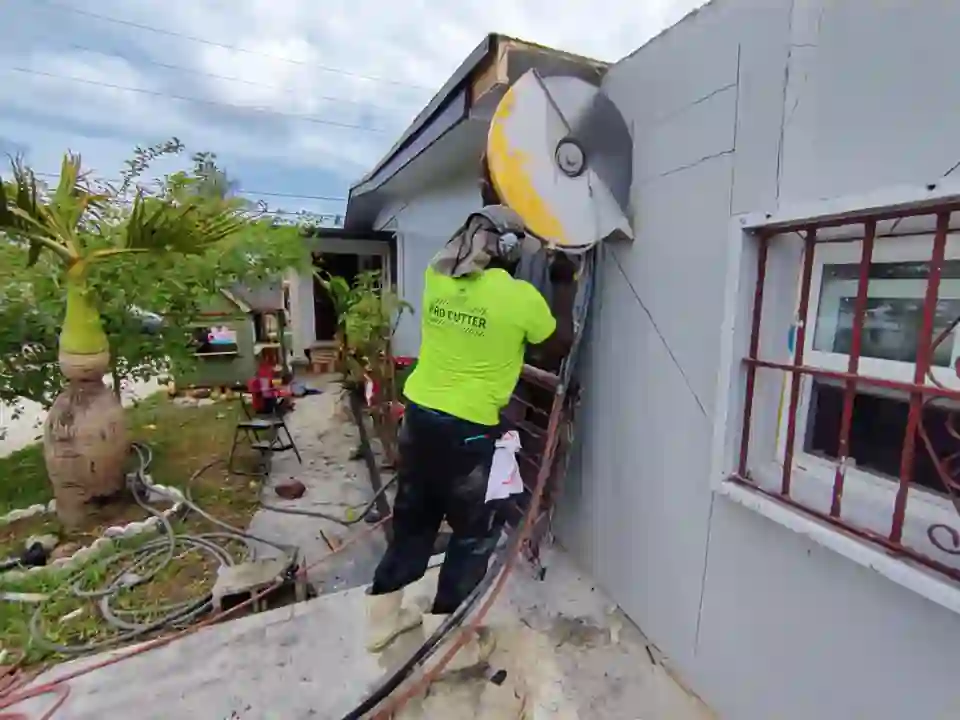
Before any wet cutting or wet coring operation begins, the job site perimeter is engineered for total liquid containment. The specific systems we deploy depend on the project type — whether we are performing structural modifications to an existing residence, executing full residential concrete demolition, or handling specialized tasks like roof cutting where gravity creates additional slurry migration challenges. The core components of our containment strategy include the following:
- Bermed containment dikes: Compactable foam berm systems installed at all drainage pathways and low points surrounding the active cutting zone, rated to contain a minimum of 150% of the estimated slurry volume for the day’s work.
- Vacuum slurry recovery: Industrial wet-vac systems with minimum 20-gallon collection tanks, operated continuously during all wet cutting operations to capture slurry at the point of generation rather than allowing it to pool and migrate.
- Impermeable ground sheeting: 10-mil polyethylene sheeting deployed beneath all cutting equipment on permeable surfaces including soil, pavers, and unsealed concrete, preventing infiltration of slurry into the substrate and groundwater.
- Secondary containment vessels: 55-gallon poly drums staged at each collection point, clearly labeled as regulated waste, with secondary drip trays beneath each vessel to prevent leakage during transport staging.
- Perimeter silt fencing with filter fabric inserts: Installed as a last-line-of-defense measure around the full job site boundary, providing passive filtration if primary containment is compromised by unexpected precipitation or equipment failure.
Wet Versus Dry Cutting Decisions in Coastal Proximity Zones
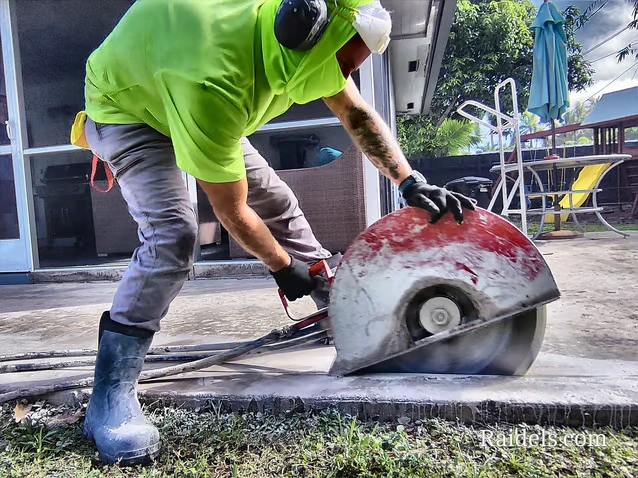
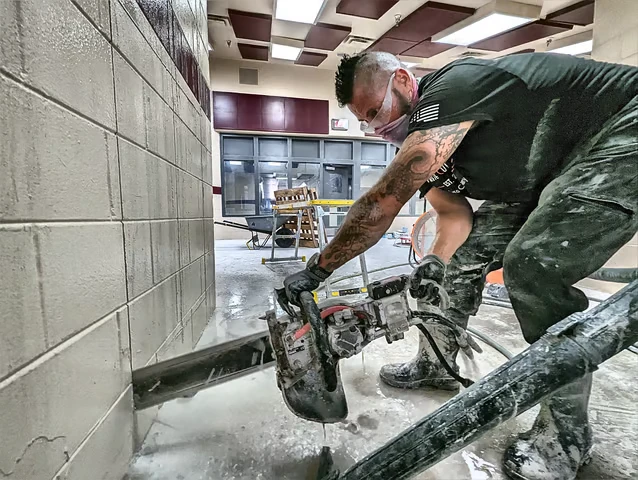
One of the most consequential decisions made at the pre-project planning stage is whether to specify wet or dry cutting methods for a given Golden Beach application. Wet cutting, which uses a continuous water feed to cool diamond blades and suppress airborne silica dust, generates the slurry management burden described above. Dry cutting, which uses vacuum-shrouded blades and HEPA-filtered dust collectors, eliminates liquid waste but requires rigorous air quality management to meet OSHA silica exposure standards under 29 CFR 1926.1153. In Golden Beach’s predominantly residential environment, both approaches require careful neighbor notification and site management. For interior structural work — such as the precision cutting described in our guide on concrete cutting for renovation projects in existing structures — dry methods with HEPA collection are often preferable because they eliminate the risk of water intrusion into finished spaces while maintaining full silica compliance. For exterior slab demolition and seawall-adjacent work, wet methods with full containment infrastructure remain the standard.
Demolition Debris Classification and Disposal Routing for Golden Beach Projects
Construction and demolition debris generated in Golden Beach must be classified, manifested, and disposed of in strict accordance with Miami-Dade County’s C&D materials management ordinances and Florida Statute 403. Clean concrete rubble — free of reinforcing steel, coatings, and contaminants — qualifies for recycling at permitted C&D recycling facilities and can be processed into recycled concrete aggregate for road base and fill applications. This pathway diverts material from landfill and can qualify projects for LEED credits where applicable. Reinforced concrete sections require steel separation, which we perform on-site using hydraulic breakers and sorting equipment before load-out. Any substrate suspected of containing asbestos-containing materials — particularly relevant in pre-1980 construction common in Golden Beach’s older estate properties — must be tested by a licensed asbestos inspector before demolition commences, with abatement completed by a licensed contractor prior to any mechanical demolition activity.
Stormwater Pollution Prevention Plans for Permitted Demolition Scopes
Projects exceeding one acre of land disturbance in Florida require a Stormwater Pollution Prevention Plan filed under the NPDES Construction General Permit. Many Golden Beach demolition projects, while geographically small, trigger additional permit requirements due to their proximity to Outstanding Florida Waters and Class II shellfish harvesting waters. We prepare site-specific SWPPPs that document all Best Management Practices, identify responsible parties, establish inspection schedules, and define corrective action procedures for containment failures. These plans are living documents updated as site conditions change, and they are maintained on-site and available for regulatory inspection at all times during active work. This level of documentation is not optional — it is the baseline expectation for any contractor operating responsibly in a coastal municipality like Golden Beach.
Noise, Vibration, and Dust as Secondary Compliance Dimensions
Environmental compliance in Golden Beach extends beyond liquid and solid waste management. The town enforces strict noise ordinances with decibel limits that are lower than unincorporated Miami-Dade, and mechanical demolition equipment operating without vibration isolation can trigger nuisance complaints that result in work stoppages. We deploy rubber anti-vibration mounts beneath all stationary equipment, schedule high-impact operations within the narrowest permissible windows, and use sound-attenuating enclosures around compressors and generators where site geometry allows. Airborne silica and concrete dust, even when wet cutting is employed, must be actively managed through perimeter air monitoring on projects near occupied residences. Our team uses real-time particulate monitors to verify that PM2.5 and PM10 levels at the site boundary remain within acceptable thresholds throughout the working day.
What Property Owners in Golden Beach Should Demand From Any Demolition Contractor
If you are managing a construction or demolition project in Golden Beach — whether a full estate teardown, a seawall replacement, a pool removal, or a structural renovation — the environmental compliance credentials of your concrete contractor are not a secondary consideration. They are the primary risk management issue. Before any work begins, your contractor should be able to provide a written slurry management plan, proof of insurance covering pollution liability, documentation of current OSHA silica compliance training for all field personnel, and references from comparable coastal projects where regulatory compliance was verified. The consequences of hiring a contractor who treats slurry containment as an afterthought include DEP enforcement actions, restoration cost liability, and project shutdowns that can cost multiples of what proper compliance would have cost upfront. Golden Beach’s environmental character is what makes it one of the most desirable addresses in South Florida — protecting that character is a professional obligation, not an optional upgrade.