Why Country Club Sites Break Every Standard Concrete Removal Assumption
Walk onto a country club property expecting a standard concrete removal job, and you’ll walk off humbled. These environments compress every logistical variable that makes concrete demolition challenging — restricted equipment access, active membership operations, manicured landscaping that cannot be disturbed, underground irrigation networks, and architectural finishes that demand surgical precision rather than brute-force tearout. Whether you’re dealing with a failing pool surround near the 9th hole, a cracked cart path running through a narrow maintenance corridor, or a deteriorated terrace slab adjacent to the clubhouse entrance, the site logistics at a country club are categorically different from a standard commercial or residential removal project. At Concrete Cutting Miami, LLC, we’ve worked enough of these properties across Miami-Dade and Broward to know that the planning phase on a country club job takes longer than the actual cutting and breaking — and it should.
Access Route Engineering Before a Single Blade Touches the Slab
The first question on any country club concrete removal project isn’t “what’s the PSI of the existing slab?” — it’s “how do we get equipment in and out without tearing up everything else?” Country clubs are designed to be beautiful, not functional for heavy equipment movement. Turf protection boards, crane mats, and aluminum road plates become standard line items before mobilization even begins. Equipment selection flows directly from access constraints. A 20,000-pound hydraulic excavator might be the fastest tool for the job, but if the only access path crosses a recently sodded fairway or passes beneath a low-clearance decorative archway, you’re using a compact skid-steer with a hydraulic breaker instead — and adjusting your production rates accordingly.
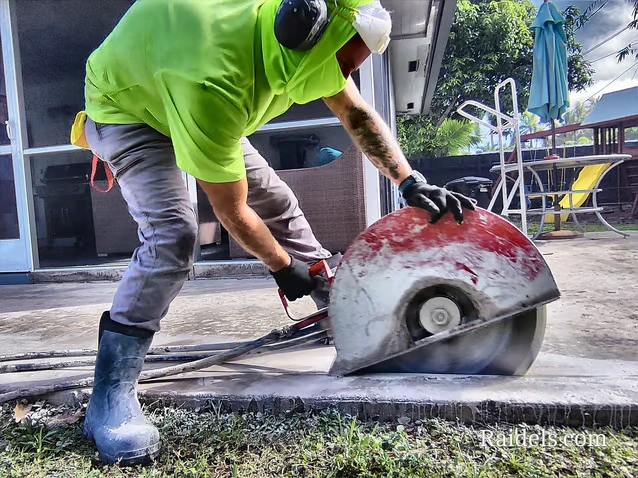
On cart path removals specifically, the path itself often serves as the only viable equipment corridor. This creates a sequencing problem: you need the path to move equipment, but the path is what you’re removing. Experienced crews solve this by working in phased sections, maintaining a passable corridor at all times and breaking the slab into manageable segments that can be loaded without blocking the active route. Traditional concrete cutting techniques like flat slab sawing are often the right call here because they allow precise panel sizing that matches the bucket capacity of whatever compact machine is operating in that corridor.
Confined Space Conditions Inside Mechanical Rooms and Pump Vaults
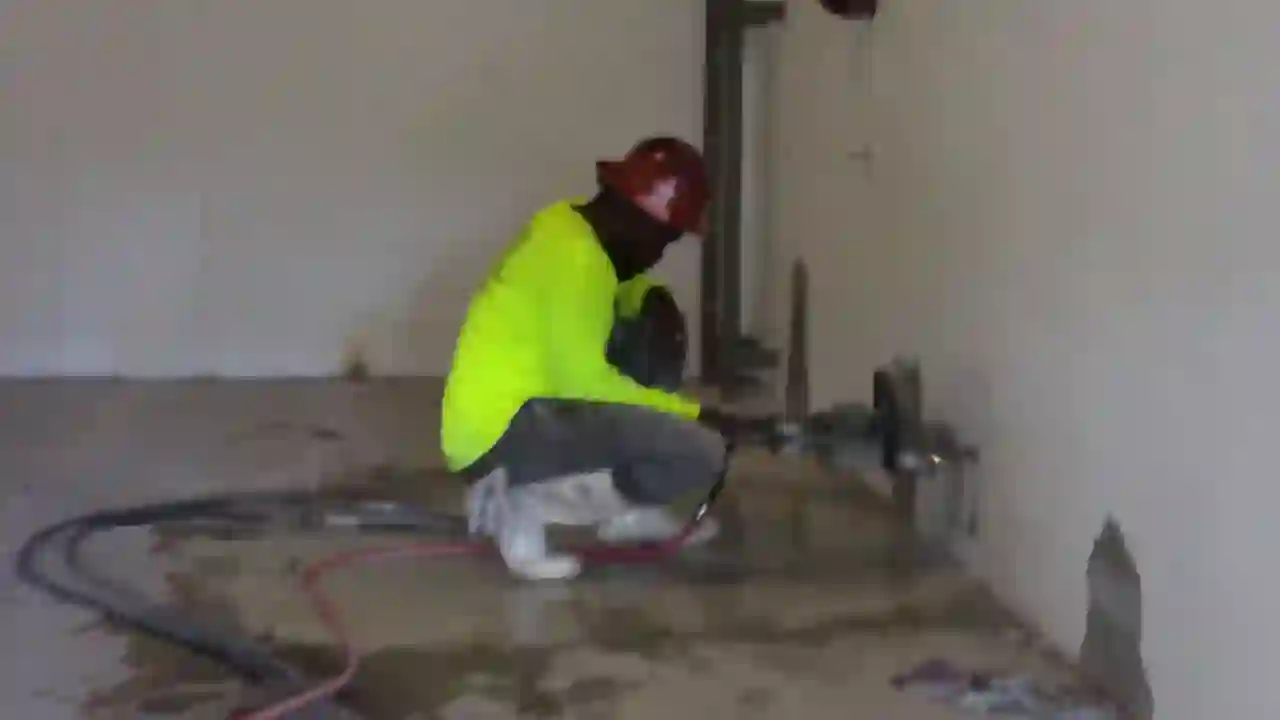
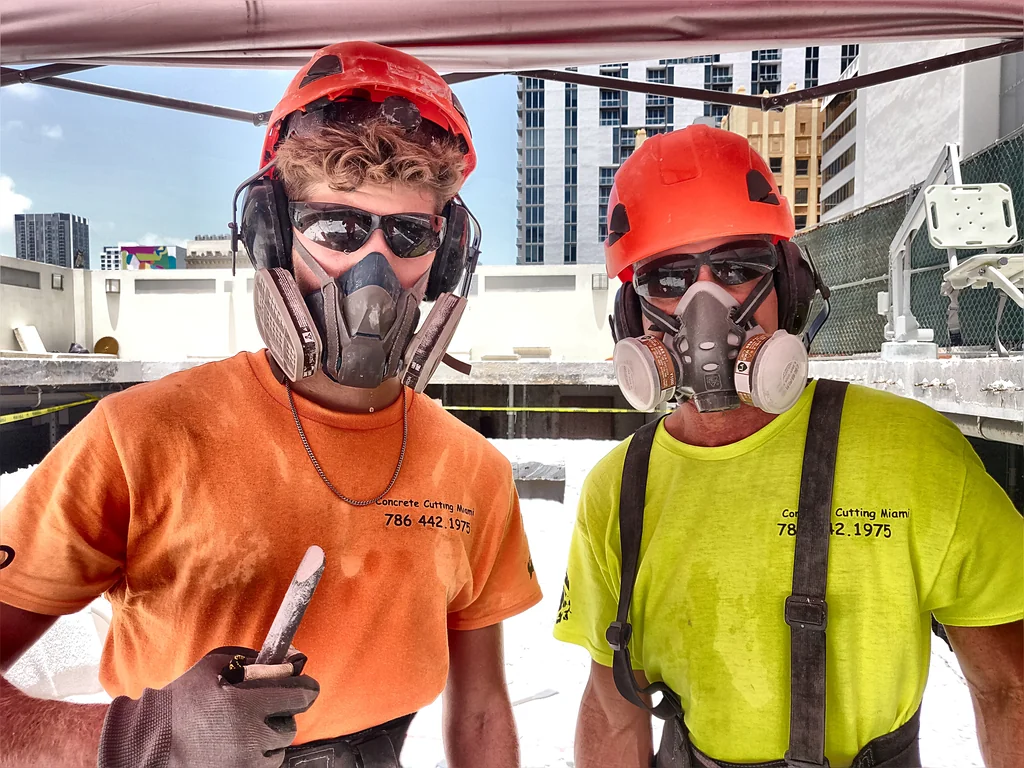
Pool mechanical rooms, irrigation pump vaults, and below-grade equipment pads at country clubs represent the most technically demanding confined space scenarios in the concrete removal trade. These aren’t just tight — they’re actively hazardous. Chlorine off-gassing from pool systems, CO accumulation from gas-powered equipment, and limited ventilation paths turn a straightforward core drill or wall saw operation into a full confined space entry protocol. OSHA 29 CFR 1910.146 compliance isn’t optional here; it’s the baseline.
For cutting operations inside these spaces, electric-powered equipment is the only sensible choice. Gas-powered saws in a poorly ventilated pump vault will put your crew on the ground before the first cut is finished. Electric flat saws, electric wall saws, and battery-assisted hydraulic systems eliminate combustion exhaust from the equation. Concrete drilling and sawing in confined mechanical spaces also demands wet cutting at all times — not just for blade longevity, but because silica dust accumulation in an enclosed vault with no air movement creates an immediate respiratory crisis. Slurry management inside these spaces requires portable vacuum extraction systems running continuously throughout the operation.
Wall Saw Rigging in Sub-Grade Equipment Rooms
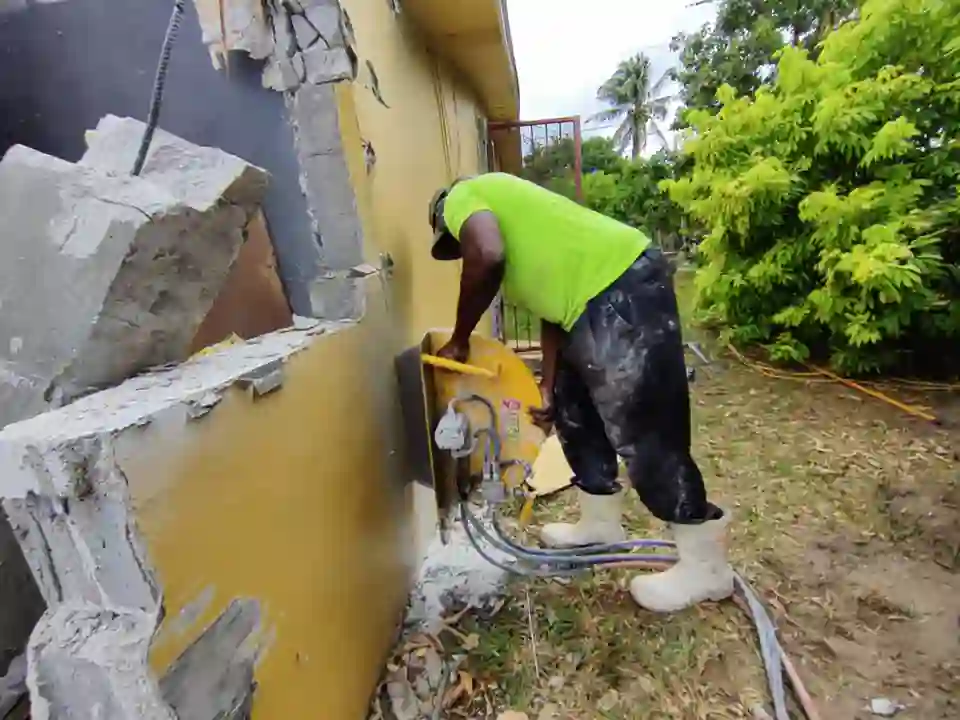
When a country club needs an opening cut through a below-grade wall — for new mechanical penetrations, drainage upgrades, or equipment replacement — the rigging geometry for a wall saw track system becomes a serious engineering exercise. Track anchoring into deteriorated concrete, limited floor space for the drive unit, and overhead clearance restrictions that prevent standard mast configurations all require field adaptation. Crews need to be fluent in alternative track anchor patterns and understand how to calculate blade overhang relative to the confined geometry without sacrificing cut depth. The diamond blade selection for these cuts also changes — tighter segments, softer bond matrix blades that release diamond faster in abrasive aggregate conditions typical of older South Florida concrete mixes.
Protecting Active Irrigation Infrastructure During Slab Demolition
Country clubs run some of the densest underground irrigation networks of any property type in South Florida. Mainlines, lateral lines, valve boxes, and wire conduits can be buried as shallow as 4 inches below the slab surface — sometimes shallower where frost protection was never a design consideration in our climate. Before any mechanical breaking begins, GPR (ground-penetrating radar) scanning of the demolition footprint is non-negotiable. A single hydraulic breaker strike through a 2-inch irrigation mainline creates a repair bill and a scheduling delay that no project budget absorbs gracefully.
After scanning, the perimeter of the removal zone gets hand-chipped to expose and protect utility lines before the mechanical equipment engages. This adds time. It also adds cost. But it’s the only approach that keeps the project on schedule and keeps the club’s irrigation superintendent from shutting down your operation mid-demo. Slab saw cutting along the removal boundary — rather than breaking from the edge — gives crews a clean, controlled separation line that reduces the risk of fracture propagation toward utility infrastructure outside the work zone.
Noise and Vibration Management During Active Club Operations
A country club doesn’t stop operating because you have a concrete removal permit. Members are on the course, in the dining room, and using the pool. Vibration from hydraulic breaking transmits through the ground and into adjacent structures in ways that are measurable and, at certain frequencies, damaging to ornamental tile work, glass facades, and post-tensioned slabs in adjacent clubhouse wings. Pre-construction vibration monitoring with triaxial seismographs establishes baseline readings and allows crews to set operational thresholds before work begins.
When vibration limits require it, professional concrete cutting companies shift from impact breaking to saw-and-remove methodology — full-depth flat slab cuts that section the concrete into liftable panels, which are then pried and removed without percussive energy transfer. This is slower. The daily production rate drops significantly. But it’s the only method that keeps vibration within acceptable limits near active occupied structures, and it’s the approach that protects the contractor’s relationship with the property manager for the next project.
Scheduling Around Tournament Calendars and Member Events
Every country club has a tournament calendar, and that calendar governs your work windows more rigidly than any permit condition. Concrete removal near the 18th hole approach cannot happen during a member-guest tournament weekend. Pool deck demolition cannot run during peak swim season without a carefully negotiated work-hours agreement. Experienced crews build these constraints into the project schedule at the proposal stage — not as surprises during execution. Early morning start windows, weekend blackout dates, and noise curfew agreements all get documented in the project scope before mobilization.
Debris Haul Routes and Load Staging on Restricted Properties
Concrete debris from a country club removal project doesn’t leave through the front entrance. Haul routes are designated, approved by the grounds superintendent, and protected with turf matting for every pass. Dump trucks staging near the removal zone need a turnaround area that doesn’t require backing across irrigated turf. Load capacity of existing pavement on the haul route gets verified — a fully loaded 10-wheel dump truck at 80,000 GVW will crack a decorative paver entry drive that was never engineered for that load class.
Concrete debris is typically crushed on-site when volume and logistics allow, reducing haul trips and associated turf damage. When on-site crushing isn’t feasible due to noise or space restrictions, debris is staged in a designated area and removed in concentrated haul windows — typically early morning before membership activity begins. Every load gets covered per Miami-Dade transport regulations, and the haul route gets swept at the end of each shift. These aren’t optional courtesies on a country club site; they’re the minimum standard for maintaining access and maintaining the relationship with property management through project completion.
Country club concrete removal is a discipline that rewards preparation, penalizes assumptions, and demands crews who understand that the physical work is only half the job. The other half is managing a complex site environment where the margin for error is measured in inches, decibels, and the patience of a membership that paid a significant initiation fee to not watch their property get torn apart carelessly.