Slab sawing services are the most common concrete cutting request in Miami — and the most frequently underestimated
When a contractor needs a trench through a warehouse floor for a new drain line, when a homeowner needs a cracked driveway section removed cleanly enough to pour a matching patch, when a GC needs control joints cut into a freshly poured commercial slab — all of these are slab sawing services. Horizontal concrete cutting, also called flat sawing, is the workhorse of the concrete cutting industry. It is also the service that looks the simplest and is the easiest for an inexperienced operator to do badly.
We run slab saws across Miami-Dade County almost every day, cutting everything from 4-inch residential patios to 12-inch reinforced commercial floors. The saw itself is a specialized machine — a walk-behind or ride-on unit with a diamond blade mounted on a depth-adjustable arbor, powered by a gas engine, electric motor, or hydraulic power unit. It looks like a heavy, slow lawnmower. But the physics happening at the blade-concrete interface — the diamond particles grinding through aggregate and steel at thousands of RPM while water cools the cut and suppresses silica dust — is anything but simple. Understanding what is happening below the blade is what separates professional slab sawing services from a rental saw and a hope for the best.
How a flat saw actually cuts through horizontal concrete
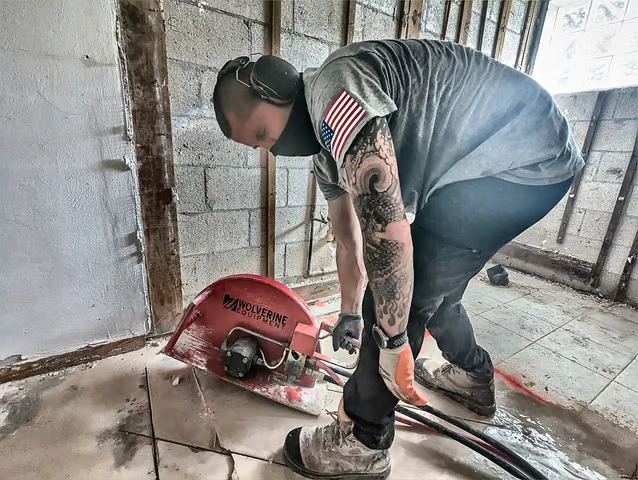
A slab saw is fundamentally different from a handheld concrete saw. The blade is mounted on a rigid arbor attached to a frame that rolls on the concrete surface. The operator controls the depth of cut by lowering the blade into the concrete in increments — each pass goes deeper than the last — rather than trying to cut full depth in a single pass. This incremental cutting is what produces the clean, straight lines that define professional slab sawing.
Why incremental depth matters
A diamond blade cutting concrete is grinding, not chipping. If you try to cut too deep in a single pass, three things happen: the blade motor bogs down under the load, the blade overheats because the water cannot reach the full depth of the cut, and the blade can wander — following a path of least resistance through the aggregate rather than the straight line you marked. Professional slab sawing services cut in depth increments matched to the blade diameter, the concrete hardness, and the rebar content. A typical pass might be 1 to 2 inches deep. By the final pass, the blade has cut through the full slab thickness, producing a cut face that is clean and square from top to bottom.
Water delivery systems
Wet cutting is standard for slab sawing in Miami. Water is delivered to the blade through the blade guard, either from a garden hose connected to the saw’s water inlet or from a pressurized tank on the saw. The slurry — water mixed with concrete dust — must be managed after the cut. On exterior work, the slurry is contained with berms or vacuumed as it is produced. On interior work, a wet/dry vacuum follows the saw, collecting slurry before it spreads across the floor.
What slab sawing services handle in Miami
Driveway and patio removal
When a driveway or patio is being partially removed — for expansion, repair, or utility access — slab sawing creates a clean cut line at the boundary between the concrete being removed and the concrete being preserved. This is the step that prevents the spiderweb cracking that happens when someone tries to break out a section of driveway without saw-cutting the perimeter first. The saw cut physically separates the two areas, so the breaking force used to remove the unwanted section stops at the cut line. Professional slab sawing for driveway work typically uses a walk-behind flat saw with a 14 to 20-inch blade, cutting the full depth of the driveway — usually 4 to 6 inches — in multiple passes.
Plumbing and utility trenching
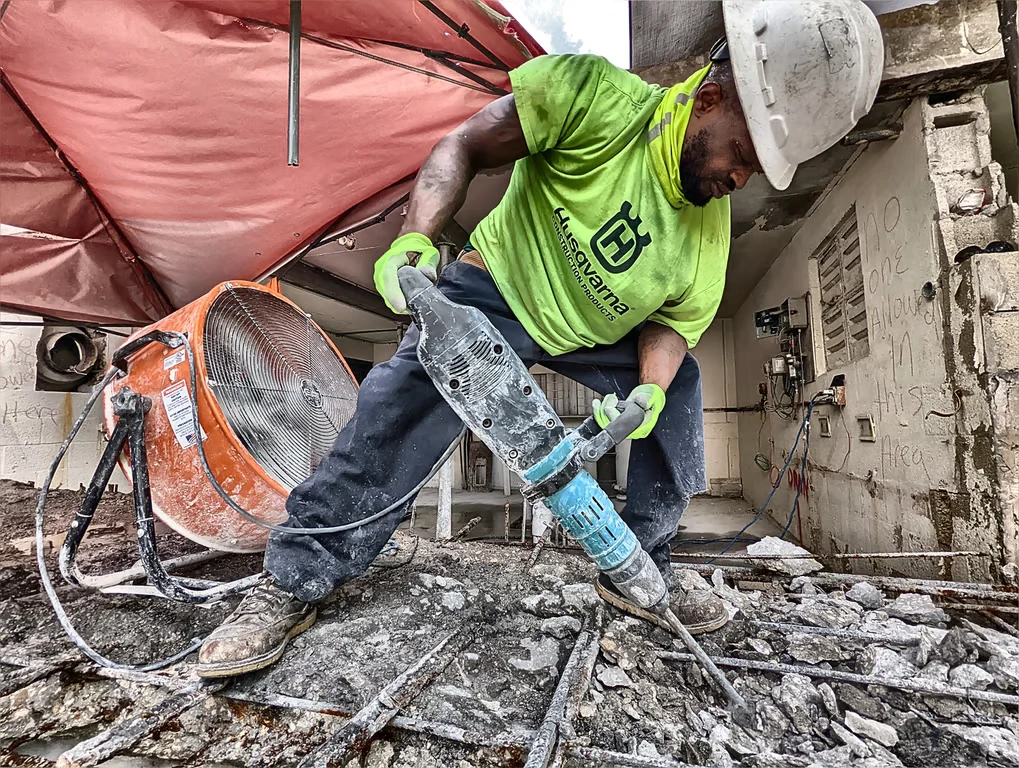
Every plumber in Miami has at some point needed a trench through a slab that was not in the original plans. Slab sawing services create the two parallel cuts that define the trench edges, allowing the concrete between them to be removed without damaging the surrounding floor. The saw cuts are made full-depth, and the center section is broken out with a chipping hammer or small breaker. The result is a trench with clean, straight edges that can be patched cleanly after the plumbing or utility work is complete.
Control joints and expansion joints
Freshly poured concrete shrinks as it cures, and it expands and contracts with temperature changes throughout its life. Control joints — saw-cut grooves in the concrete surface — create weakened planes where cracking will occur if the concrete moves. By placing control joints at strategic locations, you control where the concrete cracks rather than letting the cracks appear randomly. Slab sawing services cut control joints within the first 24 hours of the concrete pour, while the concrete is still green and relatively soft.
Slab sawing equipment — the machines behind the cut
- Walk-behind flat saws: The most common type for residential and light commercial work. Blade diameters from 12 to 24 inches, cutting depths up to about 9 inches. Powered by gas engines (20 to 35 horsepower) or electric motors for indoor work.
- Ride-on flat saws: For large commercial and industrial floors. The operator rides on the machine, allowing longer, straighter cuts at higher speeds. Blade diameters up to 36 inches or more.
- Early-entry saws: Lightweight saws with small blades designed to cut control joints in green concrete within hours of the pour, using special blades and low ground pressure.
- Electric slab saws: For interior work where combustion engines cannot be used due to ventilation requirements. Quieter than gas saws with no exhaust.
What slab sawing services cost in Miami
Slab sawing is typically priced per linear foot, with the rate depending on depth of cut (every additional inch requires additional passes and more blade consumption), concrete hardness (Miami’s limestone aggregate concrete cuts faster than granite-aggregate concrete), rebar content (heavy rebar can double the cutting cost for the same depth), access constraints (interior work, cuts near walls, and special dust or noise control add cost), and slurry management (interior cuts require vacuum collection of all slurry).
Questions to ask your slab sawing contractor
- “What blade are you using for this concrete?” The answer should reference the blade type and why it is appropriate for your specific concrete and rebar conditions.
- “How do you handle the slurry?” Interior cuts require vacuum collection. Exterior cuts require containment. The contractor should have a specific plan.
- “Do you GPR scan before cutting?” If the slab contains post-tension cables or embedded utilities, scanning is mandatory.
- “How deep will each pass be?” The answer tells you whether they are cutting incrementally (professional) or trying to force the blade through in one or two passes.
Slab sawing services done correctly produce clean, straight cuts through any horizontal concrete surface without damaging the surrounding slab. The equipment is specialized, the technique takes years to develop, and the difference between a professional cut and an amateur one is visible from across the room.